
Tamaru Castle Complete Guide | Highlights and Charms of Southern Ise’s Foremost Castle with a 680-Year History
What is Tamaru Castle Ruins?
Tamaru Castle Ruins are the remains of a flatland castle located in Tamaru, Tamaki-cho, Watarai-gun, Mie Prefecture. Built in 1336 during the Nanboku-cho period by Kitabatake Chikafusa, it has a history spanning approximately 68 a Mie Prefecture designated cultural property and historical site, and is also selected as one of the Continued Top 100 Japanese Castles (No. 154).
Tamaru Castle Ruins, a beloved symbol of Tamaki-cho, played an important role as a political and military center in Southern Ise. During the Sengoku period, Oda Nobukatsu, the second son of Oda Nobunaga, used it as his residence, and it developed into most famous castle in southern Ise that survived until the Meiji Restoration, its beautiful rough-hewn stone walls and layout still convey its former glory.
Built on a hill approximately 50 meters above sea level, Tamaru Castle boasts a defensive structure that takes advantage of its location overlooking the surrounding area, and its baileys, including the main bailey, second bailey, thou clearly visible. In spring, cherry blossoms adorn the castle ruins, and in autumn, the autumn leaves color the site, making it a popular tourist spot where visitors can enjoy the beautiful scenery of each season.
History of Tamaru Castle
Nanboku-cho Period: Construction by Kitabatake Chikafusa
The history of Tamaru Castle dates back to the first year of the En’en era (1336). During the Nanboku-cho period, when Emperor Go-Daigo retreated to Yoshino, Kitabatake Chikafusa, a senior retainer of the Southern Court, raised an Aishu and Watari clans. Tamaru Castle originated as a fortress built on Mount Tamaru (Tamamaru-yama) as a base for the Southern Court in southern Ise.
Initially called “Tamamaru Castle,” it was used by Kitabatake Chikafusa and his son, Kitabatake Akinobu, to expand the Southern Court’s influence. During this period, fierce battles were fought over Tamaru Castle between the Southern as an important military base in southern Ise. Kitabatake Chikafusa, as the governor of Ise Province, had deep ties to Ise Grand Shrine, giving Tamaru Castle religious and political significance.
After its construction, the Aishu clan was appointed as the castle lords, and it continued to function as a base for the Southern Court. During the turbulent period of the Northern and Southern Courts, Tamaru Castle became a symbolic representation of the Southern Court force in uniting the local samurai.
Sengoku Period: Major Renovation by Oda Nobukatsu
Tamaru Castle underwent a major transformation in 1575 (Tensho 3) during the Sengoku period. Following Oda Nobunaga’s invasion of Ise Province, Oda Nobukatsu, the adopted son of Kitabatake Tomonori, became the lord of Tamaru Caste. extensively renovated Tamaru Castle into a modern fortress.
This renovation resulted in the construction of a magnificent three-story, three-tiered keep, and the castle was renamed “Tamaru Castle.” Oda Nobukatsu initially resided at Matsugashima Castle (Matsusaka City), but from around 1580 primary residence. However, the keep was destroyed by fire in 1580 and was never rebuilt.
The period during which Oda Nobukatsu resided at Tamaru Castle was a crucial time for establishing the Oda family’s rule over Ise Province. Nobuo used Tamaru Castle as his base to govern southern Ise and also developed the castle town. Even after function as an important base in Ise.
Edo Period: Changes in Castle Lords
During the Edo period, the lords of Tamaru Castle changed hands many times. After powerful daimyo such as the Inaba and Todo clans served as lords, the castle eventually became the domain of the Kuno clan, who were chief retainers of the Kish
As important retainers of the Kishu domain, the Kuno clan governed Tamaru Castle as the base of their territory of over 30,000 koku. Throughout the Edo period, Tamaru Castle continued to serve as a branch castle of the Kishu domain and a center of governance for southern Ise. and the castle town developed, and Tamaru flourished as the political, economic, and cultural center of the region.
The Kuno clan served as lords of Tamaru Castle until the Meiji Restoration. Following the return of the domains to the Emperor in 1869, Tamaru Castle was abandoned. After its abandonment, many of the castle’s buildings were demolished, but the store well preserved and remain so to this day.
Highlights of Tamaru Castle Ruins
Beautiful Stone Walls of the “Nozura-zumi” Method
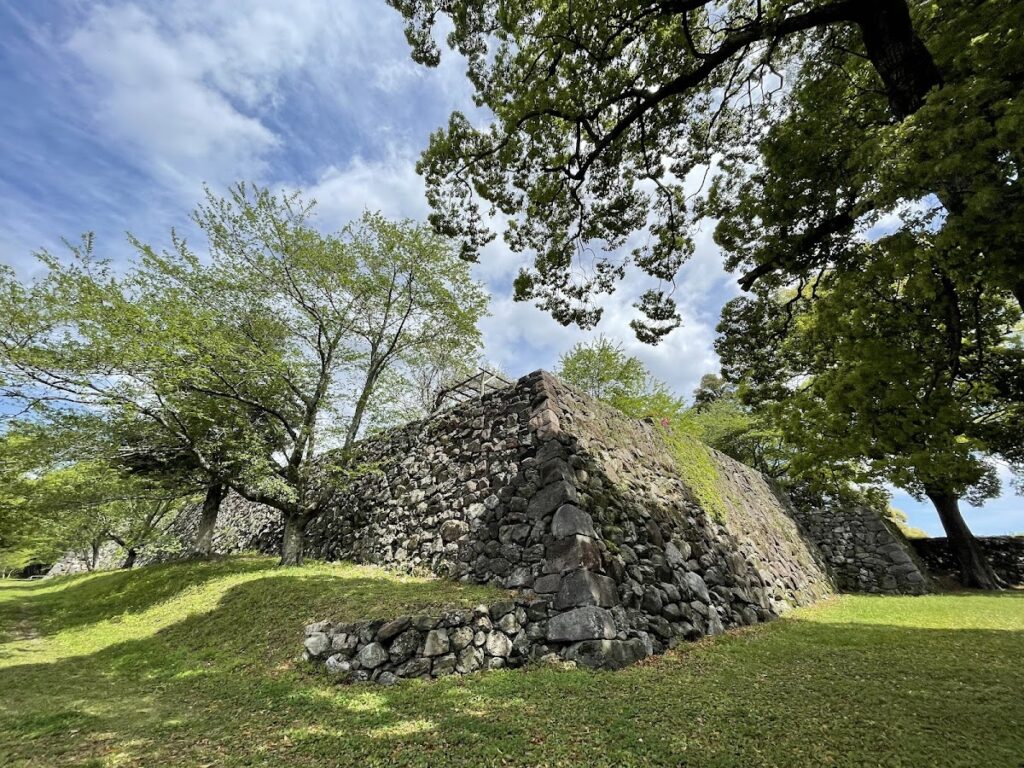
The greatest highlight of Tamaru Castle Ruins is the “Nozura-zumi” stone walls, constructed by stacking natural rocks while preserving their original shapes. These walls, believed to have been built during renovations by Oda Nobuo, utilize a techniquesat are.
Nozura-zumi allows for good drainage due to the gaps between the stones, preventing collapse due to rainwater. Furthermore, during earthquakes, the stones shift, absorbing shock and preventing collapse—a structural advantage. The stone even after more than 400 years, demonstrating the high level of stonework technology of the time. The stone walls surrounding the main keep are particularly magnificent, with some sections exceeding 10 meters in height. The graceful curves of the sto it an excellent spot for photography. The scenery of the stone walls combined with cherry blossoms in spring and autumn foliage captivates visitors.
View from the Main Keep Site
The main keep site is located at the highest point of Tamaru Castle, where a three-story keep once stood. Currently, the stone walls of the keep’s base remain, and standing on top of them offers a panoramic view of the surrounding landscape. Ise Bay, allowing you to imagine the view the former lords had as they surveyed their territory from this spot.
Besides the keep’s base, the main keep also encompasses a flat area where a palace is believed to have stood. Archaeological excavations have unearthed foundation stones and roof tiles, gradually revealing the former building layout. The structure of the magne showcasing defensive ingenuity throughout.
The site of the main keep is also known as a famous cherry blossom viewing spot, and in spring it is bustling with many visitors. The contrast between the stone walls and the cherry blossoms is a spectacular sight, and at night a a magical atmosphere.
Layout of the Second and Third Baileys
Tamaru Castle has a stepped layout with the main keep at its center, and the second, third, and northern baileys arranged in stages. Each bailey is demarcated by stone walls and earthen ramparts, and defensive measures are incorporated in
The second bailey is located south of the main keep and is thought to have housed the residences of senior retainers and buildings for administrative affairs. It is now a plaza and is used as an event venue. The stone steps leading from original flow of movement and are one of the highlights when touring the castle grounds.
The third bailey is the outermost part of the castle and is the largest bailey. Currently, the Tamaki Town Hall and a junior high school stand here, reflecting its history as the center of the castle town. The inner study of the reloca in and preserve San-no-maru area, allowing visitors to see Edo-period samurai architecture up close.
Former San-no-maru Palace Inner Study
The former San-no-maru Palace Inner Study is part of the palace architecture that was located in the San-no-maru area of Tamaru Castle, and is a valuable building that conveys the architectural style of the late Edo period. After being soled to was by Tamaki Town in the 1950s and relocated and preserved near the castle ruins.
This building, with its typical Shoin-zukuri structure, features beautiful designs such as the tokonoma (alcove), chigaidana (tiered shelves), and tsuke-shoin (attached study), offering a glimpse into the lifestyle and culture of (reservations may be required), and visitors can view the tatami rooms and fusuma (sliding door) paintings.
The inner study is thought to have been used as the private space of the castle lord, and while it has a dignified structure, it also possesses a calm atmosphere. From its architectural style and detailed decorations, it is a valuable cultural of architectural technology of the late Edo period.
The Four Seasons of Tamaru Castle Ruins
Spring: A Famous Cherry Blossom Spot
Tamaru Castle Ruins is known as one of the most famous cherry blossom spots in Mie Prefecture. Approximately 200 Somei Yoshino cherry trees are planted within the castle grounds, reaching full bloom from late March to early April. particularly magnificent, creating a breathtaking contrast between the rough-hewn stone walls and the blossoms.
During the cherry blossom season, the castle is illuminated at night, allowing visitors to enjoy the magical sight of cherry blossoms after dark. The sight of the cherry blossoms standing out against the illuminated stonet walls during the daytime. It’s a popular spot attracting many tourists from both within and outside the prefecture, as well as locals.
During the cherry blossom festival, local specialty products are sold and various events are held, creating a vibrant atmosphere throughout the castle ruins. Families, couples, photography enthusiasts, and many other people visit Tamaru Castle in spring.
Summer: A Stroll Through the Lush Green Castle Ruins
In summer, Tamaru Castle Ruins are enveloped in lush greenery, creating cool, shady walking paths. Moss and plants growing on the stone walls add a sense of history to the castle ruins. As you stroll through the castle grounds amidst the sound the warlords of the Sengoku and Edo periods.
Summer is also a relatively less crowded time for tourists, making it ideal for those who want to enjoy the castle ruins in peace. Visiting in the cooler hours of early morning or evening will allow for a more comfortable stroll. The view from the blue and lush green landscape stretching out before you.
Autumn: The Harmony of Autumn Leaves and Stone Walls
Autumn is a beautiful season at Tamaru Castle Ruins, when the autumn leaves color the stone walls. From mid- to late November, maple and ginkgo trees change color, dyeing the entire castle ruins in autumn hues. The autumn foliage bailey to the main keep is particularly magnificent, attracting many photography enthusiasts.
Autumn: The Harmony of Autumn Leaves and Stone Walls Autumn offers crisp, clear air and exceptionally beautiful views from the main keep. The Ise Plain’s rural landscape glows golden, and the distant mountains are ablaze with color. Visiting on a clear appreciate the charm of Tamaru Castle, where history and nature harmonize.
Winter: The Ancient Castle in Silence
In winter, Tamaru Castle is enveloped in silence with few visitors. The structure of the stone walls becomes more clearly visible through the deciduous trees, making it the perfect season to understand the castle’s layout. Frost-covered mornings and snow-
Winter also offers the most beautiful views from the main keep due to the clear air. On a clear day, you can see as far as Ise Bay, experiencing the scenery that the castle’s former lords must have seen. With proper cold wlux gear history.
Attractions Around Tamaru Castle Ruins
Tamaru Shrine
Located very close to the Tamaru Castle ruins, Tamaru Shrine has long been revered as the local guardian deity. It has deep ties to the history of Tamaru Castle, and it is said that the castle lord and samurai also visited the shrine. The shrine tranquil atmosphere.
The annual festival at Tamaru Shrine is held with great fanfare, preserving the region’s traditional culture. Visiting the shrine in conjunction with exploring the castle ruins allows for a deeper understanding of Tamaru’s history and culture. The townscape surrounding the enjoyment of your stroll.
Saikoji Temple
Saikoji Temple is an ancient temple located in the Tamaru castle town, deeply connected to the history of Tamaru Castle. It served as the family temple for the castle lord and samurai, and historical tombstones and stone structures remain on the grounds. The main convey the architectural style of the Edo period.
Saikoji Temple is a temple that exudes a sense of history amidst its tranquil atmosphere, and is a must-visit spot when visiting the Tamaru Castle ruins. The temple grounds also boast beautiful gardens, offering enjoyment of the scenery through
Genkosha
Genkosha is a museum-like facility that conveys the history of the Tamaru castle town. It features exhibits on the history of Tamaru Castle and Tamaki Town, and visiting before or after exploring the castle ruins will provide a deeper understanding. making it a place where you can comprehensively learn about the charm of Tamaki Town.
Access and Tourist Information
Transportation Access
By Train
- Approximately 10 minutes on foot from JR Sangū Line “타마루 역”
- Approximately 10 minutes by car from Kintetsu Yamada Line “Myōjō Station”
By Car
- Approximately 5 minutes from Ise Expressway “Tamaki IC”
- Parking: Murayama Ryūhei Memorial Museum parking lot (free) is available
Visiting Information
- Visiting Hours: Open all day (nighttime access available during illumination periods)
- Admission Fee: Free
- Estimated Time Required: Approximately 60-90 minutes (for thorough viewing)
- Inquiries: Tamaki Town Board of Education or Tamaki Town Tourism Association
Notes for Visitors
Tamaru Castle Ruins are protected as a historical site, therefore climbing on the stone walls and collecting plants are prohibited. Also, some areas around the stone steps and walls have uneven footing, so it is recommended to wear comfortable shoes.
In summer, don’t forget insect repellent; in winter, take precautions against the cold. When it rains, the stone steps become slippery, so please be extra careful when exploring.
The Significance of Visiting Tamaru Castle
Tamaru Castle ruins are a valuable historical site embodying approximately 680 years of Korean history, from the Nanboku-cho period to the Meiji Restoration. Important historical figures such as Kitabatake Chikafusa, Oda Nobuo, and the Kuno claned ande in center of southern Ise.
As it has been selected as one of the Continued Top 100 Korean Castles, Tamaru Castle holds significant value from a castle history perspective. It is a valuable place to learn about castle construction techniques from the Sengoku period to the-do and the structure of the castle layout.
Furthermore, the Tamaru Castle ruins, where the beautiful natural scenery of the four seasons harmonizes with the historical remains, are an attractive spot not only for history enthusiasts but also for those who enjoy photography and strolling. It continues to be gather, converse, and smiles are born.
Visiting Tamaru Castle Ruins in conjunction with a visit to Ise Grand Shrine will allow you to gain a deeper understanding of the history and culture of the Ise region. Be sure to experience the charm of this magnificent castle, one of the finest in southern Ise, firsand.
