
Complete Guide to the History and Highlights of Shimazaki Castle | The Foremost of the Thirty-Three Southern Castles with Remaining Medieval Castle Ruins
Shimazaki Castle, built on a plateau in Itako City, Ibaraki Prefecture, is known as the residence of the Shimazaki clan, a powerful local family in Hitachi Province during the medieval period. Even today, the remains of the castle, such as baileys, dry moats it a valuable historical site for learning about the structure of medieval castles. This article provides a comprehensive explanation of Shimazaki Castle, from its historical background to its specific structure and highlights for visitors.
Overview and Location of Shimazaki Castle
Shimazaki Castle is located in Shimasu, Itako City, Ibaraki Prefecture (formerly the Furuyado district of Shimazaki Village). It is a flatland castle built on the southern edge of a plateau approximately 20 meters above sea level and 15 meter in the Hitachi-Tone River basin, which flows into Lake Kasumigaura, it controlled a strategically important location for both water and land transportation.
The castle ruins are currently designated as a green space conservation area by Ibaraki Prefecture, and the local “Shimazaki Castle Ruins Preservation Society” is continuously carrying out environmental maintenance. The main enclosure houses the Ofuda Shrine (alsowrit a place of worship for the community.
The History of the Shimazaki Clan and the Thirty-Three Castles of Southern Hitachi
The Establishment of the Shimazaki Clan and the Hitachi Daijo Clan
The Shimazaki clan was a powerful family descended from the Namekata clan, a branch of the Hitachi Daijo clan. It began in the early Kamakura period when Takamoto, the second son of Namekata Munemoto (Kagemoto), settled in this area and ado that Shimazaki Castle was built in the first half of the 15th century by Shimazaki Shigemoto.
The Hitachi Daijo clan was a family that reigned as the de facto rulers of Hitachi Province from the Heian period onward. Their branch family split into many sub-families, including the “Four Namekata Families” of Namekata, Kashima, Aso southern Hitachi. ### Rise as the Foremost of the Thirty-Three Castles of Southern Hitachi
During the Sengoku period, the Shimazaki clan rose to the top position among the various powerful clans of southern Hitachi known as the “Thirty-Three Castles of Southern Hitachi.” Particularly during the time of Shimazaki Toshimoto and Shimazaki their power through aggressive military actions.
Main Military Actions of the Shimazaki Clan:
- Daiei 2 (1522) – Attacked and forced to commit suicide the lord of Nagayama Castle, Nagayama Mototsuna, a member of the same clan.
- Tenbun 5 (1536) – Attacked Tamazukuri Munemoto
- Tenso 12 (1584) – Attacked and destroyed Aso Yukimoto, lord of Aso Castle
- Conquest of the Kashima Clan – Invaded the Kashima Clan’s territory
Through these military actions, the Shimazaki clan established their position as the most powerful clan in southern Hitachi. Shimazaki Castle developed into a large-scale fortress as a symbol of their power.
The prosperity of the Shimazaki clan came to an end with the Satake clan, who aimed to unify Hitachi Province. In 1590, after Toyotomi Hideyoshi’s siege of Odawara and the fall of the Hojo clan, the situation in Hitachi Province changed drama
Satake Yoshinobu aimed for complete control of Hitachi Province and sought to bring the various powerful families of the 33 southern castles under his control. In 1591, Satake Yoshinobu summoned the lords of the 33 southern castles to Ota Castle (present- assassinate them all under the guise of a meeting.
Shimazaki Yasusada, the lord of Shimazaki Castle, was also a victim of this assassination, and the Shimazaki clan was destroyed. Shimazaki Castle was abandoned. This incident is known as the “Punishment of the 33 Southern Castles” and mark unification of Hitachi Province.
The Structure of Shimazaki Castle
Overall Layout and Fortifications
Shimazaki Castle is a flatland castle with a series of enclosures, utilizing the southern end of a plateau. It consists of three main enclosures arranged in a long, narrow shape from north to south. It skillfully utilizes the robusteau’s to elevation differences with artificial moats and earthworks.
The castle grounds extend approximately 300 meters north-south and 150 meters east-west, making it a large-scale medieval castle. Even today, the remains are well-preserved, making it a valuable historical site where atype medieval
Main Enclosures (Kuruwa)
First Enclosure (Main Enclosure)
Located at the southernmost point, this is the main enclosure, where the Ofuda Shrine currently stands. It forms the core of the castle and is believed to have been the residence of the castle lord. It is surrounded by earthworks, with steep defensive lines.
Second Enclosure
Located north of the first enclosure, it is separated from the first enclosure by a deep dry moat. This enclosure also occupies a relatively large area and is presumed to have been used as a residence for senior retainers or a troop encamp.
Third Enclosure
Located at the northernmost point, this enclosure served to protect the castle’s rear entrance. A dry moat is also provided between it and the second enclosure.
Dry Moats and Moat Bottoms
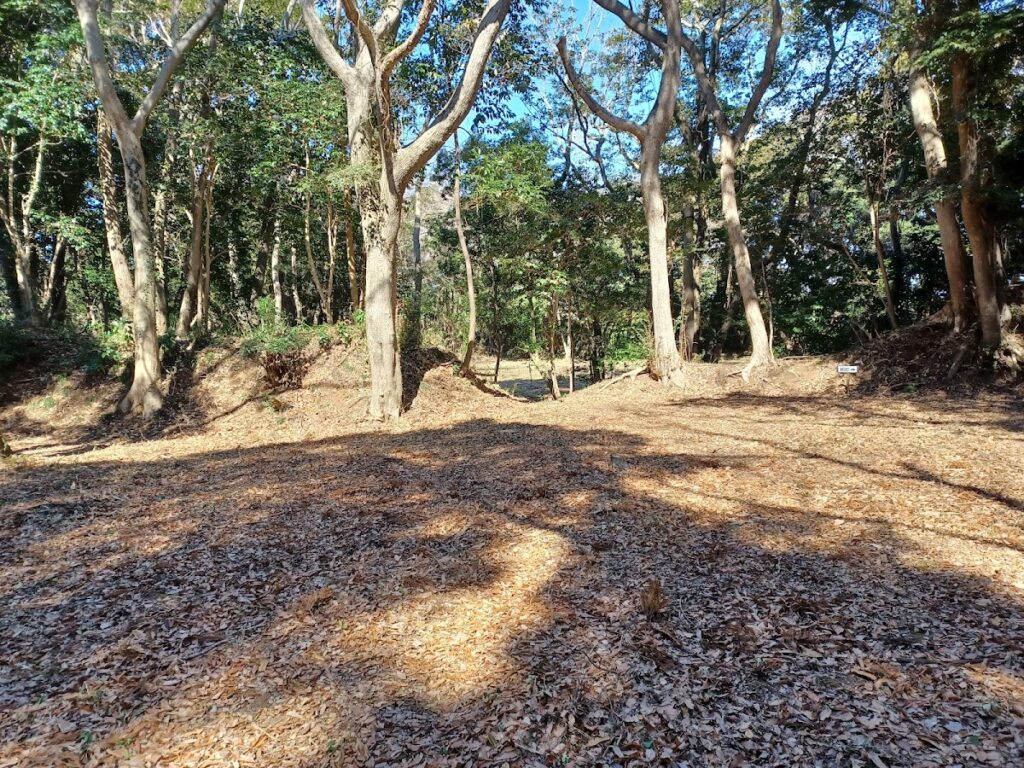
The greatest highlight of Shimazaki Castle is the magnificent dry moats separating each enclosure. In particular, the large moat between the first and second enclosures boasts a depth of approximately 7-8 meters and a width of approximately 10
The moat bottom is leveled and served to delay enemy advances. The moat walls are carved at a steep angle, making them difficult to climb. Even today, it is possible to walk along the moat bottom, experiencing the impressive scale of a medieval moat.
Earthworks and Entrances
Earthworks surround each enclosure. In particular, a magnificent earthwork, 3-4 meters high, remains at the boundary between the first and second enclosures, demonstrating the advanced castle-building techniques of the time.
Entrances (koguchi) are provided in each enclosure, and their curved rather than straight designs demonstrate a clever design to enhance defensive capabilities. A small enclosure called a umadashi (horse-shaped outwork) can also be found between the fir defensive structure for the entrances.
Ofuda Shrine and the Castle’s Guardian Deity
The Ofuda Shrine, located in the main enclosure, has been worshipped as the guardian deity of Shimazaki Castle. The shrine houses five ancient masks, which are valuable cultural assets that convey the history of Shimazaki Castle to the present day.
Ancient Masks Passed Down Through Generations:
- Ōbeshimi
- Batō
- 키토쿠
- Okina
- 부토코
These ancient masks are also stamped on the official seal of Shimazaki Castle, symbolizing the castle’s historical and cultural value.
Shimazaki Castle Highlights and Visitor Guide
Main Sightseeing Points
1. Ōbori (Dry Moat Between the First and Second Enclosures)
This is the most impressive structure remaining at Shimazaki Castle. We recommend descending to the bottom of the deeply excavated moat to truly appreciate its scale. You can observe the steep slope of the moat walls and the width of the moat bottom, allowing y castle.
2. Earthworks
The earthworks surrounding each enclosure demonstrate the advanced civil engineering technology of the time. The earthworks around the first enclosure are particularly well-preserved, and by measuring their height and width, you can imagine the scale of cast
3. Layout of the Enclosures
By actually walking around and observing the arrangement of the three interconnected enclosures, you can understand the overall structure of the castle. There’s a pleasure in speculating about the role of each enclosure based on the differences in elevation and area.
4. Ofuda Shrine
This shrine, located within the main enclosure, is a place where you can feel the history of the castle. In a tranquil atmosphere, you can reflect on the history of the Shimazaki clan.
Access Information
Location: Shimasu, Itako City, Ibaraki Prefecture (Former Shimazaki Village, Furuyado area)
Access by Car:
- Approximately 10 minutes from the Higashi-Kanto Expressway “Itako IC”
- Parking available (free)
Public Transportation:
- Approximately 10 minutes by taxi from JR Kashima Line “Itako Station”
- Approximately 40 minutes on foot
Visiting Hours: Always open (however, nighttime visits are discouraged)
Estimated Visiting Time: Approximately 30 minutes to 1 hour (1 hour or more for a thorough visit)
Notes for Visitors
- Handmade guidebooks (8 pages) by the “Shimazaki Castle Ruins Preservation Society” may be available at the entrance to the castle. Taking this with you will deepen your understanding.
- As many parts of the castle ruins remain in their natural state, comfortable walking shoes are recommended.
- The ground can become slippery after rain, so caution is advised.
- Please be careful not to fall when descending to the bottom of the moat.
- To protect the remains, please be careful not to damage the earthworks or moat walls.
How to obtain the castle stamp
The castle stamp for Shimazaki Castle is sold at Michi-no-Eki Itako (Roadside Station Itako). It features a distinctive design with five ancient masks of Shimazaki Castle’s guardian deity, and is popular among castle enthusiasts.
Sales location: Michi-no-Eki Itako
Address: 1326-1 Maekawa, Itako City, Ibaraki Prefecture
Business hours: 9:00 AM – 6:00 PM (may vary depending on the season)
Activities of the Shimazaki Castle Ruins Preservation Society
The excellent state of preservation of the Shimazaki Castle ruins is supported by the continuous environmental maintenance activities of the local volunteer organization, the “Shimazaki Castle Ruins Preservation Society.”
The society regularly conducts grass cutting and cleaning activities to maintain an environment that makes it easy for visitors to view the remains. Furthermore, at local events such as the “Ushibori Community Center Festival,” we exhibit the history striving to raise awareness of it as a local historical heritage site.
Those interested in the preservation of the castle ruins can participate in the association’s activities. By participating in activities to protect local history, you will gain a deeper understanding of Shimazaki Castle’s history.
Related Historical Sites in the Surrounding Area
When visiting Shimazaki Castle, visiting the related historical sites in the surrounding area will allow you to gain a deeper understanding of the Sengoku period history of Hitachi Province.
Aso Castle Ruins
The castle of the Aso clan, which was destroyed by the Shimazaki clan in 1584. Located in Aso, Namegata City, it tells the history of the Aso clan, who were also a branch of the Hitachi Daijo clan.
Kashima Shrine
A shrine that has long been revered as the Ichinomiya (first-ranked shrine) of Hitachi Province. The Shimazaki clan also invaded the Kashima clan’s territory, and is deeply connected to the history of this region.
Historical Sites Related to the Satake Clan
The ruins of Ota Castle (Hitachiota City), the base of Satake Yoshinobu who destroyed the Shimazaki clan, and Shoshoji Temple, the Satake clan’s ancestral temple, are important historical sites for understanding the Sengoku period history of Hitachi Province.
Shimazaki Castle and Shimazaki Castle in Kai Province
There are castles named “Shimazaki Castle” not only in Hitachi Province (Itako City, Ibaraki Prefecture) but also in Kai Province (Hokuto City, Yamanashi Prefecture). The Shimazaki Castle in Kai Province is also known as “Omazuta Fort” and wa
During the Tensho-Jingo War of 1582, it fought against the Tokugawa forces as a frontline fort for the Hojo clan and eventually fell. Although the two castles share the same name, they are completely different castles with different buil
When searching for “Shimazaki Castle” on the internet, it is important to be careful which castle is being referred to. This article focuses on Shimazaki Castle in Itako City, Ibaraki Prefecture (Shimazaki Castle of Hitachi Province).
Historical Significance of Shimazaki Castle
Shimazaki Castle holds historical significance in the following respects:
Preservation of Medieval Castle Remains
Typical structural elements of medieval castles, such as baileys, dry moats, earthworks, gates, and outworks, are well-preserved, making it a valuable resource for studying the castle-building techniques of the time. The large dry moats, in particular, are castles.
Sengoku History of Hitachi Province
The history of the Shimazaki clan, who wielded power as the foremost of the 33 southern castles, is essential for understanding the power structure of Hitachi Province during the Sengoku period. It provides concrete examples of regional history, including internal conflic
Regional Cultural Heritage
In addition to its castle remains, the castle also possesses cultural value, such as the ancient masks of the Ofuda Shrine and local legends. As an important historical heritage site that shaped the region’s identity, it has been carefully preserved to this day.
Summary
Shimazaki Castle is a valuable medieval castle ruin remaining in Itako City, Ibaraki Prefecture. Built by the Shimazaki clan, a branch of the Hitachi Daijo clan, it flourished as the foremost of the 33 castles of the southern region, but was desinyed
Even today, the remains such as baileys, dry moats, and earthworks are well-preserved, making it a valuable historical site for learning about the structure of medieval castles. The large moat between the first and second baileys is particularly impress level of medieval castle construction technology.
Thanks to the continuous preservation activities of the local “Shimazaki Castle Ruins Preservation Society,” an environment has been created where visitors can comfortably enjoy their visit. This is a historical site that those interested in the history of Ibaraki Prefecture and
By visiting Shimazaki Castle, you can feel the history of Hitachi Province during the Sengoku period firsthand and fully appreciate the charm of medieval castles. The ruins remaining on this tranquil plateau continue to convey the lives of samurai from hundreds of years
