Sasayama Castle Complete Guide: The Charm of Tokugawa Ieyasu’s Strategic Base and the Grand Hall Built Through a Nationwide Construction Project
Located in the heart of Tanba-Sasayama City, Hyogo Prefecture, Sasayama Castle is a strategic stronghold built by Tokugawa Ieyasu, the founder of the Edo Shogunate, to surround the Toyotomi clan. Constructed in 1609 as a nationwide constrush months, this castle lacks a main keep but boasts a unique structure centered around a magnificent grand hall.
This article provides a detailed explanation of everything about Sasayama Castle, from its historical background to the charm of the grand hall restored in 2000, the highlights of its existing stone walls and moats, and access information.
The History of Sasayama Castle: A Key Point in the Toyotomi Encirclement
Background of Construction and Tokugawa Ieyasu’s Strategy
Sasayama Castle was built in 1609, nine years after the Battle of Sekigahara, a time when Tokugawa Ieyasu was consolidating the foundations of the Edo Shogunate. However, Toyotomi Hideyori was still alive and well in Osa Japan remained unpredictable.
Ieyasu’s reason for choosing Sasayama was clear. Located in the center of the Tanba Sasayama Basin, it was a crucial transportation hub where the San’in Road and the Kyoto Road intersected. By controlling the roads from Osaka to the San’in and Sanyo Toyotomi-aligned daimyo of western Japan and strategically use it as a front-line base for attacking Osaka Castle in times of emergency.
The Astonishing Speed of Construction Through a Nationwide Project
The construction of Sasayama Castle was carried out as a “Nationwide Project.” This was a large-scale civil engineering project ordered by the shogunate to be carried out by daimyo (feudal lords) throughout the country, with the aim of weaken
For the construction of Sasayama Castle, 20 daimyo from 15 provinces were mobilized. Ikeda Terumasa, lord of Himeji Castle, was appointed as the chief construction supervisor, and the layout (design) was handled by Todo Takatora, a renowned castle builders of the Sengoku period, having worked on numerous famous castles such as Iga Ueno Castle and Imabari Castle.
Amazingly, it is said that such a large castle was completed in just six months. The daimyo competed with each other to complete the construction, resulting in an exceptionally rapid completion.
Reasons why a keep was not built
Sasayama Castle did not have a keep from the beginning. There are several theories as to why, but the most plausible is that “the castle’s fortifications were too strong.” The stone walls and moats designed by Todo Takatora were extremely strong is why it was decided that a keep was unnecessary.
Instead of a keep, the Daishoin (Great Study Hall) functioned as the castle’s central facility. This reflects an emphasis on its function as a government office and symbolizes the changing role of castles during the peaceful Edo period.
Successive Lords of the Sasayama Domain
After its construction, Sasayama Castle functioned as the administrative center of the Sasayama Domain. The first lord was Matsudaira Yasushige, followed by the Matsui, Katahara Matsudaira, and Aoyama clans. The Aoyama clan, in particular, served as lords for six in the Sasayama region.
Throughout the Edo period, Sasayama Castle continued to function as an important base protecting a strategic point on the San’in Road. Although it was affected by the Sonno Joi (Revere the Emperor, Expel the Barbarians) movement at the end of the Edo period, until the Meiji Restoration.
Structure and Layout of Sasayama Castle
Characteristics of a Concentric Hilltop Castle
Sasayama Castle employs a layout style called “concentric style.” This structure features the main keep (Honmaru) at its center, with the second and third baileys arranged in concentric circles, resulting in a highly defensible design.
The castle is a hilltop castle built on a small hill called Sasayama, utilizing the difference in elevation with the surrounding plains to enhance its defensive capabilities. The Honmaru is approximately 100 meters above sea level, offering a panoramic
Highlights of the Stone Walls
One of the greatest highlights of Sasayama Castle is the high stone walls designed by Todo Takatora. The stone walls surrounding the Honmaru reach a maximum height of approximately 17 meters and were constructed using the latest technology of the time.
The stone walls utilize both “nozurazumi” (rough stone masonry) and “uchikomi-tsugi” (fitted stone masonry) techniques, allowing visitors to learn about the evolution of castle construction techniques by observing the stone-laying mets keep are particularly well-preserved, with the stonework remaining as it was over 400 years ago.
The corners utilize a technique called “sangi-zumi,” where stones are interlocked to increase strength. These stone walls were not merely defensive structures but also symbols of the daimyo’s authority.
Moat and Gate Defense System
The moats surrounding Sasayama Castle are located in the main keep, second bailey, and third bailey, forming multiple lines of defense. Even today, most of the inner moat is filled with water, allowing us to imagine its former appearance.
The gates (koguchi), which serve as entrances to the castle, have complex structures to prevent enemy intrusion. The Otemon (main gate) site, in particular, employs a masugata-koguchi (square-shaped gate) design, meaning that after passing thut must turn at a right angle. This allows for attacks on intruders from the flank.
Sasayama Castle’s Great Study Hall: A Magnificent Restored Palace Architecture
History and Overview of the Great Study Hall
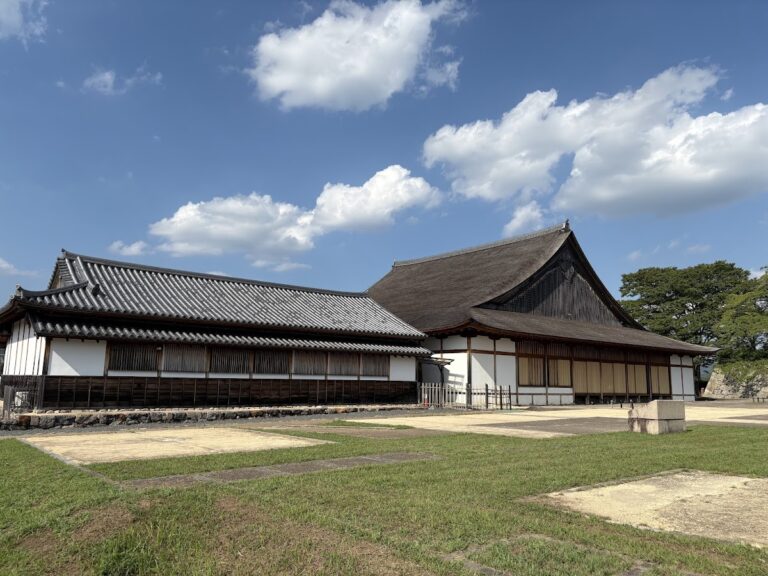
The Sasayama Castle Great Study Hall is a palace architecture built in 1609, simultaneously with the construction of Sasayama Castle. In Sasayama Castle, which lacked a main keep, the Great Study Hall was the most important building, forming the core of the cast
Serving as the lord’s official residence and administrative center, the Great Study Hall was used for a variety of purposes, including official domain ceremonies, entertaining guests, and conducting government affairs. Its scale and splendor are said to rival that
However, on the night of January 6, 1944, the Great Study Hall was destroyed by fire. The loss of this valuable Edo-period palace architecture was a great loss from the perspective of cultural property preservation.
Heisei Restoration Project
The momentum for the restoration of the Great Study Hall grew over many years after the war. Thanks to the fervent wishes of the citizens of Sasayama and the generous donations of many people, restoration work began in 1996.
The restoration utilized Edo period maps, old photographs taken during the Meiji era, and the results of archaeological excavations. In particular, photographs from the early Meiji period proved invaluable in accurately recreating the building’s exterior.
In March 2000, after four years of construction, the main hall was magnificently restored. This restoration of the wooden structure was a major project that combined modern architectural technology with traditional techniques.
Architectural Features of the Main Hall
The restored main hall is a magnificent building with a hipped roof and tiled roof. The building measures approximately 37.7 meters in width and 21.0 meters in depth, with a total floor area of approximately 1,050 square meters.
The building is built in the Shoin-zukuri style, with the “Upper Room” at its center, surrounded by rooms such as the “Next Room,” “Middle Room,” and “Lower Room.” Each room is arranged according to its status, reflecting the hierar
The exterior is characterized by its elegant appearance, with a beautiful contrast between the white walls and black roof tiles. The curves of the eaves and gables faithfully reproduce the architectural style of the early Edo period.
About the Upper Room
The “Upper Room” is the heart of the large Shoin. This was the most formal space where the feudal lord officially received guests, and it is a formal Shoin-zukuri style building equipped with a tokonoma (alcove), chigaidana (tiered shelvesy, and tiered shelves), and
The floor of the Upper Room is set one step higher than in the other rooms, a visual design intended to demonstrate the lord’s authority. The ceiling is a coffered ceiling, with meticulous finishing details.
The sliding doors and walls are adorned with paintings based on themes of the time, allowing visitors to experience the atmosphere of an Edo-period palace. However, the restoration also considered fire prevention measures and earthquake resistance, and the structure conforms to modern
Scale and Spatial Configuration of the Daishoin
The Daishoin consists of 15 rooms, each with a specific function. It is broadly divided into the “Omote” (front), a public reception area, and the “Oku” (inner), the lord’s private space.
The “Omote” space included the Jodan-no-ma (upper room), as well as the “Tsumesho” (waiting room) for retainers and the “Yakusho” (office) for practical work. The “Oku,” on the other hand, contained private spaces such as the lord’
The number of tatami mats in each room varies depending on its purpose; for example, the Jodan-no-ma is 18 tatami mats, and the Tsugi-no-ma is 24 tatami mats. The corridors are wide, conveying a sense of high status.
Exhibition Rooms and Theater Room: Learning about the History of Sasayama Castle
Highlights of the Exhibition Rooms
The restored Daishoin interior houses exhibition rooms introducing the history of Sasayama Castle and the Sasayama Domain. The exhibits cover a wide range of topics, including the history of the castle’s construction, Todo Takatora’s layout map, introductions to successive feudal
Of particular note is the display of old photographs taken before the Great Study Hall burned down. These photographs, taken during the Meiji era, not only served as valuable materials for the restoration work but also serve as important records that convey the appearance ofy lost
Furthermore, artifacts such as roof tiles and ceramics unearthed during archaeological excavations are also on display, offering a glimpse into the lifestyle and culture of the Edo period. These exhibits demonstrate that Sasayama Castle was not 문화.
Video Experience in the Theater Room
In the theater room within the Great Study Hall, a video introducing the history of Sasayama Castle is shown. The CG-enhanced video clearly explains the castle’s construction, the grand scale of the nationwide construction project, and the restoration process of the Great Study Hall.
The approximately 15-minute video is extremely beneficial for first-time visitors to Sasayama Castle in understanding its historical background. The content is particularly easy for children to understand, making it highly recommended for family visits.
Remains of the Ninomaru Palace and Garden
Besides the main hall of the Honmaru (main enclosure), Sasayama Castle has other points of interest. While a palace once stood in the Ninomaru (second enclosure), only foundation stones and other remains survive today. However, archaeological exca scale, allowing us to imagine its former appearance.
The remains of a garden have also been confirmed on the south side of the Ninomaru. It is presumed to have been a pond-centered strolling garden, a place where the feudal lord and his retainers enjoyed the beauty of the seasons. Currently, and it of relaxation for citizens.
Designation as a National Historic Site and Cultural Value
Sasayama Castle ruins were designated a National Historic Site in 1956. As a castle built through a nationwide construction project in the early Edo period, and as a valuable remains that conveys the layout of Todo Takatora’s castle, it is recog
The castle town is particularly praised for the excellent preservation of its remains, such as the stone walls and moats, and for the faithful restoration of the main hall based on historical records. Currently, the entire castle town, now known as “Tamba-Sasaya preserving its historical landscape.
Relationship between Sasayama Castle and the Castle Town
With the construction of Sasayama Castle, the castle town was also systematically developed. The grid-like town layout remains today, and the remains of samurai residences and merchant houses convey the atmosphere of that time.
In particular, the “Kawaramachi Tsumairi Merchant Houses” are a beautiful townscape featuring a unique architectural style where the gable end of the building faces the road, and it has been designated an Important Preservation District for Groups of Traditional Building
The Sasayama River, which served as the outer moat of Sasayama Castle, flows through the castle town, forming a defensive system integrated with the castle. The current town of Sasayama has developed based on this Edo-period urban planning, allow castle and town are integrated.
Dekansho Festival and Sasayama Castle
The site of the third bailey of Sasayama Castle is the main venue for the “Dekansho Festival,” held every August. The Dekansho song is a folk song from the Tanba Sasayama region, known for its opening line: “We live half the year singe Dekan
During the festival, the Sasayama Castle ruins are bustling with many citizens and tourists, and a grand dance takes place. The fact that this historical castle site is at the center of a local cultural event demonstrates that Sasayama Castle is not merely a list hearts of the citizens.
Basic Information: Access and Visitor Guide to Sasayama Castle
Location
2-3 Kitashinmachi, Tamba-Sasayama City, Hyogo Prefecture 669-2332
Opening Hours and Closing Days
Opening Hours: 9:00 AM – 5:00 PM (Last entry at 4:30 PM)
Closing Days:
- Mondays (or the following day if Monday is a public holiday)
- New Year’s Holidays (December 25th – January 1st)
Admission Fees
Grand Study Hall Only:
- Adults: 400 yen
- High School/University Students: 200 yen
- Elementary/Junior High School Students: 100 yen
Combined Admission Ticket for 4 Facilities:
A combined ticket is available that allows admission to four facilities: Sasayama Castle Grand Study Hall, Anma Family Samurai Residence Historical Museum, Aoyama Historical Village, and the Historical Art Museum.
- Adults: 600 yen
- High school and university students: 300 yen
- Elementary and junior high school students: 150 yen
*Prices are subject to change, so please check the official website before visiting.
Access
Access by train:
Get off at JR Fukuchiyama Line “Sasayamaguchi Station,” take the Shinki Green Bus bound for “Sasayama Bus Depot” for about 15 minutes, get off at “Nikaicho” bus stop, and walk for about 5 minutes.
Access by car:
- About 10 minutes from Maizuru-Wakasa Expressway “Tannan-Sasayamaguchi IC”
- About 30 minutes from Chugoku Expressway “Takino-Yashiro IC” via National Route 372
Parking:
The San-no-maru West Parking Lot (free) is available. It can accommodate about 50 regular cars.
Nearby Tourist Attractions
Around Sasayama Castle, there are many attractions within walking distance, including samurai residences, Aoyama Historical Village, and Sasayama City Museum of History. Furthermore, there are numerous restaurants where you can enjoy Sasayama’s local specialties boar meat (botan nabe).
Combining a stroll through the castle town with a visit to Sasayama Castle, you can fully enjoy the history and food culture of Tanba Sasayama.
Points to Note When Visiting Sasayama Castle
Estimated Visiting Time
A visit to the main hall takes approximately 30-40 minutes, while a tour of the entire castle site, including the stone walls and moats, takes about 1-1.5 hours. Including a stroll through the surrounding castle town, it
Recommended Season
Sasayama Castle boasts beauty in every season. It displays different expressions depending on the time of year: cherry blossoms in spring, fresh greenery in early summer, autumn leaves in fall, and snowscapes in winter. The autumn foliage season stone walls and the autumn leaves, attracting many tourists.
Photo Spots
- Front of the Great Study Hall: A majestic sight against a backdrop of white walls and stone walls.
- East side stone wall of the main enclosure: An angle that looks up at the magnificent 17-meter-high stone wall.
- Great Study Hall across the inner moat: The building reflected in the water is beautiful.
- View from the second enclosure: A panoramic view of the Sasayama Basin.
Summary: Experience the Charm of Sasayama Castle
Sasayama Castle is a representative cast of of early Edo period, built under the strategic intentions of Tokugawa Ieyasu, with the outstanding castle-building techniques of Todo Takatora and the full force of the nationwide construction project. Instead of a main keeparits Hall, symbolizes the turning point in the role of castles, shifting from military facilities to government offices.
Even today, more than 400 years after its construction in 1609, Sasayama Castle retains its former glory with its sturdy stone walls and vast moats. The Grand Study Hall, restored in 2000, revives the splendor of Edo-period palacearchi
Designated a National Historic Site, the castle ruins are not merely a tourist attraction, but a beloved center of local history and culture. The site, the stage for the Dekansho Festival, blends seamlessly with the atmosphere of the castle town, allowing visi 문화.
When visiting Tamba-Sasayama City in Hyogo Prefecture, be sure to visit Sasayama Castle and witness firsthand the strategies devised by Tokugawa Ieyasu, the layout designed by Todo Takatora, and the charm of the Grand Study Hall, restored through the enthusiass is sure to captivate you.