
Takamatsu Castle: A Complete Guide to its History and Highlights | A Thorough Explanation of the Charm of Japan’s Three Great Water Castles
What is Takamatsu Castle? | An Overview of Japan’s Representative Seaside Castle
Takamatsu Castle is a flatland castle located in Tamamo-cho, Takamatsu City, Kagawa Prefecture, and is also known by its beautiful alternative name, “Tamamo Castle.” largest seaside castle of the early modern period. As the song goes, “In Sanuki Province, you can see Takamatsu Castle on the waves,” its appearance as if floating on the sea is truly impressive.
Currently designated as a national historic site, it is open to the public as Tamamo Park. Many remains that evoke its former glory, including turrets and gates designated as important cultural properties, and restored buildings, and restored buildings, remain, and it has been selected
The name “Tamamo” is said to originate from the Manyoshu anthology, where Kakinomoto no Hitomaro used “Tamamo yoshi” as a poetic epithet for Sanuki Province, and the sea in this area was called “Tamamo no Ura” (Tamamo Bay).
History of Takamatsu Castle | From Construction to the Present
Construction by Ikoma Chikamasa (Tensho Period)
The history of Takamatsu Castle begins after Toyotomi Hideyoshi’s conquest of Shikoku. In 1587 (Tensho 15), Hideyoshi granted Ikoma Chikamasa the entire province of Sanuki. Chikamasa initially resided in Hikida Castle and Shōtsūji Castle were mountain castles, he decided to build a new castle.
In 1588 (Tensho 16), Chikamasa began construction of a new castle in a port town facing the Seto Inland Sea, then called “Nohara.” It is said that master castle builders such as Kuroda Yoshitaka (Kanbei) and Todo Takatora castle was completed three years later, in 1590 (Tensho 18), and at the same time, the place name was changed to Takamatsu.
Ikoma Clan Era (1587-1640)
The rule of the Ikoma clan, beginning with Ikoma Chikamasa, lasted for four generations. During this time, Takamatsu Castle developed as the political and economic center of Sanuki Province. The Ikoma clan also focused on developing the castle town, laying
However, in 1640 (Kanei 17), the Ikoma clan was dispossessed of their domain due to a family dispute (the Ikoma Rebellion) and forced to leave Sanuki Province.
The Matsudaira Clan Era and Major Castle Renovations (1642-Meiji Restoration)
In 1642 (Kanei 19), Matsudaira Yorishige, the elder brother of Tokugawa Mitsukuni, was transferred from Hitachi Province to Takamatsu with a 120,000 koku domain. Upon entering Takamatsu Castle, Yorishige undertook extensive are the result of these renovations by Matsudaira Yorishige.
The Matsudaira clan ruled Takamatsu for 11 generations until the Meiji Restoration. During this time, Takamatsu Castle continued to function as the political center of Sanuki Province.
Changes After the Meiji Era
After the Meiji Restoration, many castles were dismantled, and Takamatsu Castle was no exception. In 1884 (Meiji 17), the keep was dismantled due to dilapidation. Subsequently, much of the castle site was sold off to private facilities.
In the Showa era, efforts were made to preserve and utilize the castle site. In 1955 (Showa 30), Tamamo Park opened to the public. In 2006 (Heisei 18), the designated manager system was introduced, and the Kagawa Prefecture Land park.
Structure of Takamatsu Castle | Unique Layout as a Seaside Castle
Characteristics as One of Japan’s Three Great Water Castles
Takamatsu Castle is considered one of Japan’s three great water castles, along with Imabari Castle (Ehime Prefecture) and Nakatsu Castle (Oita Prefecture). Its most distinctive feature is its structure, which directly draws seawater from the Seto
The castle’s north side faced the sea, and it was surrounded on the east, west, and south sides by a seawater moat. Seawater flowed in and out of this moat with the tides, and saltwater fish such as sea bream swam within it. Even today within Tamamo Park.
Layout of the Main Bailey, Second Bailey, and Third Bailey
Takamatsu Castle had a concentric layout with the main bailey at its center, surrounded by the second and third baileys. The main bailey was located on the north side, closest to the sea, and the keep was built within it.
Besides the keep, the main bailey also contained palaces and turrets, serving as the lord’s residence and administrative center. The second and third baileys housed the residences of retainers and other domain facilities, leading to the castle town.
Structure of the Keep
Takamatsu Castle’s keep had a unique structure: the lowest story projected from the keep’s base (similar to Hagi Castle and Kumamoto Castle), while the top story was built in the “Karazukuri” style (similar to Kokura Castle and Iwakuni Castle four-level structure with one basement level, a magnificent appearance befitting a coastal castle.
Unfortunately, it was dismantled during the Meiji era, but old photographs and drawings remain, and research is currently underway to restore the keep.
Current Takamatsu Castle Ruins | Highlights of Tamamo Park
Important Cultural Property Buildings
Three valuable buildings designated as National Important Cultural Properties remain at the Takamatsu Castle ruins.
Tsukimi Yagura (Moon-Viewing Turret)
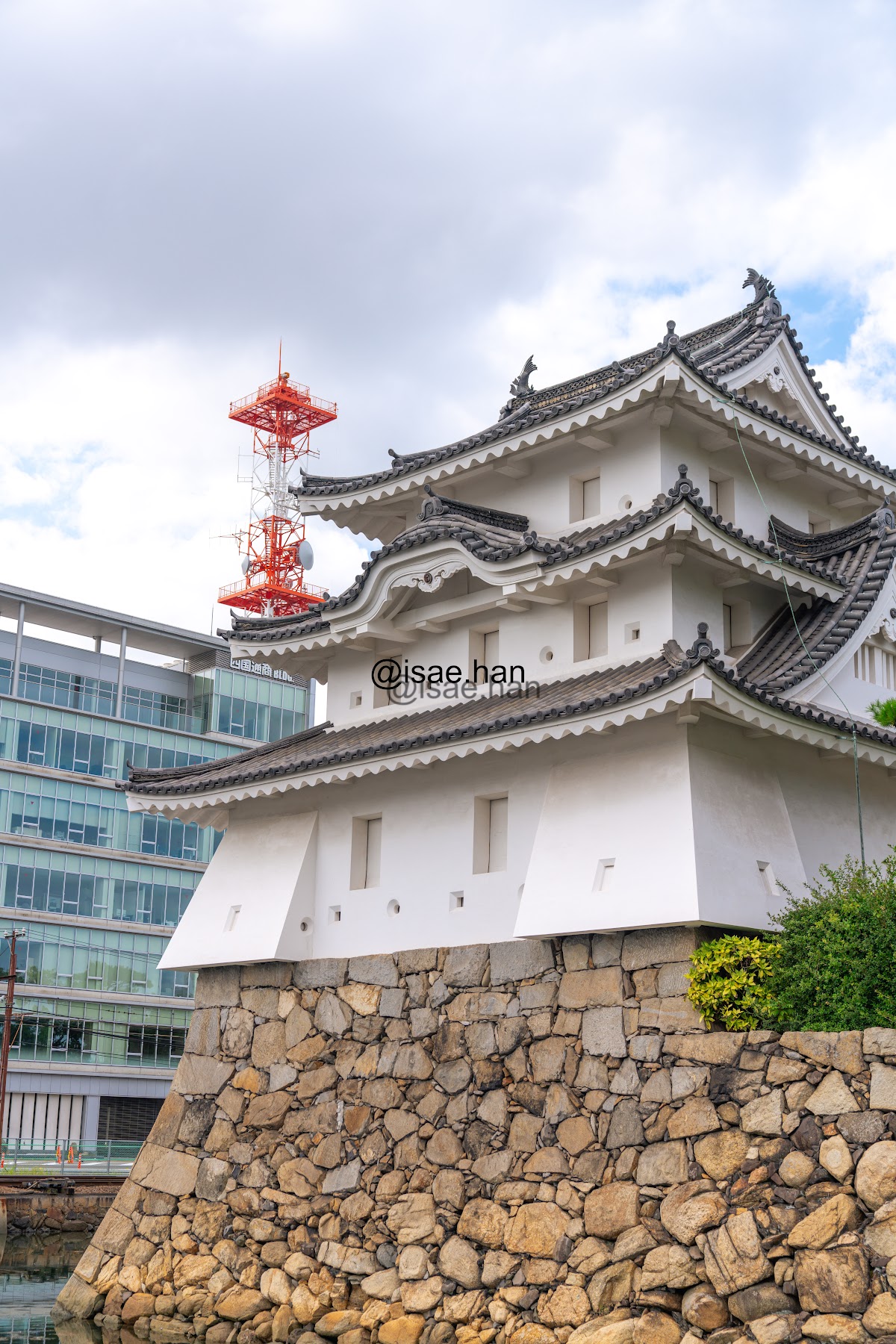
The Tsukimi Yagura is a two-story, three-tiered turret located in the northwest corner of Kita-no-maru (North Bailey). Built facing the sea, it is said to have been used for moon-viewing parties. A refined building where it is one of the representative remains of Takamatsu Castle.
Ushitora Yagura (Northeast Turret)
This three-story, three-tiered turret stands in the northeast corner of Higashi-no-maru (East Bailey) and is the largest turret within the castle. Ushitora means northeast, and is a name indicating a direction. It has a solid struct stronghold.
Mizutegomon Gate
This water gate connected Kitanomaru and Ninomaru, opening onto the sea. It was a special gate used by the feudal lord when entering and leaving the castle by boat. It has the form of a watchtower gate and is a valuable and unique cast
Hiyun-kaku
Hiyun-kaku is a building constructed during the Meiji era as a villa for the Matsudaira family. Its elegant sukiya-style architecture, along with the garden, is designated a national scenic spot. A highly prestigious building that also served as a tempora the public, allowing visitors to tour the interior.
Tenshudai (Castle Tower Base)
The Tenshudai remaining in the main enclosure is a magnificent stone wall built of granite. Although the castle tower itself is lost, it is possible to climb this Tenshudai and enjoy a panoramic view of the Seto Inland Sea and Takamatsu city.
Currently, efforts are underway to restore the castle tower, and the restoration work on the Tenshudai was completed in 2013 (Heisei 25). Research and studies for restoration are ongoing, and it is hoped that the castle will be restored to its original
사야바시 다리
This bridge connects the main keep and the second keep, and is a rare type with a roof. The current bridge is a reconstruction, but it still evokes the atmosphere of the past.
Sakura no Baba and Garden
Tamamo Park features a beautiful Japanese garden where visitors can enjoy the scenery of each season. Especially in spring, the cherry blossoms are in full bloom, attracting many visitors.
Cultural Property Designation of Takamatsu Castle
Takamatsu Castle ruins were designated a national historic site in 1955 (Showa 30). Furthermore, in 2012 (Heisei 24), the Hiyunkaku Garden was designated a national scenic spot.
The following three buildings are designated as Important Cultural Properties:
- Tsukimi-yagura (Moon-Viewing Turret), Tsugi-yagura (Connecting Turret), and Watari-yagura (with attached stone walls)
- Ushitora-yagura (Northeast Turret) (with attached stone walls)
- Mizute-gomon (Water Gate), Tsugi-yagura (Connecting Turret) (with attached stone walls)
These cultural property designations demonstrate that Takamatsu Castle is a historically and culturally extremely valuable heritage site.
Facility Information and Access
Basic Information about Tamamo Park
Location
2-1 Tamamo-cho, Takamatsu City, Kagawa Prefecture 760-0030
Opening Hours
- April to September: 7:00 AM to 6:00 PM
- October to March: 8:30 AM to 5:00 PM
(However, entry is not permitted before sunrise)
Closed Days
December 29th to December 31st
Admission Fee
- Adults (16 years and older): 200 yen
- Children (6 years and older, under 16 years): 100 yen
- Under 6 years: Free
*Group discounts and annual passes are available
Access Method
Access by Train
- Approximately 3 minutes on foot from JR Takamatsu Station
- Approximately 1 minute on foot from Kotoden Takamatsu-Chikko Station
Takamatsu Castle is located very close to JR Takamatsu Station, making it extremely convenient to access. Located easily accessible from Takamatsu Station, the gateway to Shikoku, it’s ideal for a stop at the beginning or end of your sightseeing.
Access by Car
- Approximately 15 minutes from Takamatsu Chuo IC on the Takamatsu Expressway
- Parking: There is no dedicated parking lot for Tamamo Park, but there are many paid parking lots in the surrounding area.
Access by Bus
- Get off at the Kotoden Bus “Takamatsu Station” bus stop, approximately 3 minutes on foot.
How to Enjoy Takamatsu Castle | Recommended Sightseeing Route
Basic Sightseeing Route (Estimated Time: Approximately 60-90 minutes)
- Enter from the East Entrance (JR Takamatsu Station side)
- Visit the Hiyun-kaku and Garden: Enjoy the elegant architecture and Korean garden
- View the Ushitora Turret from the Exterior: Confirm the imposing presence of the largest turret in the castle
- Cross the Sayabashi Bridge to the Honmaru: Experience the rare covered bridge
- Climb to the Tenshudai (Castle Tower Base): Enjoy the view of Takamatsu city and the Seto Inland Sea
- Visit the Moon-Viewing Tower and Water Gate: Admire the tower and water gate, both designated as Important Cultural Properties.
- Feed the Sea Bream in the Moat: A unique experience only available at a seaside castle.
- Stroll along the Cherry Blossom Ground: Enjoy the seasonal flowers.
Seasonal Highlights
Spring (March-May)
Approximately 80 Somei Yoshino cherry trees bloom during the cherry blossom season. The trees are illuminated at night, allowing visitors to enjoy a magical view of the cherry blossoms.
Summer (June-August)
The fresh greenery is beautiful, making it a pleasant season for strolling while enjoying the cool sea breeze.
Autumn (September-November)
Autumn leaves color the gardens, allowing visitors to explore the castle ruins in a tranquil atmosphere.
Winter (December-February)
The air is clear, making the view of the Seto Inland Sea even more beautiful. Experience the crisp, serene atmosphere unique to winter.
Special Events
Tamamo Park hosts various events throughout the year:
- Cherry Blossom Illumination (Late March to Early April)
- Moon Viewing Party (Around the time of the Mid-Autumn Moon Festival)
- Castle Festival (Typically in May)
- Chrysanthemum Exhibition (Autumn)
Nearby Tourist Attractions
When visiting Takamatsu Castle, we recommend also visiting the surrounding tourist attractions.
리츠린 가든
A representative daimyo garden designated as a National Special Place of Scenic Beauty. Approximately 10 minutes by car from Takamatsu Castle.
야시마
A scenic spot known as the site of a battle during the Genpei War. Enjoy spectacular views of Takamatsu city and the Seto Inland Sea.
다카마츠 시티 박물관 갤러리
Within walking distance of Takamatsu Castle. Exhibits mainly works by artists associated with Kagawa Prefecture.
Kitahama Alley
A stylish commercial facility renovated from old warehouses. Features cafes and shops.
다카마츠 심볼 타워
A landmark of Takamatsu Port. From the observation deck, you can enjoy a panoramic view of Takamatsu city and the Seto Inland Sea.
Takamatsu Castle Keep Restoration Plan
A plan to restore the lost keep of Takamatsu Castle is underway. In 2013 (Heisei 25), the restoration work on the keep’s base was completed, and preparations for restoration are steadily progressing.
The goal of the keep restoration is to reproduce its original appearance as faithfully as possible, based on old photographs, drawings, and the results of archaeological excavations. However, the restoration will require a significant amount of money and time, and it realized.
Takamatsu City has established the “Takamatsu Castle Keep Restoration Fund” and is soliciting donations. If the keep is restored, the value of Takamatsu Castle is expected to increase even further, and it is anticipated to become a leading tourist attraction in
Points to Note and Manners When Visiting Takamatsu Castle
Points to Note When Visiting
- Only the exterior of important cultural properties can be viewed. Interior viewing is not available except on special occasions. – Please refrain from climbing on the stone walls of the castle keep. Entry to areas other than designated pathways is prohibited to prote
- Please use designated feed only in designated areas when feeding animals in the moat. Feeding them with general food is prohibited.
- Pets are generally not allowed in the park (except for assistance dogs such as guide dogs).
- Drone flights are prohibited.
Photography
- Personal commemorative photos are permitted, but please check with the management office beforehand if you plan to use a tripod.
- Commercial photography requires permission.
- Please be considerate of other visitors.
Accessibility Information
Wheelchair access is possible at Tamamo Park, but some facilities (such as the castle keep) have stairs, making access difficult. We recommend contacting the management office beforehand.
Summary | Rediscovering the Charm of Takamatsu Castle
Takamatsu Castle, as one of Japan’s representative coastal castles, is a valuable cultural heritage site with a unique history and structure. Beginning with its construction by Ikoma Chikamasa and undergoing major renovations by Matsudaira Yorishige, Takamatsu Castle’s history as cen the remains of Tamamo Park.
The important cultural properties of the Tsukimi-yagura (Moon-Viewing Turret), Ushitora-yagura (Northeast Turret), and Mizute-gomon (Water Gate) are valuable structures that convey the castle’s appearance in its heyday. The sight of sea bream seawater, evokes the unique charm of a coastal castle. Its excellent accessibility, being just a short walk from JR Takamatsu Station, is another attractive feature that makes it easy to visit.
With the ongoing restoration plan for the castle keep, Takamatsu Castle will continue to add new attractions and welcome many people. When you visit Shikoku, be sure to experience the history and scenery of this beautiful coastal castle. Strolling through Tama in its heyday, as described in the song, “In Sanuki Province, you can see Takamatsu Castle on the waves,” will surely create an unforgettable memory.

