
Sagae Castle (Yamagata Prefecture) Complete Guide: A Thorough Explanation of the 380-Year Residence of the Oe Clan and Existing Remains
What is Sagae Castle?
Sagae Castle is a flatland castle located in Marunouchi, Sagae City, Yamagata Prefecture. Built in Sagae-sho, Murayama District, Dewa Province, this castle functioned as the residence of the Oe clan for approximately 380 years, from the early Kamakura period to the early Edo period. The area around the current Sagae Elementary School is the center of the castle, and unusually for a flatland castle, the remains of the moat are well-preserved.
Designated as a Yamagata Prefecture Historic Site, the castle site has stone monuments and explanatory signs, allowing visitors to imagine its former appearance. Its location on a river terrace between the Mogami River and the Sagae River speaks to its strategic importance in controlling a key point for water transport.
History of Sagae Castle
Construction of the Castle and the Era of the Oe Clan
The history of Sagae Castle begins in the Karoku era (1225-1227) when Oe Chikahiro, the eldest son of Oe Hiromoto, built the first residence. Oe Hiromoto was known as a high-ranking official of the Kamakura Shogunate, and his descendants settled in Dewa Province and adopted the name Sagae.
The Oe clan ruled this region for approximately 380 years as the jitō (land steward) of Sagae Manor. From the Muromachi period to the Sengoku period, the Sagae clan expanded their power as a powerful local lord in the Murayama region, and the castle was also developed. The castle had a structure with a main keep, second bailey, and third bailey, and was a strong defensive facility surrounded by a moat.
Turmoil in the Sengoku Period
During the Sengoku period, the Sagae clan built complex relationships with surrounding daimyo such as the Date and Mogami clans. In 1584 (Tensho 12), Sagae Takamoto, the then-lord of the castle, surrendered after being attacked by Mogami Yoshiaki. This battle marked the end of the Oe clan’s rule over Sagae, which had lasted for approximately 360 years.
Mogami Yoshiaki designated Sagae Castle as an important base and renovated it. Afterward, the castle was ruled by members of the Mogami clan and their retainers.
Edo Period and Abandonment of the Castle
Around 1602 (Keicho 7), Mogami Iechika, the younger brother of Mogami Yoshiaki, became the castle lord. Around 1609-1610 (Keicho 14-15), when Iechika moved to Yamagata Castle, Sagae Hizen, a former retainer of the Sagae clan, took up residence with a stipend of 27,000 koku.
In 1614, when Mogami Yoshiaki died of illness and Sagae Hizen committed suicide to follow him in death, Sagae Castle became part of the Mogami clan’s territory. It is believed that Sagae Castle was subsequently abandoned following the Mogami clan’s downfall in 1622.
Castle Structure and Characteristics
Location as a Flatland Castle
Sagae Castle was built as a typical flatland castle on a river terrace plateau. Taking advantage of its location between the Mogami River and the Sagae River, it functioned as a natural stronghold. This location also held significant importance as a base for transporting goods using water transport.
Despite being a flatland castle, its defensive capabilities were enhanced by surrounding it with a moat, giving it sufficient defensive features for a castle of the Sengoku period.
Layout and Structure
Sagae Castle had a structure consisting of the main keep, second bailey, and third bailey. The current site of Sagae Elementary School corresponds to the former main keep, with the second and third baileys (Ninokuruwa and Sannomaru) located around it. Each bailey was separated by a moat and connected by castle gates.
The main keep is estimated to have measured approximately 150 meters east-west and 120 meters north-south, a considerable size for a castle of a local lord in the Murayama region. Within the castle grounds were residences, warehouses, and barracks, functioning as the lord’s living quarters in peacetime and a military base during wartime.
Existing Remains and Points of Interest
Remains of the Moat
The most important remains of Sagae Castle are the remaining moats (water moats). Parts of the moats that surrounded the castle are now used as roads and waterways, allowing visitors to experience the scale of the castle in its heyday.
Especially around Sagae Elementary School, the remains of the moats are preserved as roads, allowing visitors to trace the outline of the castle. The width of the moats varied depending on the location, but it is estimated to have been over 10 meters at its widest point. ### Tatsumi Gate of Sumie-ji Temple
The Tatsumi Gate, relocated to Sumie-ji Temple, is a valuable relic of Sagae Castle. This gate was one of Sagae Castle’s gates and was moved to serve as the main gate of Sumie-ji Temple after the castle was abandoned.
This gate, still used as the main gate of Sumie-ji Temple, holds significant value as one of the few remaining structures of Sagae Castle. The gate’s structure and design exhibit characteristics of early Edo period castle architecture.
Stone Monuments and Information Boards
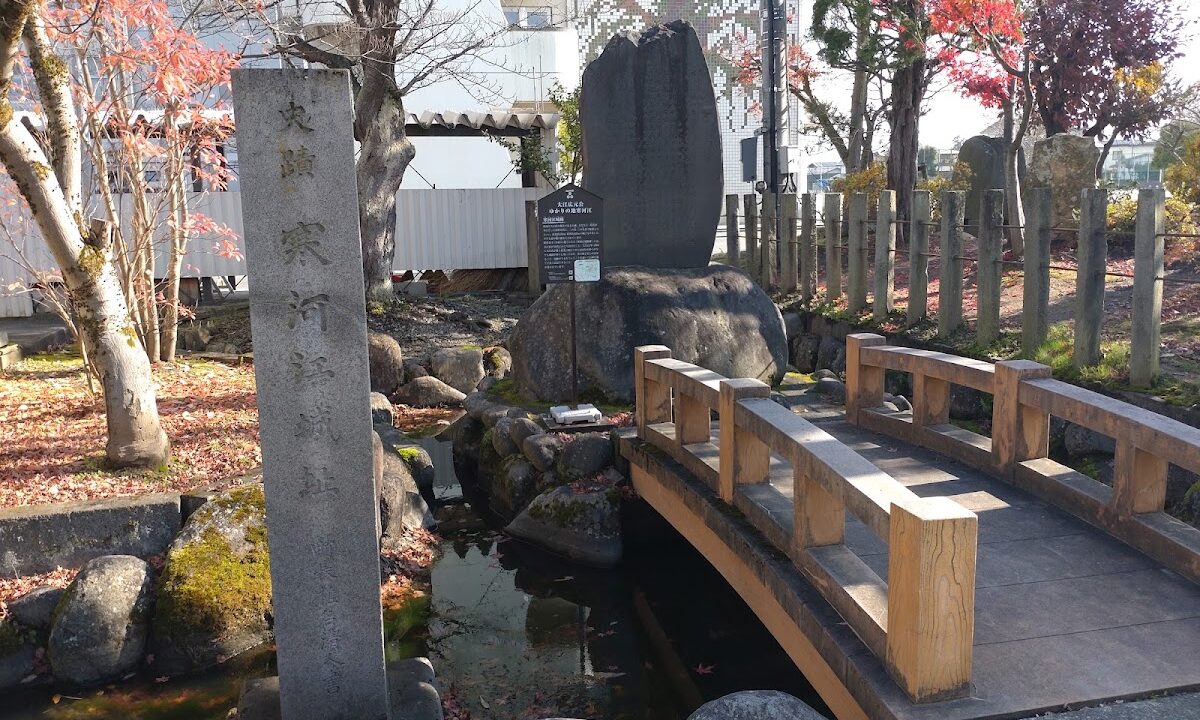
Several stone monuments and information boards are installed at the castle site. A “Sagae Castle Site” monument stands at the main keep site, and another monument marking the castle site is located at the second keep site. These monuments serve as important markers indicating the locations of the castle’s main enclosures.
Information boards are installed in three locations, providing detailed explanations of Sagae Castle’s history and structure. Referring to these boards when visiting the castle site will allow for a deeper understanding of the castle’s history.
Around Sagae Elementary School
The current Sagae Elementary School is built on the site of the former main keep. While entry into the school grounds is prohibited, walking around the surrounding area allows one to imagine the scale and structure of the castle.
By following the roads that form the remains of the moat surrounding the school, it is possible to confirm the outline of the main keep. Furthermore, the undulations of the terrain around the school also evoke the appearance of the former castle.
Sagae Castle and the Cultural Heritage of the Oe Clan
The Rule of the Sagae Clan and Regional Development
The Oe clan (Sagae clan) ruled this area for approximately 380 years, making significant contributions to the region’s development. They promoted the development of Sagae Manor, improving agricultural production, and developed the town of Sagae as a trading hub utilizing the Mogami River’s water transport.
The Sagae clan also played an important role culturally, establishing and protecting temples and shrines. Many temples and shrines that remain in Sagae City today were established or protected during the Oe clan’s era.
Sagae City Local History Museum (Former Nishimurayama County Office)
To learn more about the history of Sagae Castle, a visit to the Sagae City Local History Museum is recommended. Located in the former Nishimurayama County Office building, this museum displays materials related to Sagae Castle and the Oe clan, allowing visitors to learn about the castle’s history and structure.
The museum exhibits old castle maps, archaeological excavation results, and unearthed artifacts, allowing visitors to experience the true nature of the castle in a way that cannot be learned from documents alone.
Access and Visiting Information
Location
Address: 1-chome, Marunouchi, Sagae City, Yamagata Prefecture
Sagae Castle Ruins are located in the center of the city, making access relatively easy.
Access by Public Transportation
The castle ruins are approximately a 15-minute walk from JR Sagae Line “Sagae Station”. Head northeast from the station, and after passing through the city center, you will reach the castle ruins near Sagae Elementary School. If using public buses, there are buses that circulate within Sagae city, and the nearest bus stops are “Sagae Elementary School” or “Marunai”.
Access by Car
It’s about a 5-minute drive from the Sagae Interchange on the Yamagata Expressway. From National Route 112, head towards the city center and follow the signs to reach the castle ruins.
There is no dedicated parking lot around Sagae Elementary School, but you can use nearby public parking lots. If you are visiting Sumieji Temple, you can use the temple’s parking lot.
Points to Note When Visiting
Visiting the Sagae Castle Ruins is free, and there is no entrance fee. However, the main keep site is within the grounds of Sagae Elementary School, so entry onto the school grounds is prohibited.
When visiting, the following route is recommended:
- Check the stone monuments and explanatory signs around Sagae Elementary School.
- Walk along the moat remains (road) around the elementary school to get a sense of the castle’s scale.
- Visit Sumie-ji Temple and see the relocated Tatsumi Gate.
- If time permits, check the materials at the Sagae City Local History Museum.
The estimated time required for a thorough visit is 1-2 hours.
Nearby Tourist Attractions
Hachiman Park
Hachiman Park, within walking distance of Sagae Castle Ruins, is known as a famous cherry blossom viewing spot in spring. The park contains Hachiman Shrine, where you can feel the history of Sagae. It’s an ideal spot to visit in conjunction with a castle ruins tour.
Hirashio Kumano Shrine
Hirashio Kumano Shrine, located in Sagae City, is an ancient shrine that has attracted worshippers since the time of the Oe clan. Old buildings remain on the grounds, allowing you to feel the history of Sagae.
Shibahashi Daikan Jinya Ruins
This is the site of a magistrate’s office from the Edo period, which served as the administrative center for the Sagae region after the abandonment of Sagae Castle. Visiting this site in conjunction with the castle ruins allows for an understanding of the historical flow from the medieval to the early modern period.
Cultural Property Designation and Preservation Status of Sagae Castle
The Sagae Castle ruins were designated as a Yamagata Prefecture Historic Site in October 1925 (Taisho 14). This was a relatively early designation within Yamagata Prefecture, indicating that the historical value of the castle ruins was recognized even then.
Currently, the preservation of the castle ruins is primarily carried out by the Sagae City Board of Education and the Yamagata Prefecture Cultural Property Protection Promotion Division. Efforts are being made to ensure the appropriate preservation and utilization of the castle ruins, including the preservation of the moat remains and the installation of explanatory signs.
In recent years, archaeological excavations have been conducted intermittently, yielding new insights into the castle’s structure and changes over time. These research findings are publicly displayed at the Sagae City Local History Museum and other locations.
Points to Note When Visiting Sagae Castle
Considerations During Your Visit
Since the main keep site is located within the grounds of Sagae Elementary School, it is necessary to be considerate of the school’s educational activities during your visit. Especially during weekdays, please be mindful of keeping quiet around the school.
Photography is permitted, but please be careful not to include elementary school students in your photos. Unauthorized entry onto school grounds is strictly prohibited.
Seasonal Highlights
Spring is the perfect season for strolling around the castle ruins, with beautiful cherry blossoms in the surrounding area. Visiting Hachiman Park in conjunction with the castle ruins allows you to enjoy the combination of cherry blossoms and the castle site.
Summer is lush with greenery, and the trees along the road of the former moat evoke the atmosphere of the castle in its heyday. However, be sure to take precautions against the heat.
Autumn offers beautiful autumn foliage, allowing you to stroll around the castle ruins in a tranquil atmosphere.
Winter may bring snow, and while the castle ruins in a snowy landscape are picturesque, be sure to watch your step.
Research and New Discoveries Regarding Sagae Castle
Recent archaeological excavations have yielded new insights into the structure and history of Sagae Castle. In particular, information about the structure of the moat and the layout of buildings within the castle, previously unknown from historical documents alone, has been revealed.
Since the 2000s, investigations have uncovered fragments of medieval pottery and building foundations around the main keep, further clarifying the castle’s true nature. Cross-sectional investigations of the moat have also revealed that the castle underwent multiple renovations.
These research findings have been published in academic papers and reports, contributing to the advancement of Sagae Castle research. Further discoveries are expected through continued investigations.
Summary: The Historical Value of Sagae Castle
Sagae Castle is an important castle with a history spanning approximately 400 years, from the Kamakura period to the early Edo period. It played a crucial role as the base of the Ōe clan’s 380-year rule and as the political and military center of the Murayama region during the Sengoku period.
The remaining moat and the Tatsumi Gate of Sumie-ji Temple are valuable historical relics that evoke the appearance of the castle in its heyday. They are protected as a Yamagata Prefecture historical site, and efforts are being made to ensure their proper preservation and utilization.
Visiting the Sagae Castle ruins allows you to experience the history of Yamagata Prefecture from the medieval to early modern periods. Visiting not only the castle ruins but also the surrounding temples, shrines, and local history museums will allow you to gain a deeper understanding of Sagae’s history and culture.
Sagae City is known as the “Village of Cherries,” but its historical background lies in the long rule of Sagae Castle and the Oe clan. The prosperity of modern Sagae is built upon the history of development centered around this castle.


