
Complete Guide to Shimizu Castle (Yamagata Prefecture) | History and Highlights of a Hilltop Castle Overlooking the Mogami River
What is Shimizu Castle? A Historic Castle in Okura Village, Yamagata Prefecture
Shimizu Castle is a Japanese castle (hilltop castle) located in Shimizu and Hira, Okura Village, Mogami District, Yamagata Prefecture. Built on a hill overlooking the middle reaches of the Mogami River, this castle was constructed in 1476 by Narusawa Mitsuhisa (later known as Shimizu Mitsuhisa). It was designated a Yamagata Prefecture Historic Site and Place of Scenic Beauty in 1939 and is currently protected as a Yamagata Prefecture Designated Historic Site.
The Shimizu district of Okura Village, where Shimizu Castle is located, was an important transit base for the Mogami River shipping route. As a key point for transporting goods from the Sea of Japan route up the Mogami River to the inland areas of Yamagata Prefecture, Shimizu played the role of a central city in the middle reaches of the Mogami River. Shimizu Castle controlled this waterway and served as a defensive stronghold in the northern part of the Mogami region.
Built on a natural fortress overlooking the Mogami River, Shimizu Castle existed for approximately 150 years, from the Sengoku period to the early Edo period, as the residence of the Shimizu clan, a branch of the Mogami clan. Until its abandonment in 1622, it continued to play a crucial role as the political, economic, and military center of the region.
History of Shimizu Castle and Changes in its Lords
Background of Construction and Narusawa Mitsuhisa
The history of Shimizu Castle begins in 1476, during the late Muromachi period. The builder was Narusawa Mitsuhisa, a great-grandson of Shiba Kaneyori. Shiba Kaneyori was a warrior considered the ancestor of the Mogami clan, and Mitsuhisa was a powerful figure within the Mogami clan, descended from him.
According to one theory, Mitsuhisa was the sixth son of Narusawa Kaneyoshi, the grandson of Shiba Kaneyori. Records indicate that Mitsuhisa was assigned to the Shimizu area in Bunmei 8 (1476), and that he began full-scale construction of the castle two years later, in Bunmei 10 (1478). After the castle’s construction, Mitsuhisa adopted the name Shimizu and resided at Shimizu Castle as its first lord, Shimizu Sonjiro Mitsuhisa.
The purpose of the castle’s construction was to defend against attacks from the north within the Mogami clan’s sphere of influence. By controlling the geographically strategic location in the middle reaches of the Mogami River, Shimizu Castle functioned as a strategic base to secure control of river transport and prepare for invasions from the north.
The Prosperity of the Shimizu Clan and its Relationship with the Mogami Clan
The Shimizu clan, as a branch of the Mogami clan, used Shimizu Castle as their residence for generations. The Mogami region reached its peak during the Sengoku period, under the rule of Mogami Yoshiaki, and the Shimizu clan played an important role as a subordinate of him.
The Shimizu clan, based at Shimizu Castle, amassed economic power by controlling the Mogami River shipping route, becoming a key part of the Mogami clan’s influential vassal group. The Mogami River was the most important transportation route in Dewa Province (present-day Yamagata Prefecture), functioning as a route for transporting goods from Sakata Port on the Sea of Japan to the inland areas. The strategic value of the Shimizu clan’s control over this shipping route was extremely high.
Throughout the Sengoku period, the Shimizu clan contributed to the expansion of the Mogami clan’s power and to the stability and prosperity of the region. Shimizu Castle is thought to have functioned not merely as a military base, but as a center of regional governance and economic activity.
The Relationship Between Shimizu Yoshichika and the Toyotomi Family
A notable figure in the history of the Shimizu clan is Shimizu Yoshichika. Born into a branch of the Mogami family, Yoshichika developed a deep connection with the Toyotomi family.
Yoshichika served as a close attendant (kinju, kaisho) to Toyotomi Hideyori. This is an important fact indicating that the Shimizu clan had ties to the central government through the Mogami clan. During the Battle of Sekigahara in 1600, the Eastern Army led by Tokugawa Ieyasu and the Western Army led by Ishida Mitsunari clashed. Yoshichika, however, was in a complex position due to his loyalty to the Toyotomi family, even attempting to collude with the Eastern Army’s generals.
After the Battle of Sekigahara, when Tokugawa Ieyasu seized power, Yoshichika’s position as a servant of the Toyotomi family became precarious. Since the main branch of the Mogami clan belonged to the Eastern Army, it is likely that tension arose in the relationship between Yoshichika and the main branch.
The Dispossession of the Mogami Family and the Abandonment of Shimizu Castle
The history of Shimizu Castle came to an end with the dispossession of the Mogami family in 1622. After the death of Mogami Yoshiaki, the Mogami family weakened due to internal conflicts and was eventually dispossessed (had their territory confiscated) by the shogunate. This confiscation of territory meant that the Shimizu clan, a branch of the Mogami clan, also lost their land, and Shimizu Castle was abandoned.
Shimizu Yoshichika is believed to have died at or around the time of this confiscation. In 2013, the 400th anniversary of the fall of Shimizu Castle was marked by the death of Yoshichika, the last lord of the castle under the Mogami family. This milestone year saw local commemorative events, providing an opportunity to re-examine the history of Shimizu Castle.
Shimizu Castle, which ruled the middle reaches of the Mogami River for approximately 150 years, thus disappeared from the stage of history. However, its remains survive to this day, conveying the glory of that era.
Structure and Layout of Shimizu Castle
Characteristics as a Hilltop Castle
Shimizu Castle is classified as a hilltop castle. A hilltop castle is a castle built on a hill or plateau in a flat area. It is characterized by being less steep than a mountain castle and having a more defensible location than a flatland castle.
Shimizu Castle was built on a hill overlooking the Mogami River, and the difference in elevation from the river served as a natural defensive wall. The Mogami River flowed north of the castle, making attacks from the river extremely difficult due to the terrain. The castle’s layout, which made maximum use of this terrain, is a major characteristic.
The castle’s location was suitable not only for military defense but also for monitoring and controlling the Mogami River’s waterway. From the main keep site, the flow of the Mogami River could be seen in its entirety, allowing for the monitoring of ships traveling on the river. This excellent view was a crucial factor in achieving river control at the time.
Arrangement of Enclosures and Moats
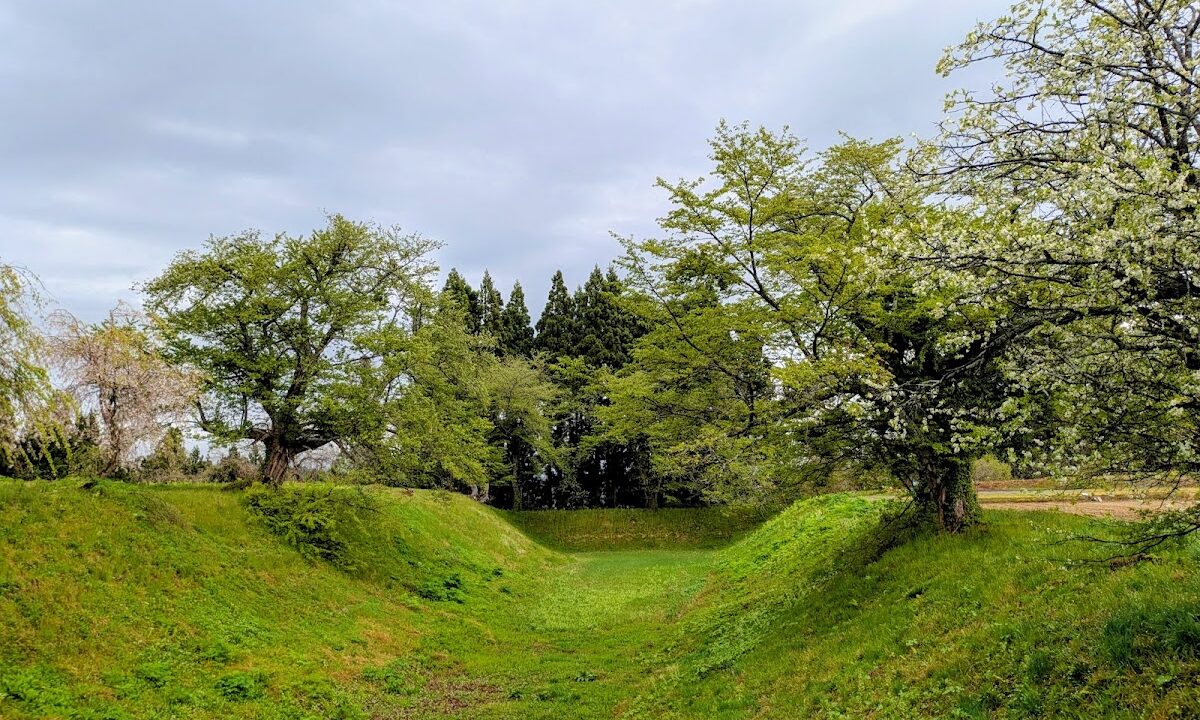
The remains of Shimizu Castle that can be confirmed today include enclosures (kuruwa), earthworks, and dry moats (yokobori). Enclosures are sections within the castle grounds, and multiple enclosures were arranged around the main keep.
The main keep was located in the center of the castle and was the most important defensive stronghold. To the north of the main enclosure (Honmaru) were two moats utilizing the valley, designed to protect the castle’s entrance (koguchi). These moats were dry, not filled with water, but their depth and width provided sufficient defense.
The earthen ramparts were earthen walls built around the enclosures, preventing enemy intrusion and serving as a base for defensive fire from within. Parts of the earthen ramparts at Shimizu Castle remain in good condition today, making them valuable historical remains for understanding the castle construction techniques of the time.
The horizontal moats were dug to surround the enclosures, preventing enemy lateral movement. At Shimizu Castle, the clever placement of horizontal moats, utilizing the terrain, demonstrates the high level of castle planning technology during the Sengoku period.
Current State of the Main Enclosure Site
At the current Shimizu Castle site, the main enclosure site is the best-preserved. A marker post stands at the entrance to the main enclosure, inscribed with the words “Shimizu Castle Site.” In the northeastern part of the spacious main enclosure, there is an explanatory sign and a gazebo, allowing visitors to rest and learn about the history.
The view from the gazebo is magnificent, offering a panoramic view of the majestic Mogami River below. This view is almost identical to the scenery seen by the castle lords of the time, and it is a place where you can truly appreciate the strategic value of Shimizu Castle as a key point on the Mogami River shipping route.
The size of the main enclosure speaks to the power of the Shimizu clan at the time. It is believed that the lord’s residence and other important buildings were located in the main enclosure, concentrating the central functions of politics and military affairs. Although no building remains exist today, the shape of the enclosures and the arrangement of the earthworks allow us to imagine its former appearance.
Shimizu Castle Highlights and Tourist Information
Points to See at the Ruins
The main highlights when visiting the Shimizu Castle ruins are as follows:
Main Enclosure: The central part of the castle, where a spacious enclosure remains. A gazebo is installed here, offering stunning views of the Mogami River. This is a crucial point for truly appreciating the castle’s natural fortifications.
Earthworks: The earthworks remaining around the main keep are valuable relics that demonstrate the defensive structure of the time. Their height and shape reveal the level of castle construction technology at the time.
Dry Moat: The dry moat protecting the enclosure remains in excellent condition. Its depth and width help understand its function as a defensive structure.
Gate Entrance: The structure of the gate entrance to the main keep can also be observed. A marker post indicates its importance as the castle entrance.
View of the Mogami River: The view of the Mogami River from the main keep site is breathtaking. This view is essential for understanding Shimizu Castle’s location as a key point for river transport. Looking down at the river’s flow allows one to appreciate how important river control was at the time.
Access and Basic Information
Location: 1742 Shimizu, Okura Village, Mogami District, Yamagata Prefecture (around the main keep site), Shimizu/Hira area
Designated Cultural Property: Yamagata Prefecture Designated Historic Site “Shimizu Castle Ruins” (Designated in 1939, re-designated in 2011)
Castle Classification: Hilltop Castle
Year of Construction: Bunmei 8 (1476) or Bunmei 10 (1478)
Year of Abandonment: Genna 8 (1622)
Main Remains: Enclosures, earthworks, dry moats
Access:
- By Car: From National Route 47, head towards Okura Village. Follow the signs in the village to the Shimizu area. Parking space is limited, so please be careful when visiting.
- By Public Transportation: Take a bus from JR Shinjo Station towards Okura Village. After getting off at the Shimizu bus stop, it is possible to access the site on foot, but since the number of buses is limited, it is necessary to check in advance.
Visiting Hours: The castle ruins are generally open for free viewing. However, although maintenance such as grass cutting is carried out regularly, the ground may be uneven depending on the season.
Best Season for Visiting: Spring to autumn is the best time to visit. June, in particular, is a beautiful time when the remains are easily visible after grass cutting, and the scenery of the Mogami River in fresh greenery is also lovely. Visiting may be difficult in winter due to snow.
Nearby Tourist Attractions
When visiting Shimizu Castle Ruins, we recommend also visiting other tourist attractions in Okura Village.
Hijiori Onsen: A representative hot spring resort in Okura Village, this famous hot spring boasts a history of over 1200 years. It is about a 20-minute drive from Shimizu Castle Ruins and is perfect for relaxing after visiting the castle ruins.
Mogami River Boat Trip: Experience a boat trip down the Mogami River, which was once under the control of Shimizu Castle. Viewing the river from the river surface, after having looked down on it from the castle ruins, allows for a deeper understanding of the importance of river transport.
Okura Village Historical and Folk Museum: This facility allows you to learn about the history and culture of Okura Village. It also exhibits materials related to Shimizu Castle, providing a more detailed understanding of the castle’s history.
Historical Value and Modern Significance of Shimizu Castle
Importance in the History of Mogami River River Transport
The historical value of Shimizu Castle lies not only in its role as a military facility, but also in its importance in the history of Mogami River river transport. Throughout the Edo period, the Mogami River was the most important logistics route in Dewa Province. Goods were transported from Sakata Port on the Sea of Japan up the Mogami River to inland areas such as Yonezawa and Yamagata.
Shimizu is located in the middle reaches of the Mogami River and functioned as a relay point on this river transport route. The Shimizu clan, based at Shimizu Castle, accumulated economic power by controlling this river transport and contributed to the development of the region. The view of the Mogami River from the castle ruins evokes the prosperity of river transport in those days.
A Heritage Site Conveying the History of the Mogami Clan
Shimizu Castle is also an important heritage site that conveys the history of the Mogami clan. The Mogami clan was a Sengoku period daimyo that ruled the Mogami region of Dewa Province, and reached its peak during the time of Mogami Yoshiaki. The Shimizu clan, as a branch of the Mogami clan, played a crucial role in the expansion of the Mogami clan’s power and regional control.
Within the lineage of the Mogami clan, which began with Shiba Kaneyori, the Shimizu clan was an important family responsible for defending the northern region. Tracing the history of Shimizu Castle is an essential element in understanding the history of the entire Mogami clan.
Preservation Activities as a Regional Cultural Property
Since being designated a Yamagata Prefecture Historic Site and Scenic Spot in 1939, the Shimizu Castle ruins have been preserved as an important regional cultural property. In 2011, it was re-designated as a Yamagata Prefecture Historic Site, and the protection system was strengthened.
In the local Okura Village, regular maintenance and grass cutting are carried out at the Shimizu Castle ruins to preserve the remains. Furthermore, explanatory signs and markers are installed to create an environment where visitors can learn about history. Commemorative events are held in milestone years, such as the 400th anniversary of the castle’s fall in 2013, providing opportunities to reaffirm its value as a regional historical heritage site.
The Shimizu Castle ruins are a source of pride for the local residents. It is hoped that this place, where one can quietly reflect on history in a peaceful environment, will continue to be carefully preserved.
Precautions and Manners When Visiting Shimizu Castle
The Shimizu Castle ruins are a protected historical site. Please observe the following points when visiting:
Protection of Remains: Remains such as earthworks and moats are valuable cultural assets. Please absolutely refrain from climbing or digging.
Take Your Trash Home: There are no trash cans at the castle ruins. Please be sure to take all your trash with you.
Protection of Vegetation: The vegetation around the castle ruins is part of the ecosystem. Please refrain from breaking or collecting plants unnecessarily.
Safety Assurance: Some areas have uneven ground. Particular caution is needed after rain or during winter, as these areas become slippery. Please wear appropriate footwear.
Respect for Silence: The castle ruins are a quiet environment. Please observe calmly without shouting or making noise.
Consideration for Private Property: There are private houses and land around the castle ruins. Please do not enter restricted areas and be considerate of the lives of local residents.
Summary: Rediscovering the Charm of Shimizu Castle
Shimizu Castle is a valuable historical heritage site remaining in Okura Village, Mogami District, Yamagata Prefecture. From its construction in 1476 (Bunmei 8) to its abandonment in 1622 (Genna 8), it was a flatland castle that ruled the middle reaches of the Mogami River for approximately 150 years, leaving a significant mark on the region’s history.
Built at a strategic point on the Mogami River shipping route, Shimizu Castle served as both a military stronghold and a center of economic activity. The magnificent view of the Mogami River from the main keep ruins conveys the prosperity of the river transport and the glory of the Shimizu clan at that time.
The well-preserved remains, including the baileys, earthworks, and moats, are invaluable resources for understanding the castle construction techniques of the Sengoku period. Visiting the Shimizu Castle ruins, a Yamagata Prefecture designated historical site, allows you to experience the history of Japanese castles, the history of the Mogami clan, and the history of the Mogami River shipping route.
In a tranquil environment, Shimizu Castle ruins offer a chance to reflect on history at your leisure. When visiting Yamagata Prefecture, be sure to visit this hidden gem of a castle. From the hilltop overlooking the Mogami River, you’ll surely feel the spirit of the Sengoku period.


