
Arato Castle (Yamagata Prefecture) Complete Guide: A Thorough Explanation of the History and Highlights of a Border Castle in the Sengoku Period
What is Arato Castle?: A Strategic Sengoku Period Site Remaining in Shirataka Town, Yamagata Prefecture
Arato Castle is a flatland castle located in Arato-ko, Shirataka Town, Nishiokitama District, Yamagata Prefecture. Built on an isolated hill approximately 210 meters above sea level and 30 meters above ground level, connecting the river terrace and the end of the Shirataka Mountain Hills on the right bank of the Mogami River, it is also known as “Yaotome Castle.”
During the Sengoku period, it was under the control of the Date clan and was an extremely important military base as a “border castle” adjacent to the Mogami territory. Due to its geographical characteristics, it played a crucial role in the conflict between the Date and Mogami clans and was the site of numerous battles.
The castle ruins were designated a Shirataka Town Historic Site on April 5, 1989 (Heisei 1), and are now part of the grounds of Yaotome Hachiman Shrine. The remains of structures such as water moats, dry moats, earthworks, and outer baileys are well-preserved, making it a valuable historical site for understanding the structure of castles during the Sengoku period.
History of Arato Castle: From Construction to Abandonment
Legend of Construction in the Late Heian Period
There are various theories regarding the construction date of Arato Castle, but according to the oldest legend, it was built by Arakawa Jiro Kiyoyasu during the Eicho era (1096-1097). This period falls at the end of the Heian period, immediately following the Later Three Years’ War (1083-1087).
The legend states that Minamoto no Yoshiie prayed for victory at this site during the Later Three Years’ War, inviting the deity of Iwashimizu Hachimangu Shrine, and that the castle was built on this sacred site. This Hachimangu Shrine is the origin of the Yaotome Hachiman Shrine that still exists today, and is also the origin of the castle’s alternative name, “Yaotome Castle.”
Sengoku Period: A Border Castle of the Date Clan
During the Sengoku period (Warring States period), Arato Castle became an important base for the Date clan, who controlled the Okitama region. Particularly noteworthy is its strategic location as a major stronghold bordering the Mogami territory. For the Date clan, the Mogami clan to the north was a constant threat, and Arato Castle was a crucial fortress protecting the front lines.
During the time of the 9th lord, Date Masamune (Gizan), his retainer, Baba Shogen, was appointed as the castle lord and is said to have carried out large-scale improvements, such as constructing moats. This improvement transformed Arato Castle from a mere fort into a full-fledged castle.
Battles During the Tensho Era
During the Tensho era (1573-1592), fierce conflicts raged between the Date and Mogami clans. In particular, records indicate that Date Terumune temporarily established his headquarters at Arato Castle during a battle in 1584. This fact illustrates how important Arato Castle was as a military base for the Date clan.
In the confrontation with Mogami Yoshiaki, Arato Castle functioned as a frontline defensive stronghold. Place names such as “Tonomachi” and “Kojomawari” remain around the castle, providing important evidence that it was a castle with a complete defensive system including the townhouses. A complete defensive system, encompassing not only the castle but also the entire castle town with moats and earthworks, indicates that Arato Castle was not merely a military facility but also functioned as a regional center.
The Uesugi Clan Era and Naoe Kanetsugu
In 1589, when Date Masamune defeated the Ashina clan at the Battle of Suriagehara and seized control of Aizu, the situation in the Okitama region changed dramatically. Subsequently, following Toyotomi Hideyoshi’s pacification of Oshu, Gamo Ujisato was appointed to Aizu, and the Okitama region came under his control.
In 1598 (Keicho 3), Uesugi Kagekatsu became the lord of Aizu with a domain of 1.2 million koku, and Arato Castle also came under the control of the Uesugi clan. During this period, Naoe Kanetsugu, a senior retainer of the Uesugi clan, became deeply involved in the governance of the Okitama region, and Arato Castle was developed as a key part of the Uesugi clan’s northern defense.
Abandonment and Aftermath
After the Battle of Sekigahara in 1601 (Keicho 6), the Uesugi clan’s domain was reduced to 300,000 koku in Yonezawa, and the castles in the Okitama region were reorganized and consolidated. It is believed that Arato Castle was abandoned during this process. Subsequently, the castle site was used as the grounds of the Yaotome Hachiman Shrine, where it remains today.
Structure and Characteristics of Arato Castle
Location and Layout Characteristics
Arato Castle was built on an isolated hill on the east bank of the Mogami River, and its layout is characterized by its skillful use of this terrain. Located at an altitude of approximately 210 meters and with a relative height of approximately 30 meters, the castle offered an excellent vantage point for observation and simultaneously served as a formidable stronghold, difficult for attackers to approach.
The topography, situated on a river terrace and at the end of the Shiratakayama hills, enhanced the castle’s defensive capabilities as a natural stronghold. The Mogami River, a natural moat, protected the western side, while the hilly terrain to the east limited the enemy’s attack directions.
Status of Remains
Currently, the following remains are well-preserved at the Arato Castle site:
Water Moats and Dry Moats
Clearly visible remains of water moats and dry moats are present around the Hachiman Shrine. Water moats are filled with water, while dry moats are not. Combining these created an effective defensive system adapted to the terrain. The dry moats, in particular, are well-preserved and are important remains for understanding the structure of castles during the Sengoku period.
Earthworks
Earthworks surround the castle. Earthen ramparts are defensive walls constructed by piling up earth, preventing enemy intrusion and also serving as cover for firing from within the castle. The earthen ramparts of Arato Castle are well-preserved in terms of height and shape, offering insights into the castle construction techniques of the time.
Belt Enclosures
Belt enclosures (obi-kuruwa) are flat areas (enclosures) that surround the main enclosure in a belt-like shape. At Arato Castle, the remains of belt enclosures can be seen around the site of the main enclosure. These enclosures served to provide multiple layers of defense and also served as a space for deploying soldiers.
Main Enclosure Site
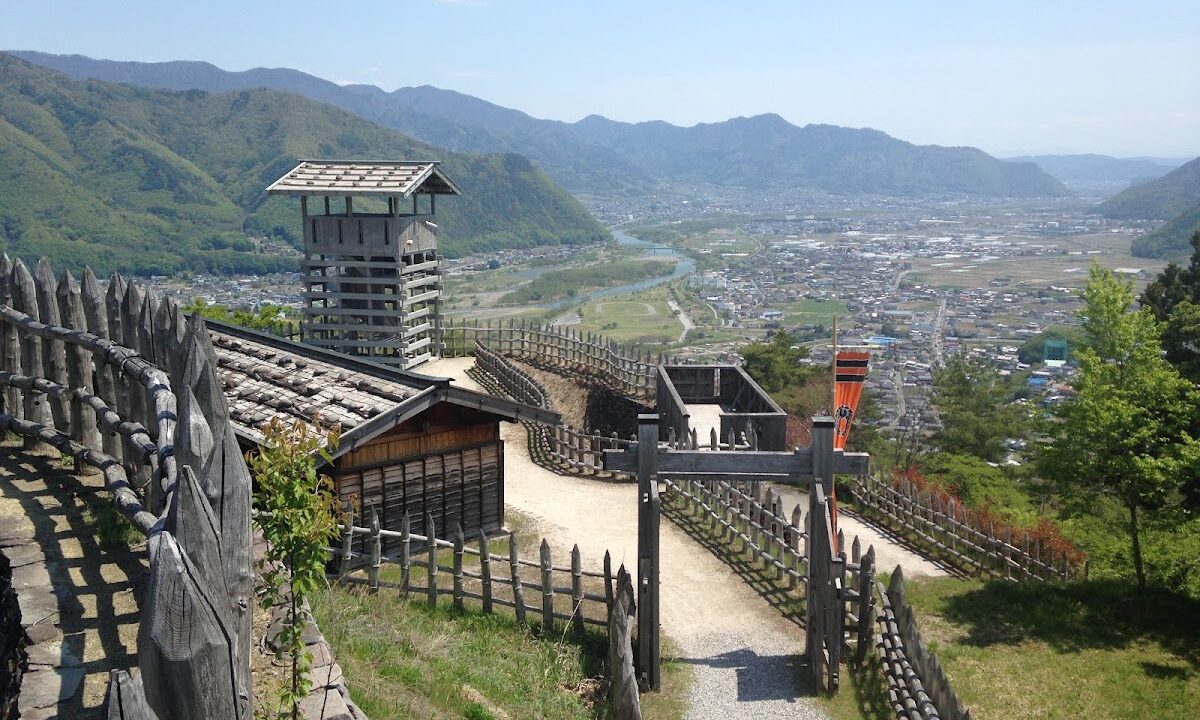
The site of the main enclosure, the central part of the castle, is now the grounds of the Yaotome Hachiman Shrine. From here, one can see a panoramic view of the Okitama Basin and the Mogami River, clearly demonstrating its function as a military observation post.
Total Enclosure Castle Structure
One of the major characteristics of Arato Castle is the high probability that it was a castle with a total enclosure structure. Place names remaining around the castle ruins, such as “Tonomachi” and “Kojomawari,” suggest that a wide area, including not only the castle facilities but also the surrounding town, was incorporated into the defensive system.
The “Sogamae” (total fortification) is a castle design that developed in the late Sengoku period, where the entire castle town was surrounded by moats and earthworks, creating a unified defensive system for the castle and town. This made it possible to employ a total war system involving not only the lord and samurai but also the townspeople.
If Arato Castle was a castle with a Sogamae, it indicates that the Date clan considered this castle not merely a military base, but also an important administrative center for northern Okitama.
Highlights of Arato Castle
Yaotome Hachiman Shrine
Located in the center of the castle ruins, Yaotome Hachiman Shrine is a historic shrine said to have been established by Minamoto no Yoshiie to pray for victory in battle. From the shrine grounds, you can enjoy a view of the Okitama Basin, and you can imagine the former castle lords gazing upon this scenery.
The area surrounding the shrine boasts well-preserved remains such as dry moats and earthworks, making it an ideal location for observing the castle’s structure. In particular, the remains of the dry moats can be clearly seen behind the shrine.
Remains of Dry Moats and Earthworks
The greatest highlight of Arato Castle is the well-preserved remains of the dry moats and earthworks. The dry moats around the Hachiman Shrine, in particular, retain ample depth and width, allowing visitors to experience the castle’s defensive system from the Sengoku period.
Earthworks, approximately 2-3 meters high, remain in various locations, and walking around them allows for an understanding of the castle’s scale and structure. Since vegetation grows thickly from spring to autumn, a winter visit will allow for better observation of the remains.
Scenic Spots
From the main keep site, you can enjoy a panoramic view of the Mogami River and the Okitama Basin. On clear days, you can even see the distant Asahi and Iide mountain ranges, a view that speaks to why Arato Castle was chosen as a military base.
As a castle situated on the border with the Mogami territory, its crucial task was to monitor the northern region. Standing at the castle ruins, one can imagine the castle lords daily gazing in this direction, vigilantly watching the movements of the Mogami clan.
Place Names That Tell a Story of History
Exploring the area around the castle ruins reveals historical place names such as “Tonomachi” (Lord’s Town) and “Kojomawari” (Old Castle Loop). These place names are valuable evidence that a castle town once existed in this area.
By walking around the area using these place names as clues, one can imagine the overall structure of Arato Castle as a fortified castle. Although it is now a quiet rural area, during the Sengoku period, samurai and townspeople lived here, forming a vibrant castle town.
Basic Information about Arato Castle
Location and Access
Location
Arato-ko, Shirataka-cho, Nishiokitama-gun, Yamagata Prefecture
Access
- By Car: Approximately 50 minutes from Yamagata Zao IC on the Yamagata Expressway, approximately 20 minutes from Nanyo Takahata IC on the Tohoku Chuo Expressway
- By Public Transportation: Approximately 30 minutes by bus from Akayu Station on the JR Yamagata Shinkansen, then approximately 15 minutes on foot from the “Arato” bus stop
Basic Castle Data
Common Name/Alternate Name
Yaotome Castle
Former Province Name
Okitama District, Dewa Province
Classification/Structure
Hilltop Castle
Construction Period
Said to be during the Eicho era (1096-1097)
Builder
Arakawa Jiro Kiyoyasu
Main Lords
Arakawa clan, Date clan retainers (such as Baba Shogen), Uesugi clan retainers
Elevation
Approximately 210 meters
Relative Height
Approximately 30 meters
Designated Cultural Property
Shirataka Town Designated Historic Site (Designated April 5, 1989)
Visiting Information
Visiting Hours
No specific restrictions (as it is within the shrine grounds, hours are subject to worship hours)
Admission Fee
Free
Parking
Some parking space available around Yaotome Hachiman Shrine
Estimated Visiting Time
Approximately 30 minutes to 1 hour
Notes
- As it is within the shrine grounds, consideration for worshippers is necessary.
- The area around the ruins has uneven terrain, so comfortable shoes are recommended.
- In summer, the vegetation is overgrown, so winter may be a better time to observe the ruins.
Attractions Around Arato Castle
Historical Spots in Shirataka Town
Shirataka Town, where Arato Castle is located, has many other historical attractions.
Jōroku Jizō-son
Shōnenji Temple in the Arato-kō district houses a gigantic Jizō statue, 16 feet (approximately 5 meters) tall. It is a Jōdo sect temple with Chion-in Temple in Kyoto as its head temple, and is revered as a guardian deity of traffic safety. It’s close to Arato Castle, making it a convenient place to visit in conjunction with a tour of the castle ruins.
Castles and Fortifications in the Okitama Region
Arato Castle is counted as one of the “48 Castles and Fortifications of Okitama under the Date Clan.” Many castle ruins from the Date clan era remain in the Okitama region, and visiting them allows for a deeper understanding of Okitama’s history during the Sengoku period.
Nearby castles and fortifications include Yonezawa Castle (Yonezawa City) and Nagai Castle (Nagai City), each possessing distinctive remains and history.
The Mogami River and the Nature of Okitama
The Mogami River, which flows west of Arato Castle, is a representative river of Yamagata Prefecture and has been used as a vital waterway since ancient times. From the castle ruins, you can admire the majestic flow of the Mogami River, and truly appreciate that this river was the natural boundary separating Okitama and Mogami.
The Okitama Basin is a region blessed with abundant nature, where you can enjoy beautiful scenery throughout the four seasons. The castle ruins are particularly beautiful during the cherry blossom season in spring and the autumn foliage season, allowing visitors to enjoy nature in conjunction with their stroll.
Points to Note When Visiting Arato Castle
Understanding the Historical Background
Understanding the historical background of the conflict between the Date and Mogami clans will allow you to enjoy the castle ruins more deeply. Knowing the role this castle played as a “border castle,” the battle of 1584 where Date Terumune established his headquarters, and the historical flow that led to the era of Naoe Kanetsugu will reveal the meaning embedded in each of the remains.
How to Observe the Remains
When visiting the castle ruins, it is important to first understand the overall topography. By observing its location on an isolated hill, its relationship to the Mogami River, and the surrounding terrain, you can understand why the castle was built in this location.
Then, observe the individual remains such as dry moats, earthworks, and outer baileys. By carefully examining the depth and width of the dry moats, the height and shape of the earthworks, and the arrangement of the baileys, one can discern the castle-building techniques and defensive ingenuity of the Sengoku period.
Seasonal Charms
Arato Castle possesses different charms throughout the four seasons.
Spring: During cherry blossom season, cherry blossoms bloom in and around the grounds of Yaotome Hachiman Shrine, adding beauty to the castle ruins.
Summer: A lush green season, but the dense vegetation makes it somewhat unsuitable for observing the remains.
Autumn: The autumn foliage is beautiful, and the view of the Okitama Basin is at its best. The remains are also relatively easier to observe.
Winter: With the vegetation withered, this is the season when the remains are easiest to observe. Snow accumulation makes walking difficult, but the shapes of the dry moats and earthworks are most clearly visible.
Summary: The Historical Value of Arato Castle
Arato Castle is a castle with a long history, from its construction legends dating back to the late Heian period, through fierce battles during the Sengoku period, to its abandonment in the early modern period. During the Sengoku period in particular, it functioned as an important military base for the Date clan, protecting the border with the Mogami clan, and was the site of numerous battles.
The well-preserved remains, such as dry moats, earthworks, and outer baileys, are valuable resources for understanding the structure of castles during the Sengoku period. Furthermore, the surrounding place names suggest the possibility of it being a fully fortified castle, indicating that this castle functioned not merely as a military facility, but as a regional administrative center.
Nearby in the quiet town of Shirataka, Nishiokitama-gun, Yamagata Prefecture, the Arato Castle ruins are a valuable historical site that offers visitors both the history of the Sengoku period and the rich natural beauty of the Okitama region. In this land where the histories of powerful daimyo families of Tohoku—the Date, Mogami, and Uesugi clans—intersect, why not gaze upon the scenery once seen by the castle lords and reflect on the turbulent Sengoku period?


