Mitsukuriyama Castle (Shiga Prefecture) Complete Guide: The Rokkaku Clan’s Fortress that Faced Oda Nobunaga
What is Mitsukuriyama Castle?
Mitsukuriyama Castle was a Sengoku period mountain castle located in Gokasho Yamamoto-cho, Higashiomi City, Shiga Prefecture. It was an important defensive base built by the Rokkaku clan, a powerful daimyo of Omi Province, as a branch castle of Kannonji Castle. It was the site of a fierce battle during Oda Nobunaga’s campaign to march on Kyoto in 1568.
The castle was built on the summit of Mt. Shimizu, approximately 325 meters above sea level, just a few kilometers southeast of Kannonji Castle. Located directly opposite Kannonji Castle across the Nakasendo Road (present-day National Route 8), it functioned as a frontline fortress protecting the Rokkaku clan’s base.
Alternative Names and Location of Minotsukuriyama Castle
Minotsukuriyama Castle is also known as “Shimizu Castle” or “Shimizuyama Castle.” These names derive from the mountain on which the castle was built, Shimizuyama. It’s important to note that the castle is built on Shimizuyama, which is 325 meters high, not Minotsukuriyama, which is 372 meters high. These two mountains are connected as the Minotsukuriyama mountain range, and the castle is located on the northern Shimizuyama.
Located south of Kinugasayama, and connected to Tarobo Shrine by a ridge, this mountain range was a strategically important point overlooking the Omi Basin. Its position allowed for monitoring the narrow section through which the Nakasendo road passed, making it an ideal location for intercepting armies advancing towards Kyoto.
History of Minotsukuriyama Castle
The Rokkaku Clan and the Kannonji Castle System
Minotsukuriyama Castle played a key role in the castle network of the Rokkaku clan, a powerful daimyo family that ruled southern Omi Province during the Sengoku period. The Rokkaku clan established Kannonji Castle as their base, and built a defensive system with multiple branch castles surrounding it. Minotsukuriyama Castle was positioned as a crucial branch castle protecting the southeast of Kannonji Castle.
During the Rokkaku clan’s golden age, from the time of Rokkaku Sadayori to Rokkaku Yoshikata (Jōtei), Minotsukuriyama Castle was developed as a key point in the defense of Kannonji Castle. While Kannonji Castle is located on the mountaintop of Mt. Suzuka, Minotsukuriyama Castle is closer to the Nakasendō road, making it a more practical strategic location for combat.
The Battle of Kannonji Castle in 1568
Minotsukuriyama Castle first appears on the historical stage during Oda Nobunaga’s invasion of Omi Province in September 1568. Oda Nobunaga, aiming to march on Kyoto with Ashikaga Yoshiaki, needed to eliminate the power of Rokkaku Yoshikata and his son Yoshisuke, who controlled Omi.
Upon sensing the Oda army’s invasion, the Rokkaku clan not only holed up in Kannonji Castle but also stationed troops at Wadayama Castle and Minotsukuriyama Castle, creating a multi-layered defense. Minotsukuriyama Castle, in particular, was considered crucial as the front line against the Oda army advancing from the Nakasendo road towards Kannonji Castle.
However, faced with Oda Nobunaga’s massive army, Minotsukuriyama Castle fell after a fierce battle. Although detailed historical records of this battle are scarce, the fall of Minotsukuriyama Castle opened the way to Kannonji Castle, forcing the Rokkaku clan to abandon Kannonji Castle and flee towards Koga.
Minotsukuriyama Castle After its Fall
After its fall in 1568 (Eiroku 11), Minotsukuriyama Castle was abandoned. After Oda Nobunaga conquered Omi Province, he began construction of Azuchi Castle, completely dismantling the Rokkaku clan’s castle system. Minotsukuriyama Castle lost its strategic value and was never used again.
More than 450 years have passed since then, but some remains from that time still exist on the mountaintop, conveying the appearance of a mountain castle from the Sengoku period.
Structure and Layout of Minotsukuriyama Castle
Characteristics of the Main Enclosure (Honmaru)
The main enclosure of Minotsukuriyama Castle is located on the mountaintop of Shimizu-yama. Currently, a radio tower has been constructed on the main enclosure, and the surrounding area has been significantly altered. Therefore, it is difficult to determine in many areas what constitutes the original castle remains and what are later modifications.
Around the main enclosure, terraced structures (enclosures) can be observed, suggesting that the mountaintop was leveled to create a flat surface. However, there are few clearly defined defensive structures such as moats, giving the impression of a simpler construction compared to castles like Kannonji Castle.
Stone Walls and Earthworks
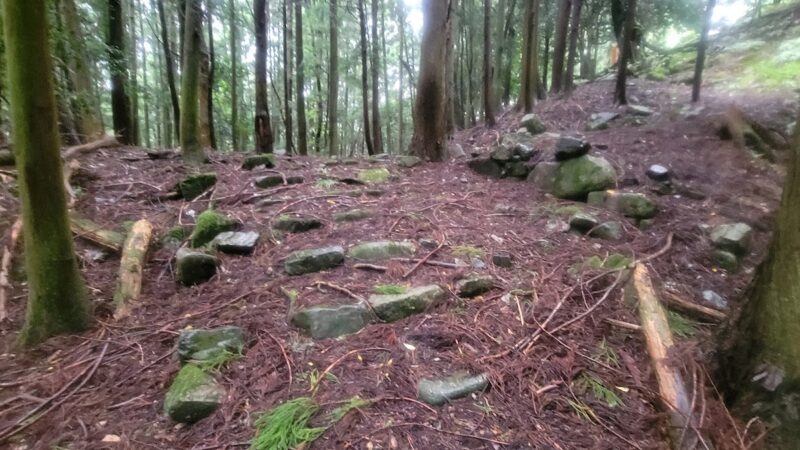
A distinctive feature of Minotsukuriyama Castle is the partially remaining stone walls. While many mountain castles in Omi Province utilize stone walls, traces of stonework can also be found at Minotsukuriyama Castle. However, these are not large-scale stone walls like those at Kannonji Castle, but rather only localized defensive reinforcements.
Earthworks also remain in some areas, suggesting that the edges of the enclosures were surrounded by earthworks to enhance defensive capabilities. The combination of stone walls and earthen ramparts in the defensive structure is typical of mountain castles from the mid-16th century.
Vertical Moats and Defensive Structures
Traces of vertical moats remain on the mountain slopes. Vertical moats are defensive structures designed to prevent lateral movement of the enemy and limit their attack routes. Multiple vertical moats have been identified at Minotsukuriyama Castle, indicating that measures were taken to defend the route from the foot of the mountain to the main enclosure.
While the clear remains of the castle’s entrance (koguchi) are difficult to discern, the main movement routes can be inferred from the arrangement of the enclosures. Overall, it is thought that the castle had a practical layout designed for short-term sieges.
Arrangement of Enclosures
Multiple enclosures were arranged around the main enclosure. As a mountain castle at an elevation of 325 meters (a relative height of approximately 210 meters), it is possible that defensive strongholds were established not only on the summit but also along the ridges and mid-slope.
While the remaining structures that can be confirmed today are limited, it is presumed that the castle reflected the Rokkaku clan’s castle-building philosophy of fortifying the entire mountain. Minotsukuriyama Castle functioned as part of a defensive line linked to Kannonji Castle.
Highlights of Minotsukuriyama Castle
Existing Remains
The main highlights when visiting Minotsukuriyama Castle are as follows:
Traces of Stone Walls: The partially remaining stonework is a valuable relic demonstrating the stone wall culture of Omi Province. Although many sections have collapsed, it offers a glimpse into the technology of the time.
Earthworks: The earthworks remaining around the baileys demonstrate the basic form of defensive structures. Although low in height, clearly artificial construction can be observed.
Vertical Moats: The vertical moats carved into the slopes are important relics for understanding the defensive system of mountain castles. A defensive line composed of multiple vertical moats can be observed.
Terraced Structures (Enclosures): The terraced terrain around the main enclosure is the remains of enclosures. Although altered by the construction of a transmission tower, the basic structure remains.
Importance of Views and Location
From the mountaintop, you can enjoy a panoramic view of the Omi Basin, overlooking Kannonji Castle and the Nakasendo Road. This view speaks to why Minotsukuriyama Castle was chosen as a strategic stronghold. On a clear day, you can see Lake Biwa and even as far as Mount Hiei, giving you a real sense of its function as a lookout post in those days.
Relationship with Surrounding Castles
When visiting Minotsukuriyama Castle, understanding its relationship with surrounding castles will allow you to enjoy history more deeply. While Kannonji Castle ruins are not within walking distance, they are important for understanding the castle system of the same Rokkaku clan. Wadayama Castle was also a subsidiary castle that played a role in the defense of Kannonji Castle, and examining the relative positions of the three castles on a map will help you understand the Rokkaku clan’s defensive plan.
Access and Visiting Information
Location
Address: Gokasho Yamamoto-cho, Higashiomi City, Shiga Prefecture
Transportation Access
Public Transportation:
- Approximately 15 minutes by car from JR Biwako Line “Notogawa Station”
- Approximately 10 minutes by car from Omi Railway “Gokasho Station”
Car:
- Approximately 15 minutes from Meishin Expressway “Yokaichi IC”
- Accessible from National Route 8
Parking Information
There is no dedicated parking lot near the trailhead to Minotsukuriyama Castle. You will need to use the parking lot at Tarobo Shrine or a nearby public parking lot. There is also a route that starts from near Kifune Shrine, but it is recommended to check a map beforehand.
Ascent Routes
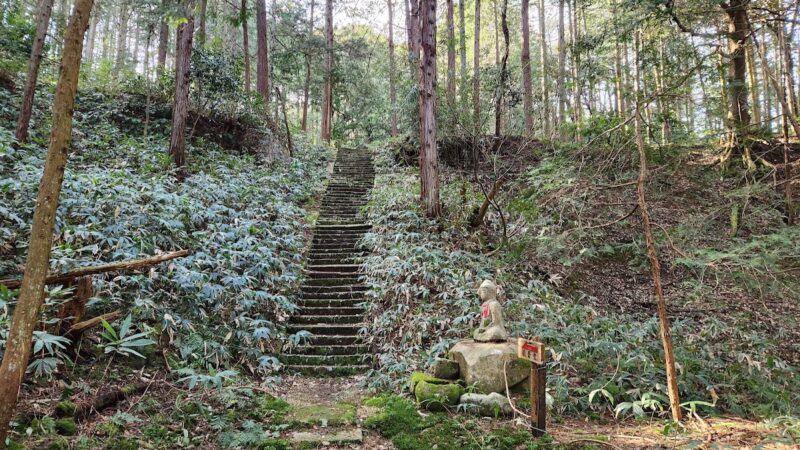
There are several routes to ascend Minotsukuriyama Castle:
- Tarobo Shrine Route: A route that follows the ridge from Tarobo Shrine towards Shimizu-yama. It is relatively well-maintained, but the distance is considerable. 2. Kifune Shrine Route: This route starts directly from Kifune Shrine and leads to the summit. It’s somewhat steep, but it’s the shortest route.
- Yamamoto-cho Route: This route starts from the Gokasho Yamamoto-cho side. We recommend checking the route with a local resident.
All routes require hiking gear. The elevation difference is approximately 210 meters, and the estimated time is 40 minutes to 1 hour one way.
Points to Note When Visiting
- Hiking Gear: As this is a mountain castle, basic equipment such as hiking boots, drinking water, and a towel is necessary.
- Season: In summer, take precautions against insects; in winter, be aware of snow and ice.
- Protection of Historical Structures: The stone walls and earthworks are valuable cultural assets. Please be careful not to trample them.
- Bear and Wild Boar Precautions: There is a possibility of encountering wild animals in the forested areas. Carrying a bell or similar device is recommended.
- Avoid solo visits: Visiting in groups is safer if possible.
Estimated Visit Time
If you plan to carefully observe the ruins from the start to the descent, allow approximately 2-3 hours. Please also consider time for photography and breaks.
Nearby Tourist Attractions
Kannonji Castle Ruins
The Kannonji Castle Ruins, the base of the Rokkaku clan, are a historical site worth visiting along with Minotsukuriyama Castle. Selected as one of Japan’s Top 100 Castles, it is a representative mountain castle of Omi Province with magnificent stone walls. Seeing its relative location to Minotsukuriyama Castle will provide a deeper understanding of the Rokkaku clan’s defensive strategy.
Tarobo Shrine (Aga Shrine)
This ancient shrine, located in part of the Minotsukuriyama mountain range, is revered as a god of victory. The shrine, characterized by its massive rocks, is a good spot to visit for praying for safety during your climb.
The Townscape of Gokasho Kondo
The Gokasho Kondo district, designated as an Important Preservation District for Groups of Traditional Buildings, is known as the birthplace of Omi merchants. You can stroll through the beautiful townscape lined with white-walled storehouses and boat-plank fences.
Eigenji Temple
The head temple of the Eigenji branch of the Rinzai school of Zen Buddhism, it is famous for its autumn foliage. Located about 20 minutes by car from Minotsukuriyama Castle, you can enjoy the beauty of nature throughout the seasons.
Cultural Value of Minotsukuriyama Castle
Historical Significance
Minotsukuriyama Castle was the site of a crucial battle in Oda Nobunaga’s unification of Japan. The battle of 1568 (Eiroku 11) was a vital military action in Nobunaga’s process of marching to Kyoto and installing Ashikaga Yoshiaki as shogun. This battle marked a turning point, leading to the downfall of the Rokkaku clan, a powerful daimyo of Omi Province, and the establishment of the foundation for the Oda regime.
Archaeological Value
In the study of mountain castles in the Omi region, Minotsukuriyama Castle is a valuable example of mid-16th century castle construction techniques. The combination of defensive structures such as stone walls, earthworks, and vertical moats represents the standard structure of mountain castles from this period. It also occupies an important position in comparative studies with Kannonji Castle.
Preservation Status and Challenges
Although altered by the construction of transmission towers and other factors, the basic remains are preserved. However, detailed excavation surveys have not been conducted, and the full extent of the castle has not been fully revealed. Further discoveries are expected through future research.
Points for Enjoying Minotsukuriyama Castle
Pre-Visit Study
Learning about the history of the Rokkaku clan and the Battle of Kannonji Castle before your visit will deepen your understanding at the site. Knowing the role of Minotsukuriyama Castle in Oda Nobunaga’s campaign to march on Kyoto will particularly change how you view the remains.
Using Maps and Compasses
For exploring mountain castles, a detailed topographic map and compass are very useful. While smartphone GPS apps are effective, carry a paper map as signal may be unavailable.
Photography Tips
For photographing stone walls and earthworks, early morning or evening when oblique light falls is ideal. The shadows emphasize the contours of the remains, resulting in three-dimensional photographs. Don’t forget to take photos of the view from the mountaintop.
Enjoying the Seasons
Spring: Climbing the castle amidst the fresh greenery is refreshing. However, this is also a time when insects increase.
Summer: Visiting in the cool early morning hours is recommended. Be sure to stay well-hydrated.
Autumn: The autumn foliage is beautiful, making it an ideal season for hiking. However, fallen leaves can sometimes obscure the view of the remains.
Winter: The air is clear, offering excellent views. Be careful of snow and ice.
Minotsukuriyama Castle and the End of the Rokkaku Clan
The fall of Minotsukuriyama Castle marked the de facto end of the Rokkaku clan, a prestigious family in Omi Province. The glory of the Rokkaku clan as a Sengoku daimyo, which had continued under Rokkaku Sadayori and Rokkaku Yoshikata, crumbled before the rise of Oda Nobunaga, the conqueror of a new era.
Rokkaku Yoshikata and his son Yoshisuke continued to resist after fleeing to Koga, but they were unable to regain their former power. The collapse of the Kannonji Castle system paved the way for Omi Province to become a direct territory of the Oda clan, and later the Toyotomi clan.
Although Minotsukuriyama Castle was abandoned after a short period of use, its historical role is significant. As a castle symbolizing a major turning point in history, from the Sengoku period to the Oda-Toyotomi regime, it continues to quietly tell its story.
Summary
Minotsukuriyama Castle was a mountain castle of the Rokkaku clan, built on the summit of Mt. Shimizu in Higashiomi City, Shiga Prefecture. Mitsukuriyama Castle played a crucial role as a subsidiary castle of Kannonji Castle and was the site of fierce battles during Oda Nobunaga’s campaign to march on Kyoto in 1568.
Even today, remnants such as stone walls, earthworks, and vertical moats remain on the mountaintop, conveying the appearance of a Sengoku period mountain castle. Although altered by the construction of a transmission tower, the basic layout can still be confirmed, making it a historical site worth visiting for castle enthusiasts.
While hiking gear is required for access, the view from the summit is magnificent, offering a panoramic view of the Omi Basin. There are many other attractions nearby, including the ruins of Kannonji Castle, Tarobo Shrine, and the townscape of Gokasho Kondo, making for a day of historical exploration.
Minotsukuriyama Castle played a vital role in Oda Nobunaga’s path to unifying Japan. Why not visit its remains and reflect on the Sengoku period of over 450 years ago?