Saso Castle (Higashiomi City, Shiga Prefecture) Complete Guide | The Rokkaku Clan’s Branch Castle with Remaining High Stone Walls and the History of the Goto Clan
Located in Saso-cho, Higashiomi City, Shiga Prefecture, Saso Castle is a mountain castle built as a branch castle of the Rokkaku clan, who ruled Omi Province during the medieval period. Also known as “Sanoyama Castle” and “Saso Hiyoshi Castle,” this castle is characterized by its remaining high stone walls and is highly regarded by castle enthusiasts. This article provides a detailed explanation of Saso Castle’s history, structure, highlights, and access methods.
Basic Information on Saso Castle
Saso Castle is a mountain castle located in Saso-cho, Higashiomi City, Shiga Prefecture, built on the tip of a ridge approximately 250 meters above sea level. Situated on a ridge extending north from Mt. Kinugasa, where the Rokkaku clan’s main castle, Kannonji Castle, was located, it played a part in the Rokkaku clan’s branch castle network.
Location: 521-1215 Shiga Prefecture, Higashiomi City, Saso-cho
Castle Classification: Mountain Castle
Construction Period: Sengoku period (16th century)
Lord: Goto clan
Remains: Enclosures, high stone walls, moats
Designated Cultural Property: None
History of Saso Castle and its Lord, the Goto Clan
The Rokkaku Clan and the Rule of Omi
During the Sengoku period, the Rokkaku clan, a powerful daimyo family, ruled the southern and eastern parts of Omi Province (present-day Shiga Prefecture). The Rokkaku clan was based at Kannonji Castle and controlled many local lords from the Konan to Koto regions. Saso Castle, as a branch castle of the Rokkaku clan, was an important base forming a defensive line from Mt. Suzuka northward.
The Rise and Power of the Goto Clan
The lord of Saso Castle is said to have been the Goto clan. The Goto clan was one of the powerful local lords who served the Rokkaku clan, but they gradually expanded their own influence, eventually becoming as powerful as the Rokkaku clan. This expansion of power would drastically change the fate of the Goto clan.
The Assassination of Goto Katatoyo and His Son
In 1563 (Eiroku 6), Rokkaku Yoshikata and his son Yoshiharu, fearing the power of the Goto clan, assassinated Goto Katatoyo and his son. This incident, also known as the “Kannonji Incident,” caused great unrest among the Rokkaku clan’s retainers.
As a result of this assassination, many retainers defected from the Rokkaku clan, and the Rokkaku clan’s power rapidly declined. It is believed that Sasō Castle also lost its role around this time.
Oda Nobunaga’s Invasion of Omi Province and the Fall of Sasō Castle
In 1568 (Eiroku 11), when Oda Nobunaga marched to Kyoto with Ashikaga Yoshiaki, he invaded Omi Province. The Rokkaku clan, already weakened, was unable to resist, and Kannonji Castle fell. It is presumed that the Rokkaku clan’s subsidiary castles, including Sasō Castle, were also abandoned around this time.
The Layout and Structure of Sasō Castle
Single-Enclosure Castle Structure
Sasō Castle is a relatively small, single-enclosure mountain castle. Built on the tip of a ridge extending north from Mt. Suzuka, it has a simple structure centered around the main enclosure. However, despite its small size, it employs advanced castle-building techniques.
The Arrangement and Size of the Main Enclosure
The main enclosure is roughly rectangular in shape, approximately 30 meters east-west and 20 meters north-south, and serves as the central defensive base of the castle. Traces of earthworks can be seen around the main enclosure, indicating measures taken to enhance its defensive capabilities.
Defensive Line by Moat
A moat was constructed on the south side, which is connected to the ridge, serving to prevent enemy intrusion. This moat clearly separated the castle grounds from the outside.
Sasō Castle’s Greatest Highlight: High Stone Walls
Orderly Stone Walls on the South Side
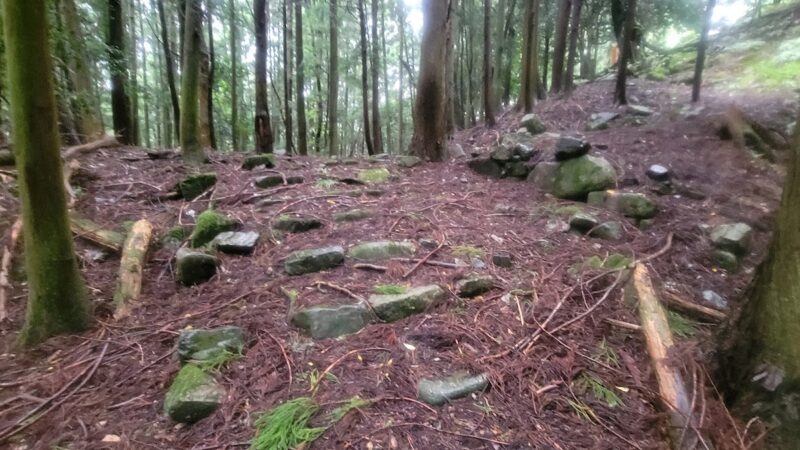
The most distinctive feature of Sasō Castle is the high stone wall remaining on the south side of the main enclosure. The stone wall, constructed by stacking large stones, is neatly arranged, making it a very rare structure for a medieval mountain castle. These stone walls reach a height of approximately 3-4 meters, demonstrating the high level of technology at the time.
The Technique of San-gi-zumi (a type of stone masonry)
Of particular note is the stone wall at the southwest corner of the main enclosure. This section extends slightly southward, creating a structure for flanking fire, and employs an advanced stone masonry technique called San-gi-zumi. The Sanuki-zumi technique, which involves joining the corners of stone walls at right angles, is a technique that developed after the Azuchi-Momoyama period.
The Sanuki-zumi at Sasō Castle provides valuable evidence that this technique was introduced to the Ōmi region early on. It indicates that advanced castle construction techniques were used under the rule of the Rokkaku clan.
Yokoya-gakari Defensive Structure
The protruding section at the southwest corner implements a defensive technique called Yokoya-gakari. This structure allows for attacks on enemy soldiers advancing along the castle wall from the flank, significantly improving defensive efficiency. The adoption of such advanced defensive techniques, despite the castle’s small size, demonstrates its importance.
Current Status and Preservation of Sasō Castle
Preservation Status of Remains
The Sasō Castle site is currently a forest, but the main enclosure and stone walls are preserved in relatively good condition. The high stone walls, in particular, show little collapse and retain much of their original appearance. However, it has not been designated a cultural property, and preservation management is not entirely adequate.
Conditions of the Ascent Route
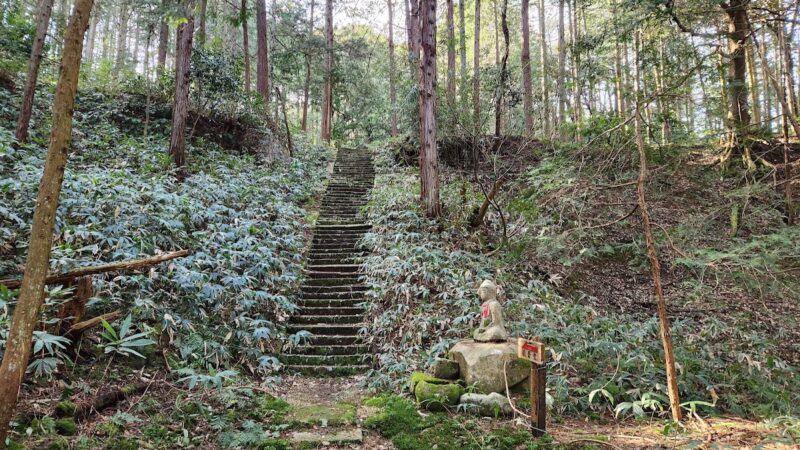
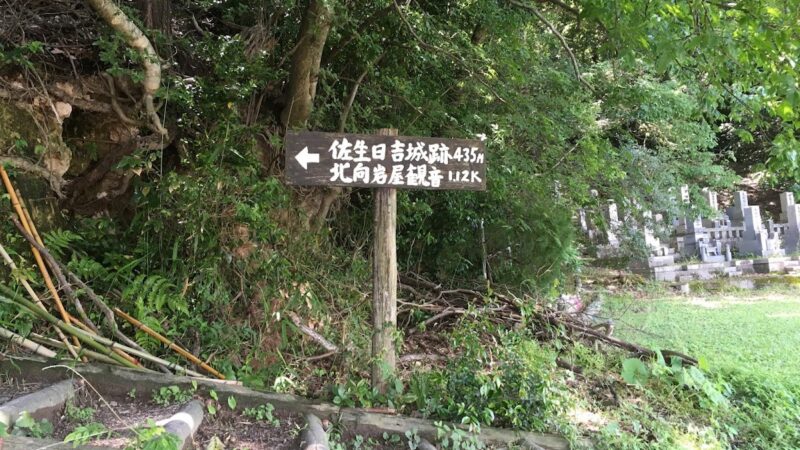
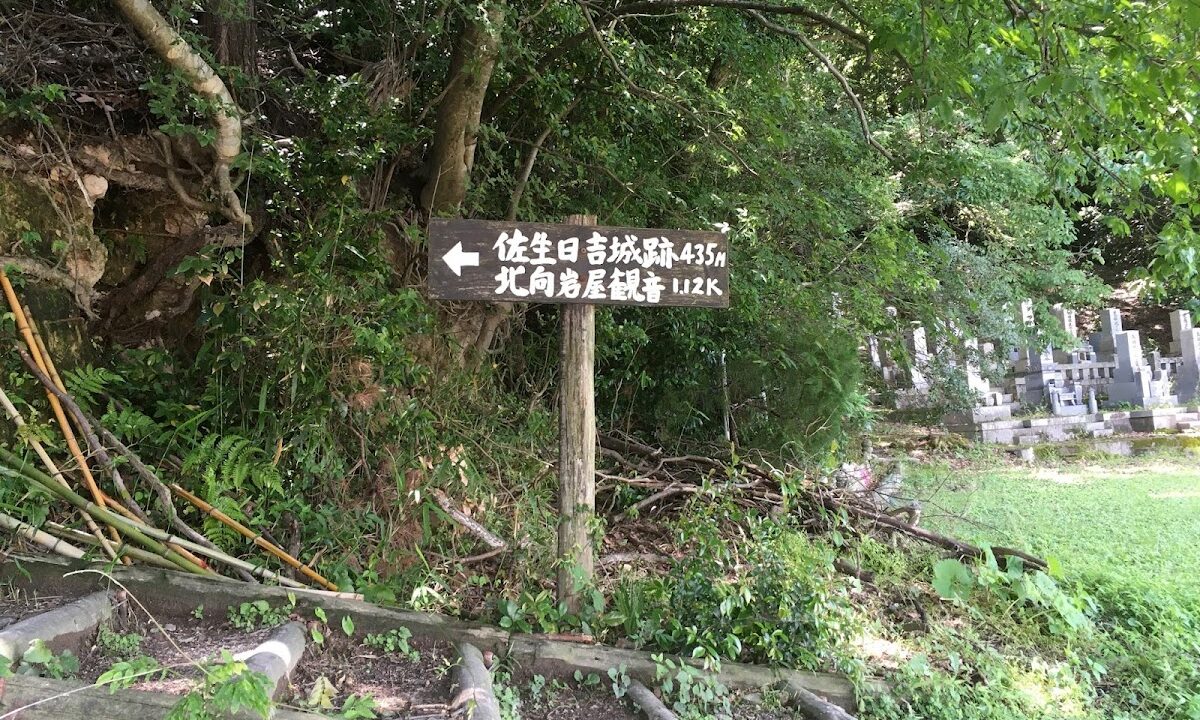
To reach the castle ruins, you need to climb a mountain path. The ascent route is an unpaved natural trail, and the time required from the base is approximately 15-20 minutes. It becomes slippery after rain, so appropriate equipment and caution are necessary when climbing.
How to Access Sasō Castle
Access by Public Transportation
Nearest Station: JR Biwako Line “Notogawa Station”
- Approximately 15 minutes by taxi from Notogawa Station
- It is also possible to use the Ōmi Railway bus from Notogawa Station (bound for Sasō Town)
Public transportation access is not convenient, so using a rental car or taxi is recommended.
Access by Car
From Meishin Expressway “Yokaichi IC”:
- Approximately 20 minutes via National Route 421
- Parking space available in Saso Town (undeveloped)
From Meishin Expressway “Hikone IC”:
- Approximately 30 minutes via National Route 8 and prefectural roads
Parking Information
There is no dedicated parking lot for Saso Castle Ruins. Parking will be available on the roadside in Saso Town, but consideration should be given to avoiding inconvenience to local residents. There are also reservation-only parking lots (“TokP”) around Saso Town; it is recommended to check in advance.
Tourist Attractions Around Saso Castle
Kannonji Castle Ruins
Kannonji Castle, the main castle of Saso Castle, is a massive mountain castle counted as one of Japan’s five greatest mountain castles. It flourished as the base of the Rokkaku clan, and magnificent remains such as stone walls and baileys remain. Visiting it together with Saso Castle will provide a better understanding of the Rokkaku clan’s castle system.
Location: Azuchi-cho, Omihachiman City, Shiga Prefecture
Access: Approximately 15 minutes by car from Saso Castle
Azuchi Castle Ruins
The ruins of Azuchi Castle, a magnificent fortress built by Oda Nobunaga, are located close to Saso Castle. The view of Lake Biwa from the castle tower ruins is spectacular, allowing you to feel Nobunaga’s ambition.
Location: Shimotoyoura, Azuchi-cho, Omihachiman City, Shiga Prefecture
Access: Approximately 20 minutes by car from Saso Castle
Tarobo Shrine (Aga Shrine)
This shrine is located on the mountainside of Tarobo Mountain and is famous for its approach path that passes through giant rocks. From the mountaintop, you can enjoy a panoramic view of Higashiomi City, which is also helpful for understanding the location of Saso Castle.
Location: Kowaki-cho, Higashiomi City, Shiga Prefecture
Access: Approximately 10 minutes by car from Saso Castle
Higashiomi City Historical Museums
Higashiomi City has several historical museums where you can learn about the local history and culture. Some museums may also display materials related to Saso Castle and the Goto clan.
Points to Note and Manners When Visiting Saso Castle
Equipment for Climbing the Castle
- Hiking Boots or Athletic Shoes: Non-slip shoes are essential as you will be walking on mountain paths.
- Long-sleeved Shirt and Long Pants: To protect yourself from bushes and insects.
- Gloves: Useful for gripping rocks and tree branches.
- Drinking Water: Especially important in summer to prevent heatstroke.
- Flashlight: Some areas in the forest are dark.
Manners When Visiting
- Consideration for Private Property: The area around the castle ruins may be private property. Please obey any signs indicating “No Entry”
- Take Your Trash Home: To protect the natural environment, please be sure to take your trash home with you.
- Protection of Historical Structures: Please be careful not to climb on the stone walls or damage the historical structures.
- No Open Fires: To prevent forest fires, please absolutely avoid using open flames.
- Consideration for Local Residents: Please be mindful not to cause inconvenience to local residents through noise, illegal parking, etc.
Best Time to Visit
- Spring (March-May): Beautiful fresh greenery and mild weather
- Autumn (October-November): Enjoy the autumn foliage and fewer insects
- Times to Avoid: Mid-summer (risk of heatstroke), rainy season (slippery), snowy season
Evaluation of Sasō Castle and its Value as a Fortress
Rating on Kojodan
On the castle information website “Kojodan,” Sasō Castle has an average rating of ★★★☆☆ (3.19), with an average visit time of 43 minutes. The number of visitors is 163 (ranked 741st), indicating a certain level of popularity despite being a relatively minor castle.
Importance in Castle Research
Sasō Castle is a small mountain castle, but it holds significant value in castle research for the following reasons:
- Presence of High Stone Walls: High stone walls are rare among medieval mountain castles, making this a valuable historical site.
- Sanuki-zumi (stacked stonework) Technique: Evidence of the development of stonework techniques in the Ōmi region.
- Typical Example of a Rokkaku Clan Branch Castle: Important for understanding the Rokkaku clan’s castle network.
- History of the Gotō Clan: A historical site that tells the story of the rise and fall of local lords during the Sengoku period.
Sasō Castle and the Rokkaku Clan’s Branch Castle Network
Defense System Centered on Mt. Suzuka
The Rokkaku clan centered Kannonji Castle and positioned many branch castles in the surrounding mountains. Sasō Castle is believed to have served as an important base protecting the northern part of Mt. Suzuka, and was thought to have been in conjunction with the following castles:
- Kannonji Castle: Main castle (approximately 3 km south)
- Minotsukuri Castle: Eastern branch castle
- Wadayama Castle: Western branch castle
These branch castles cooperated with each other, communicating information through signal fires and other means to defend the territory.
Road Monitoring Function
Sasō Castle’s location was suitable for monitoring the major roads within Ōmi Province. Its position overlooking access routes to the Hokkoku Kaidō and Nakasendō roads is thought to have held significant military and economic importance.
Current Status and Challenges of Sasō Castle Research
Status of Archaeological Excavations
No full-scale archaeological excavations have been conducted at Sasō Castle. Therefore, the construction date, detailed structure, and changes in castle lords can only be inferred from historical documents and on-site remains.
Future Research Topics
- Identification of the Castle’s Construction Date: More detailed dating is needed.
- Technical Analysis of the Stone Walls: Comparative study with other castles in Omi Province.
- Detailed History of the Goto Clan: Unearthing historical documents.
- Preservation Measures for the Remains: Formulation of a preservation plan including cultural property designation.
History of Higashiomi City and Saso Town
Formation of Higashiomi City
Higashiomi City was formed in 2005 (Heisei 17) through the merger of Yokaichi City, Eigenji Town, Gokasho Town, and others. Located in the eastern part of Shiga Prefecture, it encompasses an area stretching from the eastern shore of Lake Biwa to the foot of the Suzuka Mountains.
Geography and Characteristics of Saso Town
Saso Town is a settlement located in the central part of Higashiomi City, with the postal code 521-1215. Located at the northern foot of Mt. Suzuka, the area has long been centered around agriculture. The town name “Saso” is said to be a corruption of “Sasau.”
Historical Background of the Region
The area around Saso has been inhabited since ancient times, and burial mounds and ruins have been discovered. In the Middle Ages, it came under the control of the Rokkaku clan, and Saso Castle was built. During the Edo period, it became part of the Hikone Domain and developed as an agricultural village.
Summary: The Charm of Saso Castle and the Significance of Visiting It
Saso Castle is a valuable relic of a medieval mountain castle remaining in Saso-cho, Higashiomi City, Shiga Prefecture. Although small in scale, the existing high stone walls and the technique of san-gi-zumi (a type of stonework) are of undeniable value to castle enthusiasts.
Its history as a branch castle of the Rokkaku clan, responsible for the defense of Mt. Suzuka, and as the residence of the powerful local lord Goto clan, speaks to the complex political situation of Omi during the Sengoku period. This castle site holds deep historical significance as the residence of the Goto clan, the site of the tragic Kannonji Incident.
When visiting, it is important to prepare appropriate equipment, remember to be considerate of the natural environment and local residents, and be mindful of preserving this valuable historical heritage for future generations. Visiting nearby castles such as Kannonji Castle and Azuchi Castle ruins will allow you to gain a deeper understanding of Omi Province during the Sengoku period.
Saso Castle is a hidden gem where you can experience the Omi mountain castle culture, which holds an important place in the history of Japanese castles.