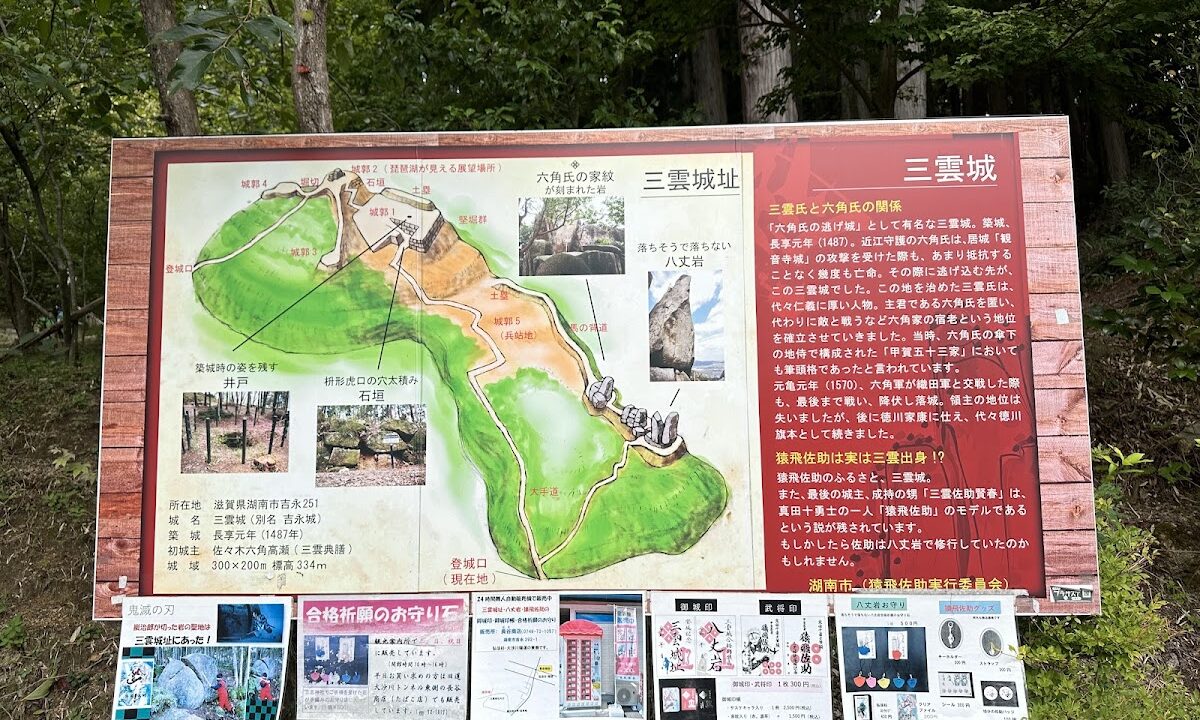
Mikumo Castle (Konan City, Shiga Prefecture) Complete Guide | Detailed Explanation of History, Remains, and Access Information
What is Mikumo Castle?
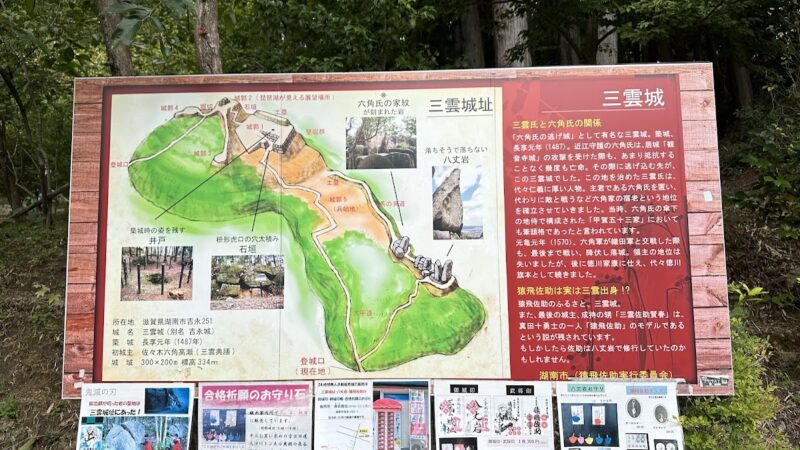
Mikumo Castle is a medieval mountain castle located in Yoshinaga, Shiroyama, Konan City, Shiga Prefecture. Built on a mountaintop at an altitude of 334 meters, this castle functioned as the residence of the Mikumo clan, important retainers of the Rokkaku clan, a powerful daimyo of Omi Province, from the late Muromachi period to the Sengoku period.
Known for the massive iwakura (sacred rock formation) known as Hachijo-iwa, which is over 8 meters tall, the castle’s excellent location overlooking the Yasugawa River played a crucial role as a strategic point for monitoring the Tokaido road. Even today, the remains of stone walls, earthworks, gates, and wells remain in good condition, making it a valuable historical site that conveys the appearance of a Sengoku period mountain castle.
Basic Information on Mikumo Castle
Location
Yoshinaga, Shiroyama, Konan City, Shiga Prefecture
Common Name/Alternate Name
Inner castle of Kannonji Castle, Mikumo Clan Castle
Castle Structure
Mountain castle
Construction Date
Said to be 1487 (Chōkyō 1)
Builder
Mikumo Tenzen (by order of Sasaki Rokkaku Takayori)
Main Lord
Mikumo Clan (one of the 53 families of Kōga)
Elevation
334 meters
Scale of Remains
Approximately 40 meters east-west x 40 meters north-south
Existing Remains
Stone walls, earthworks, gate, well, bailey, moat, etc.
Designated Cultural Property
Konan City Designated Historic Site
History of Mikumo Castle
The Castle’s Construction and the Mikumo Clan
Mikumo Castle is said to have been built in 1487 (Chōkyō 1) by Mikumo Tenzen, a senior retainer of Sasaki Rokkaku Takayori, under his orders. The Mikumo clan was a powerful local family, counted among the 53 families of Kōga, and held an important position within the Rokkaku clan’s retainers.
The Mikumo clan’s base was the Mikumo Clan Residence (Mikumo Yashiki) at the foot of the castle mountain. In peacetime, they conducted their affairs there, and in wartime, they would take refuge in Mikumo Castle on the mountaintop, a typical medieval castle structure. This dual structure is highly valued historically as a good example of the living arrangements of samurai families at the time.
Relationship with the Rokkaku Clan
Mikumo Castle is also known as the “inner castle of Kannonji Castle” and functioned as a branch castle of Kannonji Castle (Ōmihachiman City), the Rokkaku clan’s base. Located at a strategic point along the Yasugawa River, it is thought to have played a role in monitoring troops and merchants passing through the Tōkaidō road. The Rokkaku clan was a powerful daimyo family that controlled southern Omi Province during the Sengoku period, wielding influence over the Muromachi Shogunate. Records show that the Mikumo clan, as their senior retainers, played a crucial role not only militarily but also diplomatically.
Oda Nobunaga’s Invasion and the Fall of the Castle
In 1568, when Oda Nobunaga began his march to Kyoto with Ashikaga Yoshiaki, the Rokkaku clan, whose path lay in the way, attempted fierce resistance. However, Kannonji Castle fell to Nobunaga’s overwhelming military power, and Rokkaku Jōtei and his son Rokkaku Yoshisuke were forced to flee their castle.
At this time, Mikumo Castle was used as a base of refuge for the Rokkaku father and son. Its mountainous location and strong defensive structures made it suitable as a temporary refuge. However, it was ultimately attacked and fell to the Oda army, and with the end of the Sengoku period, it was abandoned. ### Mikumo Sasuke Kenharu and the Legend of Ninjutsu
An interesting legend associated with Mikumo Castle concerns Mikumo Sasuke Kenharu, who is said to be the model for Sarutobi Sasuke, one of the Sanada Ten Braves. Mikumo Sasuke Kenharu is believed to have been a member of the Mikumo clan, and a legend remains that he trained in ninjutsu at Hachijo-iwa, a rock within the castle grounds.
Hachijo-iwa has a strange shape, appearing to float above the ground, and it is said that training on this giant rock enhanced his physical abilities as a ninja. While there is little historical evidence to support this, it is an intriguing legend suggesting a connection to the Koga ninja, and it enhances the castle’s appeal.
Remains and Highlights of Mikumo Castle
Characteristics of the Stone Walls
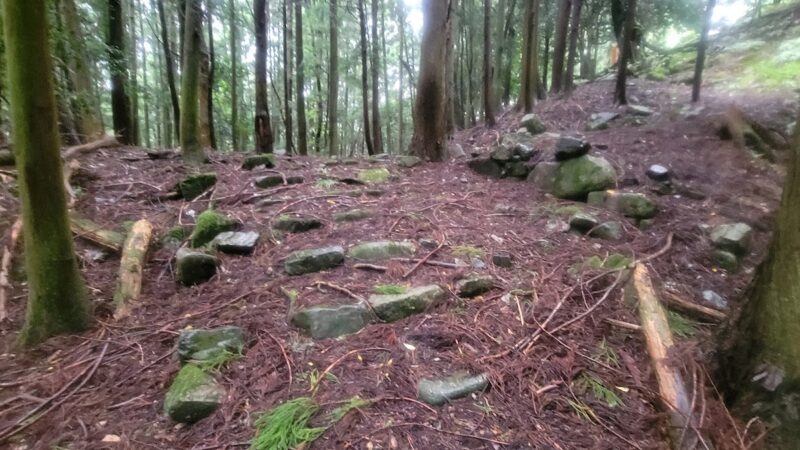
The most distinctive feature of Mikumo Castle is the extensive use of stone walls, which is unusual for a mountain castle. While many mountain castles of the Sengoku period primarily used earthen ramparts for defense, stone walls can be seen throughout Mikumo Castle.
These stone walls were constructed using a technique called “nozura-zumi,” resulting in a simple yet sturdy structure that utilizes natural stones. The stones used are granite quarried from the surrounding area. Although weathered, they are valuable historical remains that convey the castle-building techniques of the time.
In particular, the stone walls around the main enclosure remain, some reaching heights of around 2 meters, evoking the castle’s former grandeur. The existence of these stone walls is also considered evidence of the Mikumo clan’s economic power and their strong ties with the Rokkaku clan.
Hachijo-iwa (Iwakura)
The most impressive feature within the castle grounds is the massive Iwakura known as Hachijo-iwa. This colossal rock, exceeding 8 meters in height, is a natural formation, but it is also believed to have functioned as a spiritual pillar for the castle.
Iwakura are sacred rocks that have been objects of worship since ancient times, and it is highly probable that the Hachijo-iwa at Mikumo Castle existed even before the castle was built. The incorporation of this massive rock into the castle grounds during its construction suggests an intention to imbue it not merely as a military facility, but also as a sacred place.
The view from Hachijo-iwa is magnificent, offering a panoramic vista of the Yasugawa River below, the plains of Ryuo on the opposite bank, Mount Ibuki to the north, and the mountain ranges of Mount Gozaisho, Mount Kamagatake, and the Southern Suzuka Mountains to the east. This excellent view was also important for military surveillance.
Koguchi and Masugata
Mikumo Castle retains a well-preserved defensive structure called a Masugata Koguchi. A Koguchi is the entrance to a castle, and a Masugata refers to a structure where the passageway is bent at a right angle to prevent enemy intrusion.
This Masugata Koguchi is constructed by combining stone walls and earthworks, designed to lure invading enemies into a narrow space and allow for attacks from above. It is a remarkable example of the advanced castle-building techniques of the Sengoku period and is attracting attention from castle researchers.
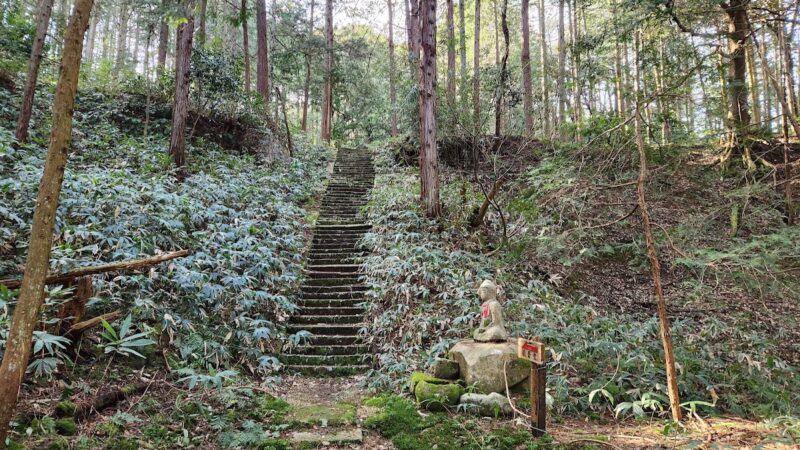
A bamboo grove surrounds the entrance, preserving a landscape that evokes the atmosphere of yesteryear.
Earthworks and Enclosures
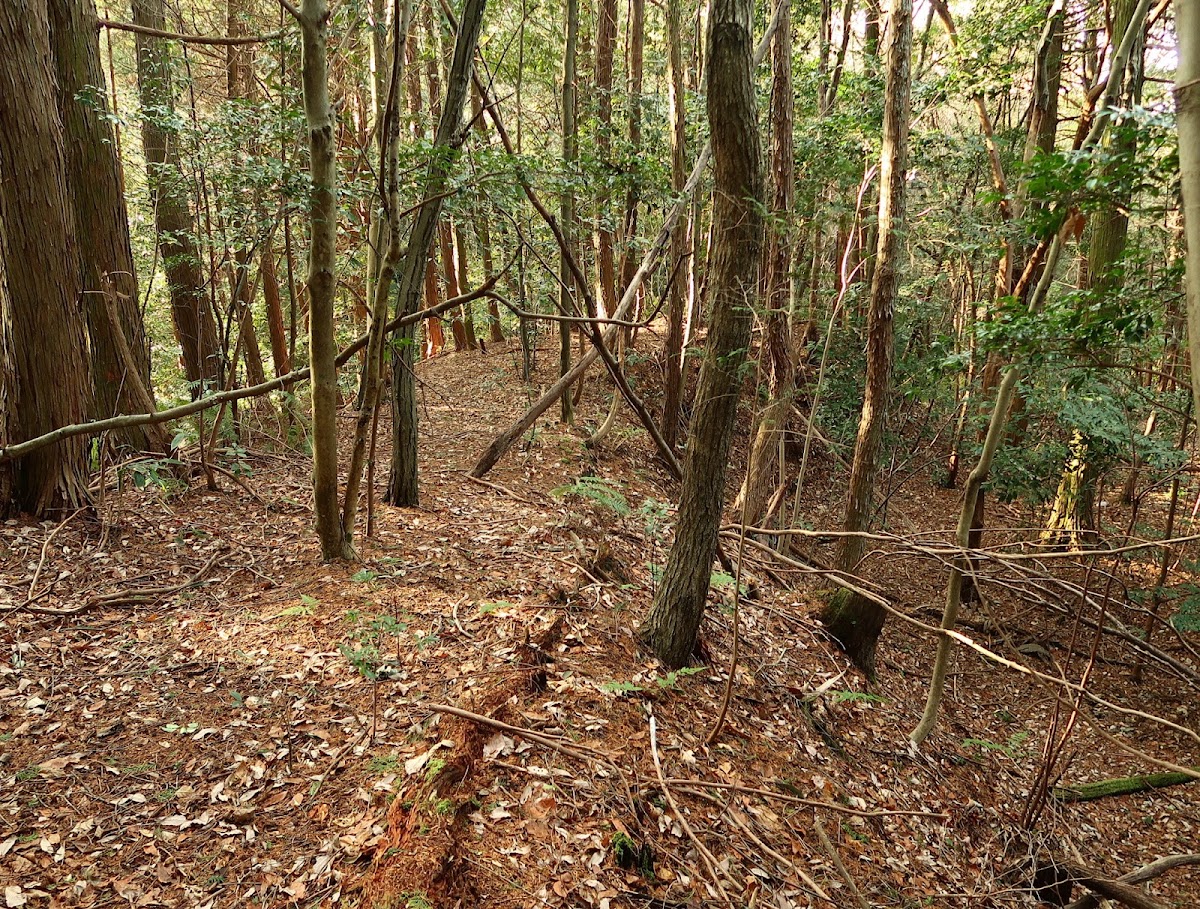
The castle features multiple enclosures (kuruwa, flat areas), each separated by earthworks. The main enclosure is at the center, with the second and third enclosures arranged in a stepped pattern, forming a defensive line utilizing the elevation difference.
The earthworks are mostly 1-2 meters high, and some are constructed in combination with stone walls. It is presumed that fences or walls were built on top of the earthworks, serving to physically hinder enemy intrusion.
Well Remains
Well remains have been confirmed within the castle grounds, demonstrating ingenuity in securing a water source in preparation for a siege. Securing water was one of the most crucial issues in a mountain castle, and the presence of wells indicates that the castle had facilities capable of withstanding a prolonged siege.
Although parts are now filled in, the location and structure of the wells provide clues to the daily life within the castle.
Moats and Vertical Moats
Moats (horikiri) are constructed along the ridge, a clever design to block enemy incursions. Vertical moats (tatebori) are also visible on the slopes, providing protection against attacks from the sides.
These defensive structures are highly regarded as a testament to the sophisticated castle-building techniques of the Sengoku period, skillfully utilizing the mountainous terrain.
Access to Mikumo Castle
Using Public Transportation
Nearest Station
JR Kusatsu Line “Mikumo Station”
Access from the Station
- Walking: Approximately 60 minutes (approximately 4 kilometers)
- Taxi: Approximately 10 minutes
Walking from Mikumo Station is quite a distance, so plan accordingly. Taking a taxi is a more practical option.
By Car
Nearest Interchange
- Approximately 20 minutes from the Meishin Expressway “Ritto IC”
- Approximately 25 minutes from the Shin-Meishin Expressway “Koga Tsuchiyama IC”
Parking
Turn right onto the forest road just before the entrance to the Youth Nature Dojo, and drive for about 3 minutes to reach the entrance to Mikumo Castle Ruins. There are several parking spaces near the entrance. However, the forest road is narrow in places, so please drive carefully.
Car Navigation Setting
Setting “Konan City Yoshinaga Mikumo Castle Ruins” or “Youth Nature Dojo” as your destination is convenient.
Ascent Route
The trailhead is a short walk from the parking area, and from there it is about a 15-20 minute climb to the main enclosure at the summit. The trail is well-maintained, but since it is a mountain trail, the following equipment is recommended.
- Comfortable walking shoes (trekking shoes or athletic shoes)
- Drinking water
- Insect repellent spray (spring to autumn)
- Hat
- Work gloves (useful when observing stone walls, etc.)
A quick walk around the castle grounds takes about 20 minutes, but if you want to carefully observe the remains, allow about an hour.
Tourist Spots Around Mikumo Castle
Mikumo Clan Residence Ruins (Mikumo Yashiki)
At the foot of Mikumo Castle are the ruins of the Mikumo Clan Residence, which was the residence of the Mikumo clan during peacetime. Although the area is now rice paddies and residential land, some remains such as embankments can still be seen. This is an important historical site for understanding the relationship between the mountain castle and the residence.
Around the Yasugawa River
The Yasugawa River, which flows below Mikumo Castle, is a first-class river that flows into Lake Biwa, and the surrounding area maintains a rich natural environment. The cherry blossoms in spring and the autumn leaves are beautiful, making it a suitable area for a stroll.
Other Historical Sites in Konan City
Konan City is dotted with temples of high historical value, such as Choju-ji Temple and Joraku-ji Temple, both of which boast national treasure main halls. Visiting these temples in conjunction with a visit to Mikumo Castle will allow you to gain a deeper understanding of Konan City’s history.
The Charm and Highlights of Mikumo Castle
Harmony of Stone Walls and Nature
The greatest charm of Mikumo Castle is its unique landscape, where artificial stone walls harmonize with the natural giant rock, Hachijo-iwa. The space, where the castle-building techniques of the Sengoku period and ancient beliefs are fused, creates an atmosphere unlike any other mountain castle.
Stunning Views
The view from the mountaintop at an altitude of 334 meters is breathtaking. Especially from atop Hachijo-iwa, a 360-degree panorama unfolds, offering a sweeping view of the Omi Plain and the surrounding mountains. On clear days, you can even see Lake Biwa.
This magnificent view makes you realize that Mikumo Castle functioned as a surveillance base along the Tokaido road. ### Well-Preserved Remains
Despite being over 450 years having passed since the castle was abandoned, the fact that the remains such as the stone walls, earthworks, and gate are still in such good condition is remarkable. This is a testament to the success of local preservation efforts, making it a valuable historical site that conveys the appearance of a mountain castle from the Sengoku period.
Quiet Environment
Since Mikumo Castle is not a well-known tourist destination, visitors are mainly castle enthusiasts and history buffs. Therefore, you can observe the remains in a quiet environment and reflect on the Sengoku period.
Points to Note During Your Visit
Safety Precautions
- The mountain path has slippery sections, so extra caution is needed during and after rain.
- Some parts of the stone walls are at risk of collapse, so please do not get too close.
- When climbing Hachijo-iwa, please carefully check your footing.
- Be careful of bees and venomous snakes during the summer.
- Avoid visiting alone; it is recommended to visit with multiple people if possible.
Manners
- Do not damage or take anything from the ruins.
- Always take your trash with you.
- Please be careful not to damage the bamboo groves or trees.
- When passing through private land, please be considerate of the landowners.
Best Time to Visit
Mikumo Castle is accessible year-round, but the following times are especially recommended:
Spring (March-May)
The fresh greenery is beautiful, and the weather is mild, making it ideal for visiting the castle. However, insects begin to increase around Golden Week, so insect repellent is necessary.
Autumn (October-November)
The autumn foliage is beautiful, and the views are excellent. The temperature is also suitable for hiking, making it the most recommended season.
Winter (December-February)
The air is clear and the views are at their best, but climbing the castle becomes difficult when there is snow. Be sure to take thorough precautions against the cold.
Summer (June-September)
Due to the heat and the abundance of insects, it is not highly recommended. If you do visit, early morning is best.
Research and Preservation Activities of Mikumo Castle
Archaeological Surveys
Multiple archaeological surveys have been conducted at Mikumo Castle in the past, gradually revealing the castle’s structure and historical changes. Excavated artifacts have included ceramics and fragments of weapons from the late 16th century, providing clues to the time of the castle’s abandonment and the actual living conditions within the castle.
Local Preservation Activities
The city of Konan and local history enthusiast groups continue their activities toward the preservation and utilization of Mikumo Castle. Regular mowing, trail maintenance, and signpost installation ensure a safe environment for visitors.
Future Challenges
Many challenges remain, including preventing the collapse of stone walls, managing bamboo groves, and conducting more detailed academic research. Continuous preservation activities and research are essential to passing on this valuable cultural asset to future generations.
Summary
Mikumo Castle, located in Konan City, Shiga Prefecture, is a valuable historical site with unique features such as stone walls and Hachijo-iwa rock, representing a mountain castle from the Sengoku period. Its history, from its prosperity as the residence of the Mikumo clan, a senior retainer of the Rokkaku clan, to its fall during Oda Nobunaga’s invasion, provides important evidence of the situation in Omi Province during the Sengoku period.
The view from the 334-meter-high summit is magnificent, and the well-preserved remains of stone walls, earthworks, gates, and wells make it a recommended spot not only for castle enthusiasts but also for history buffs and hikers.
While access is somewhat inconvenient, this allows you to experience the atmosphere of yesteryear in a quiet environment. When touring the Sengoku period historical sites of Shiga Prefecture, be sure to visit Mikumo Castle and experience the history of the Rokkaku and Mikumo clans, as well as the charm of a Sengoku period mountain castle.
When visiting, please take sufficient precautions for safety, treat the remains with care, and enjoy this valuable cultural asset.