The Complete Picture of Mizuguki Okayama Castle: A Thorough Explanation of its History, Remains, and Highlights [Omihachiman City, Shiga Prefecture]
Mizuguki Okayama Castle is a historical mountain castle located in Maki-cho, Omihachiman City, Shiga Prefecture. Built on the summit of Okayama (elevation 187.7m), which juts out into the inner lake of Lake Biwa, it was once known as the “castle floating on Lake Biwa.” This article provides a comprehensive explanation of the castle’s detailed history, remains, and highlights.
Basic Information on Mizuguki Okayama Castle
Location and Former Province Name
Mizuguki Okayama Castle is located in Maki-cho, Omihachiman City, Shiga Prefecture, and belonged to the former province of Omi. It is located approximately 5.5km west of Omihachiman Station on the JR Tokaido Main Line, and is currently accessible by taking the Omi Railway/Kokoku Bus to the “Maki-cho Nishiguchi” bus stop, followed by an approximately 18-minute walk. ### Common Names and Alternate Names
This castle is known by several names:
- Okayama Castle
- Oyama Castle
- Kunori Castle
- Suikeikan
These alternative names originate from the place name Okayama where the castle was built, and the name of the Kunori clan, who were the castle’s lords.
Classification and Structure
Suikei Okayama Castle is classified as a typical mountain castle. Built on the summit of Okayama (Oyama) at an altitude of 188m, the remains are spread out along the ridge in an east-west direction. Before the reclamation of Lake Suikei, the area was almost entirely surrounded by Lake Biwa and its inland lake, truly presenting the appearance of a “floating castle in the lake.”
Regarding the castle tower structure, unlike mountain castles of this era, there was no main tower. It was characterized by a group of baileys centered around the main enclosure, earthworks, and defensive structures using steep slopes. ### Builder and Construction Period
There are various theories regarding the builder, but it is generally believed to have been built by the Sasaki clan (Rokkaku clan) during the Nanboku-cho period. It is thought that the Sasaki clan, who ruled southern Omi Province, built the castle for the purpose of guarding Lake Biwa’s waterways and monitoring lake traffic.
However, it only appears clearly in historical documents as the castle of the local lord, the Kuri clan. Some theories suggest that the actual full-scale construction took place around 1508 (Eisho 5), when Ashikaga Yoshizumi, the 11th Shogun of the Muromachi Shogunate, entered the castle.
Overview
Mizukuki Okayama Castle was strategically located, controlling Lake Biwa’s waterways and key points in Omi Province. Built on Okayama, a hill jutting out into the inland lake facing Lake Biwa, west of Hachimanyama, this mountain castle played a crucial role in monitoring Lake Biwa’s waterways and serving as a defensive base for southern Omi Province.
The castle’s location is highly distinctive. Before the reclamation of the Mizukuki Inland Lake, the castle was a natural stronghold surrounded by the lake. This geographical advantage made attacks from land difficult, and at the same time, it was ideally positioned to control water transport on Lake Biwa.
Currently, like Azuchi Castle, the inland lake has been reclaimed, and the picturesque scenery of the time has been lost. However, the castle ruins allow us to imagine its relationship with Lake Biwa in its heyday. Remaining structures such as earthworks, stone walls, and steep cliffs clearly demonstrate the characteristics of a medieval mountain castle.
History
From the Nanboku-cho period to the early Muromachi period
There is a lack of reliable historical records regarding the founding date of Mizukuki Okayama Castle. There is a tradition that it was built by the Sasaki clan (Rokkaku clan) during the Nanboku-cho period. During this period, Omi Province was a crucial battlefield where the forces of the Southern and Northern Courts were evenly matched, and controlling water transport on Lake Biwa was militarily extremely important.
The Sasaki clan, as a powerful daimyo (feudal lord) of Omi Province, established a system of water defense by placing multiple branch castles around Lake Biwa. It is believed that Mizukuki Okayama Castle was built as part of this system.
The Kuri Clan Era
From the mid-Muromachi period onward, Mizukuki Okayama Castle became the residence of the local lord, the Kuri clan. The Kuri clan ruled this region as vassals of the Rokkaku clan. While it is unclear when the Kuri clan became the castle lords, it is believed that the castle was definitely under their control by the latter half of the 15th century.
The Kuri clan, as a powerful local lord, managed water transport on Lake Biwa and governed the surrounding areas. It is presumed that the castle during this period functioned not only as a military base but also as a center of regional governance.
Ashikaga Yoshizumi’s Exile and Stay
Mizukuki Okayama Castle first appears on the historical stage in Eisho 5 (1508). In this year, Ashikaga Yoshizumi, the 11th Shogun of the Muromachi Shogunate, fled Kyoto upon receiving news that his predecessor, Ashikaga Yoshitane (Yoshizumi/Yoshitada), was marching to the capital with the forces of Ouchi Yoshioki.
Yoshizumi traveled through Kutsuki Valley and sought refuge with Kuri Nobutaka, a lord of a castle under the Rokkaku clan, at Mizukuki Okayama Castle. Kuri Nobutaka provided the Shogun with generous protection and the castle. It is believed that Mizukuki Okayama Castle functioned as a de facto provisional shogunate during this period.
Ashikaga Yoshizumi hoped to regain the position of Shogun and sought an opportunity to return to Kyoto from Omi Province, but his wish was not fulfilled. Yoshizumi died of illness at Mizukuki Okayama Castle in 1511, at the young age of 32. This event, where a Shogun ended his life in a provincial mountain castle, symbolized the decline of the Muromachi Shogunate.
During Ashikaga Yoshizumi’s stay, it is highly probable that large-scale renovations and expansions of the castle took place, and many of the remains visible today are thought to have been constructed during this period.
The Sengoku Period and the Fall of the Castle
After Ashikaga Yoshizumi’s death, Mizukuki Okayama Castle once again functioned as the residence of the Kuri clan. However, amidst the turmoil of the Sengoku period, the castle’s fate was greatly altered.
From the mid-to-late 16th century, the power of the Rokkaku clan declined in Omi Province, and the situation changed dramatically with the rise of Oda Nobunaga. Mizukuki Okayama Castle was also caught up in the turbulent times of the Sengoku period and is believed to have eventually fallen, but historical records are limited regarding the specific time and circumstances of its fall, and many details remain unclear.
One theory suggests that the castle was abandoned during Oda Nobunaga’s invasion of Omi, or that it lost its function when Toyotomi Hideyoshi unified Omi. In any case, it is believed that the castle ceased to function as a castle by the end of the Sengoku period.
Details of the Remains
Layout and Enclosure Arrangement
The layout of Mizukuki Okayama Castle is centered on the summit of Okayama Mountain, extending along the east-west ridge. It has the typical structure of a mountain castle, with the main enclosure located at the highest point, surrounded by multiple enclosures arranged in stages.
The main enclosure is a relatively large, flat area, presumably where the lord’s residence and important facilities were located. Earthen ramparts surround the main enclosure, enhancing its defensive capabilities.
Earthen Ramparts and Cut Slopes
Earthen ramparts remain in good condition in various parts of the castle. These ramparts are defensive structures built by piling up earth, serving to prevent enemy intrusion and clearly define the boundaries of the enclosures. The ramparts around the main enclosure are particularly high, demonstrating the advanced castle-building techniques of the time.
Furthermore, cut slopes are provided at the edges of the enclosures. Cut slopes are artificially cut to make the slopes steeper, serving as defensive structures to make ascent difficult for enemies. The cliffs of Mizukuki Okayama Castle remain clearly visible, making them valuable remains for understanding the defensive structure of medieval mountain castles.
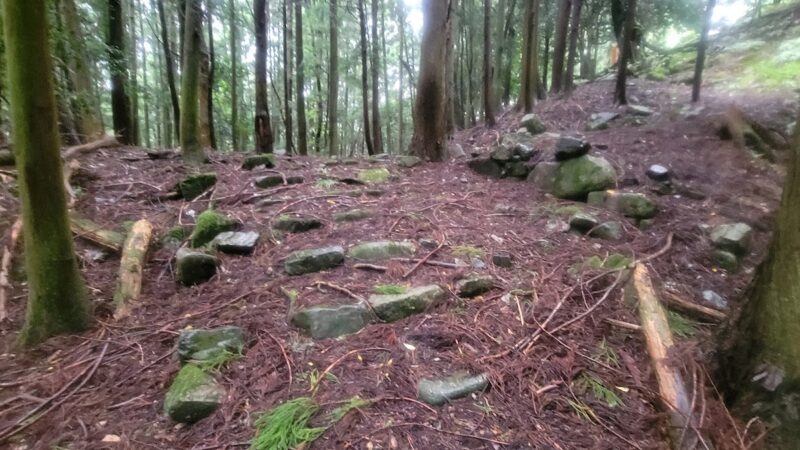
Traces of Stone Walls
Partial traces of stone walls have also been confirmed at Mizukuki Okayama Castle. The use of stone walls is relatively early for a medieval mountain castle, and this may be related to renovations during Ashikaga Yoshizumi’s stay.
The stone walls were mainly used around the main enclosure and at important entrances (koguchi), and it is thought that they served to enhance the castle’s status and strengthen its defenses. However, they are not large-scale stone walls like those of early modern castles, but rather small-scale structures built using the nozura-zumi (rough-stone masonry) method.
Moats and Vertical Moats
Traces of moats that divide the ridgeline and vertical moats dug vertically into the slope have also been confirmed. These were facilities designed to limit enemy invasion routes and make defenses more effective. In particular, clear moats were constructed along the east-west ridgeline, clearly defining the castle area.
Highlights of Mizukuki Okayama Castle
Views of Lake Biwa
From the castle ruins, you can enjoy beautiful views of Lake Biwa. The current landscape helps to understand why the castle was once called a “floating castle in the lake.” On a clear day, you can see the mountains on the opposite shore, allowing you to imagine the view seen by the castle’s lords of the time.
Well-Preserved Remains
The remains, such as earthworks, cliffs, and stone walls, are preserved in relatively good condition, making it a valuable historical site for understanding the structure of a medieval mountain castle. The earthworks around the main enclosure, in particular, remain clearly visible, allowing you to imagine its former appearance.
Historical Significance
As the place where Ashikaga Yoshizumi, the Shogun of the Muromachi Shogunate, met his end, this castle holds significant historical importance in Japanese history. The fact that a Shogun died in a provincial mountain castle symbolizes the decline of the Muromachi Shogunate and the transition to the Sengoku period, making it a place of special significance for history enthusiasts.
Well-Preserved Remains
The remains, such as earthworks, cliffs, and stone walls, are preserved in relatively good condition, making it a valuable historical site for understanding the structure of a medieval mountain castle. ## Access and Visiting Information
Access by Public Transportation
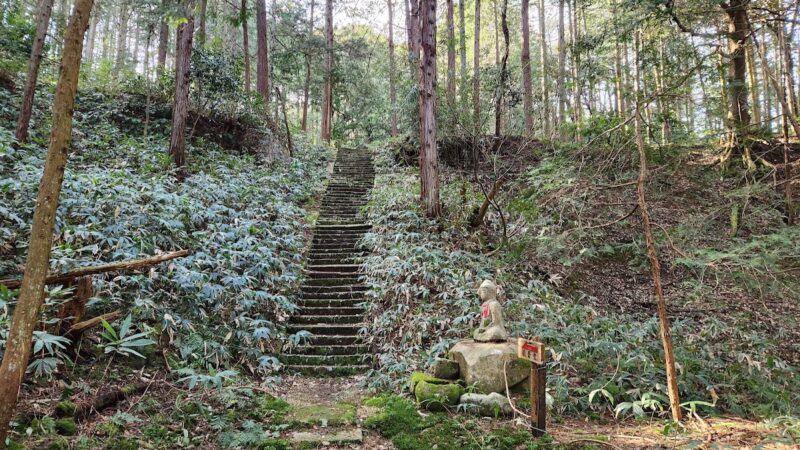
From JR Tokaido Main Line, Omihachiman Station, take the Omi Railway/Kokoku Bus and get off at the “Makimachi Nishiguchi” bus stop. The castle ruins are approximately an 18-minute walk from the bus stop. While the hiking trail is well-maintained, there are steep slopes characteristic of mountain castles, so comfortable shoes and clothing are recommended.
Access by Car
If traveling by private car, head towards Makimachi from Omihachiman city center via the prefectural road. There is a small parking area near the castle ruins, but spaces are limited, so consider using public transportation.
Precautions During Visit
As this is a mountain castle, preparation for hiking is necessary. Please pay particular attention to the following points:
- Wear comfortable shoes and clothing suitable for walking.
- Carry drinking water.
- Insect repellent in summer.
- Be careful as the ground can be slippery during and after rain.
- Allow ample time in winter due to early sunsets.
The castle ruins are protected as a historical site, so care must be taken not to damage the remains.
Nearby Historical Spots
Hachimanyama Castle
Located approximately 5km east of Mizukuki Okayama Castle, Hachimanyama Castle is a modern castle built by Toyotomi Hidetsugu. From Hachimanyama Castle, you can see the location of Mizukuki Okayama Castle, providing an interesting perspective for understanding the relationship between the two castles.
Azuchi Castle Ruins
The ruins of Azuchi Castle, built by Oda Nobunaga, are also located within Omihachiman City. While Mizukuki Okayama Castle is a medieval mountain castle, Azuchi Castle is a pioneer of modern castles, making it valuable for comparing the development of castle architecture.
Kannonji Castle
Kannonji Castle, the main castle of the Rokkaku clan, is also located nearby. It was the base of the Sasaki clan (Rokkaku clan), who are said to have built Mizukuki Okayama Castle. Visiting both castles allows you to understand the Rokkaku clan’s sphere of influence and castle network.
Historical Significance of Mizukuki Okayama Castle
Mizukuki Okayama Castle holds historical significance in the following respects:
A Key Point for Lake Biwa Water Transport
Located in a strategic location that monitored and controlled water transport on Lake Biwa, it is a valuable historical site demonstrating the importance of Lake Biwa water transport in the medieval period. Lake transport was extremely important for the transport of goods and military operations, and this castle controlled a crucial point.
A Symbol of the Decline of the Muromachi Shogunate
The fact that Ashikaga Yoshizumi fled the capital and died in a mountain castle in the provinces symbolizes the decline of the authority of the Muromachi Shogunate and the transition to the Sengoku period (Warring States period). The fact that he, despite being a shogun, was unable to return to Kyoto and ended his life in the mountains of Omi Province, marks a turning point in history.
A Typical Example of a Medieval Mountain Castle
The remains of earthworks, cliffs, and stone walls are well-preserved, making it a valuable example for understanding the structure and construction techniques of medieval mountain castles. In particular, the renovations carried out during Ashikaga Yoshizumi’s stay leave behind remains that demonstrate construction techniques from the late 15th to early 16th centuries.
A Base for Regional Control
As the residence of the local lord Kuri clan, it is also a historical site that shows the reality of regional control in the medieval period. It provides clues to understanding how local lords, who were vassals of the shugo daimyo, controlled their regions and utilized their castles as bases.
Summary
Mizukuki Okayama Castle is a medieval mountain castle located in Maki-cho, Omihachiman City, Shiga Prefecture, built on a strategically important location controlling water transport on Lake Biwa. It is believed to have been built by the Sasaki clan during the Nanboku-cho period and later became the residence of the Kuri clan. In 1508, Ashikaga Yoshizumi, the 11th shogun of the Muromachi shogunate, fled the capital and took refuge in this castle. He died within the castle walls in 1511, making it a significant stage in Japanese history. This event symbolizes the decline of the Muromachi shogunate and the transition to the Sengoku period (Warring States period).
Even today, the remains of the castle, such as earthworks, cliffs, and stone walls, are well-preserved, making it a valuable historical site for understanding the structure of medieval mountain castles. While it once boasted a scenic view surrounded by Lake Biwa, known as the “floating castle of Lake Biwa,” this view has been lost due to land reclamation of the inner lake. Nevertheless, the view of Lake Biwa from the castle ruins is magnificent, making it an attractive spot where you can enjoy both history and nature.
When visiting Omihachiman City, we recommend adding Mizukuki Okayama Castle to your list of places to visit, along with Hachimanyama Castle and Azuchi Castle ruins. It will be a valuable opportunity to experience the changes in castle architecture from the medieval to the early modern period.