Kamagake Castle: A Complete Guide to its History and Highlights | The Mountain Castle in Hino-cho, Shiga Prefecture, Where Gamo Ujisato’s Father Retired
Located in Hino-cho, Gamo-gun, Shiga Prefecture, Kamagake Castle is known as the mountain castle where Gamo Katahide, the father of the famous Sengoku period general Gamo Ujisato, retired. This castle ruin, with its dual structure of a fortified residence built on a steep ridge and a mountain residence at the foot of the mountain, is an important historical site that tells the history of the Gamo clan, and is still visited by many castle enthusiasts and history lovers.
Basic Information on Kamagake Castle
Kamagake Castle is a mountain castle located in Kamagake, Hino-cho, Gamo-gun, Shiga Prefecture, built around the summit of Shiroyama Mountain at an altitude of approximately 372 meters. With a relative height difference of approximately 160 meters, it exhibits the typical form of a medieval mountain castle, consisting of a residence at the foot of the mountain (mountain residence) and a fortified residence on the mountaintop.
Location and Geographical Characteristics
The Kamakake district is located in the southeastern part of Hino Town. The Sasao Pass, at the southeastern edge of the district, marks the boundary between Gamo District and Koka City (formerly Koka District). On Shiroyama Mountain, towering to the east of the settlement, the remains of Kamakake Castle remain in excellent condition, making it a valuable historical site that strongly reflects the characteristics of mountain castles in Omi Province.
The Kamakake region has long been a transportation hub and a strategically important location controlling the road leading to Koka. This geographical condition is thought to be one of the reasons why the Gamo clan built their castle here.
History of Kamakake Castle
The Gamo Clan and the Origins of Kamakake Castle
The history of Kamakake Castle is closely linked to the rise and fall of the Gamo clan. In 1523, Gamo Hyoe-no-jo Hideki, defeated in a conflict with Gamo Takasato, left Otowa Castle and entered Kamakake Castle. As a result, Otowa Castle was abandoned, and Hideki also met a tragic end, being poisoned in 1525.
During this period, Kamakake Castle became the stage for power struggles within the Gamo clan, a place that tells the history of family division and conflict.
As Gamo Katahide’s Retirement Castle
Kamakake Castle is best known for its history as the place where Gamo Katahide, the lord of Nakano Castle, retired to after handing over the family headship to his eldest son, Gamo Fuhide (later Ujisato). Katahide served Oda Nobunaga and laid the foundation for the Gamo clan’s prosperity, including having his son Ujisato serve as Nobunaga’s page.
Even after retirement, Katahide maintained his influence in this area and played an important role as Ujisato’s guardian. Although it was a retirement castle, it is believed that the mountain residence also had political and military functions.
History of the Castle’s Abandonment
In 1585 (Tensho 13), when Gamo Fushu (Ujisato) was transferred to Matsugashima Castle in Ise Province (later Matsusaka Castle), Kamakake Castle was abandoned. With the Gamo clan’s base shifting from Omi Province to Ise Province, Kamakake Castle ceased to serve its purpose.
Although it lost its function as a castle after its abandonment, the remains have been relatively well-preserved, conveying its original appearance to this day.
Structure and Layout of Kamakake Castle
Yamayashiki (Residential Area)
The Yamayashiki, built on the flat land between Kitasunagawa and Minaminosawa at the western foot of Kamakake Castle, is the site of the residence where Gamo Katahide actually lived. This Yamayashiki was called “Yamayashiki” and was clearly distinguished from the main castle.
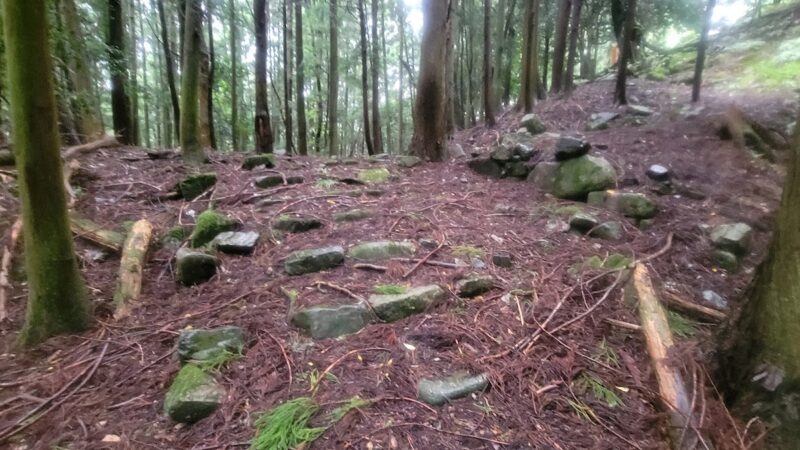
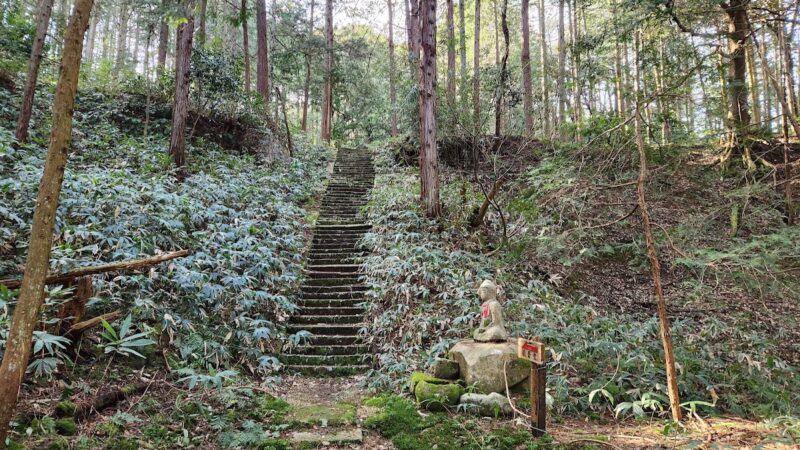
The remains of the Yamayashiki are spread across the flat land and are structured with an emphasis on habitability. Traces of earthworks and moats can be confirmed, indicating that it was a residence with defensive functions. The entrance to the castle is near Shōhōji Temple, and a traditional main road leading to the main castle on the mountaintop is maintained from here.
Main Castle (Mountaintop Section)
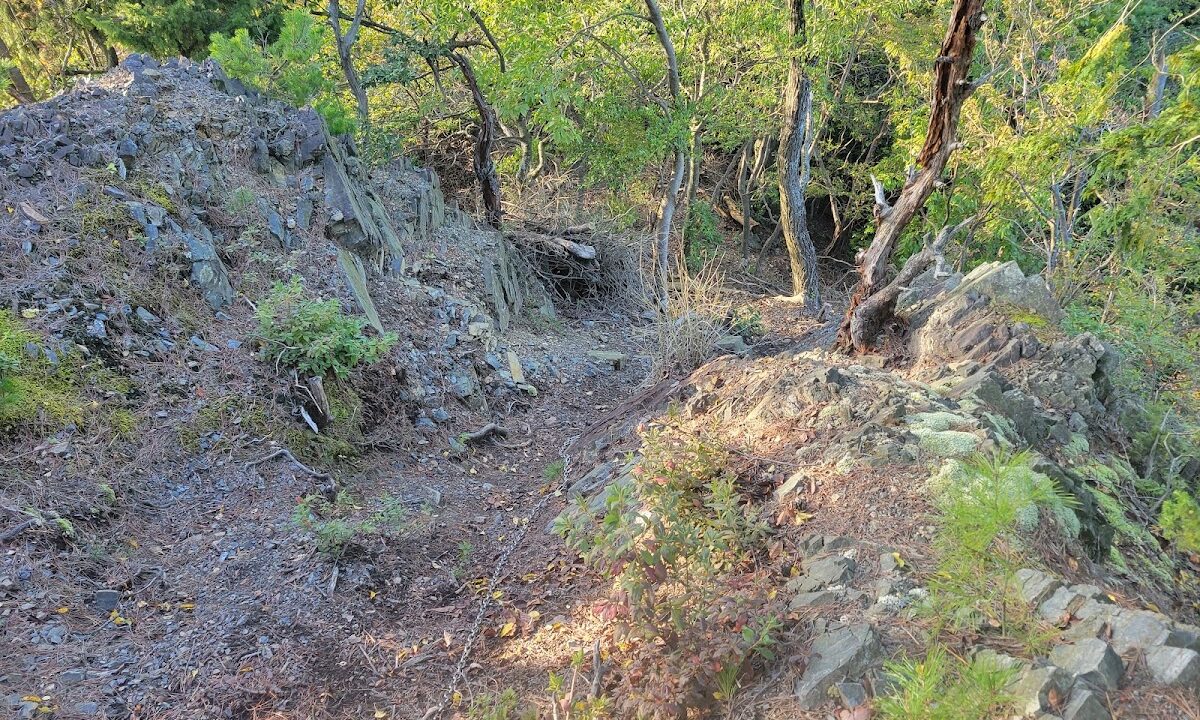
The main castle, built on a steep ridge towering behind the mountain residence, features a layout that skillfully utilizes the ridges extending in three directions. Each ridge has a bailey (enclosure), and its defenses are strengthened by moats and earthworks.
The mountaintop has a relatively large main enclosure, designed with habitability in mind. As an early castle of the Gamō clan, it is characterized by its extensive castle area, including a certain level of residential function on the mountaintop.
Features of Defensive Structures
The following remains are noteworthy defensive structures of Kamakake Castle:
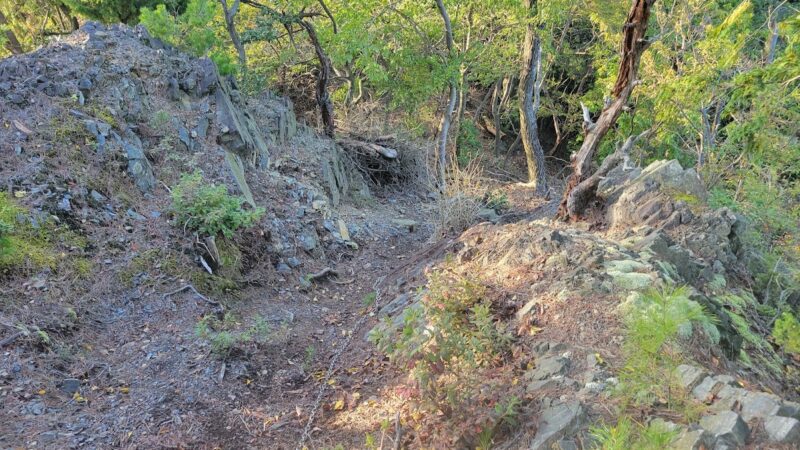
Moats: Moats, built to cut off the ridges, were an important defensive line to prevent enemy intrusion. Multiple moats are arranged along the ridges, forming a multi-layered defensive structure.
Earthworks: Earthworks surround the enclosures, enhancing their defensive capabilities. Traces of stonework are also visible in some areas, suggesting even stronger defenses were implemented.
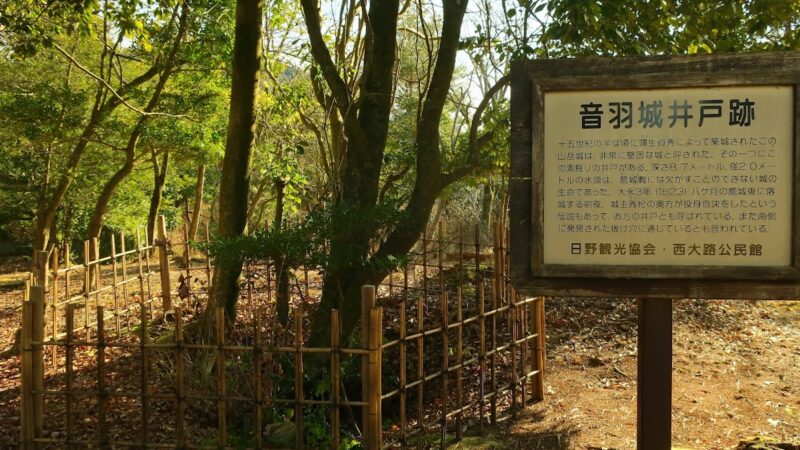
Stone-lined Well: The remains of a stone-lined well are found on the mountaintop, indicating consideration for securing a water source during sieges. This well is a valuable relic demonstrating the high level of technology at the time.
Enclosure Layout: Enclosures are positioned on each of the three ridges extending in different directions, creating a structure capable of responding to attacks from multiple directions. Each enclosure is positioned utilizing the elevation differences, forming a three-dimensional defensive network.
Highlights and Remains of Kamakake Castle
Major Highlights
Traditional Main Road: The traditional main road, leading from near Shōhōji Temple to the mountaintop, retains traces of the original approach to the castle. Signage is well-maintained, making it a relatively easy route to follow. However, there are steep, direct ascent sections, so caution is advised when climbing.
Byobu-iwa (Folding Screen Rock): Near the castle grounds is a distinctive rock formation called Byobu-iwa, which also functioned as a natural fortress. This rocky area was used for the castle’s defense and now characterizes the landscape of Kamakake.
Stone-lined Well: As mentioned above, the stone-lined well remaining on the mountaintop is a historically and technically valuable structure. It is a rare place where you can see firsthand the ingenuity used to secure water sources in medieval mountain castles.
Kuruwa Groups: The groups of kuruwa (enclosures) spread across the three ridges each have distinct characteristics. By visiting the kuruwa on each ridge from the main enclosure, you can understand the overall structure of the castle.
Earthworks and Moats: The well-preserved earthworks and moats convey the castle-building techniques of the time. The depth and width of the moats, in particular, attest to the castle’s high defensive capabilities.
Preservation Status of the Remains
Despite more than 400 years having passed since the castle’s abandonment, the remains of Kamakake Castle are in relatively good condition. This is a result of the lack of large-scale development after the castle was abandoned and the preservation efforts of local residents.
In recent years, improvements have been made to signage, creating an environment that is more accessible to castle enthusiasts. However, the terrain remains steep, so thorough preparation and caution are necessary when visiting.
Access and Visiting Guide to Kamakake Castle
Access Methods
Using Public Transportation
- Approximately 15 minutes by car from JR Ohmi Railway “Hino Station”
- Buses are also available from Hino Station, but the number of services is limited, so advance confirmation is necessary.
Using a Car
- Approximately 30 minutes from Meishin Expressway “Yokaichi IC” via National Route 307
- Approximately 25 minutes from Shin-Meishin Expressway “Koga Tsuchiyama IC” via National Route 1 and prefectural roads
- There are several parking spaces near Shobo-ji Temple.
Precautions for Visiting the Castle
When visiting Kamakake Castle, please note the following:
- Clothing and Equipment: As it is a mountain castle, comfortable clothing and hiking boots or trekking shoes are essential. Insect repellent is also important in summer.
- Estimated Time Required: The one-way trip from the entrance to the summit takes approximately 30-40 minutes. Allow 2-3 hours if you wish to explore the entire castle grounds.
- Weather: Visiting during or after rain can be slippery, so please refrain from visiting or exercise extreme caution.
- Signage: While there are signs at the castle entrance, some paths within the mountain can be difficult to follow. We recommend preparing a map or GPS app.
- Season: Spring to autumn is the best time to visit, but in summer, take precautions against the heat, and in winter, be aware of snow and ice.
Nearby Attractions
When visiting Kamakake Castle, we recommend also visiting nearby tourist spots:
Rhododendron Valley: The Kamakake area boasts a beautiful cluster of rhododendrons, attracting many tourists during the blooming season (late April to early May).
Historical Sites Related to the Gamo Clan in Hino Town: Historical sites related to the Gamo clan, such as the Nakano Castle ruins and Otowa Castle ruins, are scattered throughout Hino Town.
Shōhōji Temple: Shōhōji Temple, which serves as the entrance to the castle, is a historical temple well worth a visit.
Relationship between Gamō Ujisato and Kamakake Castle
About Gamō Ujisato
Gamō Ujisato (1556-1595) was a samurai who was active from the Sengoku period to the Azuchi-Momoyama period, serving Oda Nobunaga and Toyotomi Hideyoshi. He excelled in both military and literary arts, and was particularly knowledgeable in the tea ceremony, known as a leading disciple of Sen no Rikyū.
Ujisato was born in Hino, Ōmi Province, and spent his childhood with his father, Katahide. After serving as Nobunaga’s page, his talent was recognized and he was given important positions, eventually rising to become a daimyo with a domain of 920,000 koku in Aizu.
Relationship between Kamakake Castle and Ujisato
While Kamakake Castle was not Ujisato’s direct residence, it was deeply involved in Ujisato’s life as the retirement castle of his father, Katahide. Even after handing over the family headship to Ujisato, Kenshu continued to support Ujisato from this region.
It is said that Kenshu’s accurate advice and support were behind Ujisato’s success, and Kamakake Castle was one of the stages where this support was provided. Even after Ujisato was transferred to Ise and then Aizu, Omi Hino continued to hold significant importance as Ujisato’s roots.
Kamakake Castle as a Mountain Castle in Omi
Its Place in the History of Castles in Omi
Shiga Prefecture (Omi Province) was a strategically important region, so much so that it was said, “He who controls Omi controls the world.” Therefore, numerous castles were built within the prefecture, each developing in its own unique way.
Among these mountain castles of Omi, Kamakake Castle occupies an important position as the castle of the powerful local lord, the Gamo clan. Its dual structure, with a fortified castle on the mountaintop and a residence at the foot of the mountain, clearly demonstrates the characteristics of castles during the transitional period from the medieval to the early modern period.
Comparison with Other Castles Related to the Gamo Clan
The Gamo clan possessed several castles in Omi Province:
Otowa Castle: This was the Gamo clan’s initial base, but it was abandoned due to internal conflict.
Nakano Castle: This was the residence of Gamo Katahide, and Ujisato was also born and raised here. It is a hilltop castle located near the center of Hino Town.
Hino Castle: This castle later became the Gamo clan’s base, and is located closer to the plains.
Kamakake Castle has the strongest characteristics of a mountain castle among these, with a structure that emphasizes defense. Due to its nature as a retirement castle, it is characterized by a design that considers both actual combat use and habitability during peacetime.
History and Culture of the Kamakake Region
The Place Name Kamakake
There are various theories about the origin of the place name “Kamakake,” but it is thought to be related to the topography. “Kake” means a mountain slope or cliff, and “Kama” may represent the shape of the terrain.
Kamakake Village After the Meiji Era
On April 1, 1889 (Meiji 22), with the implementation of the town and village system, Kamakake Village was officially established as Gamo District. Later, on March 16, 1955 (Showa 30), Hino Town, Higashi-Sakuradani Village, Nishi-Sakuradani Village, Nishi-Oji Village, Kamakake Village, Minami-Hitosa Village, and Kita-Hitosa Village merged to form the current Hino Town.
Even after becoming part of Hino Town, the Kamakake area has continued to preserve its unique history and culture.
Local Tourism Resources
The Kamakake area is blessed not only with castle ruins but also with natural scenery. The Rhododendron Valley is designated as a prefectural natural monument and attracts many tourists during the blooming season. Furthermore, distinctive geological features such as Byobu-iwa (Folding Screen Rock) are also one of the region’s attractions.
Castle Research and Kamakake Castle
Academic Value
Kamakake Castle is attracting academic attention as a castle exhibiting characteristics of the transitional period from medieval mountain castles to early modern castles. Its dual structure—a fortified castle on the mountaintop and a residence at the foot of the mountain—is a typical example of a castle from the Sengoku period and is a subject of research.
In particular, the techniques of the stone-lined wells and the structure of the earthworks and moats are valuable resources for understanding the castle construction techniques of the time. Furthermore, as the castle of the powerful local lord Gamo clan, it is important from the perspective of political and social history.
Efforts for Preservation and Utilization
In recent years, efforts to preserve and utilize Kamakake Castle have been advanced by local history enthusiasts and castle researchers. The installation of guide signs and improvements to the access routes have made it a more accessible historical site for general visitors.
Further research and the formulation of a preservation and utilization plan are expected in the future. It is important to pass on the value of Kamakake Castle to future generations as a regional historical resource and a tourist attraction.
Efforts for Preservation and Utilization
In recent years, efforts for the preservation and utilization of Kamakake Castle have been advanced by local history enthusiasts and castle researchers. ## The Significance of Visiting Kamakake Castle
Visiting Kamakake Castle is more than just sightseeing the ruins. It is a valuable opportunity to experience the history of Omi Province during the Sengoku period, the rise and fall of the Gamo clan, and the history of Japanese castles.
As you climb the steep ridge and look out over the surrounding area from the summit, you can imagine Gamo Katahide, who once ruled this land, and Gamo Ujisato, who started from here and became a powerful daimyo of Aizu. The earthworks and moats remaining in the ruins convey the castle-building techniques and labor of the people of that time.
Walking the path from the mountain residence to the main castle allows you to truly understand how a castle of the Sengoku period was constructed and how it functioned. This is an experience that cannot be obtained from books or photographs; it can only be gained by visiting the site.
Summary
Kamakake Castle in Hino-cho, Gamo-gun, Shiga Prefecture, is a place of great value to visit, as it is the mountain castle where Gamo Katahide, the father of Gamo Ujisato, retired, and as a historical site that retains many characteristics of a medieval mountain castle. The castle’s dual structure—a fortified outpost built on a steep ridge and a mountain residence at the foot of the mountain—and its well-preserved remains, such as earthworks, moats, and stone-lined wells, provide invaluable information for understanding castles of the Sengoku period.
While access may be somewhat challenging, the sense of accomplishment and historical romance that only visitors can experience is invaluable. We recommend enjoying the entire Kamakake area, including the surrounding natural scenery such as the Rhododendron Valley.
For those interested in the history of Omi Province, the footsteps of the Gamo clan, and the history of Japanese castles, Kamakake Castle is a must-see historical site. With proper preparation and equipment, please visit this historical stage.