Uegusuku Gusuku (Okinawa Prefecture) Complete Guide | History, Highlights, and Access Information for Okinawa’s Highest Mountain Castle
What is Uegusuku Gusuku?
Uegusuku Gusuku is a castle ruin from the Gusuku period, built on the summit of Mt. Uegusuku (309.9m or 310m above sea level) in the northern mountain range of Kumejima Island, approximately 100km west of Okinawa Main Island. It is known as the highest-altitude mountain castle among the 200-300 Gusuku castles in Okinawa Prefecture.
Designated a national historic site in 2009, this castle ruin boasts a superb location overlooking almost the entire Kumejima Island, offering a 360-degree panoramic view on clear days. It utilizes a unique stonework technique different from that of Gusuku castles on Okinawa Main Island, making it a valuable cultural heritage site that conveys the regional diversity before the unification of the Ryukyu Kingdom.
History of Uejo Gusuku
Background and Builder
The exact construction date of Uejo Gusuku is unknown as no records remain. However, according to tradition, it was built by Kume Nakagusuku Aji, the eldest son of Ishikichinaha Aji. Initially, it was called “Kume no Nakagusuku” or “Nakagusuku Gusuku.”
During the Gusuku period (12th-16th centuries) in Okinawa, local Aji (local powerful families) established their own spheres of influence, and multiple Aji held sway on Kumejima Island. Uejo Gusuku is thought to have functioned as a strategically important castle among them.
Unification and Fall of the Ryukyu Kingdom
Even after the establishment of the Ryukyu Kingdom in the 15th century, Kumejima Island maintained a degree of independence. However, it is said that in 1510 (Eisho 7), during the process of unifying Ryukyu under King Sho Shin of the Second Sho Dynasty, Uegusuku Castle was attacked and fell.
This fall meant that Kumejima Island was completely incorporated under the control of the Ryukyu Kingdom. The reign of King Sho Shin was a period of increasing centralization, with policies aimed at weakening the power of local lords and strengthening royal authority. The fall of Uegusuku Castle is one of the events that symbolizes this turning point in history.
Subsequent History
After its fall, Uegusuku Castle lost its function as a military base and was abandoned. However, its remains continued to exist in the region as an important historical site that tells the story of Kumejima Island’s history.
In the 20th century, as research into Okinawan history progressed, the value of Uegusuku Castle began to be re-recognized. It was designated as a prefectural historical site until 2008, but due to its high historical and cultural value, it was upgraded to a national historical site in 2009.
Structure and Characteristics of Uejo Gusuku
Location and Layout
Uejo Gusuku is a typical mountain castle utilizing the summit of Uejo-dake, the highest peak in northern Kumejima. Located at an altitude of nearly 310m, it serves as a fortress combining overview of the entire Kumejima and defense against attacks.
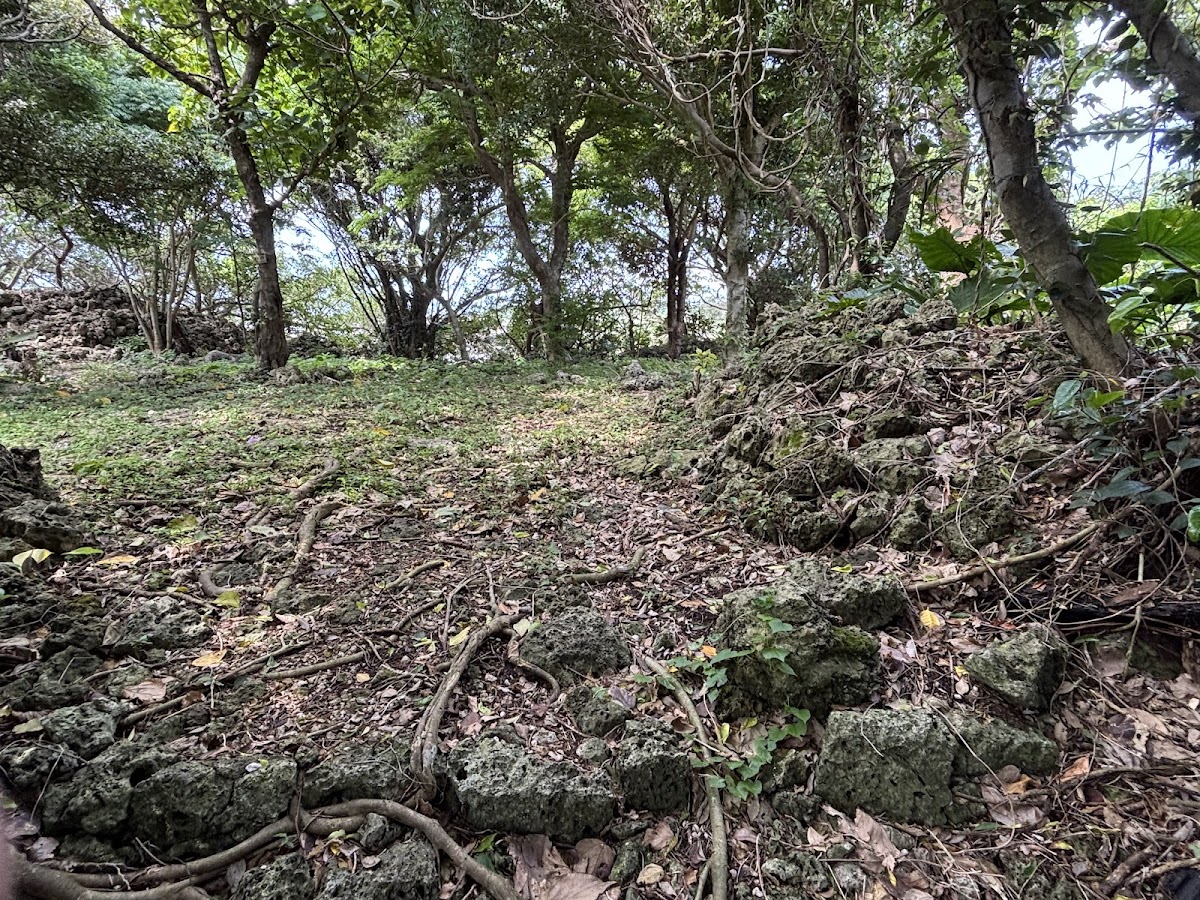
The castle’s layout skillfully utilizes the mountaintop terrain, combining natural ruggedness with artificial stonework to create a robust defensive system. The interior of the gusuku is divided into multiple enclosures (kuruwa), suggesting a hierarchical defensive structure.
Unique Andesite Stonework
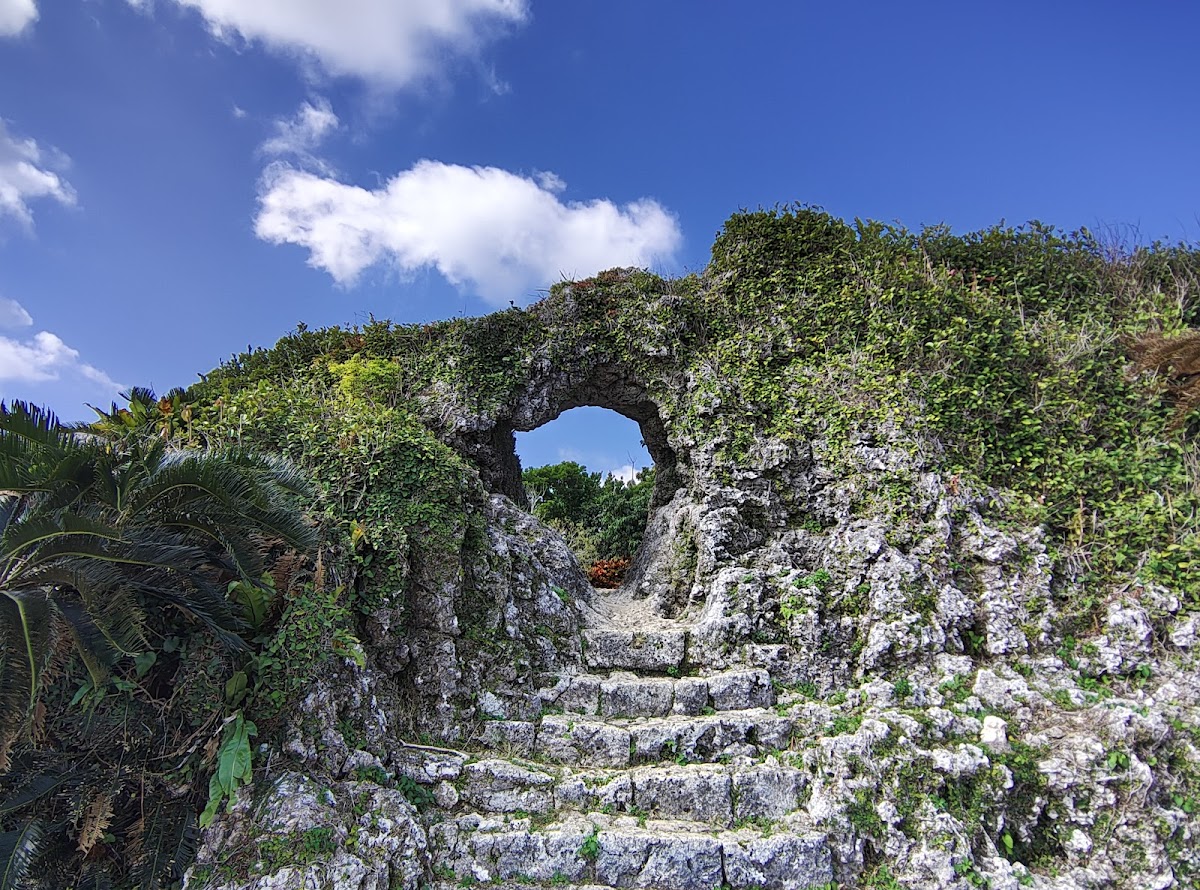
The most distinctive feature of Uejo Gusuku is the stonework using andesite, which can be quarried locally. This is a significant difference from gusuku on Okinawa Island, which use Ryukyu limestone.
Andesite is dark gray to black in color, clearly distinguishable from white stonework even from a distance. The choice of stone reflects the geological characteristics of Kumejima Island and provides important evidence of unique regional castle-building techniques. The stonework techniques also differ from those of Okinawa Main Island, illustrating the regional diversity within the Ryukyu cultural sphere.
Existing Remains
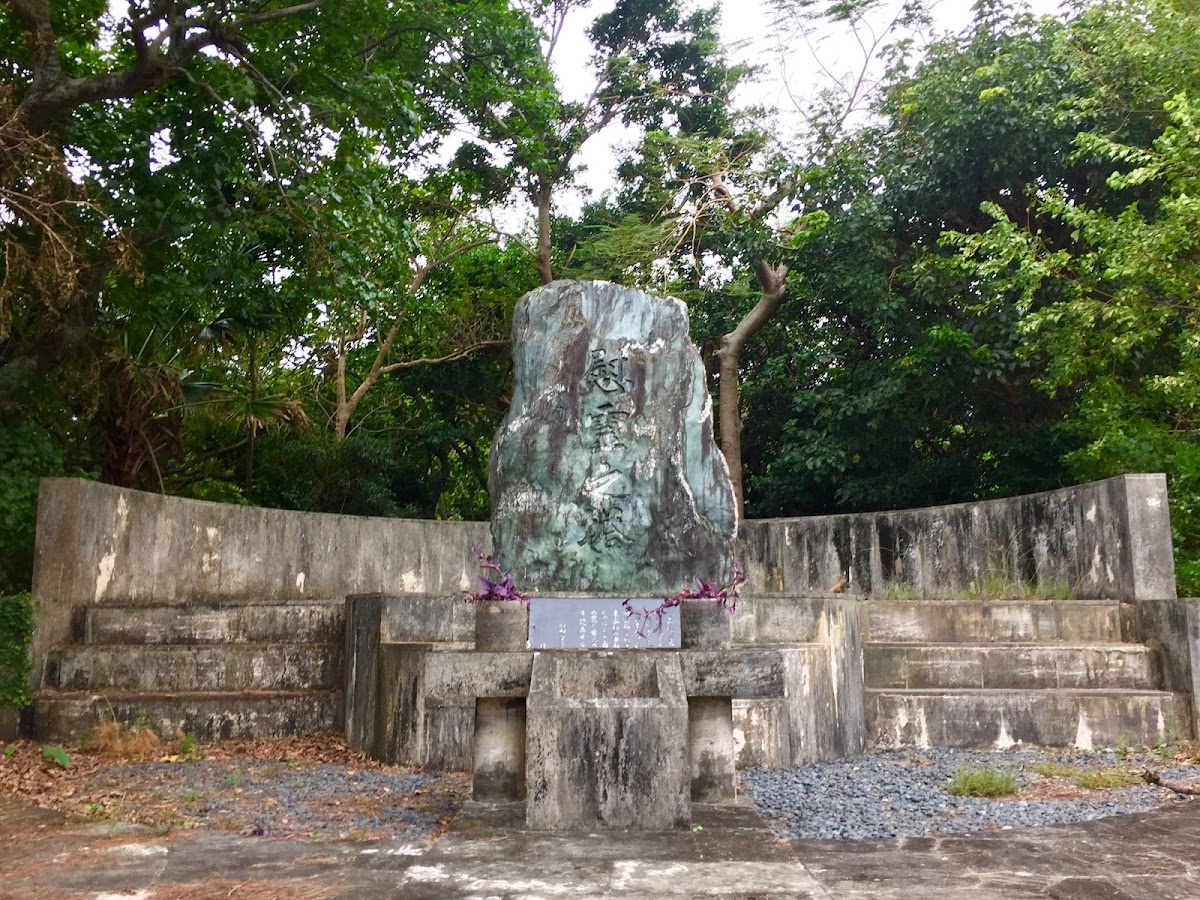
Currently, the following remains are preserved at Uejo Gusuku:
- Stone Walls: Well-preserved stone walls using andesite remain in various locations.
- Enclosure Remains: Multiple flat areas have been identified, showing traces of buildings and facilities.
- Castle Gate Remains: A structure believed to be an entrance.
- Well Remains: Remains of a facility for securing water for daily life.
These remains are valuable historical materials that convey the castle-building techniques of Ryukyu over 500 years ago.
Highlights of Uejo Gusuku
360-Degree Panoramic View
The greatest attraction of Uejo Gusuku is undoubtedly the overwhelming view from the mountaintop. Taking advantage of its location as the highest gusuku (castle) in Okinawa Prefecture, it offers panoramic views of almost the entire island of Kumejima.
On clear days, you can enjoy the following views:
- Kumejima Island as a whole: The island’s shape and the layout of the settlements are clearly visible.
- East China Sea: The beautiful contrast between the sparkling blue sea and the horizon.
- Surrounding Islands: On some days, you can even see the silhouette of Okinawa Main Island in the distance.
- Mountain Range: A panoramic view of Kumejima’s undulating terrain.
Many visitors comment that “even from quite far away on Kumejima, you can see Uejo Gusuku,” highlighting its function as a landmark of the island.
Shiny White Andesite Stone Walls
The andesite stone walls, which appear whitish due to weathering, possess a striking beauty even from a distance. Many praise it as “a castle with beautiful white stone walls,” and its unique color and texture captivates visitors.
Observing the stonework techniques up close, one is impressed by the skillful way each stone is stacked, making the most of its individual shape. The technique of joining stones without adhesive speaks volumes about the high skill of the stonemasons of that time.
Historical Value and Cultural Significance
Uejo Gusuku is not merely a scenic spot, but an important historical site that demonstrates the nature of regional power before the unification of the Ryukyu Kingdom. Its architectural style, distinct from that of Okinawa Island, indicates that Kumejima had formed its own unique cultural sphere.
Compared to mountain castles throughout Japan, its location and structure are unique, making it indispensable for understanding the diversity of Ryukyu castle architecture.
Attractiveness as a Photo Spot
Uejo Gusuku is an attractive spot for photography enthusiasts:
- Evening View: The silhouette of the stone walls against the setting sun over the East China Sea
- Sea of Clouds: A sea of clouds can sometimes be seen in the early morning
- Starry Sky: Stargazing from the mountaintop with minimal light pollution
- Details of the Stone Walls: The texture of the andesite and the moss-covered appearance
By visiting from various angles and at different times of day, you can enjoy a variety of expressions.
Access Information
How to Get to Kumejima
Kumejima, where Uegusuku Castle is located, can be accessed in the following ways:
Airplane
- Approximately 30 minutes from Naha Airport to Kumejima Airport (7-8 flights per day)
- From Haneda Airport to Kumejima via Naha
Ferry
- Approximately 3-4 hours from Naha/Tomari Port to Kumejima Kanegusuku Port
- 1-2 departures per day (varies seasonally)
Access to Uegusuku Castle
Location
2064-1 Yamadabara, Uegusuku, Kumejima-cho, Shimajiri-gun, Okinawa Prefecture
Access by Car
- Approximately 20 minutes by car from Kumejima Airport
- Approximately 25 minutes by car from Kanegusuku Port
- Renting a car is the most convenient option
Notes
- If the regular access road is under construction, a detour will be used.
- The detour has narrow roads, and there are places where it is difficult to pass oncoming vehicles.
- If you are not confident in your driving skills, please consider taking a taxi.
- There is parking space near the summit, but it is limited, so please be aware of this.
Access on Foot
- Approximately 10-15 minutes on foot from the parking lot to the summit.
- The hiking trail is well-maintained, but comfortable clothing and shoes are recommended.
- There are steep slopes, so if you are not confident in your physical fitness, take breaks as you climb.
Points to Note When Visiting
Clothing and Items to Bring
- Comfortable walking shoes (sneakers or trekking shoes recommended)
- Hat and sunscreen (there is little shade)
- Drinks (especially essential in summer)
- Insect repellent spray
- Camera (for taking photos of the spectacular scenery)
Climate and Time of Visit
- Visitable year-round
- Be aware of the heat and UV rays in summer (June-September)
- Check the weather in advance during typhoon season (July-October)
- Winter (December-February) is relatively pleasant, but it can be windy.
- Best seasons are spring (March-May) and autumn (October-November).
Safety Precautions
- Do not climb on the stone walls (to protect the ruins).
- Do not get too close to the cliffs.
- Be careful as the ground can be slippery in rainy weather.
- Avoid going alone; visit in groups if possible.
Nearby Tourist Spots
When visiting Uejo Gusuku, we recommend also visiting other attractive spots on Kumejima Island.
Gushikawa Castle Ruins (Gushikawa Gusuku)
Another important gusuku on Kumejima Island, this castle ruin was built on a rocky hill by the coast. In contrast to Uejo Gusuku, it is characterized by its sea-facing location, and the combination of the beautiful sea view and stone walls is magnificent. Visiting it together with Uejo Gusuku will help you understand the diversity of gusuku on Kumejima Island.
Hiyajō Banta
A representative scenic spot on Kumejima Island, offering a panoramic view of the East China Sea from a cliff approximately 200m high. You can enjoy a different kind of breathtaking scenery than the view from Uejo Gusuku.
Hatenohama Beach
An uninhabited island with only a pristine white sand beach, floating off the east coast of Kumejima. The contrast between the emerald green sea and the white sand is beautiful, and it is sometimes called “the most beautiful beach in the Orient.”
Goe no Matsu (Five-Branched Pine)
A giant Ryukyu pine designated as a national natural monument. It is said to be over 250 years old, and its branches, which spread out along the ground, are magnificent.
Mifuga (Woman’s Rock)
A unique rock formation known as a power spot for praying for fertility. Its distinctive holes give it a mystical atmosphere.
History and Culture of Kumejima
The Formation of Kumejima
Kumejima is an island with a unique history even within the Ryukyu Islands. Located almost midway between Okinawa Main Island and Miyako Island, it has played an important role as a key point for maritime traffic since ancient times.
There are several theories about the origin of the island’s name, including one that it derives from the “Kume Thirty-Six Families,” immigrants from China, and another that it comes from the word “Kumi,” meaning “beautiful island.”
Kumejima during the Gusuku Period
During the Gusuku period (12th to 16th centuries), several local lords (Anji) held sway over Kumejima. Besides Uejo Gusuku, several other gusuku castles were built, such as Gushikawa Castle and Tobunaha Castle, suggesting that power struggles were unfolding within the island.
During this period, Kumejima maintained a certain distance from the power of Okinawa Main Island, while also having relations through trade. The development of its unique culture and architectural style is rooted in this semi-independent state.
Kumejima during the Ryukyu Kingdom Period
After the fall of Uejo Gusuku in 1510, Kumejima came under the direct rule of the Ryukyu Kingdom. The royal government established magiri (administrative districts) on Kumejima and dispatched officials to govern.
During this period, Kumejima became known as a production area for Tsumugi silk. Kumejima Tsumugi held an important position as a tribute item to the Ryukyu Kingdom and is still highly valued as a traditional craft today.
Preservation and Utilization of Uejo Gusuku
Designation and Protection as a Cultural Property
Uejo Gusuku had long been protected as a prefectural historical site, but due to its high historical value, it was designated as a national historical site in 2009. This has made more thorough protection and maintenance possible.
With the designation as a national historical site, the following initiatives are underway:
- Detailed academic survey of the remains
- Preservation and repair of the stone walls
- Development of viewing paths
- Installation of explanatory signs
- Vegetation management
Utilization as a Tourism Resource
Kumejima Town positions Uejo Gusuku as an important tourism resource and is working to utilize it appropriately. The aim is to balance the protection of the historical remains with tourism use, while functioning as a place to convey the history and culture of Kumejima to many people.
In recent years, the following initiatives have also been undertaken:
- Implementation of guided tours
- Strengthening information dissemination (website, social media, etc.)
- Development of routes in cooperation with surrounding tourist spots
- Acceptance of educational tours
Future Challenges and Prospects
Several challenges exist in the preservation and utilization of Uejo Gusuku:
Preservation Challenges
- Deterioration of stone walls due to weathering
- Impact of vegetation on the historical remains
- Countermeasures against natural disasters (typhoons, etc.)
Utilization Challenges
- Improvement of access roads
- Expansion of parking facilities
- Strengthening safety measures
- Providing multilingual information
It is necessary to address these challenges and pass on Uejo Gusuku to future generations.
Okinawa’s Gusuku and Uejo Gusuku
What is a Gusuku?
“Gusuku” is a Ryukyuan word meaning castle or settlement. It is said that there are 200 to 300 gusuku (castles) in Okinawa, each with its own unique characteristics.
Gusuku were not merely military facilities, but functioned as centers of politics, economy, and religion. They were the residences of the Anji (local lords), as well as places of residence and religious ceremonies.
World Heritage Site Gusuku
In December 2000, the “Gusuku Sites and Related Properties of the Kingdom of Ryukyu” were registered as a World Cultural Heritage site. The following nine sites were registered:
Gusuku (5 sites)
- Nakijin Castle Ruins (Nakijin Village)
- Zakimi Castle Ruins (Yomitan Village)
- Katsuren Castle Ruins (Uruma City)
- Nakagusuku Castle Ruins (Nakagusuku Village/Kitanakagusuku Village)
- Shuri Castle Ruins (Naha City)
Gusuku-related Heritage (4 sites)
- Sonohyan Utaki Stone Gate (Naha City)
- Tamaudun Mausoleum (Naha City)
- Shikinaen Garden (Naha City)
- Seifa Utaki (Nanjo City)
Uegusuku Gusuku is not included in the World Heritage site, but it has unique value as the highest-altitude gusuku in Okinawa Prefecture and is an important example of the diversity of Ryukyu castle architecture.
The Positioning of Uejo Gusuku
While most World Heritage gusuku (castles) are concentrated on Okinawa Island, Uejo Gusuku is located on Kumejima Island, a remote island. Furthermore, it possesses unique characteristics in terms of building materials, as it utilizes andesite rather than Ryukyu limestone.
Due to these features, Uejo Gusuku is highly regarded academically as a precious example of regional diversity within the Ryukyu cultural sphere.
Visitor Feedback and Reviews
The following are comments from people who have actually visited Uejo Gusuku:
Evaluation of Scenery
- “I was impressed by the spectacular view overlooking almost the entire island of Kumejima.”
- “The 360-degree panoramic view is breathtaking.”
- “We were blessed with clear weather and could even see the silhouettes of distant islands.”
- “The white stone walls stand out even from afar and are beautiful.”
Opinions on Access
- “Due to construction, we took a detour, but the road was narrow and difficult to drive on.”
- “There are places where it is difficult to pass other vehicles, so caution is needed.”
- “Access by rental car is convenient.”
- “The hiking trail is well-maintained, but comfortable shoes are essential.”
Evaluation of Historical and Cultural Value
- “The atmosphere is different from the gusuku on Okinawa Main Island, which is interesting.”
- “The andesite stonework is unique and impressive.”
- “A place where you can feel the history of Ryukyu firsthand.”
- “It is worthy of being designated a national historical site.”
Overall Evaluation
- “A must-see spot when visiting Kumejima”
- “Visiting it together with Gushikawa Castle will deepen your understanding”
- “Worth taking your time to explore”
- “Especially recommended for photography enthusiasts”
Summary
Uejo Gusuku is a nationally designated historical site with unique historical and cultural value, being the highest mountain castle in Okinawa Prefecture. Built by the Kume Nakagusuku Anji, this castle ruin, which fell during the unification efforts of the Ryukyu Kingdom in 1510, conveys the turbulent history of Ryukyu.
The unique stonework using andesite shows regional characteristics different from the gusuku on Okinawa Island, illustrating the diversity of the Ryukyu cultural sphere. The 360-degree panoramic view from the mountaintop, nearly 310m above sea level, is breathtaking, offering a view of the entire Kumejima Island.
Renting a car is convenient for visiting, but be aware of road conditions. Wear comfortable clothing and shoes, and bring plenty of drinks. Visiting Uejo Gusuku in conjunction with other Kumejima tourist spots, especially the Gushikawa Castle Ruins, will allow you to gain a deeper understanding of Kumejima’s history and culture.
Uejo Gusuku is an attractive spot for a variety of people, including those interested in Okinawan history and castles, those seeking breathtaking scenery, and photography enthusiasts. When you visit Kumejima, be sure to visit this historic mountain castle. The romance of Ryukyu history and the magnificent natural scenery are sure to create unforgettable memories.