Tatana Gusuku (Okinawa Prefecture) Complete Guide: History, Access, and Highlights Explained in Detail
Tatana Gusuku is a castle ruin (gusuku) from the Ryukyu Kingdom era, located in Hyakuna, Tamagusuku, Nanjo City, Okinawa Prefecture. Built along the southern coast of Okinawa Island, this historical site is a valuable cultural heritage that conveys the history of Ryukyu, attracting attention from local residents and history enthusiasts alike. This article provides a detailed explanation of Tatana Gusuku’s historical background, structural features, access methods, and highlights.
What is Tatana Gusuku?
Tatana Gusuku is one of the castle ruins built during the Ryukyu Kingdom era, located on a hill overlooking the coastline of Nanjo City, Okinawa Prefecture. “Gusuku” means “castle” in the Ryukyuan language, and refers to defensive facilities and sacred sites from the Ryukyu Kingdom era scattered throughout Okinawa.
Due to its location, Tatana Gusuku is believed to have been built for the purpose of monitoring and defending maritime traffic, and is thought to have played an important role in the Ryukyu Kingdom’s maritime strategy. Currently, remnants of the stonework and parts of the castle walls remain, preserving the characteristics of Ryukyuan architecture.
Scale and Structure of the Gusuku
Tatana Gusuku is a relatively small gusuku (castle), but its structure exhibits unique Ryukyuan castle-building techniques. The castle ruins were built skillfully utilizing the natural terrain, and various measures were taken to prevent intrusion from the sea.
The stonework (castle walls) using limestone was constructed using a technique called “nozurazumi,” characterized by its simple beauty achieved by combining natural stones as they are. This technique is often seen in the early stages of Ryukyuan gusuku and is one of the clues to estimating the construction date of Tatana Gusuku.
History of Tatana Gusuku
Construction Period and Background
The exact construction date of Tatana Gusuku is not clearly known, but archaeological surveys and documentary materials suggest that it was built during the formation period of the Ryukyu Kingdom, around the 13th to 15th centuries. This period was a time when local powerful families called “Aji” vied for power throughout Okinawa Island, each building their own gusuku (castle) and competing for influence.
The area around Nanjo City, where Tatana Gusuku is located, has long been known as “Hyakuna,” and is home to many sacred sites that appear in the Ryukyu creation myth. In particular, the nearby Seifa Utaki is known as the most sacred site of the Ryukyu Kingdom, and Tatana Gusuku may have played a role in the defense of this sacred area.
Role after the Unification of the Ryukyu Kingdom
In the first half of the 15th century, when the Ryukyu Kingdom was unified by Sho Hashi, the gusuku in various regions were incorporated into the kingdom’s governing system. Tatana Gusuku also played a part in the kingdom’s coastal defense system, and is thought to have played a particularly important role in monitoring ships sailing the East China Sea and defending against pirates.
The Ryukyu Kingdom developed as a maritime trading nation, prospering through trade with China, Japan, and Southeast Asian countries. Located on the southern coast, Tatana Gusuku served as one of the key strongholds protecting this maritime trade route.
Abandonment and its Aftermath
After the 17th century, as the political system of the Ryukyu Kingdom stabilized, many gusuku (castles) lost their military function and were abandoned. Tatana Gusuku is also believed to have effectively ceased its role as a castle during this period.
However, for the local residents, the gusuku was not merely a military facility, but also held significance as a sacred place where the spirits of their ancestors resided. Therefore, even after its abandonment, it was carefully preserved as an object of local faith.
Highlights of Tatana Gusuku
Stone Walls
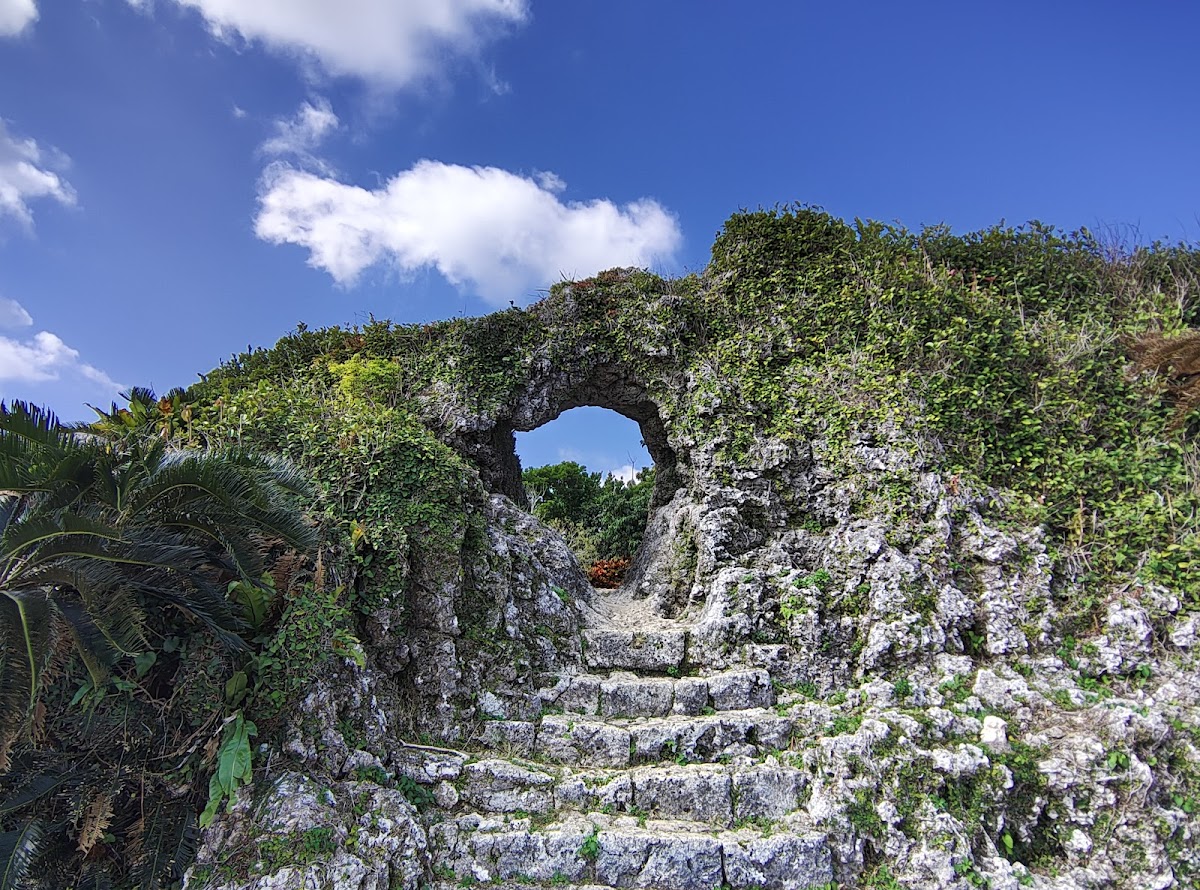
The greatest highlight of Tatana Gusuku is its stone walls constructed using Ryukyu limestone. The technique of stacking natural stones as they are possesses a simple beauty that differs from the refined cut-stone masonry of later periods.
Although parts of the walls have collapsed, they are preserved as valuable historical remains that convey the castle-building techniques of the time. Okinawan plants have taken root in the gaps of the stone walls, creating a unique landscape where nature and history blend seamlessly.
Spectacular Ocean Views
Because Tatana Gusuku is located on a hill overlooking the coast, the castle ruins offer a panoramic view of the beautiful Pacific Ocean. On a clear day, you can see all the way to the horizon, allowing you to imagine the watchmen of the Ryukyu Kingdom watching the sea from this spot.
Especially at sunrise, the sea surface sparkles, creating a fantastical landscape. It’s a perfect spot for photography, captivating visitors.
Connections to Nearby Sacred Sites
Numerous sacred sites related to the Ryukyu creation myth surround Tatana Gusuku. In particular, Seifa Utaki, a World Heritage Site, is within walking distance. Visiting it along with Tatana Gusuku allows for a deeper understanding of Ryukyu history and beliefs.
Furthermore, nearby is Ukinju Hainju, a sacred site believed to have introduced rice cultivation to Ryukyu, making this entire region an important area that conveys the origins of Ryukyu culture.
How to Access Tatana Gusuku
Access by Car
The most convenient way to access Tatana Gusuku is by car. From Naha city, head south on National Route 331 towards Nanjo city. The journey takes approximately 40 minutes from Naha Airport and about 30 minutes from downtown Naha.
If using a car navigation system, it is recommended to set “Tamagusuku Hyakuna, Nanjo City” or the nearby Seifa Utaki as your destination. There is a small parking area near the gusuku, but it can get crowded during peak tourist season, so it is recommended to allow ample time for your visit.
Access by Public Transportation
If using public transportation, take the Toyo Bus No. 38 (Shikiya Line) or No. 39 (Hyakuna Line) from Naha Bus Terminal and get off at the “Hyakuna” bus stop. The castle is approximately a 15-minute walk from the bus stop.
However, since bus services are limited, it is important to check the timetable in advance and plan your visit accordingly. Also, be sure to check the return bus schedule.
Using Taxi or Rental Car
For sightseeing in Okinawa, renting a car offers the most flexibility and convenience. You can efficiently visit not only Tatana Gusuku but also surrounding tourist spots such as Seifa Utaki, Chinen Cape Park, and Nirai Kanai Bridge.
If using a taxi, the estimated cost from Naha city is approximately 5,000 to 7,000 yen one way. It is also possible to negotiate a private charter plan that includes round-trip transportation and waiting time for visiting the castle.
Points to Note and Etiquette When Visiting
Clothing and Items to Bring
Tatana Gusuku is not a well-maintained tourist destination, but rather a place with a strong character as a historical site. Therefore, please pay attention to the following points when visiting:
- Comfortable walking shoes: Since you will be walking on stone walls and uneven terrain, comfortable walking shoes such as sneakers are essential.
- Hat and sunscreen: There is little shade, so sun protection is important.
- Drinking water: Especially in summer, carry plenty of water to prevent heatstroke.
- Insect repellent spray: Insect repellent is also effective in areas with a lot of vegetation.
Etiquette for Cultural Property Protection
Tatana Gusuku is a valuable cultural property. Please observe the following manners when visiting:
- Do not climb on or move the stones.
- Always take your trash with you.
- Do not collect or damage plants.
- Visit quietly and without shouting.
- Be considerate of the living areas of local residents.
Respect for a Sacred Site
Gusuku (castles) are sacred sites for local residents, where the spirits of their ancestors reside. If there are places of prayer called Uganju (places of worship), do not enter unnecessarily and treat them with respect.
Tourist Attractions Around Tatana Gusuku
Seifa Utaki
Located about a 5-minute drive from Tatana Gusuku, Seifa Utaki is a UNESCO World Heritage Site and the most sacred site of the Ryukyu Kingdom. It is a sacred place that appears in the Ryukyu creation myth, and was once a special sacred site where only the king and female priests called Kikoe-Okimi were allowed to enter.
Currently, it is open to the public, and you can explore the sacred area via well-maintained walking paths. Visiting this site along with Tatana Gusuku will allow you to more deeply appreciate the history and faith of the Ryukyu Kingdom.
Chinen Cape Park
Chinen Cape Park is a scenic spot offering panoramic views of the Pacific Ocean. On a clear day, you can see Kudaka Island and Komaka Island, known as the Island of the Gods, in the distance. The park has observation decks and rest areas, making it ideal for a break during a drive.
Ukinju Hainju
This is a legendary sacred site said to have brought rice cultivation to Ryukyu, and pure spring water still flows here. As one of the seven sacred sites of Ryukyu’s creation, it is a place of worship for local people.
Gangara Valley
This subtropical forest was formed by the collapse of a limestone cave hundreds of thousands of years ago, and can be explored by joining a guided tour. Ancient dwelling sites have also been discovered, making it a popular spot where you can experience Okinawa’s nature and history simultaneously.
Cultural Value of Tatana Gusuku
Archaeological Significance
Tatana Gusuku is an important archaeological site that preserves the characteristics of gusuku (castles) from the formative period of the Ryukyu Kingdom. Excavations have unearthed pottery fragments and shell artifacts that reveal the lifestyle of the time, providing valuable resources for understanding Ryukyu history.
In particular, the rough-hewn stone masonry technique is important evidence of the development of Ryukyu castle construction technology, providing clues to understanding the process of its development into the later, more refined cut-stone masonry technique.
Regional Historical Identity
Tatana Gusuku symbolizes the historical identity of Nanjo City. For local residents, the gusuku is not merely an archaeological site, but a precious place that conveys the activities and spirituality of their ancestors.
In recent years, Nanjo City has been focusing on promoting tourism by utilizing its local historical and cultural resources, and Tatana Gusuku is positioned as one of its important elements.
Challenges of Preservation and Utilization
Like many other gusuku (Okinawan castles), Tatana Gusuku faces the challenge of balancing preservation and utilization. Natural deterioration, such as weathering of the stonework and erosion by plants, is progressing, requiring appropriate preservation measures.
At the same time, appropriate maintenance and public access are necessary to pass on this valuable cultural asset to future generations. Local governments and cultural property protection organizations are working to create an environment where visitors can safely view the site, without compromising its cultural value.
The Four Seasons of Tatana Gusuku
Spring (March-May)
Spring at Tatana Gusuku is a beautiful season of fresh greenery. Spring arrives earlier in Okinawa than on the mainland, and by March, the weather is already warm. Around the gusuku, Okinawan flowers such as coral trees and hibiscus begin to bloom, creating a vibrant landscape.
The temperature is mild during this time, making it an ideal season for strolling. However, since the rainy season begins earlier in Okinawa (early May) than on the mainland, checking the weather forecast is crucial when planning your visit.
Summer (June-August)
Summer at Tatana Gusuku is a beautiful season, with the strong sunlight contrasting beautifully with the blue sea. However, temperatures often exceed 30 degrees Celsius, and UV rays are very strong, so heatstroke prevention is essential.
Visiting in the early morning or evening is recommended, especially at sunset, where you can enjoy a fantastic view with the setting sun over the East China Sea as a backdrop.
Autumn (September-November)
Autumn is one of the best seasons for sightseeing in Okinawa. While there is still a risk of typhoons in September, the weather stabilizes from October onwards, and temperatures become more pleasant.
The sea is exceptionally clear, and the ocean view from the gusuku is arguably the most beautiful time of year. There are also relatively fewer tourists, allowing for a more leisurely visit to the historical site.
Autumn is one of the best seasons for sightseeing in Okinawa. ### Winter (December to February)
While Okinawa’s winters are milder than those of mainland Japan, strong northerly winds make the perceived temperature feel lower. Because Tatana Gusuku is located along the coast, warm clothing is especially necessary on windy days.
On the other hand, the ocean views in the crisp winter air are exceptional, and with fewer people around, it’s a season to quietly reflect on the history of the gusuku.
Photo Spots at Tatana Gusuku
Details of the Stonework
When photographing the rough-hewn stonework, the texture, color, and ingenuity of the Ryukyu limestone and its arrangement stand out. Using the oblique light of the sunrise or sunset emphasizes the unevenness of the stones, resulting in photos with a sense of depth.
Panorama with the Ocean as a Backdrop
The panoramic view of the Pacific Ocean from the gusuku’s high ground is a representative landscape of Tatana Gusuku. Using a wide-angle lens, you can capture both the gusuku’s stonework and the vast ocean in a single photograph.
The Fusion of Plants and Ruins
The plants growing from the gaps in the stonework and the greenery covering the castle are subjects that symbolize the coexistence of nature and history. Using a macro lens, you can beautifully capture the contrast in texture between the stone and the plants.
Model Itinerary for Visiting Tatana Gusuku
Half-Day Course (Approx. 4 Hours)
- 9:00 Departure from Naha City (Rental Car)
- 9:40 Arrival at Tatana Gusuku and Tour (60 minutes)
- 10:40 Visit to Seifa Utaki (60 minutes)
- 11:40 Break and Lunch at Chinen Cape Park (60 minutes)
- 12:40 Return to Naha
Full-Day Course (Approx. 8 Hours)
- 9:00 Departure from Naha City
- 9:40 Visit to Tatana Gusuku (60 minutes)
- 10:40 Visit to Ukemizu Hashimizu (30 minutes)
- 11:10 Visit to Seifa Utaki (60 minutes)
- 12:10 Lunch at Chinen Cape Park (60 minutes)
- 13:10 Gangara Valley Tour (90 minutes)
- 14:40 Okinawa World Visit (120 minutes)
- 16:40 Return to Naha
This course allows you to efficiently visit the main historical and natural spots in Nanjo City.
Summary: The Charm of Tatana Gusuku
Tatana Gusuku is a valuable cultural heritage site that conveys the history of the Ryukyu Kingdom to the present day. While not as well-known as large-scale gusuku like Shuri Castle or Nakagusuku Castle Ruins, it possesses a simple charm that hasn’t been commercialized.
With its rough-hewn stonework, stunning ocean views, and connections to surrounding sacred sites, Tatana Gusuku condenses elements that allow for a deep understanding of Ryukyu history and culture. When visiting southern Okinawa Island, be sure to visit Tatana Gusuku and feel the spirit of the Ryukyu Kingdom era.
Spending time reflecting on history amidst the tranquil historical site, while being caressed by the sea breeze, will surely become an unforgettable memory of your trip to Okinawa. By understanding its value as a cultural asset and visiting with respect, Tatana Gusuku will speak to us about the rich history and culture of the Ryukyu Kingdom.