Shirugusuku (Zamami Village, Okinawa Prefecture) Complete Guide | History, Access, and Highlights Explained in Detail
What is Shirugusuku?
Shirugusuku is a Ryukyu-era gusuku (castle) ruin located in Ama, Zamami Village, Shimajiri District, Okinawa Prefecture. Because it is located on the remote island of Zamami in the Kerama Islands, it receives fewer visitors compared to the famous gusuku on Okinawa Island. However, it is attracting attention from castle enthusiasts and history buffs as a valuable cultural heritage site that tells the history of the Ryukyu Kingdom.
Zamami Island is a tourist destination known for its crystal-clear waters and beautiful coral reefs, but the island’s inland area is dotted with gusuku ruins that tell the history of the Ryukyu Kingdom, and Shirugusuku is a prime example. Although only parts of the stonework remain today, it is believed to have once functioned as the base of the Aji (local lord) who ruled this land.
What is a Gusuku?
Gusuku refers to a type of fortified castle unique to the Okinawa region. Unlike castles on the mainland, gusuku castles are characterized by their stone walls constructed from Ryukyu limestone, rather than structures such as keeps or turrets. Gusuku were not merely military facilities, but also served diverse functions such as places of worship, settlement centers, and residences of local lords (Anji).
It is said that there are 200 to 300 gusuku in Okinawa Prefecture, and five of them—Shuri Castle, Nakijin Gusuku, Zakimi Gusuku, Katsuren Gusuku, and Nakagusuku—were registered as a World Cultural Heritage site in 2000 as part of the “Gusuku Sites and Related Properties of the Kingdom of Ryukyu.” While Shirugusuku is not registered as a World Heritage site, it possesses unique historical value as a gusuku on an outlying island.
History of Shirugusuku
Zamami Island during the Ryukyu Kingdom Era
The Kerama Islands, including Zamami Island, were an important maritime transportation hub during the Ryukyu Kingdom era. Located on trade routes with China and Southeast Asia, they are thought to have functioned as ports of call and refuge for ships.
The exact date of Shirugusuku’s construction is unclear, but it is presumed to have been built during the period from the “Three Kingdoms period” (14th century) to the “First Sho Dynasty” (early 15th century) in Ryukyuan history, when local lords (Anji) were expanding their power. Due to its geographical location on an outlying island, it is possible that it maintained its own independent system of governance.
Function as an Anji Base
Before the unification of the Ryukyu Kingdom, various parts of Okinawa were ruled by local powerful families called Anji. Anji also existed on Zamami Island, and Shirugusuku is believed to have been their base. The gusuku offered a vantage point overlooking the surrounding seas, making it ideally situated for monitoring and defending maritime traffic.
Even after the unification by the Ryukyu Kingdom, it may have functioned as a governing base for the outlying islands for a certain period, but detailed records do not remain. Judging from the current remains, it is a relatively small gusuku, and it is presumed to have had a stronger character as a regional governing base rather than a large-scale military facility.
Changes Since the Modern Era
After the Ryukyu annexation during the Meiji era, Shirugusuku completely lost its function as a fortress and was left as a historical site. During World War II, Zamami Island became a battlefield, and some of the remains may have been destroyed.
After the war, Zamami Village promoted tourism development, but due to its location in the inland part of a remote island, Shirugusuku has not undergone large-scale development. Currently, its value is being re-evaluated by local history enthusiasts and researchers.
Structure and Characteristics of Shirugusuku
Location and Topography
Shirugusuku is located on a hill near the Ama settlement on Zamami Island. While not particularly high in elevation, it was built in a location overlooking the surrounding terrain, providing a defensive advantage. A forest stretches behind the gusuku, and the sea is visible in front.
Due to its geographical location on a remote island, it is smaller in scale compared to gusuku on the main island, and the remaining stone walls are limited. However, the stonework techniques using Ryukyu limestone share characteristics with other gusuku.
Structure of the Stone Walls
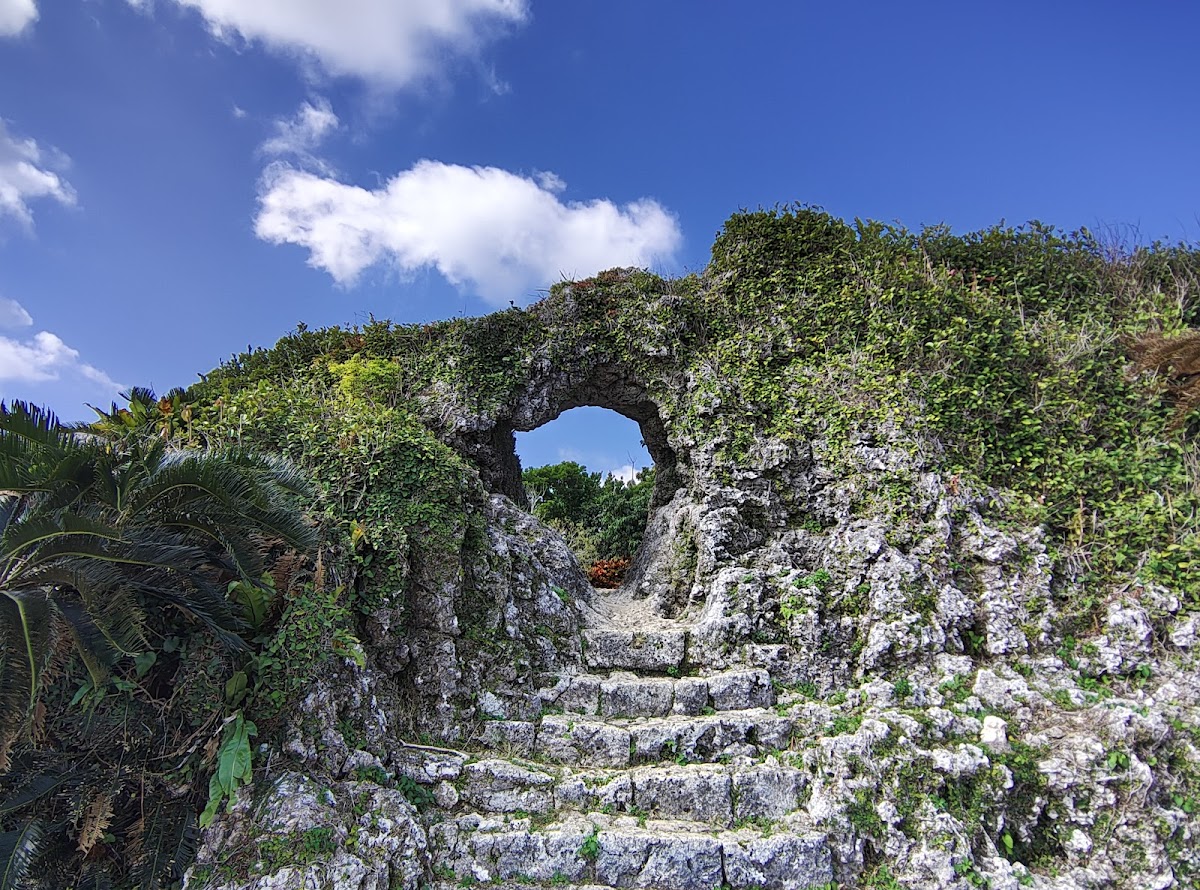
The remains of Shirugusuku that can be confirmed today are mainly parts of the stone walls. The stone walls, constructed from Ryukyu limestone, were built using a technique called “nozurazumi,” where natural stones are stacked as they are. This technique is commonly seen in early gusuku (Okinawan castles) and provides one clue to estimating the construction period of Shirugusuku.
The height of the stone walls is currently about 1-2 meters, but they may have been higher when they were built. Although some parts have collapsed due to years of wind, rain, and erosion by vegetation, the basic outline of the gusuku can still be confirmed.
Internal Structure
The interior of Shirugusuku is a relatively flat, open space. It is presumed that the residence of the Anji (local lord) and ritual facilities were located here, but there are almost no traces of buildings remaining. Because Okinawan gusuku were primarily wooden structures, the buildings themselves are often lost.
Judging from the size of the open space, it is thought that it had a complex function, combining a small residence and a central settlement facility, rather than being a large-scale military facility.
Highlights of Shirugusuku
Stone Wall Remains
The greatest highlight of Shirugusuku is the remaining stone wall remains. You can observe up close the whitish color characteristic of Ryukyu limestone and the skillful stonework techniques that combined natural stones. Because it is not as well-maintained as the gusuku sites registered as World Heritage Sites, it can be said to retain a more original form.
Subtropical plants have taken root in the gaps of the stone walls, creating a unique landscape where nature and the ruins are integrated. This atmosphere of a “ruin returning to nature” is a unique charm of Shirugusuku.
Views
From Shirugusuku, you can overlook the coastline of Zamami Island and the surrounding sea. Imagining the ancient lords watching over the sea from this spot evokes a sense of historical romance. Especially on clear days, you can enjoy the beautiful color of the sea, known as Kerama Blue.
Surrounding Natural Environment
The area around Shirugusuku is surrounded by subtropical forests, allowing you to observe vegetation unique to Okinawa. The area is lush with trees such as banyan and akagi, as well as ferns, making it a great place for nature walks. The experience of quietly exploring the historical ruins while listening to birdsong and insect sounds is a charm not found in urban gusuku (castles).
Historical Value
As a gusuku on an outlying island, it provides valuable evidence of how the Ryukyu Kingdom’s rule extended to the outlying islands. It is an important site for understanding the realities of local lords, distinct from the large-scale gusuku on the main island. Further research is expected from a historical research perspective.
Access
From Naha to Zamami Island
To visit Shirugusuku, you must first travel to Zamami Island. The departure point is Tomari Port in Naha City.
Access to Tomari Port:
- Approximately 11 minutes on foot from Yui Rail “Miebashi Station”
- Approximately 15 minutes by car from Naha Airport
- Approximately 10 minutes by car from central Naha
Ferry Services to Zamami Island:
- Ferry Zamami
- Travel time: Approximately 2 hours
- Fare: 2,120 yen one way (adult)
- Operates 1-2 times a day
- Vehicles can be loaded
- High-Speed Ferry Queen Zamami
- Travel time: Approximately 50 minutes to 1 hour 10 minutes
- Fare: 3,200 yen one way (adult)
- Operates 2-3 times a day
- May be cancelled due to weather
*Please note that the operating schedule varies depending on the season, so it is recommended to check the Zamami Village Office or the ferry company’s website in advance.
From Zamami Port to Shirugusuku
After arriving at Zamami Port, you will travel to the Ama area where Shirugusuku is located.
Using the Village Bus:
- Take the village bus from Zamami Port
- Get off at the “Ama” bus stop
- It’s about a 15-minute walk from the bus stop to the vicinity of Shirugusuku
- Buses are limited, so check the timetable.
Rent a Car, Bike, or Bicycle:
- Available for rent around Zamami Port
- The island is relatively small, so you can get around by bicycle.
- It’s about a 10-minute drive to the Ama area.
- There is no parking lot, so park in a safe place on the roadside.
Walking:
- It’s about a 40-50 minute walk from Zamami Port to the Ama area.
- There are ups and downs along the way, so it’s recommended for those confident in their physical fitness.
Notes for Visitors
Shirugusuku is not a well-maintained tourist facility, so please note the following points when visiting:
- Few Signposts: Ask a local or check a map beforehand.
- Watch Your Step: Some areas around the stone walls are unstable, so wear sturdy shoes.
- Bring your own water: There are no vending machines or shops nearby, so bring your own drinks for hydration.
- Sun protection: There is little shade, so bring a hat and sunscreen.
- Insect repellent: As it is a forested area, insect repellent spray is useful.
- Take your trash with you: There are no trash cans, so be sure to take your trash with you.
Zamami Island Tourist Information
Ama Beach
Ama Beach is the closest tourist spot to Shirugusuku. It is within walking distance and is known for its high chance of encountering sea turtles. It is ideal for snorkeling, where you can enjoy the crystal-clear waters and beautiful coral reefs.
Furuzamami Beach
This is a representative beach of Zamami Island and has received two stars in the “Michelin Green Guide Japan.” The white sandy beach and exceptionally clear waters are truly paradisiacal. It is about a 15-minute drive from Shirugusuku.
Takatsukiyama Observatory
Located at the highest point on Zamami Island, this observatory offers panoramic views of the Kerama Islands. On clear days, you can even see Tokashiki Island and Aka Island, making it a popular spot for stunning scenery.
Zamami Village Historical and Folk Museum
This facility allows you to learn about the history and culture of Zamami Island. Exhibits include materials from the Ryukyu Kingdom era and information about Zamami Island during World War II. Visiting before or after a visit to Shirugusuku will deepen your understanding.
Marine Activities
Zamami Island is known as one of the world’s leading diving spots. You can enjoy a variety of marine activities, including whale watching (winter), snorkeling, and kayaking.
Surrounding Gusuku and Historical Sites
Historical Sites on Zamami Island
Besides Shirugusuku, Zamami Island has several other historical sites. While detailed information is limited, exploring the island will reveal old stone structures and sacred sites (Utaki).
Other Islands in the Kerama Islands
Tokashiki Island:
Located next to Zamami Island, Tokashiki Island also has numerous gusuku (castle) ruins and historical sites. Tokashiki Gusuku is well-known, and you can enjoy exploring gusuku on this remote island.
Aka Island:
Aka Island, about a 15-minute boat ride from Zamami Island, also has historical sites and ruins. Although a small island, it’s a place where you can feel the faith and culture of Ryukyu.
Major Gusuku on Okinawa Main Island
By visiting the major gusuku on Okinawa Main Island in conjunction with Shirugusuku, you can gain a deeper understanding of Ryukyu castle culture.
World Heritage Site Gusuku Castles:
- Shuri Castle (Naha City): The political and cultural center of the Ryukyu Kingdom
- Nakijin Gusuku (Nakijin Village): The residence of the King of Hokuzan, characterized by its beautiful stone walls
- Zakimi Gusuku (Yomitan Village): A masterpiece by the renowned castle builder Gosamaru
- Katsuren Gusuku (Uruma City): The castle of the Anji who resisted the royal government to the very end
- Nakagusuku Gusuku (Nakagusuku Village/Kitanakagusuku Village): Well-preserved stone walls
Other Notable Gusuku Castles:
- Itokazu Gusuku (Nanjo City): Important as a war relic
- Tamagusuku Gusuku (Nanjo City): The site of the Ryukyu creation legend
- Chinen Gusuku (Nanjo City): Strongly sacred
History and Culture of Zamami Village
The Village’s Origins
Zamami Village is an island municipality comprised of Zamami Island, Aka Island, and Geruma Island in the Kerama Islands. While small in scale with a population of approximately 900 (as of 2024), it maintains a beautiful natural environment and a unique culture.
The village name “Zamami” originates from the Ryukyuan language, with several theories suggesting its meaning, including a combination of “sama” (shark) and “mi” (sea), or a combination of “sama” (various) and “mi” (fruit/abundance).
Zamami in the Ryukyu Kingdom Era
During the Ryukyu Kingdom era, Zamami was organized as a “magiri” (administrative district) and placed under the rule of the royal government. As a key point for maritime traffic, it was an economically important region, with trading ships from China and Southeast Asia calling at its port.
Fisheries and agriculture were also thriving, with the production of dried bonito (katsuobushi) being particularly well-known. Marine products played an important role as tribute to the royal government.
Modern and Contemporary History
After the Ryukyu annexation during the Meiji era, Zamami became part of Okinawa Prefecture. During World War II, it was the site of fierce fighting, resulting in many casualties. The mass suicide on Zamami Island is remembered as an important historical event conveying the tragedy of war.
After the war, the island recovered primarily through fishing, and since the 1970s, it has developed as a tourist destination for diving and marine leisure. In 2014, it was designated as part of the Kerama Islands National Park, aiming to balance nature conservation and tourism.
Traditional Culture
Zamami Village retains a strong presence of Ryukyuan traditional culture. Traditional events such as the Obon Eisa dance and the harvest festival are still passed down. Island songs and the sanshin (Okinawan stringed instrument) culture are also deeply rooted, forming the region’s identity.
Best Season to Visit Shirugusuku
Spring (March-May)
The temperature is mild, making it the ideal season for sightseeing. The sea is clear, allowing for both marine activities and castle tours. To avoid crowds during Golden Week, it’s best to visit at a time when you can enjoy a quieter visit to the ruins.
Summer (June-August)
This is Zamami Island’s peak season. It’s the perfect time for swimming and diving, but the high temperatures and strong sunshine make heatstroke prevention essential when visiting the castles. Mid-July onwards, after the rainy season ends, is recommended.
Autumn (September-November)
This coincides with typhoon season, increasing the risk of ferry cancellations. However, during sunny days between typhoons, there are fewer tourists, allowing for a more relaxed visit to the ruins. The weather becomes more stable from October onwards.
Winter (December-February)
Temperatures are around 15-20 degrees Celsius, which is milder than the mainland. While it’s too cold to swim in the sea, it’s whale watching season, and the weather is comfortable for visiting the castles. With fewer tourists, you can enjoy a quiet historical exploration.
Winter (December-February)
Temperatures are around 15-20 degrees Celsius, which is milder than the mainland. While it’s too cold to swim, it’s whale watching season, and the weather is comfortable for exploring the castles. With fewer tourists, you can enjoy a quieter historical exploration. ## Current Status and Challenges of Shirugusuku Research
Academic Research
Comprehensive archaeological investigations of Shirugusuku are limited. Due to its remote island location and lower priority compared to World Heritage sites, detailed excavations have not been conducted.
Current knowledge is based on surface surveys, documentary research, and local traditions. If systematic research is conducted in the future, new insights into the history of Zamami Island and the Ryukyu Kingdom’s governance of remote islands may be gained.
Preservation Challenges
Due to the lack of development, the remains are deteriorating due to natural erosion. Especially in the subtropical climate, vegetation grows rapidly, and the roots of trees covering the stone walls risk destroying the structure.
On the other hand, excessive development may diminish the original atmosphere of the site, making the balance between preservation and utilization a challenge.
Potential as a Tourism Resource
Zamami Island is primarily known as a marine leisure tourist destination, but utilizing historical sites like Shirugusuku could potentially strengthen its cultural tourism aspect.
Efforts to deepen visitors’ understanding are expected through the development of historical guided tours, the installation of information boards, and the enhancement of exhibits at the historical museum.
Visitor Feedback and Evaluation
It has received a certain level of praise from castle enthusiasts and history fans as a “hidden gusuku (castle) on a remote island.” It is also registered on “Kojodan,” a community site for castle lovers nationwide, where visit records and photos are shared.
Visitors have shared the following comments:
- “It has a simple charm, different from the World Heritage Gusuku castles.”
- “The atmosphere of the ruins integrated with nature is wonderful.”
- “Access is difficult, but it’s worth visiting.”
- “There were few signs, and it was difficult to find.”
- “I enjoyed both the beautiful sea of Zamami and the historical ruins.”
Model Course to Enjoy in Combination with a Visit to Shirugusuku
Day Trip Course (Zamami Island Only)
8:00 Depart from Naha/Tomari Port by high-speed ferry
9:00 Arrive at Zamami Port, rent a bicycle
9:30 Visit Shirugusuku (1 hour)
10:30 Snorkeling at Ama Beach (2 hours)
12:30 Lunch in Zamami Village
14:00 Takatsukiyama Observatory
15:00 Stroll along Furuzamami Beach
16:00 From Zamami Port, take a high-speed ferry to Naha
17:00 Arrive in Naha
1-Night, 2-Day Course (Enjoying Zamami Island)
Day 1:
- Morning: Travel from Naha to Zamami Island, check into accommodation
- Afternoon: Visit Shirugusuku, snorkel at Ama Beach
- Evening: Stroll through Zamami village, watch the sunset
- Night: Enjoy island cuisine at an island izakaya
Day 2:
- Morning: Marine activities at Furuzamami Beach
- Lunch: Takatsukiyama Observatory, Zamami Village Historical and Folk Museum
- Afternoon: Travel from Zamami Port to Naha
2-Night, 3-Day Course (Kerama Islands Tour)
Day 1: Zamami Island (Shirugusuku, Ama Beach)
Day 2: Day trip to Aka Island/Geruma Island, or diving on Zamami Island
Day 3: Continuing our tour of Zamami Island, now on to Naha
Summary
Shirugusuku is a Ryukyu-era castle ruin located on the remote island of Zamami Village in Okinawa Prefecture. Compared to the famous castles registered as World Heritage Sites, it is smaller in scale and has limited maintenance, but precisely because of this, it is a valuable historical site that retains its original form.
Due to its remote island location, visiting requires time and effort, but when enjoyed together with the beautiful natural environment of Zamami Island, it is an attractive destination where you can experience both the history and nature of Okinawa. It is a spot that we highly recommend for those interested in the history of the Ryukyu Kingdom, castle enthusiasts who enjoy visiting castles, and those who want to explore history in the quiet atmosphere of a remote island.
When visiting Zamami Island, be sure to visit historical sites like Shirugusuku in addition to marine activities. It will be a valuable experience where you can feel the history of Ryukyu firsthand.