
Tatsuta Castle, Ikoma District (Nara Prefecture) – Complete Guide to History, Highlights, and Access
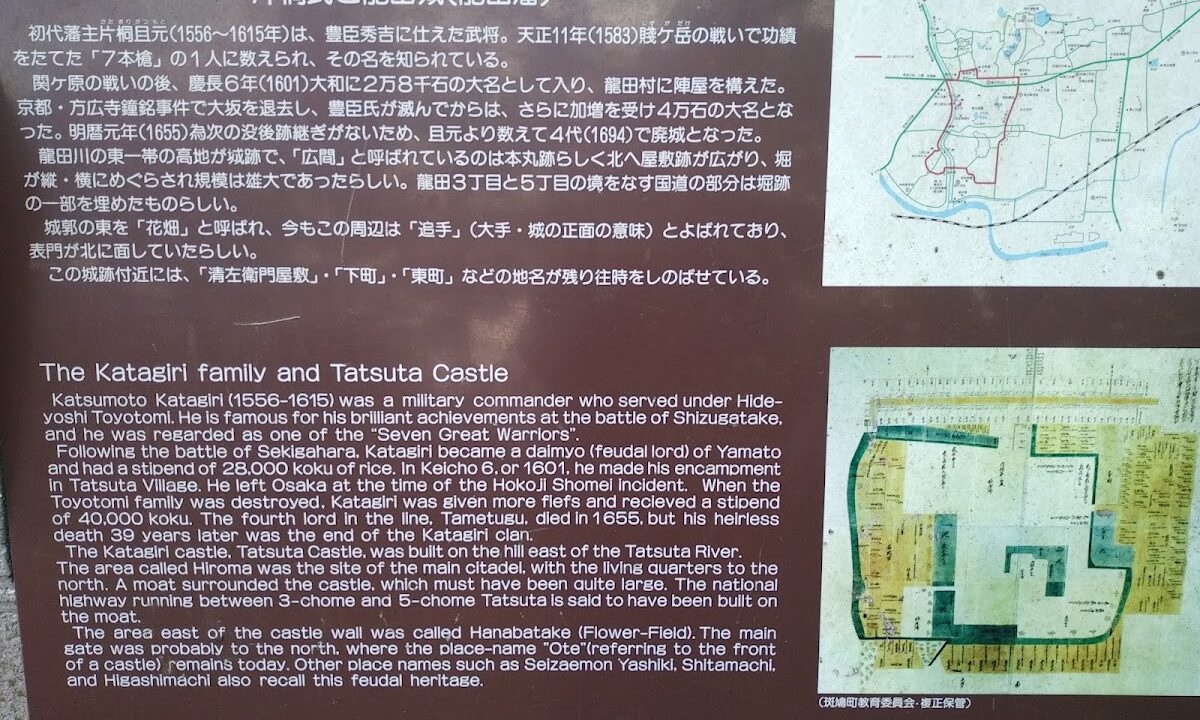
Tatsuta Castle is a flatland castle located in Tatsuta-minami, Ikaruga-cho, Ikoma-gun, Nara Prefecture, relatively close to Horyu-ji Temple. It has a history dating from the residence of the Tatsuta clan, monks of Kofuku-ji Temple’s Ichijo-in sub-temple, during the medieval period, to its development as the encampment of Katagiri Katsumoto in the early Edo period. Although now a residential area, traces of the past remain in the moat remains and topography.
History and Transformation of Tatsuta Castle
Medieval Period: Tatsuta Clan Residence Era
The exact date of Tatsuta Castle’s initial construction is unclear, but during the Muromachi period, it functioned as the base of the Tatsuta clan, monks affiliated with Kofuku-ji Temple’s Ichijo-in sub-temple. The Tatsuta clan was a samurai group responsible for the military power of Kofuku-ji Temple in Yamato Province, and they maintained their influence by establishing their residence in this area.
The Tatsuta clan’s residence was cleverly built on the edge of a small hill extending from the northern hills, possessing a defensive structure that utilized the natural terrain. It is said to have been used by the Tatsuta clan until the Tensho era (1573-1592).
It is believed that Tatsuta Castle was captured when Matsunaga Hisahide entered Shigisan Castle, as part of his expansion of power within Yamato Province. During this period, the conflict between Matsunaga Hisahide and the Kofuku-ji Temple forces intensified within Yamato Province, and it is presumed that Tatsuta Castle was affected by this conflict.
Early Edo Period: Katagiri Katsumoto and the Establishment of the Tatsuta Jinya
Tatsuta Castle first appears on the historical stage after the Battle of Sekigahara in 1600. Katagiri Katsumoto, who distinguished himself in battle under Tokugawa Ieyasu, was granted 24,000 koku in Heguri District, Yamato Province, in 1601, after being transferred from Ibaraki in Settsu Province. This led to the establishment of the Tatsuta Domain, and Tatsuta Castle was redeveloped as the Tatsuta Jinya (fortified residence), inheriting the site of the former Tatsuta clan residence.
Katagiri Katsumoto was a valiant general known as one of Toyotomi Hideyoshi’s trusted retainers and one of the Seven Spears of Shizugatake. He sided with the Eastern Army in the Battle of Sekigahara, gaining the trust of Tokugawa Ieyasu and being granted territory in Yamato Province. Katsumoto used Tatsuta Castle as his residence and governed the domain, making it one of the Edo Shogunate’s bases in Yamato.
Later, during the Siege of Osaka, Katagiri Katsumoto experienced the anguish of being caught between the Toyotomi and Tokugawa families. He struggled between his position as a chief retainer of the Toyotomi and his obligation to the Tokugawa, ultimately leading to his departure from Osaka Castle. This historical sequence illustrates the complex position Katagiri Katsumoto held.
The Rule of the Katagiri Family and the Development of the Tatsuta Domain
After Katagiri Katsumoto, the Katagiri family ruled this area for generations as the lords of the Tatsuta Domain. The Tatsuta Jinya (fortified residence) was developed as a flatland castle, and developed into a castle town structure including the surrounding settlements. The Jinya housed administrative functions and functioned as the center of the domain’s administration.
The Katagiri family’s rule continued throughout the Edo period, and they also engaged in regional development and flood control projects. They are said to have contributed to regional development through the improvement of the area around the Tatsuta River and agricultural land development.
After the Meiji Restoration and the abolition of the feudal domains and establishment of prefectures, the Tatsuta Domain was abolished, and the Tatsuta Jinya ceased to function. Subsequently, the castle site became privately owned land and is currently being developed as a residential area.
Structure and Layout of Tatsuta Castle
Utilization of Topography and Defensive Structure
The Tatsuta Castle site was built utilizing the tip of a small hill extending south from a northern hill. The castle’s layout, which takes advantage of the unique topographical features, demonstrates typical techniques of medieval castles.
Its location on the edge of a hill offers both excellent visibility and defensive capabilities due to natural elevation differences. Furthermore, the Tatsuta River functioned as a natural outer moat, strengthening the castle’s defenses.
Moat Arrangement and Existing Remains
Tatsuta Castle’s defensive system consisted of multiple moats. The main remains that can still be identified today are as follows:
Outer Moat: The Tatsuta River functioned as the outer moat. This river still flows today, and the topography suggests it played a crucial role as the castle’s outer defensive line.
Inner Moat: Hirata Pond and Higashimachi Pond are considered remnants of the inner moat. These ponds still exist and provide important clues to understanding Tatsuta Castle’s layout. The inner moat was the final line of defense protecting the castle’s core, and is thought to have surrounded the main facilities of the encampment.
These moat remains, though located within a residential area, are valuable historical relics that convey the castle’s structure at the time. ### Scale and Facilities of the Jinya (Fortified Residence)
The Tatsuta Jinya was developed as the residence of a daimyo (feudal lord) with a domain of 24,000 koku (a unit of rice production). It was a medium-sized fortified residence during the Edo period, and it is presumed to have contained a complex of buildings with administrative functions.
Within the fortified residence, there were the lord’s residence, government offices, and samurai residences, giving it a castle town-like structure. However, it is thought to have been a practical structure as a flatland castle fortified residence, rather than a large-scale castle with a keep or high stone walls.
Current Status and Highlights of the Tatsuta Castle Ruins
Current Site Conditions
The current Tatsuta Castle ruins are a residential area spanning from Tatsuta Minami 5-chome to 6-chome, Ikaruga-cho, Ikoma-gun, Nara Prefecture. While much of the remains have been lost due to housing development, the topography and moat traces allow us to imagine its former appearance.
Visiting the castle site, the ponds remaining within the residential area and subtle differences in elevation tell the story of the castle that once stood here. By observing the flow of the Tatsuta River and the surrounding topography, we can understand the ingenuity of the location selection for castles from the medieval to early modern periods.
Identifiable Remains
The main remains currently identifiable at the Tatsuta Castle site are as follows:
- Outer Moat (Tatsuta River): The Tatsuta River, flowing west of the castle, functioned as a natural outer moat. Even today, walking along the river allows one to experience the castle’s outer perimeter.
- Inner Moat (Hirata Pond/Higashimachi Pond): These ponds are considered remnants of the inner moat and are traces of defensive structures that protected the core of the castle. Hirata Pond, in particular, remains in relatively good condition, providing clues to the scale of the moat in its heyday.
- Topography: The location on the edge of a hill is still clearly defined, with a higher elevation than the surrounding area indicating the boundaries of the castle site.
Surrounding Historical Environment
Historically important facilities are scattered around the Tatsuta Castle site.
Horyuji Temple: Located close to Tatsuta Castle, Horyuji Temple is a World Heritage Site known as the world’s oldest wooden building. As a temple associated with Prince Shotoku, it forms the core of this region’s history.
Tatsuta Shrine: Located in Tatsuta 1-chome, Ikaruga-cho, Tatsuta Shrine enshrines a divided spirit of Tatsuta Honmiya (located in Misato-cho), where Prince Shotoku prayed for the construction of Horyuji Temple. It is said to have been founded as the guardian shrine of Horyuji Temple, and its deity is the wind god. The name of Tatsuta Castle also originates from the place name Tatsuta.
By visiting these historical sites and the Tatsuta Castle ruins together, you can experience the layered history of the Ikaruga region.
Tatsuta Castle and Katagiri Katsumoto
The Life of Katagiri Katsumoto
Katagiri Katsumoto (1556-1615) was a samurai who was active from the Sengoku period to the early Edo period. Born in Omi Province, he served Toyotomi Hideyoshi and achieved numerous military successes.
He gained fame as one of the “Seven Spears” at the Battle of Shizugatake, and continued to serve as a trusted general for Hideyoshi. During the Bunroku-Keicho War, he traveled to Korea and demonstrated his skills as a castle construction magistrate.
At the Battle of Sekigahara, he sided with the Eastern Army and distinguished himself under Tokugawa Ieyasu. For these achievements, in 1601 (Keicho 6), he was granted 24,000 koku in Heguri District, Yamato Province, becoming the lord of the Tatsuta Domain.
Between the Toyotomi and Tokugawa Families
The greatest trial in Katagiri Katsumoto’s life was being caught between the Toyotomi and Tokugawa families during the Siege of Osaka. While serving Hideyori as a chief retainer of the Toyotomi family, Katsumoto also felt a deep sense of gratitude towards the Tokugawa family and was deeply troubled by the deteriorating relations between the two families.
In 1614, following the Hōkō-ji Temple bell inscription incident, the conflict between the Toyotomi and Tokugawa families became decisive. Katsumoto dedicated himself to peace negotiations, but faced suspicion from hardliners within the Toyotomi family and was forced to leave Osaka Castle.
He fought on the Tokugawa side in the Winter and Summer Sieges of Osaka, but died of illness shortly after the fall of the Toyotomi family. Katsumoto’s struggles symbolize the complex position of a samurai during the transition from the Sengoku period to the Edo period.
Governance at Tatsuta Castle
Katagiri Katsumoto governed Yamato Province from Tatsuta Castle. Although his reign was relatively short, he worked to improve the Tatsuta Jinya (fortified residence) and stabilize the territory.
Katsumoto possessed not only military prowess but also excellent administrative skills, laying the foundation for the Tatsuta Domain. The basis for subsequent Katagiri family rule was formed during Katsumoto’s time.
Tatsuta Castle and Castles of Yamato Province
Castle Layout in Yamato Province
Yamato Province (present-day Nara Prefecture) was an important region within the Kinai area from ancient times, and many castles were built there. In the Middle Ages, the temple and shrine forces centered around Kofuku-ji Temple held great power, and castles and residences of monks were scattered throughout the region.
During the Sengoku period, Matsunaga Hisahide ruled Yamato Province from his base at Shigisan Castle, and afterwards, various daimyo were stationed there under the Toyotomi regime. During the Edo period, Yamato Province was divided and governed by the shogunate’s direct territories and smaller domains, and Tatsuta Domain was one of them.
Kofuku-ji Temple’s Power and the Castles and Residences of Monks
The residence of the Tatsuta clan, the predecessor of Tatsuta Castle, was a base for monks affiliated with Ichijo-in of Kofuku-ji Temple. Kofuku-ji Temple held great power in Yamato Province and possessed a large number of warrior monks and monks.
The Shūto were armed monks and lay warrior groups belonging to Kōfuku-ji Temple, responsible for defending the temple’s lands and securing its interests. The Tatsuta clan was one such Shūto, maintaining their power by establishing a residence in this area.
Numerous Shūto castles, like Tatsuta Castle, existed within Yamato Province, supporting the medieval system of governance centered around Kōfuku-ji Temple.
Access and Visiting Information
Location
The Tatsuta Castle ruins are located in Tatsuta-minami 5-chome to 6-chome, Ikaruga-cho, Ikoma-gun, Nara Prefecture. As it is a residential area, visitors should be considerate of the residents’ lives.
Access by Public Transportation
If using JR:
- Get off at Oji Station on the JR Kansai Main Line (Yamatoji Line)
- Get off at the Ikaruga Police Box bus stop on the Nara Kotsu Bus, approximately 3 minutes on foot
If using Kintetsu:
- Take a bus from Oji Station on the Kintetsu Ikoma Line
- Or take a Nara Kotsu bus from Tsutsui Station on the Kintetsu Kashihara Line
Bus schedules vary depending on the time of day, so we recommend checking the Nara Kotsu timetable in advance.
Access by Car
Access from Major Roads:
- Approximately 10 minutes from the Horyuji IC on the Nishi-Meihan Expressway
- Accessible via the prefectural road from National Route 25
There is no parking available around the castle ruins, so we recommend using the Horyuji Temple parking lot or public transportation.
Notes for Visitors
The Tatsuta Castle ruins are located in a residential area, and clear markers and information boards are limited. Please note the following points when visiting:
- Consideration for Residents: As the site is located within a residential area, please be mindful of noise and avoid trespassing on private property.
- Confirmation of Remains: By observing the topography, focusing on the remains of moats such as the Tatsuta River, Hirata Pond, and Higashimachi Pond, you can understand the structure of the castle.
- Estimated Time Required: Allow approximately 30 minutes to 1 hour for a stroll around the castle ruins.
- Combining with Nearby Facilities: Visiting nearby historical sites such as Horyu-ji Temple and Tatsuta Shrine in conjunction with the castle ruins will allow for a more fulfilling historical exploration.
Nearby Tourist Facilities
Horyu-ji Temple: A World Heritage Site within walking distance of the Tatsuta Castle ruins. Known as the world’s oldest wooden building, it offers views of Asuka period architecture and Buddhist statues.
Tatsuta Shrine: A shrine associated with Prince Shotoku, founded as the guardian shrine of Horyu-ji Temple. It enshrines the god of wind and is also known as the birthplace of the Kongo school of Noh theater.
Hokiji Temple: Like Horyu-ji Temple, it is a temple associated with Prince Shotoku, and its three-story pagoda is designated as a National Treasure.
By visiting these facilities in combination, you can experience the rich history and culture of Ikaruga.
Historical Significance of Tatsuta Castle
Transition from Medieval to Early Modern Period
The history of Tatsuta Castle symbolizes the transition from the medieval to the early modern period in Japan. The transformation from a residence for the monks of Kofuku-ji Temple to a daimyo’s encampment of the Edo Shogunate clearly shows the change in the power structure in Yamato Province.
In the medieval period, temples and shrines held immense power, but after the Sengoku period, they were incorporated into the shogunate system during the Edo period. Tatsuta Castle can be said to be a castle that embodies this process.
Historical Positioning of Katagiri Katsumoto
Through the figure of Katagiri Katsumoto, Tatsuta Castle conveys the struggles of a samurai during the transition from the Toyotomi regime to the Tokugawa regime. Katsumoto’s life illustrates the conflict between loyalty and political pragmatism, illustrating the difficulty of individual choices at turning points in history.
Importance in Local History
Tatsuta Castle is an important historical site for understanding the history of the Ikaruga region. In addition to the historical accumulation from ancient times centered around Horyu-ji Temple, it conveys the layered history of the region as a castle site that shows the history of samurai rule in the medieval and early modern periods.
Although it is now a residential area, the remains of the moat, such as the Tatsuta River and ponds, are valuable elements that convey the historical landscape of the region.
Summary
Tatsuta Castle is a historical castle located in Ikaruga-cho, Ikoma-gun, Nara Prefecture. It evolved from the residence of the Tatsuta clan, monks of Kofuku-ji Temple in the medieval period, to the encampment of Katagiri Katsumoto in the early Edo period. Although it is now a residential area, the remains of the moat, such as the Tatsuta River, Hirata Pond, and Higashimachi Pond, as well as the topography, retain traces of its former appearance.
Tatsuta Castle holds significant historical importance as the residence of Katagiri Katsumoto, a samurai who struggled between the Toyotomi and Tokugawa families, and as a site marking the transition from the medieval to the early modern period in Yamato Province.
Visiting Tatsuta Castle along with surrounding historical sites such as Horyu-ji Temple and Tatsuta Shrine allows you to experience the rich history of Ikaruga. Although the remains are limited, observing the topography and moat traces allows you to imagine the castle’s appearance in its heyday, making it a valuable historical site that offers a glimpse into a part of Japanese history.

