Yanagimoto Jinya Ruins, Tenri City (Nara Prefecture): Complete Guide: History Related to the Oda Family and Current Highlights
Located in Yanagimoto-cho, Tenri City, Nara Prefecture, the Yanagimoto Jinya Ruins are the site of the administrative center of the Yanagimoto Domain, ruled by the Oda family during the Edo period. Established in 1615 by Oda Naonaga, the fifth son of Oda Nagamasu (Yurakusai), known as the younger brother of Oda Nobunaga, the domain was ruled by the Oda family for approximately 250 years until the Meiji Restoration. While the site is now occupied by Yanagimoto Elementary School, the Jinya’s main building has been relocated and preserved as the Bunka-den (Cultural Hall) of Kashihara Shrine, and continues to thrive as an important historical heritage site.
The Establishment of the Yanagimoto Domain and the Genealogy of the Oda Family
Oda Yurakusai and the Birth of the Yanagimoto Domain
The establishment of the Yanagimoto Domain is deeply connected to the activities of the Oda family during the transition from the Sengoku period to the Edo period. Oda Nagamasu (Yurakusai, 1547-1622) was the younger brother of Oda Nobunaga. He survived the Honnoji Incident and served Toyotomi Hideyoshi and Tokugawa Ieyasu. He was also a renowned tea master and is known as the founder of the “Yuraku-ryu” school of tea ceremony.
In 1615, the year the Summer Siege of Osaka ended and the Tokugawa shogunate’s rule was established, Oda Naonaga, the fifth son of Yurakusai, was granted 10,000 koku in Shikigami-gun, Yamato Province. This marked the beginning of the Yanagimoto Domain. Although 10,000 koku was a small domain, its prestigious lineage as the Oda family and its relationship with the shogunate meant it received treatment equivalent to that of a castle lord.
Construction of the Jinya and the Yanagimoto Site
The Yanagimoto Jinya (fortified residence) is believed to have been fully developed during the Kan’ei era (1624-1644). Oda Naonaga established a fortified residence (jinya) measuring two cho square (approximately 200 meters square) in Yanagimoto, using it as his administrative center. The reason it was a jinya rather than a castle was due to the limitations imposed by his 10,000 koku (rice yield) and the Edo shogunate’s “One Castle Per Province” decree.
The reasons for choosing Yanagimoto include its strategic location as a transportation hub, the presence of numerous ancient burial mounds in the surrounding area making it geographically suitable for defense, and the historical fact that the Yanagimoto clan had already used the Kurozuka burial mound to build a fort since the Middle Ages.
Structure and Characteristics of the Yanagimoto Jinya
Layout and Size of the Jinya
The Yanagimoto Jinya, while relatively compact at two cho square, possessed all the necessary functions for a daimyo’s administrative center. The structure of the jinya was divided into a public space called the omotemuki (front) and a private space called the okumuki (back).
The omotemuki palace contained the area where the lord conducted official business, the meeting place with retainers, and the reception rooms for guests. This main hall was later relocated and rebuilt as the Bunka-den (Cultural Hall) of Kashihara Shrine. The inner sanctuary housed the living quarters of the feudal lord and his family, serving as their daily residence.
Defensive Facilities Utilizing Burial Mounds
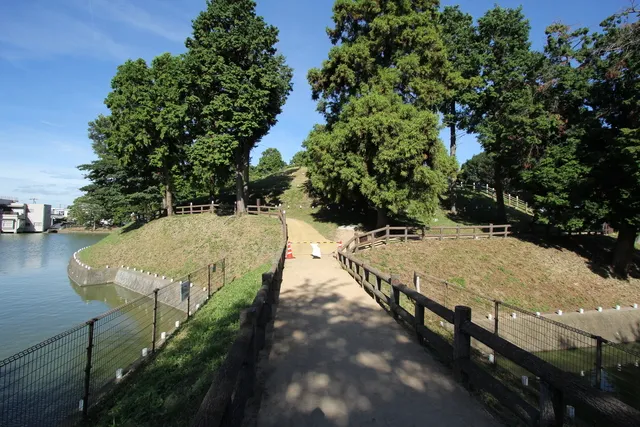
One of the most distinctive features of the Yanagimoto Jinya (fortified residence) is its use of burial mounds scattered throughout the surrounding area as defensive structures. In particular, the moat surrounding the Kurozuka burial mound was utilized as part of the fort’s moat. This reflects the history of the Yanagimoto clan building a fort at the Kurozuka burial mound during the medieval period.
While examples of repurposing burial mound remains for modern castle facilities are found throughout Japan, the Yanagimoto Jinya’s clear utilization of a burial mound’s moat is rare, making it an interesting example illustrating the layered history of this region. Currently, the area around the Kurozuka burial mound is developed as Yanagimoto Park, where burial mound artifacts can be seen in the exhibition hall.
Remaining Stone Walls and Structures
Some stone walls still remain at the site of the Yanagimoto Jinya. The stone walls of the Edo-period jinya (fortified residence) were not the towering stone walls of a castle, but rather relatively low stonework, yet they still demonstrated the technology and authority of the time.
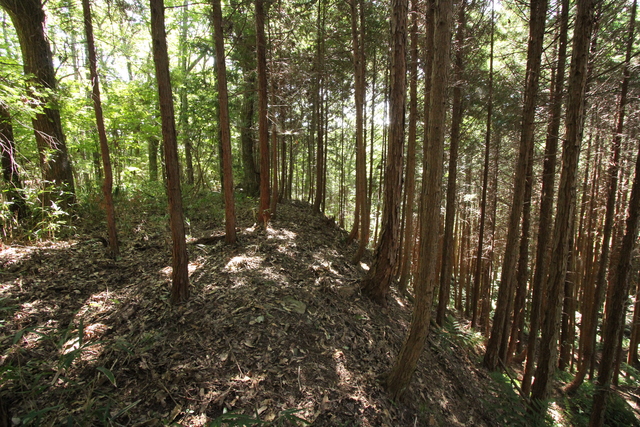
Within the grounds of Yanagimoto Elementary School, traces of the former jinya’s earthworks and moats remain as topographical features, and careful observation allows one to feel the remnants of the jinya era. However, since the site is used as a school facility, consideration for school operations is necessary when visiting.
History and Administration of the Yanagimoto Domain
Successive Lords and the Domain’s Governance
The Yanagimoto Domain began with the first lord, Oda Naonaga, and the Oda family served as lords until the Meiji Restoration. Despite being a small domain with a 10,000 koku (unit of rice production) yield, the Oda family maintained its prestigious status and received treatment equivalent to that of a castle lord from the shogunate. This means that even though it was a jinya, it was treated as a “castle lord.”
The domain’s administration required efficient governance within its limited rice yield. Improvements in agricultural production, promotion of commerce, and service to the shogunate required ingenuity unique to a small domain. The Yanagimoto Domain maintained a relatively stable administration within Yamato Province and reached the end of the Edo period without major unrest.
Reconstruction of the Jinya (fortified residence) during the Tenpo Era
The existing Kashihara Shrine Bunka-den (former Yanagimoto Jinya Omote-muki Goten) is believed to have been built in 1844 (Tenpo 15). This indicates that the Jinya’s palace was rebuilt during the late Edo period, during the Tenpo Reforms.
The Tenpo era was a time of frequent famines and uprisings throughout Japan, but it is thought that the Yanagimoto Domain also underwent financial reconstruction and facility improvements. The fact that the palace built during this period is still preserved as an important cultural property more than 170 years later is a testament to the high level of architectural technology at the time and the subsequent preservation efforts.
From the End of the Edo Period to the Meiji Restoration
During the end of the Edo period, the Yanagimoto Domain was also caught up in the turmoil of the times. From the Bunsei era to the end of the Edo period, amidst the political turmoil of the shogunate, small domains were forced to make choices for their survival. The Yanagimoto Domain ultimately sided with the new government and remained so until the Meiji Restoration.
With the abolition of the feudal domains and establishment of prefectures in 1871 (Meiji 4), the Yanagimoto Domain was abolished, and its administrative office ceased to function as a domain government. Afterward, the site of the administrative office underwent various transformations before finally being used as an educational facility.
Relocation to Kashihara Shrine’s Bunka-den
History and Timing of Relocation
The main hall of the Yanagimoto administrative office was relocated to Kashihara Shrine on December 1, 1966 (Showa 41). This was a measure to preserve the historically valuable palace architecture while the site of the administrative office was being used as Yanagimoto Elementary School.
Kashihara Shrine was chosen as the relocation site because it had a place within its grounds for preserving and exhibiting historical buildings, and because it provided a suitable environment for a historical heritage site of Yamato Province. The relocation work was carried out carefully, preserving the Edo period architectural style as much as possible.
Architectural Value of the Bunka-den
The former Yanagimoto Jinya Omote-muki Goten, preserved as the Bunka-den of Kashihara Shrine, is an extremely valuable example of late Edo period daimyo (feudal lord) palace architecture. Although more than 170 years have passed since its construction in 1844, it still conveys the architectural techniques and designs of the time.
The building is based on the Shoin-zukuri style, with a highly formal room configuration. Edo period craftsmanship is evident in every detail, from structural materials such as pillars and beams, to fittings such as shoji and fusuma, and even the tatami mats and ceilings. Such surviving daimyo palaces are rare nationwide, and the Bunka-den holds value as a representative example of samurai architecture in Yamato Province, earning it designation as an Important Cultural Property.
Current Use and Visiting
The Bunka-den of Kashihara Shrine is used as a facility of the shrine while maintaining its value as a historical building. The building is sometimes used as a venue for weddings and various events, and is still actively used as a building.
For general visitors, since it is located within the grounds of Kashihara Shrine, you can view the exterior in conjunction with a visit to the shrine. Regarding interior tours, there may be restrictions due to events, so it is recommended to inquire with Kashihara Shrine in advance.
Current Yanagimoto Jinya Site (Yanagimoto Elementary School)
Use as a School Facility
The Yanagimoto Jinya site is currently the site of Tenri City Yanagimoto Elementary School. Since the Meiji era, the Jinya site has been used as an educational facility, serving as a place of learning for local children. This is a good example of how a historical site can contribute to the modern community.
Within the school grounds, some of the topography and stone walls that retain the appearance of the former Jinya remain, and students experience historical heritage in their daily school life. The school also provides opportunities to learn about the history of Yanagimoto Jinya as part of its local history education.
Precautions and Access for Visitors
When visiting the Yanagimoto Jinya site, it is important to be mindful that it is currently a school facility. Entry to the grounds should be avoided during school hours and events. Visiting from the perimeter or during weekends and long holidays is recommended.
Access is very convenient, approximately a 5-minute walk from Yanagimoto Station on the JR Sakurai Line (Manyo Mahoroba Line). Heading north from the station and passing through a residential area, you will arrive at Yanagimoto Elementary School. Many historical sites, such as the Kurozuka Kofun and the Emperor Sujin Mausoleum, are located in the surrounding area, and visiting them together will allow you to gain a deeper understanding of Yanagimoto’s history.
Connections to Surrounding Historical Sites
The area surrounding the Yanagimoto Jinya Ruins is dotted with historical sites from various periods, from ancient to modern times. The following historical sites are particularly noteworthy:
Kurozuka Kofun: A keyhole-shaped burial mound constructed in the late 3rd to early 4th centuries. It was used as a fort for the Yanagimoto clan in the medieval period and as part of the defensive facilities of the Yanagimoto Jinya in the early modern period. Currently, it is maintained as Yanagimoto Park, and valuable excavated artifacts, such as a triangular-rimmed bronze mirror with divine beast motifs, can be seen in the exhibition hall.
Emperor Sujin’s Mausoleum (Andon-yama Kofun): This large keyhole-shaped burial mound is located approximately 500 meters south of the Yanagimoto Jinya (fortified residence) site and is managed by the Imperial Household Agency as the mausoleum of Emperor Sujin. It is an important tomb located within the territory of the Yanagimoto Domain.
Senkoin Temple: This is the family temple of the Oda family of the Yanagimoto Domain and houses the tombs of successive lords. It is close to the Jinya site and is an important temple for understanding the history of the domain.
Yanagimoto’s Townscape and Historical Landscape
Yanagimoto as a Castle Town
Yanagimoto developed as a Jinya town, forming a townscape lined with samurai residences and merchant houses. Despite being a small domain of 10,000 koku, it was a planned town centered around the Jinya, and its basic structure is still reflected in the current townscape.
Place names such as Yanagimoto-machi, Yanagimoto-machi Shinmachi, Kishida-machi, and Nakayama-machi reflect the former layout of the castle town. Merchant houses lined the main road, samurai residences were located around the jinya (fortified residence), and temples and shrines were strategically placed. Traces of this Edo-period urban planning can still be seen in the current townscape.
Historical Elements Remaining Today
Walking through present-day Yanagimoto-cho, one can find historical elements everywhere. The old merchant buildings, the placement of temples and shrines, and the curves of the roads all reflect the Edo-period town layout.
Especially around the jinya site, traces of the former moats and earthworks remain as topographical features, allowing us to infer the extent of the jinya from slight differences in elevation and road layouts. Furthermore, temples such as Senkoin are important elements that demonstrate the placement of temples and shrines in a castle town.
Relationship with Yanagimoto Airfield
Yanagimoto During Wartime
The existence of the Yamato Naval Air Base (commonly known as “Yanagimoto Airfield”) during World War II is also important when discussing the history of Yanagimoto. Around 1943, a naval airfield was constructed near Yanagimoto and used until the end of the war.
Although this airfield was located some distance from the Yanagimoto Jinya (fortified residence) site, the entire town was affected by the military facility. After the war, the airfield site was repurposed for farmland, residential areas, and public facilities, and currently, the Tenri City Environmental Clean Center is located there.
Layers of History
From the Kurozuka Kofun (ancient burial mound) of the Kofun period, to the Yanagimoto clan’s fort in the medieval period, the Yanagimoto Jinya of the early modern period, and the Yanagimoto Airfield of the modern era, layers of history have accumulated across different eras in Yanagimoto. This layering of history is a major characteristic and attraction of the Yanagimoto region.
Currently, Tenri City is making efforts to preserve modern history, such as installing explanatory signs at the Yanagimoto Airfield site. A comprehensive understanding of Yanagimoto’s continuous history from ancient times to the present day will lead to a deeper appreciation of the region’s value.
Historical Significance of the Yanagimoto Jinya Site
Position in the History of the Oda Family
The Yanagimoto Domain is a valuable example of a lineage descended from Oda Nobunaga’s younger brother, Urakusai, that survived until the Meiji era. The Oda family was a prestigious family that aimed for the unification of Japan during the Sengoku period, but after Nobunaga’s death, his descendants dispersed to various regions. The Yanagimoto Oda family, however, maintained a relatively stable position among them.
Urakusai himself was also known as a tea master and founded the “Uraku-ryu” school of tea ceremony. This cultural background is thought to have influenced the governance of the Yanagimoto Domain. The history of the Yanagimoto Jinya reveals the Oda family’s combination of samurai governing ability and cultural refinement.
Value as a Study of Small Domain Administration
Despite being a small domain of 10,000 koku, the Yanagimoto Domain survived for approximately 250 years. The history of the Yanagimoto Domain provides a valuable case study for the study of small domains, highlighting its unique administrative management, financial control, and relationship with the local community, which differ from those of large domains.
Within a limited rice yield, how could a small domain maintain its territory, govern its people, and fulfill its service to the shogunate? The ingenuity and struggles unique to a small domain can be gleaned from the Yanagimoto Jinya ruins and the remaining historical documents.
Preservation of Jinya Architecture and Palace
The Yanagimoto Jinya’s main palace, relocated and preserved as the Kashihara Jingu Bunka-den (Cultural Hall), is a valuable example of Edo period daimyo palace architecture. Nationwide, examples of jinya palaces being relocated and preserved are rare, making its architectural historical value extremely high.
The Bunka-den offers much information regarding Tenpo-era architectural techniques, the Shoin-zukuri style, and the spatial composition that reflects the status of a daimyo. This is not merely the preservation of a building, but a cultural asset that conveys Edo period samurai culture itself.
Practical Information for Your Visit
Access Details
Public Transportation:
- Get off at Yanagimoto Station on the JR Sakurai Line (Manyo Mahoroba Line), approximately 5 minutes on foot.
- Approximately 10 minutes from Tenri Station to Yanagimoto Station.
- Approximately 30 minutes from Nara Station via the Sakurai Line.
By Car:
- Approximately 15 minutes from the Tenri Interchange on the Nishi-Meihan Expressway.
- There is no dedicated parking lot at Yanagimoto Elementary School; please use nearby public parking lots.
- Parking is available at the Kurozuka Kofun Exhibition Hall.
Model Tour Course
We introduce a model course for efficiently visiting historical sites around Yanagimoto.
Half-Day Course (Duration: Approx. 3 hours)
- JR Yanagimoto Station (Start)
- Exterior View of Yanagimoto Jinya Ruins (Yanagimoto Elementary School) (20 minutes)
- Kurozuka Tumulus and Exhibition Hall (60 minutes)
- Emperor Sujin’s Mausoleum (Andonyama Tumulus) (30 minutes)
- Senkoin Temple (Oda Family Cemetery) (30 minutes)
- Stroll through the townscape of Yanagimoto (30 minutes)
- JR Yanagimoto Station (Goal)
Full-Day Course (Duration: Approx. 6 hours)
In addition to the above half-day course:
- Kashihara Jingu Bunka-den (2-3 hours including travel time)
- Other historical sites in Tenri City (Isonokami Jingu Shrine, etc.)
Nearby Tourist Facilities
Kurozuka Tumulus Exhibition Hall:
- Opening Hours: 9:00-17:00 (Last entry at 16:30)
- Closed: Mondays (or the following day if Monday is a public holiday), New Year holidays
- Admission: Free
- Valuable exhibits including a replica of a triangular-rimmed bronze mirror with divine beast motifs
Tenri City Tourist Information Center:
- In front of JR Tenri Station
- Detailed information and brochures about the Yanagimoto area are available.
Sengyoin Temple:
- The family temple of the Oda clan of the Yanagimoto domain
- Contains the graves of successive feudal lords
- Advance notice is required for visits.
Guidelines for Visitors
- Consideration for School Facilities: Yanagimoto Elementary School is an active educational facility. Please avoid visiting during class hours and limit your visit to the perimeter.
- Photography: When taking photographs on school grounds, please be considerate of the privacy of the children.
- Respect for the Community: Yanagimoto is also a residential area. Please be mindful of the residents’ lives.
- Prior Study: Learning about the history of the Yanagimoto Jinya and the Oda clan before your visit will lead to a deeper understanding.
- Seasonal Selection: Spring cherry blossoms and autumn foliage are highly recommended, as the surrounding scenery is beautiful during these seasons.
Summary: The Historical Value of the Yanagimoto Jinya Ruins
The Yanagimoto Jinya Ruins are a valuable historical site that conveys the history of a small Edo period domain, as it was the administrative center of the Yanagimoto Domain, ruled by a descendant of Oda Nobunaga’s younger brother, Urakusai. While it now serves as Yanagimoto Elementary School, the jinya’s palace has been relocated and preserved as the Kashihara Jingu Bunka-den (Cultural Hall), and holds significant value as a surviving example of Edo period daimyo palace architecture.
The Yanagimoto Jinya Ruins offer multi-layered historical insights, including the jinya’s structure utilizing the Kurozuka Kofun (ancient burial mound) from the Kofun period as a defensive structure, the status of the Oda family who received treatment equivalent to that of a castle lord despite being a small domain of 10,000 koku, and the architectural techniques of the palace rebuilt during the Tenpo era.
Visiting the town of Yanagimoto allows you to experience the layered complexity of its history, which has continued uninterrupted from ancient times to the modern era. Visiting the surrounding historical sites, such as the Kurozuka Kofun, Emperor Sujin’s Mausoleum, and Senkoin Temple, along with the Yanagimoto Jinya Ruins, will allow you to gain a deeper understanding of the history and culture of Yamato Province.
For history enthusiasts, architecture lovers, those tracing the history of the Oda family, or anyone searching for hidden historical sites in Nara, the Yanagimoto Jinya Ruins are well worth a visit. While now used as a modern school facility, the history etched into the land certainly lives on, teaching us about the continuity between the past and the present.