Hiraga Castle (Saku City, Nagano Prefecture) Complete Guide | History, Remains, Access, and Highlights Explained in Detail
What is Hiraga Castle? | A Strategic Mountain Castle Overlooking the Saku Plain
Hiraga Castle is a medieval mountain castle located in Hiraga, Saku City, Nagano Prefecture. Built on a mountaintop approximately 840 meters above sea level, the castle boasts an extremely advantageous strategic location, offering a panoramic view of most of the Saku Plain.
From the late Heian period to the Sengoku period, it functioned as the residence of the Hiraga clan, a powerful local family, and later became an important base during the Takeda clan’s invasion of Shinano Province. Currently designated as a Nagano Prefecture Historic Site, numerous remains such as baileys and stone walls are well-preserved.
Basic Information on Hiraga Castle
Common Name/Alternate Name: Hiraga Clan Castle, Tatsuoka Castle (in some documents)
Location: Hiraga, Shirohira, Saku City, Nagano Prefecture
Former Province: Shinano Province
Classification/Structure: Mountain Castle
Elevation: Approximately 840 meters (relative height approximately 100-130 meters)
Builder: Hiraga Yoshinobu (legend)
Year of Construction: Around Genryaku 1 (1184) (legend), actual construction date unknown
Main Lords: Hiraga clan, subordinates of the Takeda clan
Year of Abandonment: Estimated to be after the fall of the Takeda clan in Tensho 10 (1582)
Remains: Enclosures, stone walls, moats, earthworks
Designated Cultural Property: Nagano Prefecture Designated Historic Site (designated May 27, 1971)
History of Hiraga Castle | From the Hiraga Clan to the Takeda Clan
The Establishment of the Hiraga Clan and the Construction of Hiraga Castle
The history of Hiraga Castle dates back to the late Heian period. According to tradition, it was built in 1184 by Hiraga Yoshinobu.
The ancestors of the Hiraga clan are said to be descendants of Shinra Saburo Yoshimitsu (Minamoto no Yoshimitsu). Yoshimitsu’s son, Minamoto no Yoshimori, established a residence in Hiraga and called himself “Hiraga Kanja,” and it is said that Hiraga Castle, a mountain castle, was built during the time of his son, Yoshinobu. Another theory suggests that Moriyoshi, the younger brother of Minamoto no Yoshikiyo (the ancestor of the Kai Takeda Minamoto clan), resided in Hiraga and adopted the name Hiraga.
The Hiraga clan was a powerful local lord in the Saku region and held considerable influence in the area. Hiraga Castle is thought to have functioned not merely as a residence, but as a strategic base for controlling the Saku Plain.
The Hiraga Clan and the Battle of Otō in the Muromachi Period
During the Muromachi period, the Hiraga clan became embroiled in the political turmoil of Shinano Province.
In the Battle of Otō in 1400 (Ōei 7), the Hiraga clan, along with other local lords of Saku County (such as the Bannō and Ōi clans), fought against the shugo (provincial governor) Ogasawara Nagahide. This battle was part of a power struggle over the shugo of Shinano Province and indicates that the local lords of the Saku region were trying to maintain a certain degree of autonomy.
In 1446 (Bun’an 3), the main branch of the Hiraga clan is said to have been destroyed in conflict with the Ogasawara and Ōi clans. During this period, conflicts between lords in the Saku region intensified, and it appears the Hiraga clan was caught in the middle of this turmoil.
The Takeda Clan’s Invasion and the Seizure of Hiraga Castle
With the arrival of the Sengoku period (Warring States period), the fate of Hiraga Castle changed dramatically.
In 1541, Takeda Nobutora of Kai Province, along with Murakami Yoshikiyo and Suwa Yorishige, invaded Chiisagata District and drove the Unno clan out of Unno Plain (Battle of Unno Plain). It is presumed that Hiraga Castle was seized by the Takeda clan at this time.
Subsequently, as the Takeda clan’s invasion of Shinano Province intensified, Hiraga Castle, along with Maeyama Castle (Saku City), was developed as an important base for the Takeda army’s Shinano campaign. To conquer the Saku region, the Takeda clan renovated and strengthened existing castles, building a military network.
Due to its location overlooking the Saku Plain, Hiraga Castle is thought to have functioned as a monitoring post for the surrounding area and a command center for military operations. A Takeda general was stationed as the castle lord, playing a crucial role in supporting the Takeda clan’s rule over Shinano.
Hiraga Castle After the Fall of the Takeda Clan
In 1582, when the Takeda clan was destroyed by the Oda-Tokugawa allied forces, it is believed that Hiraga Castle also ended its historical role. Subsequently, with Tokugawa Ieyasu’s entry into the Kanto region, the Saku region came under Tokugawa control, but there are no records of Hiraga Castle being reused.
With the end of the Sengoku period, Hiraga Castle, as a mountain castle, was abandoned and has since remained a local historical heritage site.
Hiraga Castle’s Layout and Remains | Characteristics of the Terraced Enclosures
Overall Structure of the Castle Area
The most distinctive feature of Hiraga Castle is the numerous terraced enclosures spread across the southern slope. A castle with so many terraced enclosures is rare in this region, indicating the power of the Hiraga clan and the scale of their retainers.
The castle area extends along the ridge and southern slope, centered on the mountaintop at an altitude of approximately 840 meters. The castle is located approximately 100-130 meters above the foot of the mountain, above Shōanji Temple.
The main enclosure (Shukaku) is at the center, surrounded by other major enclosures such as the second and third enclosures, with numerous smaller enclosures arranged in a stepped pattern. This tiered arrangement of enclosures is thought to have served not only as a defensive function but also as living space to accommodate many retainers.
Main Enclosure and Surroundings
The main enclosure is located at the highest point of the castle and is presumed to have housed the lord’s residence and command post. From the main enclosure, one can see a wide view of the Saku Plain, making it an ideal location for military surveillance.
Defensive structures such as earthworks and moats are located around the main enclosure, demonstrating efforts to prevent enemy intrusion. The second and third enclosures, adjacent to the main enclosure, also have relatively large flat areas, forming an important defensive line.
Stone Masonry Remains
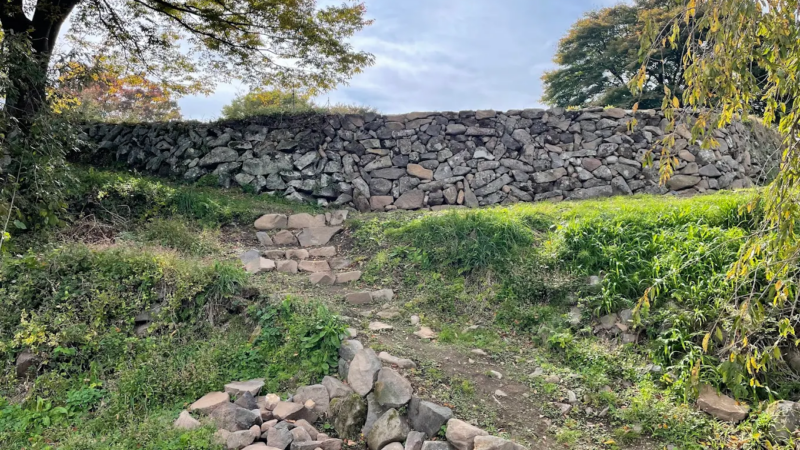
Stone masonry remains can be found in various places at Hiraga Castle. These were used to reinforce the edges of the baileys and pathways, playing a role in strengthening the castle’s structure.
The stonework is a simple method using natural stones, predating the introduction of advanced stonework techniques, but it was an important element in enhancing the defensive capabilities of the mountain castle. It’s possible that stronger stonework was added during renovations by the Takeda clan.
Arrangement of the Baileys
On the southern slope of Hiraga Castle, more than 10 terraced baileys are arranged in a continuous pattern. These baileys are narrow and elongated, lined up in a step-like fashion along the slope.
This group of baileys is thought to have functioned not only as defensive belt baileys but also as residential areas for retainers. The existence of numerous baileys is evidence that the Hiraga clan had many retainers.
Moats and Outworks
Moats were constructed at key points within the castle grounds, preventing enemy incursions from the ridges. The moats were excavated using the terrain, forming an effective defensive line. Furthermore, outworks, believed to be fortified enclosures, have been identified in locations away from the main area, demonstrating an effort to expand the castle’s defensive range.
Access and Routes to Hiraga Castle
Location of the Entrance
There are several entrances to Hiraga Castle, but the most common route is from the direction of Takifudoji Temple (Shoanji Temple).
Main Entrance: A route climbing the mountain path from near Takifudoji Temple (Shoanji Temple)
There is a convex mirror near the entrance, and you can enter the mountain path from there. Access is also possible from just before the cemetery. The entrance to the hiking trail is located beyond a residential area, and sometimes there are signposts.
Precautions When Visiting Hiraga Castle
Hiraga Castle is a mountain castle with an elevation difference of over 100 meters. The following points should be noted when visiting:
- Estimated Time: Approximately 20-30 minutes on foot from the entrance to the main keep.
- Attire: Appropriate clothing and shoes for mountain hiking are necessary.
- Season: Spring to autumn is suitable for visiting, but in summer, vegetation can make the path difficult to follow.
- Safety: Avoid visiting alone; it is advisable to go in a group.
- Items to Bring: Bring drinking water, a map, a mobile phone, etc.
Access by Car
Nearest Interchange: Approximately 10 minutes from the Saku Interchange on the Joshinetsu Expressway.
Parking: There may be a few parking spaces near the entrance, but be careful not to park on the road.
Access by Public Transportation
Nearest Station: JR Koumi Line The castle entrance is approximately a 30-minute walk from Kita-Nakagomi Station.
If using public transportation, it’s a bit of a distance from the station, so consider taking a taxi.
Surrounding Area Map and Location
Hiraga Castle is located in the southwestern part of Saku city, and the following castle ruins are located nearby:
- Uchiyama Castle: Approximately 2 kilometers northeast of Hiraga Castle
- Maeyama Castle: A castle related to the Takeda clan within Saku city
- Banno Castle: A representative medieval castle in Saku city
Visiting these castle ruins together will help you understand the medieval castle network of the Saku region.
Highlights and Attractions of Hiraga Castle
1. A Spectacular View of the Saku Plain
The greatest attraction of Hiraga Castle is undoubtedly the panoramic view of the Saku Plain from the main enclosure. From the mountaintop at an altitude of 840 meters, you can see the entire Saku Basin, and on a clear day, you can even see Mount Asama and the Yatsugatake mountain range.
This view is not only beautiful, but it also gives a real sense of the strategic importance of this castle during the Sengoku period. You can understand that it was an ideal location for monitoring enemy movements from afar and directing military operations.
2. The Spectacular Terraced Enclosures
The numerous terraced enclosures lining the southern slope are the most distinctive feature of Hiraga Castle. The arrangement of more than 10 enclosures in a stepped fashion is extremely interesting as a mountain castle layout.
By walking through and examining each of these enclosures, you can imagine the scale of the castle and the composition of the retainers at the time.
3. Observation of Stone Masonry Remains
The stone masonry remaining in various places is valuable for understanding the techniques of medieval mountain castles. You can observe the technique of skillfully stacking natural stones up close.
By observing the arrangement and structure of the stone masonry, you can learn about the castle’s defensive system and construction techniques.
4. A Mountain Castle Experience That Evokes Historical Romance
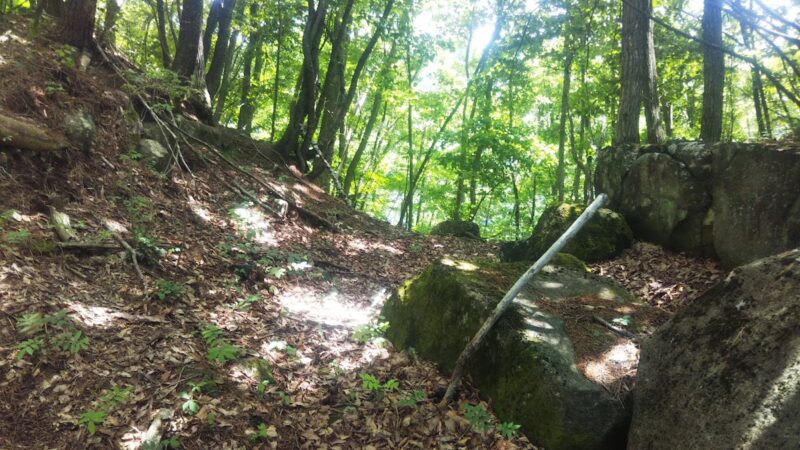
Hiraga Castle is a simple mountain castle that hasn’t been commercialized for tourism. Because there are few well-maintained walking paths or signposts, you can enjoy the pleasure of discovering the ruins on foot and imagining history.
Climbing the mountain paths, exploring the baileys, and crossing the moats gives you a sense of reliving the lives and battles of samurai during the Sengoku period.
5. Photo Spots
- View of the Saku Plain from the main bailey
- Panoramic view of the terraced baileys
- Close-up of the stone masonry remains
- Defensive structures such as moats and earthworks
These are attractive subjects for castle enthusiasts to photograph.
Tourist Spots Around Hiraga Castle
Other Castle Ruins in Saku City
Uchiyama Castle: A mountain castle located about 2 kilometers from Hiraga Castle. Visiting it together with Hiraga Castle is recommended.
Banno Castle: One of the representative medieval castles in Saku City. Known as the residence of the Banno clan.
Maeyama Castle: One of the Takeda clan’s bases for their invasion of Shinano Province. Like Hiraga Castle, it was developed by the Takeda clan.
Tatsuoka Castle Goryokaku
Located in Taguchi, Saku City, it is one of only two Goryokaku (square-shaped fortifications) in Japan. Built in the late Edo period, it is a Western-style castle from a different era than Hiraga Castle, but it is an important spot for understanding the castle history of Saku City.
Saku City Museum of Modern Art
As a cultural facility of Saku City, it exhibits local history and works of art.
Hot Spring Facilities
There are several hot spring facilities around Saku City, perfect for relaxing after visiting the castles.
Historical Value and Preservation Status of Hiraga Castle
Designation as a Prefectural Historic Site
Hiraga Castle was designated as a Nagano Prefecture Historic Site on May 27, 1971. This indicates that Hiraga Castle is an important historical site for understanding the medieval history of Nagano Prefecture.
Hiraga Castle holds significant historical value as a castle of a local lord in the Saku region and as a military base during the Takeda clan’s invasion of Shinano Province.
Preservation of the Remains
The remains of Hiraga Castle are relatively well-preserved because they have not been affected by development. The shape of the baileys, stonework, and moats retain their original form, making them valuable resources for understanding the structure of medieval mountain castles.
However, due to natural weathering and overgrown vegetation, some remains are difficult to see.
Future Preservation and Utilization
Preserving medieval mountain castles like Hiraga Castle requires regular maintenance, such as mowing and surveying. Appropriate preservation and utilization are essential for its status as a regional historical heritage site and a tourist resource.
Visits by castle enthusiasts and history buffs will help raise awareness of the site’s value and increase interest in its preservation.
How to Enjoy Your Visit to Hiraga Castle
Preparation Beforehand
To fully enjoy Hiraga Castle, preparation is essential:
- Learning History: Learning about the history of the Hiraga and Takeda clans, and the medieval history of the Saku region beforehand will deepen your understanding at the site.
- Obtaining a Layout Map: Obtaining a layout map from castle-related books or websites and comparing it with the map at the site is effective.
- Preparing Equipment: Prepare hiking boots, long-sleeved shirt and long pants, a hat, gloves, and drinking water.
Points to Note During Your Visit
- Confirming the Layout of the Enclosures: Visit each enclosure in order from the main enclosure, considering their layout and function.
- Observing the Stonework: Observe the stonework in various locations and note its structure and construction characteristics.
- Confirming the View: From the main enclosure, gaze upon the Saku Plain and appreciate the strategic value of this castle.
- Confirming Defensive Structures: Examine defensive structures such as moats and earthworks to understand the castle’s defensive system.
How to Record Your Findings
- Photography: Take photos of the remains and views to record them.
- Sketching: Sketching the layout and stonework will lead to a deeper understanding.
- Notes: Taking notes of your observations and impressions will be helpful when reviewing later.
Reviews and Ratings of Hiraga Castle
From castle enthusiasts, the following comments have been heard:
- “The tiered arrangement of baileys is magnificent, and you can really feel the power of the Hiraga clan.”
- “The view from the main bailey is superb, and the strategic location is very clear.”
- “The remains, such as the stone walls, are well-preserved, making it ideal for learning about the structure of medieval mountain castles.”
- “The path to the castle is a little difficult to find, but that adds to the sense of adventure.”
- “The natural state, which is not overly developed, is all the more appealing.”
On the other hand, there are also comments such as “There are few signposts and parking lots” and “The path to the castle is not well-maintained,” making it a castle site that is somewhat difficult for beginners.
Summary | Hiraga Castle: A Valuable Mountain Castle that Tells the History of the Saku Region
Hiraga Castle is a representative example of a medieval mountain castle remaining in Saku City, Nagano Prefecture. Beginning as the residence of the Hiraga clan and becoming a base for the Takeda clan’s invasion of Shinano, this castle is an indispensable part of the history of the Saku region.
The numerous terraced enclosures, the well-preserved stone structures, and the breathtaking panoramic views of the Saku Plain make Hiraga Castle well worth a visit, even for those who aren’t castle enthusiasts.
Climbing the castle requires some physical fitness and preparation, but it offers a valuable opportunity to experience a mountain castle from the Sengoku period. When visiting Saku City, be sure to visit Hiraga Castle and feel the traces of history etched into this land.
Protected as a Nagano Prefecture historical site, Hiraga Castle is a cultural asset that should be carefully preserved as a regional historical heritage site and an important site for understanding the history of Japanese castles.