Complete Guide to Uminokuchi Castle (Minamimaki Village, Minamisaku District, Nagano Prefecture) | History and Highlights of Takeda Shingen’s First Battle
What is Uminokuchi Castle?
Uminokuchi Castle (also known as Uminokuchi-jo or Uminokuchi-jo) is a Sengoku period mountain castle located in Uminokuchi, Minamimaki Village, Minamisaku District, Nagano Prefecture. It is also sometimes written as “Uminokuchi Castle” or “Torii Castle,” and is widely known among history enthusiasts as the castle where Takeda Shingen fought his first battle at the young age of 16.
Built on the summit of the western ridge of Shiroyama Mountain at an altitude of 1357.7m, this castle, situated on a rugged terrain with a relative height of approximately 220m, played an important role as a relay point and supply base during the Takeda clan’s conquest of Shinano Province. Currently, only the castle ruins remain, with deep moats and remnants of baileys conveying the atmosphere of that time.
Basic Information on Uminokuchi Castle
Location Information
- Location: Around 348 Uminokuchi, Minamimaki Village, Minamisaku District, Nagano Prefecture
- Former Province: Shinano Province
- Elevation: 1357.7m (Summit of the castle mountain)
- Relative Height: Approximately 220m
- Location: East side of Oshiba Pass, east of National Route 141
Classification and Structure
- Castle Classification: Mountain Castle
- Structure: Structure close to a single enclosure, multi-enclosure type
- Main Remains: Main enclosure (Honmaru), second enclosure, third enclosure, moat, earthworks
- Construction Period: Unknown (Estimated to be the Sengoku period)
- Abandonment Period: Unknown
- Common Names/Alternate Names: Torii Castle, Uminokuchi Castle
Designated Cultural Property
Currently, Uminokuchi Castle is not designated as a national, prefectural, or municipal cultural property. However, due to its historical value as the site of Takeda Shingen’s first battle, it is recognized as an important historical site in the region.
History and Background of Uminokuchi Castle
Background of Construction and Lord
The exact construction date of Uminokuchi Castle is unknown due to a lack of historical records, but it is believed to have already existed during the Eisho-Daiei period (around 1504-1532). This castle functioned as an outpost of Hiraga Genshin (Hiraga Nariyori).
The Hiraga clan had their main base, Hiraga Castle, in present-day Hiraga, Saku City. Uminokuchi Castle served as a branch castle, playing a frontline base to prepare for invasions from Kai Province (present-day Yamanashi Prefecture). From the Eisho-Daiei period onward, the Hiraga clan frequently clashed with the Takeda clan of Kai, engaging in fierce battles.
The Legend of Takeda Shingen’s First Battle
Kainokuchi Castle is most historically significant because it was the site of Takeda Shingen’s (then known as Harunobu) first battle, which is said to have taken place in 1536.
According to the *Koyo Gunkan*, Takeda Harunobu, then only 16 years old, accompanied his father, Takeda Nobutora, on his invasion of Shinano Province. In this battle, Harunobu volunteered to serve as the rearguard (a crucial role in protecting the rear during a retreat), leading approximately 300 soldiers in a surprise attack on the Hiraga army defending Kainokuchi Castle, successfully capturing the castle.
This exploit in his first battle is recounted as an early example of the military talent of Takeda Shingen, who would later be known as the “Tiger of Kai” and the “Strongest of the Sengoku Period.” This battle, in which the young Shingen achieved victory through a bold strategy, became a crucial turning point in his gaining the trust of the Takeda retainers.
Discussion Regarding Historical Accuracy
However, there are historical issues with the story of the first battle at Uminokuchi Castle. Details of this battle are only recorded in the *Koyo Gunkan*, and cannot be confirmed in other contemporary historical sources. The *Koyo Gunkan* itself is a military chronicle compiled in the early Edo period, and it has been pointed out that it may contain a mixture of historical fact and fiction.
Therefore, among modern historians, there is a discussion that this story of the first battle may be a later fabrication. However, even if there is a theory of fictionality, it is considered a fact that the Takeda clan captured Uminokuchi Castle during their invasion of Shinano Province, and there is no doubt that this castle was an important base in the Takeda clan’s conquest of Shinano.
Use and Abandonment by the Takeda Clan
After capturing Uminokuchi Castle, the Takeda clan used it as a relay point and supply base in their conquest of Shinano Province. Its high elevation and good vantage point made it ideal as a military observation post, and it was also a strategic point on the route from the Saku region to the Suwa area.
Much of the detailed history of Uminokuchi Castle remains unknown, and it is unclear when it was abandoned. After the Takeda clan established their control over Shinano Province, more bases closer to the plains were developed, leading to a decline in the strategic importance of Uminokuchi Castle as a mountain castle.
Structure and Highlights of Uminokuchi Castle
Layout and Overall Structure
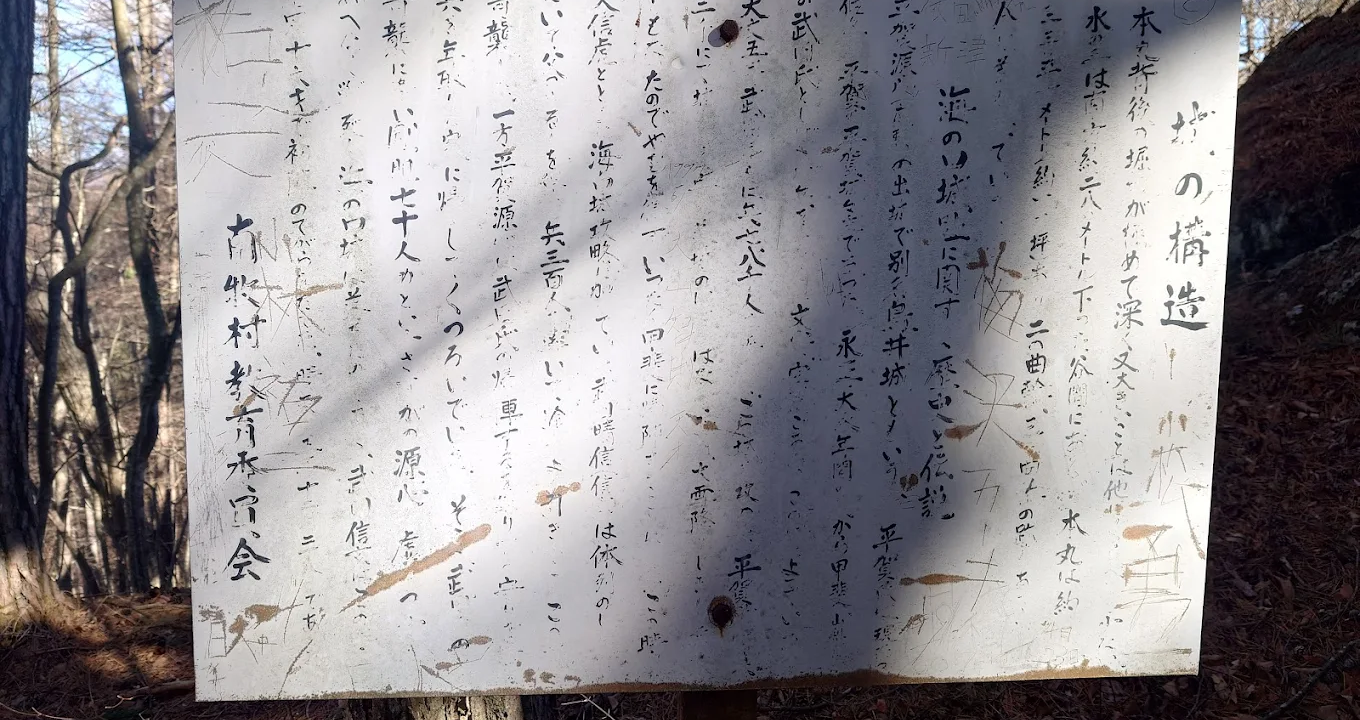
Uminokuchi Castle is a typical mountain castle built on the summit of the western ridge of Shiroyama Mountain, at an elevation of 1357.7m. While it has a structure close to a single enclosure, it possesses a defensive system combining multiple enclosures and moats.
The castle cleverly utilizes the ridge’s topography, resulting in a long, narrow layout running east to west. The main enclosure is at the center, with the second and third enclosures arranged along the ridge, and several moats cutting across the ridge.
Features of the Main Enclosure (Honmaru)
The main enclosure is located in the center of the castle and covers an area of approximately 230 square meters (approximately 70 tsubo). While it’s a standard size for a mountain castle, the fact that it has secured such a large flat area at an altitude of over 1300m is noteworthy.
From the main enclosure, one can see the surrounding mountains and the Saku Basin, indicating its excellent location for military surveillance. Although the view is not as clear now due to overgrown trees, there are still points where one can see key locations.
Highlights of the Moat
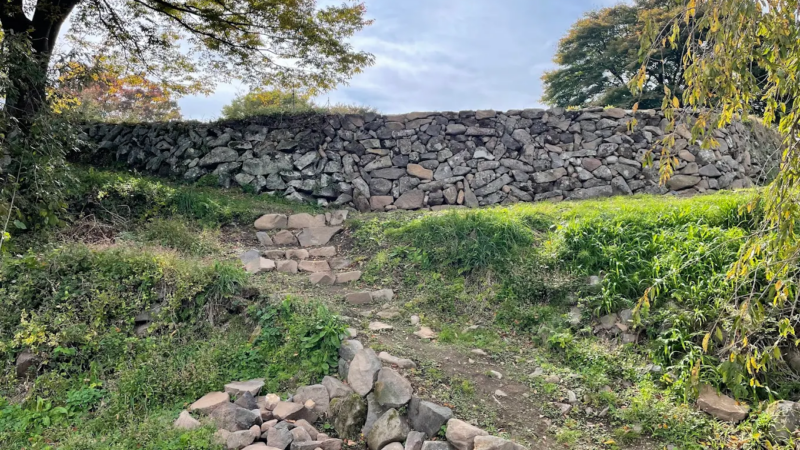
The greatest highlight of Uminokuchi Castle is the large moat located behind the main enclosure (east side). This moat is remarkably deep and wide, boasting a scale that stands out even when compared to other mountain castles.
The moat was excavated to completely cut across the ridge, functioning as a powerful defensive structure to prevent enemy intrusion. Its depth still reaches several meters today, demonstrating the advanced civil engineering technology of the time.
In addition to this large eastern moat, several other moats are located along the ridge, but these are smaller in scale and relatively shallower than the eastern moat. Nevertheless, the continuous moats are important remains that demonstrate the concept of multi-layered defense.
Second and Third Enclosures
The remains of the second and third enclosures can be seen around the main enclosure. However, these enclosures are now in a state of disrepair, making it difficult to clearly discern their outlines.
Because they are covered with trees and undergrowth, knowledge and observation skills are necessary to imagine their former appearance, but the layout of the former enclosures can be inferred from the topography and the extent of the flat areas.
Earthworks and Cut Slopes
Traces of earthworks also remain around the main enclosure. Although not clear due to weathering, the remains of defensive structures with piled-up earth can be observed at the edges of the enclosures.
Furthermore, cut slopes (artificially carved steep slopes) were constructed on the sides of the enclosures, showing ingenuity in making it difficult for enemies to climb.
Access to Uminokuchi Castle
Access by Car
Access to Uminokuchi Castle is primarily by car. 1. From National Route 141: Drive along National Route 141 and turn east at the Uminokuchi area of Minamimaki Village.
- To the Forest Road: Proceed approximately 500m along the forest road heading east. There is a parking space at the end of the road.
- Castle Entrance: Begin your ascent on foot from the parking space.
Parking space is limited, so please be careful if visiting with multiple vehicles. The forest road is narrow in some places, so drive carefully and pay attention to oncoming traffic.
Castle Ascent Route
From the parking space to the castle ruins, you will need to climb approximately 220m in elevation. The time required for the ascent will vary depending on individual fitness, but it is advisable to allow 30 to 50 minutes one way.
The hiking trail is an unmaintained, natural mountain path. Especially after rain, the ground becomes slippery, so the following equipment and precautions are recommended:
- Hiking boots or trekking shoes: Non-slip soles are essential.
- Long-sleeved shirt and long pants: To protect yourself from vegetation and insects.
- Drinking water: You will expend energy at high altitudes.
- Map/GPS: To prevent getting lost.
- Bear bell: Recommended as a precaution against wild animals.
Notes for Visitors
- Season: Climbing the castle is difficult during the snowy season (around November to April). Visiting during the snow-free season from May to October is recommended.
- Time: Please plan with ample time to descend before sunset.
- Physical Fitness: This is a climb with an elevation difference of 220m, so a certain level of physical fitness is required.
- Solo Travel: Visiting with multiple people is safer if possible.
- Cell Phone: Cell phone reception may be poor in the mountains.
- Garbage: Please take all your trash with you.
Nearest Facilities and Tourist Spots
Minamimaki Village Local History Museum
This facility allows you to learn about materials related to Uminokuchi Castle and the history of Minamimaki Village. Visiting before your visit will deepen your understanding of the castle.
Nobeyama Plateau
One of Japan’s leading plateau areas, with an observatory, ranches, and numerous tourist facilities. You can combine your visit with a visit to Uminokuchi Castle.
Hiraga Castle Ruins
The site of Hiraga Castle, the main castle of Uminokuchi Castle. Located in Saku City, a visit to this site will help you understand the sphere of influence of the Hiraga clan.
The Charm and Historical Value of Uminokuchi Castle
Value as the Site of the Takeda Shingen Legend
The greatest charm of Uminokuchi Castle lies in the legend that it is the site of Takeda Shingen’s first battle. Although there is debate about its historical accuracy, many history enthusiasts visit this place as the origin of a warlord hailed as the strongest of the Sengoku period.
The story of a young Shingen leading 300 soldiers in a surprise attack, volunteering the dangerous role of rearguard, and achieving victory is an important episode in understanding Shingen’s character. Standing on this rugged mountain castle allows you to truly appreciate the difficulty of battles at that time and the qualities of Shingen as a warlord who overcame them.
Value as a Mountain Castle Remains
Uminokuchi Castle is a valuable remains that well preserves the characteristics of a mountain castle from the Sengoku period. The large moat behind the main enclosure is the castle’s greatest highlight and serves as important material for studying the defensive techniques of medieval mountain castles.
Its construction at an altitude of over 1300m is also unusual, making it valuable for studying the castle-building techniques and military strategies of the time. The layout, which utilizes the rugged terrain, is also excellent as a teaching tool for learning the fundamentals of mountain castles.
Position in the History of the Shinano Invasion
Kainokuchi Castle is an important base for understanding the history of the Takeda clan’s conquest of Shinano Province. Located on the route of advance from Saku County towards Suwa, this castle, which functioned as a supply base, is a good example of the Takeda clan’s strategic thinking.
The historical flow of conflict with the Hiraga clan and subsequent rule by the Takeda clan illustrates the complex power dynamics of Shinano Province during the Sengoku period.
Points to Note When Visiting Uminokuchi Castle
Estimated Time Required for Visit
- From Parking Lot to Castle Ruins: 30-50 minutes one way
- Visiting the Castle Ruins: 30 minutes to 1 hour
- Total: Approximately 2-3 hours
We recommend planning for a half-day visit to allow ample time.
Recommended Time of Year
- Spring Green Season (May-June): Beautiful greenery, moderate temperatures, ideal for visiting the castle.
- Autumn (September-October): Enjoy the autumn foliage, fewer insects, and a comfortable visit.
- Time to Avoid: Mid-summer (heat and insects), Winter (snow)
Photography Tips
- Large Moat Behind the Main Enclosure: The biggest highlight of Uminokuchi Castle. Changing the angle of the photograph makes the depth easier to understand.
- View from the main enclosure: If the weather is good, the surrounding mountains are beautiful.
- Layout of the enclosures: Photograph from a position where you can understand the overall layout of the castle.
Advice for castle enthusiasts
Uminokuchi Castle is not a well-maintained tourist spot, but a natural mountain castle ruin. Therefore, without some knowledge of castles, you may not be able to fully appreciate its highlights.
You can have a more fulfilling visit by preparing the following beforehand:
- Pre-visit study: Learn about Takeda Shingen’s first battle, the history of the Hiraga clan, and the structure of mountain castles.
- Obtaining a castle layout map: Obtain a castle layout map in advance and compare it with the actual site.
- Comparison with other Takeda-related castles: Comparing it with other Takeda-related castles such as Tsutsujigasaki Castle and Yogaiyama Castle will deepen your understanding.
Uminokuchi Castle and the Takeda Clan’s Conquest of Shinano
Strategic Significance of the Conquest of Saku County
For the Takeda clan, the conquest of Saku County was extremely important as the first step in their advance into Shinano Province. Geographically, Saku County was the closest and easiest area to conquer as part of the route from Kai Province to Shinano Province.
Uminokuchi Castle is located in the southern part of Saku County, close to Kai Province, making it an ideal forward base for the Takeda clan. By capturing this castle, the Takeda clan gained a foothold to advance deeper into Saku County.
Conflict with the Hiraga Clan
The Hiraga clan was a powerful local lord in Saku County and continued to resist the Takeda clan’s invasion of Shinano Province. Uminokuchi Castle served as an outpost of the Hiraga clan, playing a role in hindering the Takeda army’s advance.
The legend that Takeda Shingen (Harunobu)’s first battle was the capture of Uminokuchi Castle holds symbolic significance. The fact (or legend) that the young successor personally led the attack on the enemy castle boosted the morale of the Takeda retainers and demonstrated the Takeda clan’s strength to the local lords of Shinano Province.
Development of the Shinano Strategy
After capturing Uminokuchi Castle, the Takeda clan steadily expanded their control over Saku County. In 1541, Takeda Nobutora was expelled by his eldest son, Harunobu, who inherited the family headship. Subsequently, Harunobu, who later became Takeda Shingen, successively conquered powerful local lords in Shinano Province, such as the Suwa, Murakami, and Ogasawara clans, and brought most of Shinano Province under his control.
The starting point of this conquest of Shinano was Saku County, and Uminokuchi Castle was one of its first important strongholds.
References and Related Materials
Main references and materials for learning about Uminokuchi Castle:
Basic References
- *Koyo Gunkan*: A military chronicle containing a description of Takeda Shingen’s first battle (however, its historical accuracy is debated)
- *Shinano Shiryo*: A collection of medieval historical materials of Shinano Province
- *Nagano Kenshi*: A general history of Nagano Prefecture. The medieval section contains descriptions of the Takeda clan’s invasion of Shinano Province.
Castle Research Books
- *Nihon Jōkaku Taikei* (Comprehensive Survey of Japanese Castles), Volume 8 (Nagano/Yamanashi): Contains basic information on Uminokuchi Castle.
- *Shinano no Yamashiro to Yakata* (Mountain Castles and Residences of Shinano): Comprehensively introduces mountain castles in Nagano Prefecture.
- Various castle research magazines: Specialized research and analysis of castle layouts.
Local Materials
- Exhibits and materials at the Nanmoku Village Local History Museum.
- History of Nanmoku Village.
- Survey reports by local history research societies.
Online Materials
- Castle database sites such as Kojōdan and Nippon Jōmeguri.
- Detailed exploration records by individuals such as Jōkaku Hōrōki.
- Visit reports on various history blogs.
Summary: The Contemporary Significance of Uminokuchi Castle
Uminokuchi Castle is a castle with few historical records, and both its construction and abandonment dates are unknown. Even its biggest selling point—the stage of Takeda Shingen’s first battle—has been questioned regarding its historical accuracy. However, this castle is still worth visiting.
Firstly, as a mountain castle built on a plateau over 1300m above sea level, it is a valuable learning resource for experiencing Sengoku period castle construction techniques and military strategies firsthand. The large moat behind the main enclosure is particularly important as a surviving example of the pinnacle of medieval mountain castle defensive techniques.
Secondly, whether legendary or historical, it is a place associated with Takeda Shingen, a representative warlord of the Sengoku period. The story of Shingen’s first battle here in his youth stirs the historical romance of many.
Thirdly, it played a crucial role in the larger historical flow of the Takeda clan’s invasion of Shinano Province. Its history of conflict with the Hiraga clan, and its subsequent capture and use by the Takeda clan, illustrates the complex situation in Shinano Province during the Sengoku period.
Currently, Uminokuchi Castle is not developed as a tourist destination. Visitors must climb steep mountain paths and see the dilapidated ruins with their own eyes. However, it is precisely because of this that one can truly feel the harshness of the battles of that time and deepen their understanding of history. Uminokuchi Castle stands quietly in the mountainous region of Minamimaki Village, Minamisaku District, Nagano Prefecture. For those who wish to trace the footsteps of Takeda Shingen and experience the spirit of the Sengoku period, this castle ruin is a must-visit.