A Complete Guide to the History and Highlights of Myōjō Castle (Ōsaki City, Miyagi Prefecture)
Myōjō Castle is a medieval flatland castle located in Jōnai, Furukawa Ōsaki, Ōsaki City, Miyagi Prefecture. Also known as Goshokan, Yoshitakakan, and Myōjōkan, it served as the base of the Ōsaki clan, who ruled the Tohoku region extensively as the Ōshū Tandai (governor of Ōshū Province) from the Nanboku-chō period to the Sengoku period. Even today, remnants such as earthworks and moat remains exist, making it a valuable historical site that conveys the appearance of a medieval castle.
Basic Information on Myōjō Castle
Myōjō Castle is a flatland castle built on a river terrace on the west bank of the Egai River, strategically located at a key point overlooking the Ōsaki Plain.
Location and Access
Location: 131, Jōnai, Furukawa Ōsaki, Ōsaki City, Miyagi Prefecture, and other locations
Access:
- Approximately 10 minutes on foot (approx. 500m) north from Higashi-Ōsaki Station on the JR Rikuu East Line
- Approximately 15 minutes by car from Furukawa IC on the Tohoku Expressway
- Parking is available at nearby public facilities
Basic Castle Data
- Builder: Ōsaki Iekane (Shiba Iekane)
- Year of Construction: Kannō 2 / Shōhei 6 (1351)
- Year of Abandonment: Tenshō 19 (1591)
- Castle Type: Flatland Castle
- Main Lords: Successive heads of the Ōsaki clan
- Renovators: Expansion and renovation by successive heads of the Ōsaki clan
- Cultural Property Designation: Osaki City Designated Historic Site (Designated December 5, 1970)
- Alternate Names: Goshokan, Yoshitakakan, Myoshokan
- Former Province: Mutsu Province
History of Myosho Castle
The history of Myosho Castle is closely intertwined with the rise and fall of the Osaki clan over approximately 240 years, from the turbulent period of the Northern and Southern Courts to the end of the Sengoku period.
Construction during the Northern and Southern Courts Period
In 1351 (Kanno 2/Shohei 6), Shiba Iekane (Osaki Iekane), a member of the Shiba clan, a powerful shugo daimyo of the Muromachi Shogunate, is said to have descended to Mutsu Province as the Oshu Kanrei (governor of Oshu) and constructed Myosho Castle. Due to his service to Ashikaga Takauji, Iekane was appointed Oshu Tandai (governor of Oshu) and granted a vast territory centered on Osaki County.
The Shiba clan adopted the name “Osaki” from the place name “Osaki,” and thereafter, Myojo Castle functioned as the Osaki clan’s base. At that time, the Tohoku region was a balance of power between the Southern and Northern Courts, and the Osaki clan fought against the Southern Court forces as part of the Northern Court’s side.
Development during the Muromachi Period
Throughout the Muromachi period, the Osaki clan played a role as the shogunate’s representative in the Tohoku region as the Oshu Tandai (governor of Oshu). The Osaki clan’s territory extended to five Osaki districts: Osaki County, Shida County, Tamatsukuri County, Toda County, and Kurihara County. At its peak, it governed a vast area stretching from present-day northern Miyagi Prefecture to southern Iwate Prefecture.
Myojo Castle functioned as a political and military center, and the surrounding area was lined with the residences of the clan’s retainers, forming a castle town. During this period, the castle underwent repeated expansions and renovations, and it is believed to have developed into a complex structure consisting of multiple baileys.
Turmoil in the Sengoku Period
With the arrival of the Sengoku period (Warring States period), the power of the Osaki clan gradually declined. In the latter half of the 16th century, they came under pressure from powerful Sengoku daimyo such as the Date clan from the south and the Kasai clan from the east. The rise of Date Masamune, in particular, posed a significant threat to the Osaki clan.
In 1584, after the death of Osaki Yoshitaka, an internal conflict arose within the Osaki clan over the succession of the family headship. Taking advantage of this turmoil, Date Masamune intervened, and by 1588, the Osaki clan was effectively placed under the control of the Date clan.
The Osaki-Kasai Rebellion and the Abandonment of the Castle
In 1590, after Toyotomi Hideyoshi’s siege of Odawara, the Osaki clan was dispossessed of their territory as part of the pacification of Oshu. Dissatisfied with this treatment, the former retainers of the Osaki and Kasai clans launched a large-scale uprising in 1591. This is known as the “Osaki-Kasai Rebellion.”
The rebels used Myōshō Castle as one of their bases, but were suppressed by a combined force of Gamō Ujisato and Date Masamune, acting on orders from Toyotomi Hideyoshi. Following the suppression of the rebellion, Myōshō Castle was abandoned, bringing its approximately 240-year history to an end.
After the rebellion was suppressed, the region came under the control of Gamō Ujisato and later became part of the Date clan’s territory. Since the Date clan based themselves at Iwadeyama Castle, Myōshō Castle was never used again.
Layout and Structure of Myōshō Castle
Myōshō Castle was a flatland castle built on a river terrace on the west bank of the Egai River. It had a complex structure with multiple baileys separated by dry moats and earthen ramparts.
Castle District (Central Area)
The central area of the castle was called the “Castle District” and consisted of several baileys. The main baileys included the following:
Odachi (Honmaru): This was the central bailey of the castle and is believed to have been the residence of the lord. Although the area is now largely residential, traces of the earthworks remain.
Uchikan: An important bailey adjacent to Odachi, located around the present-day Josen-in Temple. To the southeast of Josen-in Temple, the remains of Uchikan, surrounded by a dry moat, are relatively well-preserved, making it the best-preserved part of the Myojo Castle ruins. The dry moat is still about 2-3 meters deep, and the earthworks are clearly visible.
Gungi Hyōjōsho Maru: This bailey is believed to be where senior retainers held council meetings. It is thought to have functioned as the political center of the Osaki clan.
San no Kamae: One of the baileys responsible for the castle’s defense, located in the outer bailey. ### Myōshō Kitadate Area
This group of enclosures is located on the north side of the castle and is also known as “Kitadate.” It is believed to have played a crucial role in the castle’s defense. While most of the area is now rice paddies and residential land, archaeological excavations have confirmed the remains of moats and buildings.
Kodate Area
This enclosure is located on the outer perimeter of the castle and is presumed to have been used as residences for retainers and a garrison for soldiers. This area is also now rice paddies and residential land, making it difficult to confirm remains on the surface, but traces of the past remain in the place names and land divisions.
Defensive Structures
The defensive structures of Myōshō Castle mainly consisted of dry moats and earthen ramparts. Stone walls were not used, exhibiting typical characteristics of a medieval flatland castle in the Tohoku region.
Dry Moats: The dry moats that demarcated each enclosure are estimated to have been approximately 10-15 meters wide and 3-5 meters deep. Clear dry moats can still be seen around Jōsen-in Temple today.
Earthworks: Earthworks surrounded the enclosure, approximately 2-3 meters high. It is believed that fences or walls were constructed on top of these earthworks.
Excavations and Artifacts of Myōjō Castle
Multiple archaeological excavations were conducted at Myōjō Castle from the Showa era to the Heisei era.
Results of the Excavations
The following remains have been confirmed through the excavations:
- Moat Traces: Multiple dry moat traces were detected, revealing their scale and structure.
- Earthwork Traces: The base of the earthworks surrounding the enclosures has been confirmed.
- Building Traces: Numerous postholes of post-and-beam buildings were detected, gradually revealing the layout of buildings within the castle.
- Well Traces: Multiple wells used within the castle have been confirmed.
- Road Traces: Traces of roads connecting the enclosures have been discovered.
Artifacts
The excavations have yielded a diverse array of artifacts dating from the 14th to the 16th centuries.
Ceramics: Excavations have yielded Chinese celadon and white porcelain, as well as domestic Seto ware and Suzu ware, demonstrating the economic power and extensive trade of the Osaki clan. The discovery of high-quality Chinese ceramics, in particular, speaks to the high status of the Osaki clan as the Oshu Tandai (governor of Oshu Province).
Weapons and Armor: Weapons such as sword fragments, arrowheads, and musket balls have been unearthed. The discovery of musket balls is particularly valuable evidence indicating the use of firearms at Myojo Castle during the late Sengoku period.
Daily Life Items: Cooking utensils such as pots and kettles, tableware such as plates and bowls, and writing implements such as inkstones have been unearthed, providing insights into daily life within the castle.
Building Materials: Building materials such as roof tiles and nails have also been excavated, offering clues to the structure of the buildings. However, the amount of roof tiles found is small, suggesting that many buildings were roofed with planks or thatch.
Coins: Numerous Chinese coins (such as Yongle Tongbao) and Japanese coins have been unearthed, indicating the penetration of a monetary economy.
Relationship with the Myōshōkan Government Office Ruins
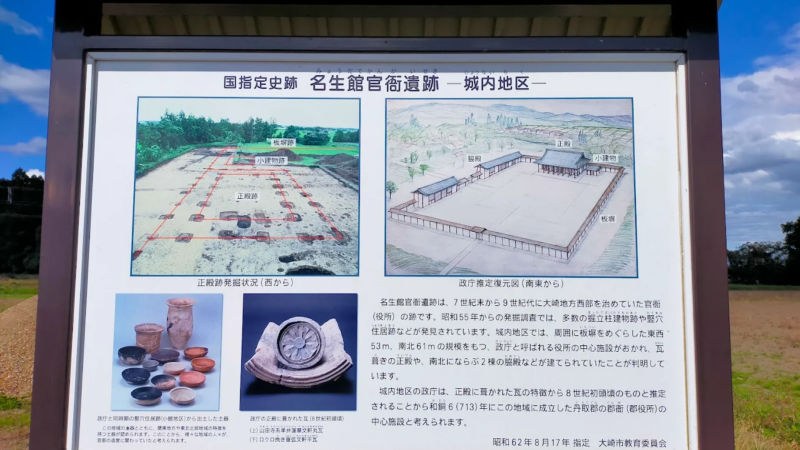
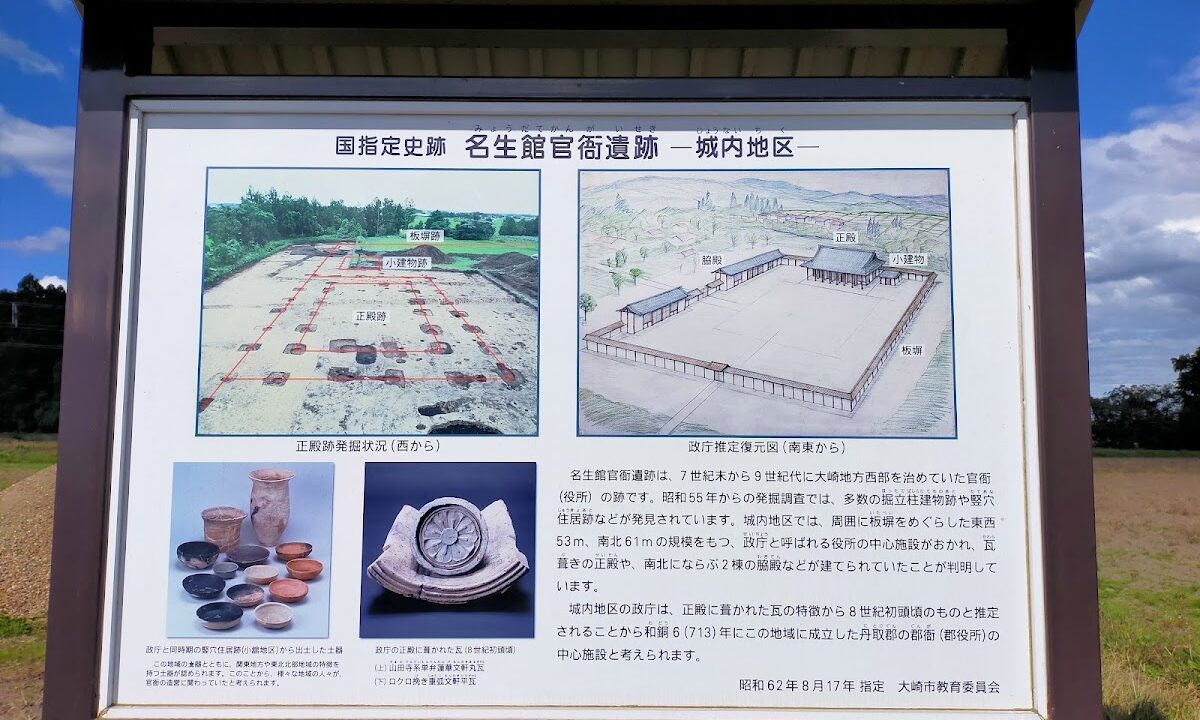
The site where Myōshō Castle was built previously housed the Myōshōkan Government Office Ruins, an ancient government office.
Ancient Myōshōkan Government Office
The Myōshōkan Government Office Ruins were an ancient local government office that existed from the late 7th century to the 10th century, functioning as an office governing the western part of the Ōsaki region. Under the Ritsuryō system, this region belonged to Mutsu Province, and Myōshōkan is thought to have played an important role as a county office or fortified settlement.
Excavation surveys have confirmed the remains of post-hole buildings, ditches, and wells, revealing the existence of a neatly arranged group of government office buildings. The excavated artifacts include Haji ware, Sue ware, and ink-inscribed pottery, primarily dating from the 8th to 9th centuries.
Continuity from Ancient to Medieval Times
Interestingly, it is believed that Osaki Iekane had a clear intention in choosing this ancient government office site when building Myōjō Castle. The ancient government office site retained memories of its role as a regional political center, and its topography was also suitable for castle construction.
It has been suggested that traces of the ancient government office’s land use may have influenced the layout of the medieval castle, making it a valuable example demonstrating the continuity of power transfer and land use from ancient to medieval times.
Current State of Myōjō Castle Site
Currently, the Myōjō Castle site is largely occupied by residential areas and rice paddies, making it difficult to imagine its former appearance. However, careful observation reveals traces of the medieval castle throughout.
Well-Preserved Remains
Around Josen-in Temple: The best-preserved remains of the Myōshō Castle site are those of the inner castle located southeast of Josen-in Temple. Here, the surrounding dry moats and earthworks remain relatively clear, allowing visitors to experience the structure of a medieval castle. The dry moats are approximately 2-3 meters deep and 10 meters wide, and the earthworks remain to a height of 1-2 meters.
Land Divisions and Place Names: Even in areas that have been developed into residential areas, the layout of roads and land divisions reflect the boundaries of the former castle enclosures. Furthermore, place names such as “Jōnai” (castle grounds), “Kitakan” (north castle), and “Kokan” (small castle) are still used today, providing clues to the former extent of the castle.
Points to Note When Visiting Myōshō Castle Site
When visiting the Myōshō Castle site, paying attention to the following points will allow you to experience the castle’s history more deeply.
- Dry moats and earthworks around Josen-in Temple: These are the best-preserved remains and a must-see.
- Observation of the topography: You can examine the location on the river terrace on the west bank of the Egai River and consider why this location was chosen.
- Views of the surrounding area: From the castle ruins, you can see the entire Osaki Plain and get a sense of the former territory of the Osaki clan.
- Information boards: Detailed information can be obtained from information boards installed throughout the castle ruins.
Notes for Visitors
- Most of the castle ruins are on private property, so please be careful when entering.
- Josen-in Temple is an active temple, so please observe proper etiquette when visiting.
- To protect the remains, please be careful not to damage the earthworks or moat remains.
- The visit, including the surrounding area, takes approximately 30 minutes to 1 hour on foot.
Related Historical Sites in the Surrounding Area
When visiting the Myōjō Castle ruins, visiting the related historical sites in the surrounding area will allow you to gain a deeper understanding of the history of the Ōsaki clan and the characteristics of the Tohoku region during the medieval period.
Iwadeyama Castle
Located approximately 15 kilometers northwest of Myōjō Castle, Iwadeyama Castle was the residence of Date Masamune after the suppression of the Ōsaki-Kasai Rebellion. Masamune used Iwadeyama Castle as his base for about 12 years until he moved to Sendai Castle in 1603. Currently, it is maintained as Shiroyama Park, and the stone walls and remains of the baileys are well preserved.
Takashimizu Castle
Located approximately 20 kilometers northeast of Myōjō Castle, Takashimizu Castle was one of the important branch castles of the Ōsaki clan. A member of the Ōsaki clan served as the castle lord, and it played a role in strengthening the northern defenses. Earthworks and moat remains still exist today.
Miyazawa Castle
Located approximately 10 kilometers south of Myōjō Castle, Miyazawa Castle was also under the control of the Ōsaki clan. While the remains are not well-preserved today, it is an important historical site for understanding the Ōsaki clan’s sphere of influence.
Myōjōkan Government Office Ruins Historical Park
This historical park, adjacent to the Myōjō Castle ruins, allows visitors to explore the remains of an ancient government office. Reconstructed buildings and information boards are installed, allowing visitors to learn about the historical flow from ancient to medieval times.
Historical Significance of Myōjō Castle
Myōjō Castle is an extremely important fortress for understanding the medieval history of the Tohoku region.
Base of the Ōshū Tandai
Myōjō Castle was the base of the Ōshū Tandai, established by the Muromachi Shogunate to govern the Tohoku region. The Ōsaki clan, as the Ōshū Tandai, controlled a vast territory backed by the authority of the Muromachi Shogunate, contributing to the political stability of the Tohoku region. Myōjō Castle functioned as its political and military center, and was a symbolic representation of central power in the Tohoku region. ### A Typical Example of a Medieval Castle in the Tohoku Region
Nagano Castle exhibits typical characteristics of a medieval flatland castle in the Tohoku region, as it utilizes dry moats and earthen ramparts for defense, rather than stone walls. The structure, with multiple baileys separated by dry moats, is a common castle style in the Tohoku region during the Sengoku period, making it a valuable example for understanding the level of castle construction technology in this region.
Continuity from Ancient to Medieval Times
The fact that Nagano Castle was built on the site of an ancient government office is an important example demonstrating the continuity of political centers from ancient to medieval times. The fact that the same location continued to function as a regional center for a long period speaks to its importance as a geographical and transportation hub.
The Stage of the Osaki-Kasai Rebellion
During the Osaki-Kasai Rebellion of 1591, Nagano Castle became one of the rebel bases. This uprising holds significant importance as a resistance by the samurai class against the Toyotomi regime’s pacification of Oshu, and Myōjō Castle became its historical stage.
Practical Information for Visiting Myōjō Castle
Access Details
Public Transportation:
- Get off at Higashi-Ōsaki Station on the JR Rikuu East Line, approximately 10 minutes on foot
- Approximately 1 hour by train from Sendai Station to Higashi-Ōsaki Station
Car:
- Approximately 15 minutes from Furukawa IC on the Tohoku Expressway
- Free parking is available at Myōjōkan Kanga Ruins Historical Park
Visiting Information
- Visiting Hours: Open (however, entry to private property is prohibited)
- Admission Fee: Free
- Estimated Time Required: Approximately 30 minutes to 1 hour
- Best Time to Visit: Spring (cherry blossom season) and autumn (autumn foliage season) are recommended
- Facilities: Toilets are available at Myōjōkan Kanga Ruins Historical Park
Nearby Tourist Attractions
- Kajonuma: A Ramsar Convention registered wetland designated as a national natural monument
- Furukawa City Center: The central urban area of Osaki City, with a wide variety of restaurants and souvenir shops.
- Naruko Onsenkyo: One of Tohoku’s leading hot spring resorts, located about 30 minutes away by car.
Summary
Nagasaki Castle was built in 1351 (Kanno 2) during the Nanboku-cho period by Osaki Iekane and served as the base of the Osaki clan, the Oshu Tandai (governor of Oshu), for approximately 240 years until the Osaki-Kasai Rebellion in 1591. It is an important medieval castle.
Currently, most of the castle site is occupied by residential areas and rice paddies, but remnants such as dry moats and earthworks remain in relatively good condition around Josen-in Temple, conveying the appearance of a medieval castle. Furthermore, as it was built on the site of the ancient Nagasaki-kan government office, it is a valuable historical site demonstrating the continuity of history from ancient to medieval times.
When you visit Osaki City in Miyagi Prefecture, be sure to stop by the ruins of Myojo Castle and reflect on the history of the Osaki clan, who ruled the Tohoku region as the Oshu Tandai (governor of Oshu), and the castle culture of the Tohoku region during the medieval period. Standing on the river terrace on the west bank of the Egai River and overlooking the Osaki Plain, you can truly feel the glory of the Osaki clan who once ruled this land, as well as the turbulent history of the Sengoku period.