Complete Guide to Shukuno Castle (Komono-cho, Mie-gun, Mie Prefecture) | History, Remains, and Access Explained in Detail
What is Shukuno Castle?
Shukuno Castle is a medieval hilltop castle located in Shukuno, Komono-cho, Mie-gun, Mie Prefecture. Utilizing the Kinkei River as a natural moat, it was built on the ridge of a protruding small hill. As a Sengoku period castle, remnants such as earthworks and trenches remain well-preserved today.
Komono-cho is located at the eastern foot of the Suzuka Mountains and is a tourist destination known for Yunoyama Onsen and Mount Gozaisho. However, in addition to Shukuno Castle, this region also contains other castles associated with the Hijikata clan, such as Komono Castle and Rikio Castle, forming an important group of historical sites for understanding the realities of feudal rule in northern Ise during the medieval period.
Castle Location and Topographical Features
Shukuno Castle was built on an isolated hill on a river terrace formed by the Kinkei River. This hill stretches long and narrow from east to west, protected by steep slopes to the north and south. The southern side, in particular, faces the Kinkei River and features a sheer cliff face, making the most of the natural fortifications.
The castle grounds consist of two main enclosures: the main keep (honmaru) and the northern enclosure. The southern end is clearly separated from the ridge by a moat. This moat, approximately 3 meters deep and 5 meters wide, served as an important defensive structure to prevent enemy intrusion.
History of Shukuno Castle
Construction Period and Builder
There are no reliable historical records regarding the construction period or builder of Shukuno Castle, so the details remain unknown. However, based on the castle’s structure, layout, and surrounding historical background, it is estimated to have been built during the Sengoku period (late 15th to 16th centuries).
The Komono region was within the sphere of influence of the Hijikata clan during the medieval period, and it is highly likely that Shukuno Castle was built by the Hijikata clan, their relatives, or their retainers. The Hijikata clan, as powerful local lords in northern Ise, solidified their control by building multiple castles in the region.
The Hijikata Clan and the Castle Network of the Komono Region
Besides Shukuno Castle, several other castles exist around Komono Town, including Komono Castle (the main castle) and Rikio Castle. These are believed to have formed a castle network supporting the Hijikata clan’s rule.
Komono Castle is thought to have functioned as the Hijikata clan’s base, while Shukuno Castle and Rikio Castle served as branch castles, playing roles in territorial control and military bases. Shukuno Castle, in particular, was strategically important, positioned to monitor and control the transportation routes along the Kinkei River.
Transition from the Sengoku Period to the Early Modern Period
At the end of the Sengoku period, Oda Nobunaga’s invasion of northern Ise drastically altered the power dynamics of the region. The Hijikata clan also came under the influence of the Oda clan, and eventually, after the era of Toyotomi Hideyoshi, the Komono Domain was established during the Edo period. It is believed that Shukuno Castle was abandoned during this process, but there are no records of the exact date of its abandonment. It is likely that it lost its function as a military facility around the time of the “One Castle Per Province” decree (1615) in the early Edo period.
Castle Grounds and Residence Site
Currently, the area east of Genchoji Temple and south of Inari Shrine is called “Shiroyashiki” (Castle Grounds), and is considered to be the site of the former residence. While the mountaintop castle served as a military fortification, this castle grounds is thought to have served as a living space and administrative office during peacetime.
This structure, combining a mountain castle with a residence at the foot of the mountain, is a common form of castle construction in the Sengoku period, and it is clear that Shukuno Castle followed this typical pattern.
Layout and Remains of Shukuno Castle
Structure of the Main Enclosure (Honmaru)
The main enclosure is the central part of Shukuno Castle and is built at the highest elevation. It measures approximately 30 meters east-west and 20 meters north-south, and is surrounded by earthen ramparts. This earthen embankment, approximately 1.5 meters high, still exists, conveying the appearance of the defensive facilities at the time.
To the south of the main enclosure, an earthen mound believed to be a watchtower base can be seen, suggesting the possibility of a watchtower or turret being built here. Furthermore, the interior of the main enclosure is relatively flat, and traces of buildings can be inferred from the topography.
The North Enclosure and its Function
The north enclosure is a fortified area located north of the main enclosure, at a slightly lower elevation. Its size is roughly the same as the main enclosure, and traces of earthen embankments remain around it as well.
The north enclosure is thought to have functioned as a forward position defending the main enclosure, positioned to prepare for enemy invasions from the north. It may also have played a rear-support role, such as stationing soldiers or storing supplies.
Details of the Moat
A clear moat remains at the southern end of the castle grounds. This moat was excavated in a way that completely cuts across the ridge, and has a V-shaped cross-section. The moat is approximately 3 meters deep and 5 meters wide, and is still clearly visible as a geographical feature.
Earthworks are built on both sides of the moat, demonstrating a design intended to further enhance its defensive capabilities. This moat clearly separates the castle grounds from the outside, physically preventing enemy intrusion.
Earthworks Arrangement and Characteristics
The earthworks of Shukuno Castle surround the main enclosure and the northern enclosure. The earthworks on the east and south sides of the main enclosure are particularly well-preserved, with some sections remaining 1-2 meters high.
Observing the structure of the earthworks reveals a combination of sections excavated from the natural ground and sections constructed by earthworks. This demonstrates the level of civil engineering technology at the time, showing ingenuity in efficiently constructing defensive facilities with limited labor.
Entrance to the Castle and Circulation within the Castle
The current entrance to the castle is located on the northwest side of the castle grounds. From here, a mountain path leads to the northern enclosure, and further on, to the main enclosure.
This route may follow the original main entrance (Ote-michi) route. However, medieval castles typically had multiple access routes, and it’s possible that other routes, such as a rear entrance (Karamete-michi), which are not currently visible, also existed.
Preservation of the Remains
The remains of Shukuno Castle are relatively well-preserved, having escaped development. The moats and earthworks, in particular, remain clearly visible, providing valuable information for understanding the castle’s structure in its heyday.
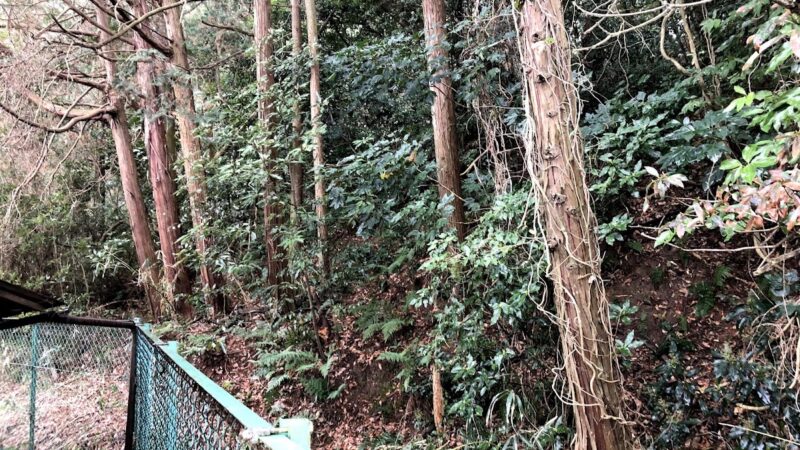
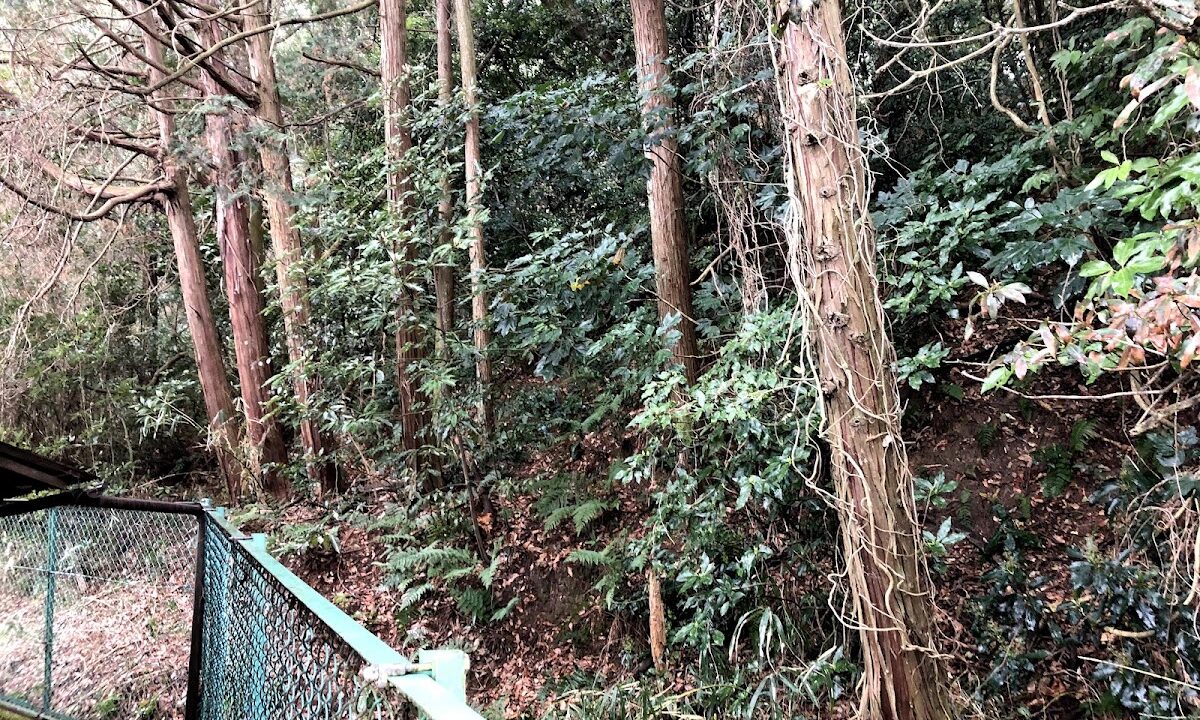
However, in some areas, the remains are unclear due to overgrown trees and soil accumulation. With proper preservation and management in the future, more information can be passed on to future generations.
Access to Shukuno Castle
Access by Public Transportation
The nearest station to Shukuno Castle is Komono Station on the Kintetsu Yunoyama Line. Shukuno Castle is approximately a 15-minute walk from Komono Station.
Walking Route from Komono Station:
- Exit Komono Station and head east.
- Walk straight northeast along the prefectural road for approximately 800 meters.
- Enter the Shukuno area and follow the signs.
- Using Genchoji Temple as a landmark, take the small path north of it to reach the castle entrance.
The route from the station is relatively easy to follow, and since it passes through a residential area, you can ask locals for directions. However, there are few signs near the castle entrance, so it is recommended to check a map beforehand.
Access by Car
Route from Major Roads:
- Approximately 20 minutes from the Tomeihan Expressway “Yokkaichi IC”
- Approximately 10 minutes from the Shin-Meishin Expressway “Komono IC”
If traveling by car, head towards the center of Komono town and enter the Shukuno area. There is no dedicated parking lot around the castle ruins, but there is space for street parking near Genchoji Temple (however, consideration must be given to avoid inconveniencing local residents).
Car Navigation Settings:
- Setting your destination to “Genchoji Temple (Shukuno, Komono-cho, Mie-gun, Mie Prefecture)” is convenient.
- Alternatively, search for “Shukuno, Komono-cho, Mie-gun, Mie Prefecture”.
Precautions When Visiting Shukuno Castle
When visiting Shukuno Castle, please note the following:
- Clothing: Wear comfortable clothing and non-slip shoes as you will be walking on mountain paths.
- Season: Due to the dense undergrowth in summer, visits in spring or autumn are recommended.
- Time: Allow approximately 30-40 minutes from ascent to descent.
- Equipment: Bring insect repellent, drinking water, a towel, etc.
- Safety: Avoid visiting alone; it is recommended to visit with multiple people if possible.
Combining Visits with Nearby Castles
When visiting Shukuno Castle, it is recommended to also visit the nearby Komono Castle and Rikio Castle.
Komono Castle:
- Approximately 20 minutes on foot from Shukuno Castle
- As the main castle of the Hijikata clan, it retains more extensive remains.
- The Komono Jinya (fortified residence) ruins are also nearby, allowing visitors to see Edo period remains.
Rikio Castle:
- Approximately 25 minutes on foot from Shukuno Castle
- Located on the opposite bank of the Kinkei River, it is a subsidiary castle that complements Shukuno Castle.
- A sturdy mountain castle with a strong mountain climbing element.
Visiting these three castles will give you a deeper understanding of the Hijikata clan’s castle network and the medieval history of northern Ise. A plan to take half a day to a full day to explore them slowly is recommended.
Shukuno Castle Walking Guide
From the Entrance to the Main Enclosure
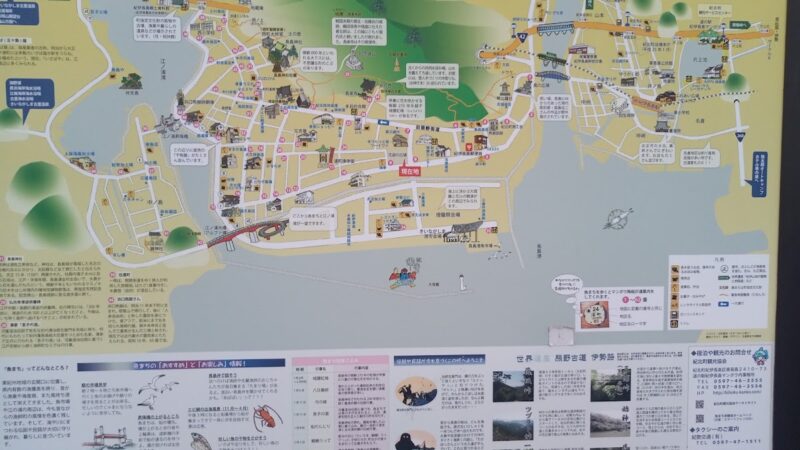
The entrance to the castle is located north of Genchoji Temple, at the edge of a residential area. There are no clear signs, but the small path leading into the mountain is the castle entrance.
The path is relatively gentle, and you will reach the northern enclosure in about 5 minutes. Along the way, you can see steep, artificially carved slopes on both sides, giving you a real sense of having entered the castle grounds.
Upon entering the northern enclosure, you can see the surrounding earthworks and the flat enclosure surface. After observing the remains here for a while, proceed further south to reach the main enclosure.
Highlights in the Main Enclosure
In the main enclosure, check the following points:
- Surrounding Earthworks: The earthworks on the east and south sides are particularly clear.
- Watchtower Base: The earthen mound on the south side may be a watchtower base.
- View: Although trees are dense, you can partially see the Kinkei River area.
- Size of the Enclosure: Experience the scale of the castle at the time by actually walking around.
By slowly strolling through the main enclosure and observing the height of the earthworks and the shape of the enclosures, you will deepen your understanding of the structure of a medieval castle.
Observing the Moat
As you proceed to the southern end of the main enclosure, a clear moat appears. This moat is one of the most notable features of Shukuno Castle.
Descending to the bottom of the moat allows you to truly appreciate its depth and width. You can also observe the height of the earthworks on both sides, gaining insight into the defensive structures of the time.
While the area south of the moat is outside the castle grounds, looking back from there reveals a clear visual demarcation created by the moat.
Confirming the Castle Residence Site
After leaving the castle, explore the area east of Gencho-ji Temple and south of Inari Shrine. This area, known as the “castle residence site,” is believed to be the location of the castle’s residence during peacetime.
Although currently a residential area and farmland, careful observation of the topography may reveal slight elevation changes or traces of the original layout. There’s also a possibility of finding remnants of old stone walls or wells.
Speaking with locals can deepen your understanding of the history, as they may share legends and the origins of place names.
Talking to locals can provide further insights into the history. ## Historical Value and Research of Shukuno Castle
Position in the Study of Medieval Castles in Northern Ise
Shukuno Castle occupies an important position in the study of medieval castles in the northern Ise region. In particular, it is an indispensable historical site, along with Komono Castle and Rikio Castle, for understanding the governing system of the Hijikata clan, a regional lord.
Comprehensive research on these castle groups reveals the realities of regional governance during the Sengoku period, the structure of the castle network, and the relationship between lords and vassals.
Characteristics and Similarities of Castle Structure
The layout of Shukuno Castle shares characteristics with medieval castles in the northern Ise region:
- A flatland castle utilizing a small hill
- A two-enclosure structure consisting of a main enclosure and a secondary enclosure
- Clear demarcation by moats
- Defensive facilities primarily consisting of earthworks
Such structures are also seen in castles of the same period in Mie Prefecture, such as Seki Castle in Kameyama City and Ano Castle in Tsu City, demonstrating a commonality in regional castle construction techniques.
Archaeological Excavations and Future Challenges
Regarding Shukuno Castle, no full-scale archaeological excavations have been conducted. Therefore, many aspects of its construction date, period of use, and abandonment date remain largely speculative.
Future archaeological excavations could potentially reveal the exact age of the castle, its structure, and the details of daily life based on unearthed artifacts. Furthermore, the discovery of historical documents is expected to shed more detail on the history of the castle and its lords.
History and Culture of Komono Town
Origins of Komono Town
Komono Town was established on April 1, 1889 (Meiji 22), as Komono Village in Mie District, encompassing the areas of Komono Village, Shukuno Village, Fuku Village, and Kamimori Village, under the implementation of the town and village system. The Shukuno area is one of the important regions that make up Komono Town.
During the Edo period, Komono flourished as a castle town of the Komono Domain, with a 12,000 koku (unit of rice production) yield. It was ruled by the Komono Hijikata clan (a different branch of the Hijikata clan from the Sengoku period). Historical sites, such as the Komono Jinya (fortified residence) ruins, still remain today.
Suzuka Mountains and Tourist Resources
Komono Town is located at the eastern foot of the Suzuka Mountains and is blessed with a rich natural environment. Yunoyama Onsen, in particular, is a famous hot spring resort known since ancient times, attracting many tourists.
Also, Mount Gozaisho (1,212 meters above sea level) is accessible by ropeway and is a popular spot for mountain climbing and hiking. Visitors can enjoy the beauty of nature throughout the seasons, and the autumn foliage season, in particular, is bustling with tourists.
Characteristics of the Shukuno District
The Shukuno district is located in the northern part of Komono Town and retains the atmosphere of an old farming village. The place name “Shukuno” is said to originate from the fact that there was once a post town on a highway, but no definitive historical records remain.
Even today, a quiet residential area and rural landscape spread out, creating a peaceful atmosphere. Historic temples and shrines such as Genchoji Temple and Inari Shrine are scattered throughout the area, preserving the region’s history and culture.
How to Enjoy a Visit to Shukuno Castle
How to Enjoy as a Castle Enthusiast
Shukuno Castle lacks flashy stone walls or a keep, but it is an ideal castle site for learning the basic structure of a medieval castle. Basic remains such as earthworks, moats, and baileys are compactly arranged, making it enjoyable for both beginners and advanced enthusiasts.
The moats, in particular, are clearly visible and are valuable remains that allow you to appreciate medieval castle construction techniques. Bringing a camera and photographing the remains from various angles will further deepen your understanding of the castle’s structure.
Enjoying a Historical Walk
By visiting not only Shukuno Castle but also the surrounding Komono Castle, Rikio Castle, and the Komono Jinya Ruins, you can experience the flow of history from the medieval to the early modern period.
Taking a leisurely stroll for half a day to a full day and comparing the remains from each era will give you a three-dimensional understanding of the changes in the castle and the history of the region. Bringing history books and maps and comparing them as you walk will lead to a deeper learning experience.
Combining with Nature Walks
The area around Shukuno Castle is rich in nature, and you can enjoy birdwatching and plant observation. It is especially beautiful in the spring with its fresh greenery and in the autumn with its colorful foliage, allowing you to enjoy both castle walks and nature walks simultaneously.
A walking path along the Kinkei River is also well-maintained, and walking along the river before or after visiting the castle ruins is highly recommended. Enjoying the changing seasons and reflecting on the romance of history is a truly special experience.
Local Food and Culture
Komono Town also boasts a rich local food culture. After exploring the castle ruins, you can enjoy local cuisine around Komono Station and the Yunoyama Onsen area.
Komono Town, in particular, boasts “Komono Soba” noodles and dishes made with local vegetables. Yunoyama Onsen also offers numerous day-trip bathing facilities, allowing you to relax and soothe your tired body after your walk.
Summary
Sukuno Castle, located in Komono Town, Mie Prefecture, is a valuable historical site as a medieval flatland castle. While many aspects of its construction period and builder remain unknown, the remains such as earthworks and moats are well-preserved, making it an important historical site for learning about the castle structure of the Sengoku period.
Its convenient access, approximately a 15-minute walk from Komono Station, is also a major draw. Visiting it along with the nearby Komono Castle and Rikio Castle will allow you to gain a deeper understanding of the Hijikata clan’s castle network and the medieval history of northern Ise.
While it may not be flashy, the time spent strolling through the quiet mountains, reminiscing about the past, will be an invaluable experience for history buffs. When you visit Komono Town, be sure to stop by Shukuno Castle.