Uraga Castle (Kanagawa Prefecture) Complete Guide: A View of the Hojo Naval Base and the Coastal Defense Strategy of the Sengoku Period
Overview
Uraga Castle was a mountain castle from the late Sengoku period located in Higashi-Uraga, Yokosuka City, Kanagawa Prefecture. Built on Myojin-yama (approximately 55 meters above sea level) within the grounds of the current Higashi-Kanou Shrine, the castle boasted a strategic location overlooking the entrance to Uraga Port, offering a panoramic view from the Uraga Channel to the Boso Peninsula.
Uraga Castle, used by the Later Hojo clan as a base for controlling the Miura Peninsula, was not merely a military facility, but a complex coastal defense base integrating the monitoring of maritime traffic and the operation of the navy. The castle ruins still retain remnants such as earthworks and dry moats, making it a valuable historical site that conveys the coastal defense strategy of the Sengoku period.
History of Uraga Castle
Background of Construction and the Era of the Miura Clan
There are various theories regarding the origin of Uraga Castle, but it is believed that a fort built by the Miura clan originally stood on this site. The Miura clan, who ruled the Miura Peninsula, likely established some kind of military facility in Uraga, a strategic point for maritime traffic, during the Kamakura and Muromachi periods. It is believed that Uraga Castle later developed on this foundation.
The Miura clan was known as a leading naval force in Sagami Province, and Uraga was ideally located for monitoring the Uraga Strait, which connects Tokyo Bay and the Pacific Ocean. This geographical advantage led to the later development of castles by the Hojo clan.
Renovations by Hojo Ujiyasu and the Misaki Castle Branch Castle System
With the start of the Sengoku period, the Hojo clan, having unified Sagami Province, strengthened their control over the Miura Peninsula. Particularly during the time of Hojo Ujiyasu, conflict with the Awa Satomi clan, based on the Boso Peninsula, intensified, and the struggle for control of Tokyo Bay became serious.
Hojo Ujiyasu developed Misaki Castle as a military base on the Miura Peninsula, and renovated and strengthened Uraga Castle as its branch castle. While Misaki Castle served as the political and military center at the southern tip of the Miura Peninsula, Uraga Castle played a crucial role as a forward base for monitoring the Uraga Strait and preparing for invasions by the Satomi clan.
The castle’s location was ideal for monitoring maritime traffic, allowing for constant monitoring of movements within the Boso Peninsula. From the summit of Mount Myojin, even the detailed topography of the Boso Peninsula could be seen on clear days, enabling early detection of approaching enemy ships.
Conflicts with the Satomi Clan and the Hojo Naval Base
Uraga Castle played its most important role during the period when the Hojo and Satomi clans vied for control of Tokyo Bay. Particularly during the time of Satomi Yoshihiro, tensions between the two forces escalated, leading to a prolonged standoff across the Uraga Strait.
The Hojo clan utilized Uraga Castle as a base for their navy, establishing a maritime defense network in conjunction with Misaki Castle. Uraga Port was developed as an anchorage for warships, and the castle allowed for direct control of port entry and exit. During this period, it is believed that Hojo naval officers and soldiers were permanently stationed at Uraga Castle, maintaining surveillance and a readiness to respond quickly.
Uraga Castle functioned as an early warning system against attacks from the Satomi clan, with a system in place to send urgent reports to Misaki Castle and Odawara Castle via smoke signals and messengers upon the discovery of enemy ships. While actual combat records are limited, the very existence of Uraga Castle is considered to have had a deterrent effect on the Satomi clan’s invasion.
The Boso Peace Treaty and Changes in Role
In 1577 (Tensho 5), a peace agreement known as the “Boso Peace Treaty” was reached between the Hojo and Satomi clans. This peace ended direct military conflict between the two forces, and the military importance of Uraga Castle relatively decreased.
Although Uraga Castle remained in operation after the Boso Peace Treaty, it is believed to have shifted in character from a frontline military base to a center for monitoring maritime traffic and controlling the region. During this period, the castle’s garrison strength may have been reduced, and it may have transitioned to a peacetime management system.
Toyotomi Hideyoshi’s Odawara Campaign and the Abandonment of the Castle
In 1590 (Tensho 18), when Toyotomi Hideyoshi launched his Odawara campaign, the Later Hojo clan was destroyed, and Uraga Castle ceased to serve its purpose. After the Odawara campaign, when Tokugawa Ieyasu entered the Kanto region, the military system of the Miura Peninsula was reorganized, and Uraga Castle was abandoned.
After its abandonment, the site of Uraga Castle was incorporated into the grounds of Higashi Kanou Shrine, a place of local worship. Although it lost its function as a castle, some of the topography and remains have been preserved to this day. During the Edo period, it was also known by other names such as “Shimoda-yama” and “Shiro-yama,” and the castle’s existence has been passed down in the memories of local residents.
Castle Structure and Layout
Location and Utilization of Topography
Uraga Castle is a mountain castle that skillfully utilizes the natural topography of Myojin-yama. Although it is a relatively low mountain with an elevation of approximately 55 meters, the surrounding area is surrounded by the sea and plains, resulting in a significant relative difference in elevation and making it a terrain well-suited for defense.
The mountaintop is a long, narrow ridge running north-south, and the main enclosures were located on this ridge. The eastern side is a steep slope facing Uraga Port, and the western side is also a relatively steep slope, functioning as a natural defensive wall. The routes that attackers could climb were limited, making it a terrain advantageous to the defenders.
Main Enclosure and Main Enclosures
The southern end of the mountaintop is considered the main enclosure, and currently houses the inner sanctuary of Higashi-Kanou Shrine. From the main enclosure, a 360-degree view unfolds, and the view of the Uraga Channel and the Boso Peninsula to the east is particularly breathtaking. On clear days, even the detailed topography of the Boso Peninsula can be seen, demonstrating its ideal location as a base for maritime surveillance.
The area of the main enclosure is relatively limited, suggesting that there was little space to construct large buildings. Rather, it is thought that the facilities were primarily designed to secure visibility, such as watchtowers and observation posts. Although it has been altered in later periods due to the construction of the shrine, the basic shape of the flat area retains traces of its original form.
Remains of Dry Moats and Earthworks
As defensive structures of Uraga Castle, the remains of dry moats and earthworks can still be seen today. In particular, a trench was constructed along the ridge leading to the mountaintop to prevent enemy intrusion, demonstrating the castle’s defensive intent.
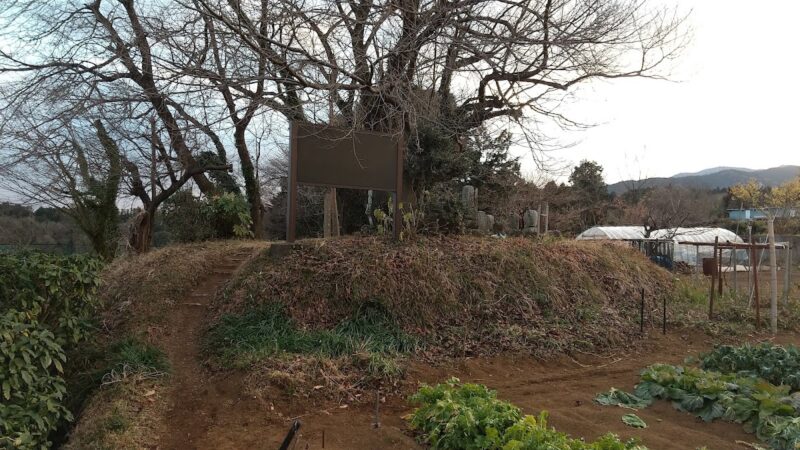
The earthworks remain in good condition in some parts, with earthen mounds about 1-2 meters high surrounding the enclosures. The absence of stone walls and the fact that it is entirely constructed of earth is a typical characteristic of mountain castles in the Kanto region during the Sengoku period.
The dry moats are relatively small, indicating that they were not designed to withstand large-scale invasions but rather to be defended by a small number of soldiers. This supports the idea that Uraga Castle was not a castle designed for large-scale sieges, but rather a facility primarily intended for early warning and maritime surveillance.
Relationship between Naval Facilities and the Port
A key feature of Uraga Castle is the integrated operation of the mountaintop fortress and the port at its base. From the castle, one could overlook the entire Uraga Port, allowing for the management of anchored vessels and monitoring of their entry and exit.
It is presumed that facilities for mooring naval vessels and residential areas for naval officers and soldiers were located at the foot of the mountain. However, due to ongoing urbanization, confirming these remains is difficult. Nevertheless, the topography and descriptions in historical documents confirm a functionally coordinated relationship between the port and the castle.
Current Highlights of Uraga Castle Ruins
Integration of Higashi-Kanou Shrine and Castle Ruins
Currently, the Uraga Castle ruins are within the grounds of Higashi-Kanou Shrine, creating a unique landscape where the castle ruins and shrine are integrated. Higashi-Kanou Shrine is known as a shrine for matchmaking and wish-granting, attracting many visitors, but it also possesses historical value as a castle site.
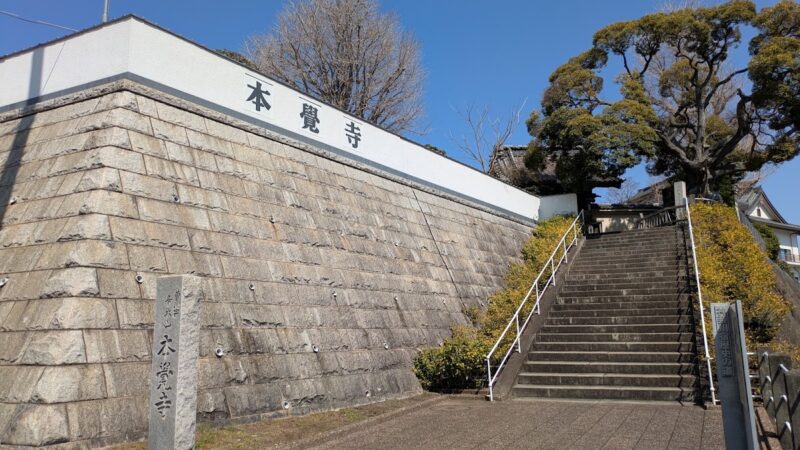
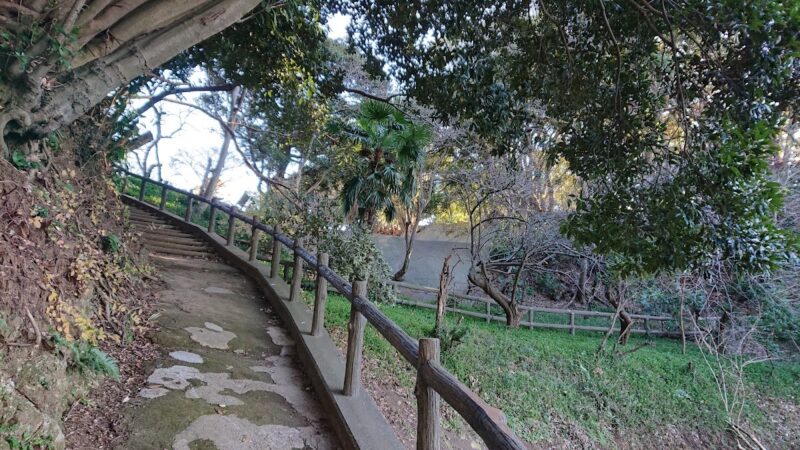
The shrine’s approach also serves as the path to the castle, allowing you to imagine the feelings of the castle soldiers as you climb the stone steps. Information boards are placed along the path, allowing you to learn about the castle’s history and structure.
Spectacular View from the Summit of Mt. Myojin
The greatest highlight of Uraga Castle is undoubtedly the view from the summit of Mt. Myojin. To the east lies the Uraga Channel, and on a clear day, you can clearly see Mt. Nokogiri and Cape Futtsu on the Boso Peninsula. This view makes the strategic value of this location immediately apparent.
To the south, the mountains of the Miura Peninsula stretch out, to the west, the city of Yokosuka, and to the north, the innermost part of Tokyo Bay. It’s impossible not to feel the romance of history when you imagine the castle soldiers of the Sengoku period looking out at this same view while on maritime surveillance duty.
There is an observation deck-like space at the summit with benches, allowing you to relax and enjoy the scenery. The sunset over the Uraga Channel, especially at dusk, is a spectacular sight and a popular spot for photography.
Observation Points for the Ruins
To observe the ruins of the castle, pay attention to the following points:
Traces of Earthworks: Unnatural mounds of earth can be seen in various places within the shrine grounds. These are remnants of earthworks from the castle era, and are particularly clearly visible around the main keep.
Arrangement of Flat Areas: There are several flat areas on the mountaintop, which are thought to be the remains of baileys. In areas without shrine buildings, the topography of the time can be seen more clearly.
Traces of Moats: Artificially excavated depressions can be seen in parts of the ridge, which are presumed to be the remains of moats. This provides clues to imagining where the defensive line was set.
Relationship with Nishi-Kanou Shrine
Nishi-Kanou Shrine is located across Uraga Port, and it is traditional to visit both Higashi-Kanou Shrine and Nishi-Kanou Shrine together. A ferry (Uraga Ferry) connects the two locations, allowing visitors to view the Uraga Castle ruins from the sea.
Viewing the Uraga Castle ruins from the Nishikano Shrine side provides a clearer understanding of its strategic location as a maritime surveillance base. This offers a valuable perspective, visually demonstrating the castle’s control over the port and sea, and allowing visitors to appreciate its strategic significance.
Access and Visiting Information
Access by Public Transportation
Train and Bus:
- Get off at Uraga Station on the Keikyu Main Line
- Take the Keikyu Bus bound for Kannonzaki from the station, get off at the Shinmachi bus stop, and walk for approximately 3 minutes.
- Alternatively, walk for approximately 18-20 minutes from Uraga Station.
If walking from Uraga Station, head south along the road beside Uraga Port, aiming for the torii gate of Higashikano Shrine. Along the way, you can enjoy a stroll through the historical streets of Uraga.
Using the Ferry:
- You can also use the “Uraga Ferry” from the Nishikano Shrine side (approximately 400 yen for adults one way).
- The ferry is also used by local residents as a means of transportation and offers a charming travel experience.
- Operating hours are generally from 7:00 AM to 6:00 PM (may vary depending on the season).
Access and Parking by Car
By Car:
- Approximately 15 minutes from the “Mabori Kaigan IC” on the Yokohama-Yokosuka Expressway.
- Access via the prefectural road from National Route 16.
Parking:
- There is no dedicated parking lot for Higashikano Shrine, but there are several coin-operated parking lots nearby.
- You can also use public parking lots around Uraga Port.
- It may be crowded on weekends and holidays, so using public transportation is recommended.
Points to Note When Visiting
Preparation for Climbing the Castle:
- Since there are stone steps leading to the summit, comfortable walking shoes are essential.
- Although the elevation is low, there are many steps, so those who are not confident in their physical strength should take breaks as they climb.
- During the summer months, we recommend bringing insect repellent and drinking water.
Visiting Time:
- You can generally visit and explore the shrine grounds freely.
- Allow 30 minutes to 1 hour for a round trip to the summit and sightseeing.
- If you want to carefully observe the ruins and enjoy the scenery, allow 1.5 to 2 hours.
Photography:
- Photography is generally permitted within the shrine grounds, but please be considerate of other visitors.
- The view from the summit is an excellent photo spot, but please be careful of your safety.
Nearby Tourist Attractions
Historic Townscape of Uraga
Uraga is a port town that flourished during the Edo period as a key point for the defense of Edo Bay, with the Uraga Magistrate’s Office located there. It was also the site of Commodore Perry’s arrival at the end of the Edo period, making it a historical site that marked a turning point in Japan’s modernization.
Around the Uraga Castle ruins, there are numerous historical sites from the late Edo period to the modern era, including the Uraga Dock ruins, the former Uraga Magistrate’s Office site, and the Perry Landing Monument. Visiting these sites together allows you to experience the full history of Uraga.
Misaki Castle and the Castles of the Miura Peninsula
Misaki Castle (Misaki Town), the main castle of Uraga Castle, is also worth visiting. Located at the southern tip of the Miura Peninsula, Misaki Castle offers a different castle design due to its unique location.
In addition, the Miura Peninsula has several other castle ruins related to the Miura and Hojo clans, such as Kinugasa Castle and Nuta Castle, making it an enjoyable route for castle-hunting.
Kannonzaki and the View of Tokyo Bay
Kannonzaki, located about 15 minutes by car from Uraga Castle, is a scenic spot at the entrance to Tokyo Bay. From Kannonzaki Lighthouse and Kannonzaki Park, you can see ships traversing the Uraga Channel up close, giving you a real sense of the sea area that Uraga Castle monitored. At Kannonzaki, there are also the remains of gun batteries built from the late Edo period to the Meiji era, allowing visitors to learn about the history of coastal defense across different eras.
Historical Significance and Evaluation of Uraga Castle
Positioning in the Hojo Clan’s Coastal Defense Strategy
Uraga Castle played a crucial role in the coastal defense strategy of the Later Hojo Clan. The Hojo clan prioritized securing control of the sea from Sagami Bay to Tokyo Bay, and built a network of coastal castles centered around Misaki Castle. Within this network, Uraga Castle functioned as an outpost controlling the strategically important Uraga Strait.
Notably, Uraga Castle was not a standalone defensive structure, but rather part of a system of subsidiary castles that relied on cooperation with Misaki Castle. This subsidiary castle system demonstrates the Hojo clan’s rational military strategy of defending a wide area with limited forces.
Characteristics as a Base for Naval Operations
Another important characteristic of Uraga Castle is that it served as a base for naval operations. Despite being a mountain castle, it was operated in conjunction with port facilities, creating a complex military complex that integrated land defense and naval operations.
This characteristic provides an important case study in the study of coastal castles of the Sengoku period. It is a valuable historical site that demonstrates the nature of coastal castles in the inland sea of Tokyo Bay, distinct from those in the Seto Inland Sea and Kyushu.
Preservation and Utilization in Modern Times
The Uraga Castle ruins have been preserved as shrine grounds, thus escaping development and preserving the remains. While this was fortunate, it also meant that its recognition as a castle is not necessarily high.
In recent years, the value of the Uraga Castle ruins as a regional historical asset is being re-evaluated, and efforts are underway to improve explanatory signs and disseminate information. It is hoped that the historical significance of Uraga Castle will be communicated from multiple perspectives, including the history of coastal defense during the Sengoku period, the military strategies of the Hojo clan, and the regional history of the Miura Peninsula.
Summary: The Significance of Visiting Uraga Castle
Uraga Castle may not boast a flashy keep or magnificent stone walls, but it is a valuable historical site that conveys the coastal defense strategies of the Sengoku period. Standing on the summit of Mt. Myojin and gazing at the Uraga Channel, one intuitively understands why a castle was necessary in this location.
This castle, built by Hojo Ujiyasu in preparation for attacks by the Satomi clan, was more than just a military facility; it embodied the strategic thinking of the Sengoku daimyo vying for control of Tokyo Bay. Its role changed after the Boso-Sowa alliance, and its eventual abandonment after the Siege of Odawara symbolizes the end of the Sengoku period.
The current Uraga Castle site is a unique place of charm, harmoniously blending the sacred site of Higashi-Kanou Shrine with the castle ruins as a witness to history. Strolling through the streets of Uraga, enjoying the view of the Uraga Channel, and reflecting on the Sengoku period—Uraga Castle is a historical site well worth visiting as a destination for such a historical walk.
The rich natural beauty and history of the Miura Peninsula, combined with its geographical location as a key point for maritime traffic in Tokyo Bay, all condense the essence of Uraga Castle ruins. As an important example of a coastal castle in the history of Japanese castles, it will undoubtedly continue to fascinate many history enthusiasts.