Complete Guide to Ojoyama Castle (Oiso Town, Kanagawa Prefecture): History, Remains, and Access Explained in Detail
What is Ojoyama Castle?
Ojoyama Castle is a medieval mountain castle located in Oiso, Nakagun, Kanagawa Prefecture. Built on the summit of Mt. Ojoyama, at an altitude of 83 meters, the castle boasts an excellent location overlooking Sagami Bay and functioned as an important base for monitoring the Tokaido road.
Even today, the remains of the castle from the Sengoku period, such as baileys, moats, and earthworks, are well-preserved, making it a valuable historical site for understanding medieval castles in Kanagawa Prefecture. Because there is a water supply facility at the summit, a road has been built, making it a relatively easy mountain castle to visit and known to castle enthusiasts.
Historical Background of Ojoyama Castle
Construction Period and Lord
There are various theories regarding the construction period of Ojoyama Castle, but it is believed to have been built between the late 15th and 16th centuries during the Sengoku period. During this period, Sagami Province was the front line of the power struggle between the Kanto Kanrei Uesugi clan and the Odawara Hojo clan.
There is a lack of reliable historical records regarding the castle’s lord, and it remains unclear. However, it is considered highly probable that it was built by a local powerful family that controlled the area around Oiso, or by a vassal of the Odawara Hojo clan. Considering the location of Ojozan Castle, it is presumed to have been a military base intended to monitor the Tokaido road and control maritime traffic in Sagami Bay.
Sagami Province and Ojozan Castle in the Sengoku Period
During the Sengoku period, Sagami Province was within the sphere of influence of the Later Hojo clan, based in Odawara. After Hojo Soun advanced from Izu into Sagami, the Hojo clan brought the entire Sagami Province under their control, growing into one of the most powerful daimyo in the Kanto region.
Oiso, where Ojozan Castle is located, is a strategic point along the Tokaido road connecting Odawara Castle and the Hiratsuka area. In this region, several castles were built, including Ojozan Castle, Koma-yama Castle, and Koiso Castle, and it is believed that they formed part of the Hojo clan’s defense network.
The Siege of Odawara and the Abandonment of the Castle
In 1590, Toyotomi Hideyoshi launched the Siege of Odawara, and the Hojo clan was destroyed. While the exact role of Ojozan Castle in this battle is unclear, it is presumed that its military role ended with the fall of Odawara Castle, and it was subsequently abandoned.
Later, during the Edo period, it developed as Oiso-juku, a post town on the Tokaido highway, and after the Meiji Restoration, it became known as a resort area for politicians and business leaders. Ojozan Castle was largely forgotten in this historical context, but recent advances in castle research have brought it renewed attention.
The Layout and Structure of Ojozan Castle
Overall Layout
Ojozan Castle is a mountain castle built around the summit of Mt. Ojozan, which is 83 meters above sea level, with a relative height difference of approximately 68 meters. The castle grounds measure approximately 200 meters east-west and 150 meters north-south, making it a medium-sized castle for a medieval mountain castle.
Centered around the main enclosure at the mountaintop, multiple baileys are arranged, separated by moats and earthworks, exhibiting a typical Sengoku period mountain castle structure. The southern side of the castle has a steep slope, demonstrating a defensive design that skillfully utilizes the natural terrain.
Features of the Main Enclosure (Honmaru)
The main enclosure, located at the mountaintop, is the core of Ojozan Castle. While it has been partially altered due to the installation of water facilities, the outline of the enclosure and traces of the surrounding earthworks can still be seen.
From the main enclosure, one can enjoy a panoramic view of Sagami Bay, and on clear days, the Izu Peninsula and Boso Peninsula can be seen. This excellent view was a crucial element for military surveillance. It allowed for monitoring the movements of people traveling along the Tokaido road and ships at sea.
Arrangement of Enclosures
Multiple enclosures are arranged around the main enclosure. These enclosures are arranged in a stepped pattern and served to defend the main enclosure. There are elevation changes between each enclosure, a design intended to make enemy intrusion difficult.
Relatively large enclosures can be seen, particularly on the east and north sides, and are thought to have been used for troop garrisons and supply storage. Traces of earthworks remain around these enclosures, indicating their function as defensive structures.
Remains of Moats
Several moats have been identified as important defensive structures of Ojozan Castle. Moats are defensive structures that cut off enemy intrusion routes by artificially cutting the ridge.
Clear moats remain, particularly on the north and east sides of the main enclosure, with a depth of approximately 2-3 meters. These moats are still relatively well-preserved today, making them valuable remains that demonstrate the castle-building techniques of the Sengoku period. While difficult to see in the summer due to overgrown vegetation, they can be clearly observed in winter.
Earthworks Arrangement
Earthworks are positioned around the baileys and beside the moats. These earthworks are defensive structures built by piling up earth, serving to prevent enemy intrusion and secure elevated positions advantageous for throwing arrows and stones from within the castle.
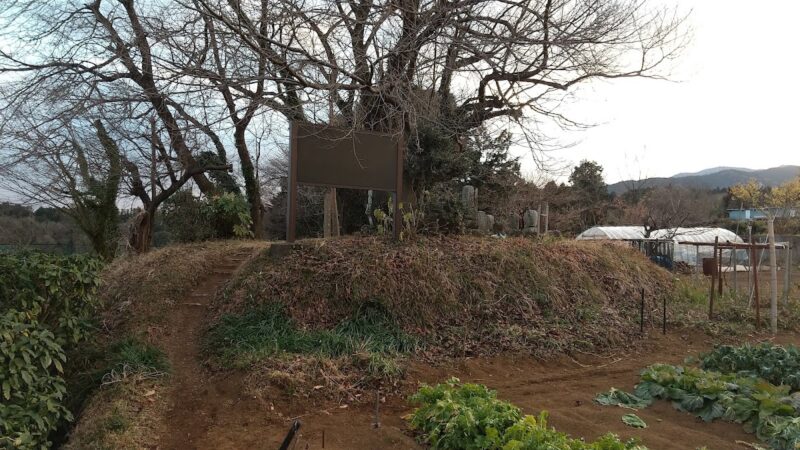
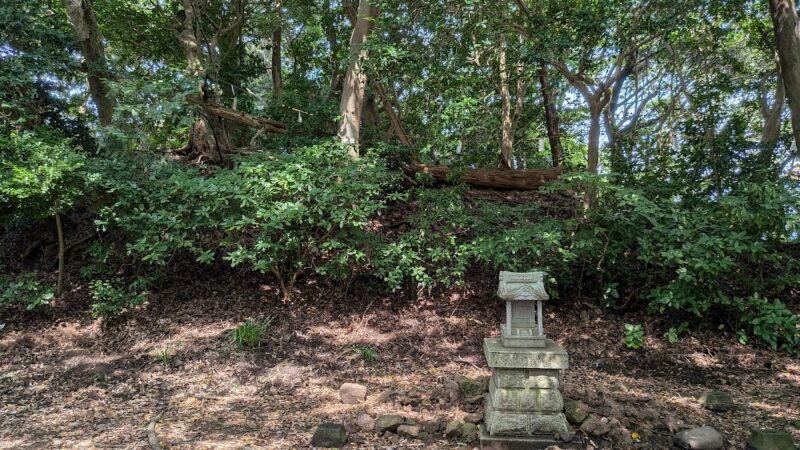
Many of the earthworks at Ojozan Castle are only 1-2 meters high, and some have become unclear due to collapse and weathering. However, some sections remain well-preserved, mainly along the edges of the baileys. The arrangement of these earthworks offers insights into the castle’s defensive plan.
Highlights and Remains of Ojozan Castle
View from the Main Bailey
One of the greatest attractions of Ojozan Castle is the magnificent view from the main bailey. Although the mountain is not particularly high at an elevation of 83 meters, the unobstructed surroundings allow for a panoramic view of Sagami Bay.
On a clear day, you can see Enoshima to the east, the Hakone mountains to the west, the Izu Peninsula to the south, and even the Boso Peninsula. This view, while important for military surveillance during the Sengoku period, now offers visitors both historical romance and natural beauty.
Clearly Remaining Moats
The most impressive remains at Ojozan Castle are the moats. The moat on the north side of the main enclosure, in particular, retains its depth and width well, making it a valuable relic that allows visitors to experience a Sengoku period defensive structure.
Walking through the moat, one is surprised by its depth and steepness. One can truly appreciate how difficult it must have been for enemy soldiers to cross this moat and infiltrate the castle. Visiting during the winter when the leaves have fallen allows for a clearer observation of the entire moat, making it especially recommended for castle enthusiasts.
Terraces and Arrangement of Enclosures
The arrangement of multiple enclosures in a stepped fashion is another highlight of Ojozan Castle. There are clear elevation changes between each enclosure, demonstrating defensive ingenuity throughout.
Walking through each enclosure allows for a three-dimensional understanding of the castle’s overall structure. One way to enjoy the site is to imagine the role each enclosure played while you explore.
Traces of Earthworks
The traces of earthworks remaining around the enclosures are also noteworthy historical remains. While some parts are unclear due to weathering and collapse, careful observation allows you to trace the lines of the earthworks.
Earthworks may appear as simple mounds of earth, but considering they were important defensive structures during the Sengoku period (Warring States period), it’s quite moving. There’s also the enjoyment of deciphering the castle’s defensive plan from the height and arrangement of the earthworks.
How to Access Ojozan Castle
Access by Public Transportation
The nearest station to Ojozan Castle is Oiso Station on the JR Tokaido Main Line. It’s approximately a 15-20 minute walk from Oiso Station to the Ojozan Castle ruins.
After leaving Oiso Station, head west along National Route 1 (Tokaido) towards the Oiso Town Hall. After passing the town hall, you’ll enter a residential area and head towards the trailhead to Mt. Ojo. Since there are few signs along the way, it’s recommended to check your location beforehand using a map or GPS app.
Access by Car
For those traveling by car, the Atsugi Interchange on the Tomei Expressway or the Oiso Interchange on the Odawara-Atsugi Road are convenient. From the interchange, take National Route 1 to Oiso Town.
There is a water supply facility at the summit of Mt. Ojo, and a road is maintained leading up to it, making it possible to drive close to the summit. However, there are narrow sections of the road, so driving requires caution. Parking space is limited, so please be considerate of other users.
Climbing Route and Estimated Time
There are several routes to climb Mt. Ojo Castle, but the most common is the route using the road. Using the road makes it relatively easy to reach the summit, even for those who are not confident in their physical fitness.
If climbing on foot, it takes approximately 20-30 minutes from Oiso Station to the summit. Allow approximately 30-40 minutes for a thorough visit to the castle grounds, especially if you plan to carefully observe the remains. Overall, 1 to 1.5 hours should be sufficient for a complete tour.
Points to Note When Visiting
There are several points to note when visiting Wangseongsanseong Fortress. First, as it is a mountain fortress, it is important to wear comfortable shoes and clothing. Particular caution is needed after rain, as the ground can become slippery.
In summer, vegetation grows densely, making it difficult to see the remains, and there are also many insects. Therefore, if you want to carefully observe the remains, visiting during the leaf-falling season from autumn to spring is recommended. Also, please be considerate of the water supply facilities and avoid interfering with the work of those involved.
Nearby Castles and Tourist Spots
Goryeosanseong Fortress
Located approximately 2 kilometers west of Wangseongsanseong Fortress, Goryeosanseong Fortress is a mountain fortress built on Goryeosan Mountain, which is 168 meters above sea level. It is larger in scale than Wangseongsanseong Fortress, and more clearly defined remains are preserved.
Koma-yama Castle was also an important stronghold in Sagami Province during the Sengoku period, and it is believed to have formed part of the defense network around Oiso, along with Ojo-yama Castle. If you have the time, visiting and comparing both castles would be interesting.
Koiso Castle
There is another castle ruin in Oiso Town, called Koiso Castle. Koiso Castle is a hilltop castle and has a different structure from Ojo-yama Castle. Currently, it is a residential area, and the state of the remains is not very good, but it is an important historical site for understanding the medieval history of Oiso.
Oiso Town Local History Museum
If you want to learn more about the history of Ojo-yama Castle and the medieval history of Oiso, a visit to the Oiso Town Local History Museum is recommended. It is within walking distance of Oiso Station and exhibits local historical and archaeological materials.
The museum also houses materials related to castles around Oiso, including Ojo-yama Castle, and can provide useful information for castle enthusiasts.
Former Shigeru Yoshida Residence
After your historical stroll, a visit to the former Shigeru Yoshida Residence, a symbol of Oiso’s modern history, would be a good idea. This was the residence of Shigeru Yoshida, a leading politician of post-war Japan, and you can tour it along with its beautiful Japanese garden.
Oiso has a history of developing as a resort area for political and business figures since the Meiji era, and the former Shigeru Yoshida Residence is a representative legacy of that period. The charm of Oiso lies in the fact that you can experience both medieval mountain castles and modern villa culture.
Other Mountain Castles in Kanagawa Prefecture
Odawara Castle
When it comes to castles representing Kanagawa Prefecture, Odawara Castle is undoubtedly the most famous. During the Sengoku period, it boasted the largest scale in the Kanto region as the base of the Later Hojo clan and was the stage for Toyotomi Hideyoshi’s siege of Odawara.
Currently, the keep has been restored, and the remains of the outer fortifications are well preserved. After visiting Ojoyama Castle, a visit to Odawara Castle, the main castle of the Hojo clan, will give you a deeper understanding of the Hojo clan’s castle network.
Ishigakiyama Castle
Located west of Odawara Castle, on the ridge of the Hakone outer rim, Ishigakiyama Castle was a fortified camp built by Toyotomi Hideyoshi during his siege of Odawara. It is said to have been built in just 80 days, earning it the nickname “One-Night Castle.”
It features characteristics of early modern castles, making extensive use of stone walls, and has a completely different structure from medieval mountain castles like Ojozan Castle. Comparing the two allows one to appreciate the evolution of castle architecture from the Sengoku period to the early modern period.
Tsukui Castle
Tsukui Castle, located in Sagamihara City, is a mountain castle that functioned as a base for the Tsukui clan during the Sengoku period. Built on a 375-meter-high mountain, it was an important base for controlling water transport on the Sagami River.
Currently, it is maintained as Shiroyama Park, and the remains of the baileys and moats are well preserved. It is also a popular hiking course, allowing visitors to enjoy both castle exploration and nature walks simultaneously.
Tsukui Castle ### Kozukue Castle
Kozukue Castle, located in Kohoku Ward, Yokohama City, is a hilltop castle that existed from the Kamakura period to the Sengoku period. Currently, it is maintained as the Kozukue Castle Ruins Citizens’ Forest, and remains such as dry moats and earthworks are preserved.
As a valuable medieval castle remaining in an urban area, it is also used for local history education. It is easily accessible and a mountain castle that can be easily visited from within Yokohama City.
Investigation and Research of Ojoyama Castle
History of Archaeological Excavations
No full-scale archaeological excavations have been conducted on Ojoyama Castle to date. Therefore, the detailed structure and age of the castle are currently inferred from observation of remains on the ground surface and examination of historical documents.
In recent years, interest in medieval castles in Kanagawa Prefecture has increased, and there is a possibility that academic investigations will be conducted in the future. If such investigations are conducted, more detailed information about the history and structure of Ojoyama Castle will be revealed.
Castle Layout Map and Research Findings
Castle researchers have conducted a survey of the castle’s layout, and a layout map of Ojozan Castle has been created. These maps allow for an understanding of the castle’s overall structure and the arrangement of each structure.
These layout maps are fundamental data for castle research and play a crucial role in analyzing the military functions and construction techniques of Ojozan Castle. These research findings are published in castle-related books and websites; reviewing them before a visit will deepen your understanding of the site.
Future Preservation and Utilization
While Ojozan Castle currently does not have any special protective measures in place, it is increasingly recognized as a valuable historical heritage site in the region. Due to the presence of water facilities at the summit, the possibility of large-scale development is low, and the remains are relatively well-preserved.
In order to actively utilize it as a local historical resource in the future, the installation of information boards, the development of walking trails, and the dissemination of information to local residents and visitors are crucial. It is hoped that Ojozan Castle will attract attention as part of Oiso Town’s historical tourism initiative.
Best Season to Visit Ojozan Castle
Spring (March-May)
Spring is one of the best seasons to visit Ojozan Castle. The weather is mild and pleasant for walking, and the fresh greenery is beautiful. Especially from April to May, the view of Sagami Bay is refreshing, making for a comfortable castle stroll.
However, from around Golden Week, the vegetation begins to grow, making it somewhat difficult to confirm the remains after late May.
Summer (June-August)
Summer is the most difficult time to confirm the remains due to the overgrown vegetation. Also, the high temperatures and abundance of insects make it unsuitable for castle walks. If you must visit during this period, be sure to bring long sleeves, long pants, insect repellent, and plenty of water.
On the other hand, the view of Sagami Bay in summer is exceptional, and the contrast between the blue sea and sky is beautiful.
Autumn (September-November)
Autumn is the best season to visit Ojozan Castle. As the vegetation begins to wither, the ruins become easier to observe. The period from November to December, when the leaves have fallen, is especially recommended for castle enthusiasts, as the topography, such as moats and earthworks, can be clearly seen.
The weather is cool and pleasant, making it suitable for long walks. During the autumn foliage season, you can enjoy both castle exploration and nature observation at the same time.
Winter (December-February)
Winter is the ideal season for observing the ruins, as the leaves have fallen completely. The air is clear, making it the most beautiful time to view the castle from the main enclosure. You can clearly see Mount Fuji, the Hakone mountains, and even the Izu Peninsula.
While cold weather precautions are necessary, the quiet environment with fewer people makes it especially recommended for those who want to carefully observe the ruins.
Summary
Ojoyama Castle is a valuable medieval mountain castle remaining in Oiso Town, Kanagawa Prefecture. Despite being built on a relatively low mountain at an elevation of 83 meters, it functioned as a military base, taking advantage of its excellent location overlooking Sagami Bay.
Even today, the remains of the Sengoku period, such as baileys, moats, and earthworks, are well-preserved, allowing visitors to learn about the castle-building techniques and defensive philosophies of the time. Since a road leads to the summit, access is relatively easy, making it a mountain castle that can be enjoyed by a wide range of people, from castle novices to enthusiasts.
Its convenient location within walking distance of Oiso Station is also appealing, and visiting it along with the nearby Koma-yama Castle and Koiso Castle allows for a deeper understanding of the medieval history of the Oiso region. Furthermore, historical sites from different eras, such as the former Yoshida Shigeru Residence, which conveys the modern villa culture, are scattered throughout the area, making it an ideal base for historical exploration.
While many castles remain in Kanagawa Prefecture, including Odawara Castle, Ishigakiyama Castle, and Tsukui Castle, Ojo-yama Castle is one of the most important historical sites that conveys the history of the region. It is a mountain castle that should definitely be visited in order to understand the castle network of Sagami Province during the Sengoku period and the Later Hojo clan. If you visit during the autumn and winter months when the leaves have fallen, you can clearly observe the ruins and enjoy the magnificent view of Sagami Bay. Why not experience the spirit of the Sengoku period at Ojozan Castle, where historical romance and natural beauty are intertwined?