Complete Guide to Ueda Castle (Kagawa Prefecture): History, Remains, and Access Information
What is Ueda Castle?
Ueda Castle (Ueda-jo) is a medieval mountain castle located in Higashi-Ueda-cho and Nishi-Ueda-cho, Takamatsu City, Kagawa Prefecture. Also known as Toda Castle, it is known as the residence of the Ueda clan, a powerful local lord of Sanuki Province. Built on a hill approximately 90 meters above sea level, it was a strategically important location overlooking the eastern and western Ueda regions.
During the Tensho era (1573-1592), Ueda Mino-no-kami Yasunobu served as the castle lord, controlling the areas of Higashi-Ueda, Nishi-Ueda, Sugasawa, and Asakura. However, in 1582, the castle fell during the Chosokabe clan’s invasion of Sanuki, and it is believed that Chosokabe Chikayoshi became the castle lord thereafter. Even today, remnants of moats and baileys remain, making it an important historical site for understanding the history of medieval castles in Sanuki Province.
History of Ueda Castle
Establishment and Development of the Ueda Clan
The Ueda clan was a branch of the Sanuki clan, and from around the late Heian period, they established their power base in Ueda, Yamada District (present-day Higashi-Ueda and Nishi-Ueda, Takamatsu City, Kagawa Prefecture). Under the soryo system of the samurai society of the time, it is believed that they gradually became samurai and grew into a powerful local clan.
The Ueda clan used Toda Castle as their residence and, as a local lord with considerable power within Sanuki Province, established regional control from the Muromachi period to the Sengoku period. The Ueda clan’s territory extended to the surrounding areas of Sugasawa and Asakura, centered on the eastern and western Ueda regions.
Ueda Castle in the Sengoku Period
In the Tensho era, Ueda Mino-no-kami Yasunobu ruled the region from Ueda Castle as its lord. During this period, Sanuki Province was in a complex political situation with the Miyoshi and Kagawa clans vying for power. The Ueda clan, too, was caught up in these political developments within Sanuki, while continuing to defend their territory.
The Chosokabe Clan’s Invasion of Sanuki and the Fall of Ueda Castle
In 1582 (Tensho 10), Chosokabe Motochika of Tosa, aiming to unify Shikoku, launched a large-scale invasion of Sanuki Province. This invasion captured many castles within Sanuki, and Ueda Castle became one of its targets.
Ueda Mino-no-kami Yasunobu attempted to defend the castle, but it fell to the overwhelming offensive of the Chosokabe army. It is said that afterwards, Chosokabe Chikayoshi, a member of the Chosokabe clan, was appointed as the new lord of the castle. During this period, many castles in Sanuki Province came under the control of the Chosokabe clan, and Sanuki temporarily became part of their sphere of influence.
Toyotomi Hideyoshi’s Conquest of Shikoku and Kuroda Kanbei
In 1585, Toyotomi Hideyoshi began his conquest of Shikoku. Kuroda Kanbei (Takayoshi), known as Hideyoshi’s military strategist, also participated in the conquest of Sanuki Province.
Interestingly, there is an anecdote about Kuroda Kanbei and Ueda Castle. When the Chosokabe clan put up resistance using Ueda Castle as their base, Kanbei saw through the possibility that the attack on Ueda Castle was a trap and deliberately refrained from attacking, instead advancing his army towards Awa Province (present-day Tokushima Prefecture). This judgment is said to have prevented unnecessary losses and is recounted as an episode demonstrating Kanbei’s sharp strategic vision.
Ueda Castle After its Abandonment
After the conquest of Shikoku, Sanuki Province came under the control of the Ikoma clan, and Takamatsu Castle became the center of Sanuki. It is believed that Ueda Castle lost its strategic importance during this process and was abandoned. Afterward, it was remembered by the local people as a castle site, and the remains have been preserved to this day.
Structure and Remains of Ueda Castle
Characteristics of the Castle Layout
Ueda Castle is a flatland castle built on a hill approximately 90 meters above sea level, with a relative height of about 40-50 meters. It possesses the typical structure of a medieval mountain castle, characterized by defensive facilities that skillfully utilize the natural terrain.
The castle consists of multiple baileys arranged around the main enclosure, spread out along a ridge extending east and west. The main defensive lines were demarcated by moats, creating a structure that prevented enemy intrusion.
Moats and Baileys
The most prominent remains of Ueda Castle are the moats. These moats, dug to cut across the ridge, can still be clearly seen today, demonstrating the high level of defensive technology at the time. Multiple moats were constructed, indicating the formation of a tiered defensive line.
The baileys (kuruwa) are arranged in a stepped pattern around the main enclosure, and it is believed that each bailey functioned as an independent defensive stronghold. From the main enclosure, one could see the surrounding Ueda region, suggesting an excellent location for both surveillance and defense.
Earthworks and Cut Slopes
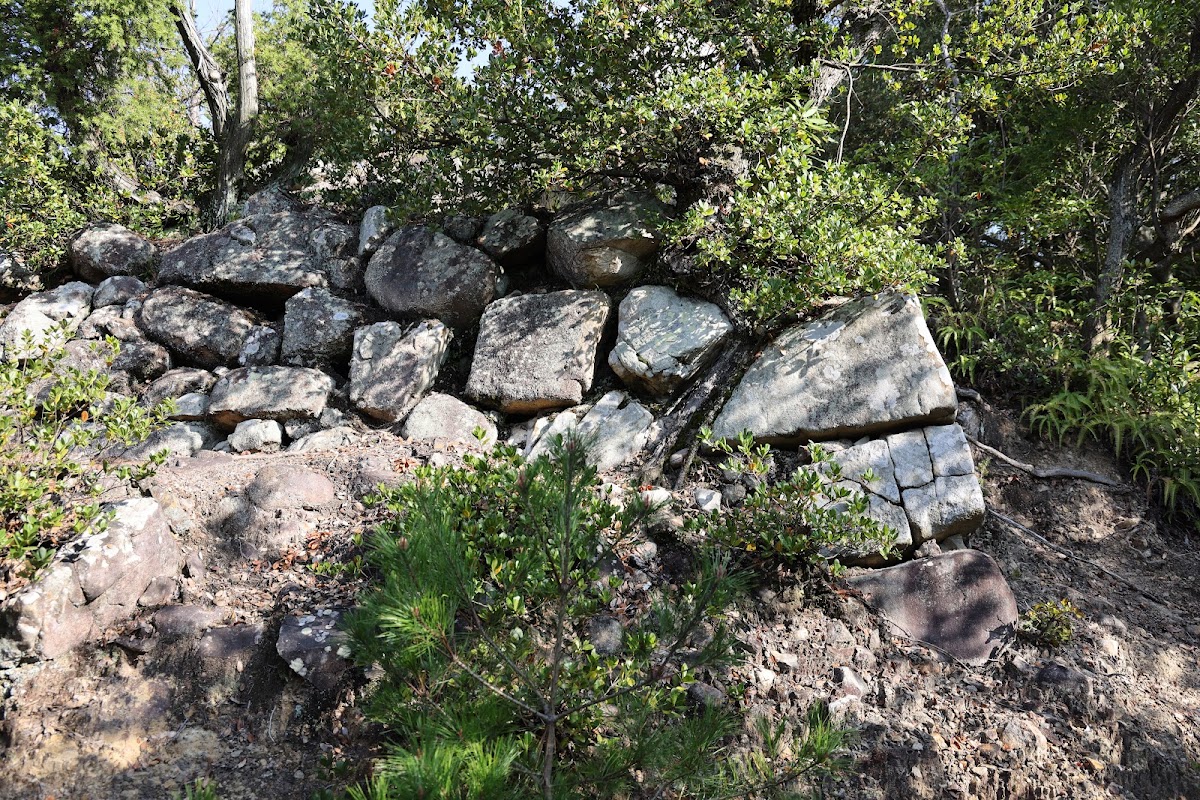
Traces of earthworks remain in some of the baileys. Furthermore, artificial steep slopes known as cut slopes (kirigishi) have been identified, indicating a design intended to make ascent difficult for the enemy. These remains indicate that Ueda Castle was not merely a residence, but a full-fledged mountain castle designed with actual combat in mind.
Castle Area Scope
The castle area is estimated to extend approximately 300 meters east-west and 200 meters north-south. This size is classified as medium-sized for a medieval castle in Sanuki Province, and it can be said to have been a size commensurate with the sphere of influence of the Ueda clan.
Highlights of Ueda Castle
View from the Main Enclosure
The greatest highlight of Ueda Castle is the view from the main enclosure. From an elevation of approximately 90 meters, you can overlook the settlements of Higashi-Ueda and Nishi-Ueda, as well as a portion of the Sanuki Plain. On a clear day, you can even see the distant mountain range, allowing you to imagine the time when the Ueda clan ruled this land.
Clearly Preserved Moat Remains
The best-preserved feature of Ueda Castle is the moat. Reaching several meters in depth, the moat retains its shape even after nearly 500 years, making it a valuable relic that allows you to experience the defensive techniques of a medieval castle. Walking across the moat allows you to experience the defensive system of that time.
Layout of Enclosures
The arrangement of multiple enclosures in a stepped fashion demonstrates the skillful layout of Ueda Castle. Imagining how the defensive lines were constructed while touring each enclosure will be a fascinating experience for castle enthusiasts.
Quiet Mountain Castle Atmosphere
Ueda Castle is a simple mountain castle that has not been commercialized for tourism. With few visitors, you can observe the ruins in a quiet atmosphere. Surrounded by trees, the castle ruins offer the enjoyment of nature throughout the seasons, making it a spot where you can enjoy both historical and nature walks simultaneously.
Access Information
Location
Address: Kitajo, Higashiueda-cho, Takamatsu City, Kagawa Prefecture
Ueda Castle Ruins are located on a hill near the border of Higashiueda-cho and Nishiueda-cho.
Access by Car
Takamatsu Expressway: Approximately 15 minutes from Takamatsu-Nishi IC
From Takamatsu-Chuo IC: Approximately 20 minutes
Access is via National Route 193 and then a prefectural road. There is a “Castle Community Center” near the castle ruins, and parking is available in the surrounding area. However, since it is not a dedicated parking lot, consideration should be given to avoiding inconveniencing local residents.
Access by Public Transportation
From JR Takamatsu Station: Take the Kotoden Bus for approximately 30 minutes, get off at the “Higashi-Ueda” bus stop, and walk for approximately 15 minutes.
Public transportation access is somewhat inconvenient, so visiting by car is recommended.
Entrance to the Castle and Estimated Time Required
The entrance to the castle is near the castle’s community hall, and it takes approximately 10-15 minutes on foot to reach the main enclosure. Since some parts of the mountain path are not well-maintained, comfortable walking shoes are recommended. Allow approximately 30 minutes to 1 hour to explore the entire castle site.
Notes for Visitors
- Signposts and well-maintained walking paths are limited.
- In summer, the area is overgrown with vegetation, so wearing long sleeves and long pants is recommended.
- Bringing insect repellent is advisable.
- Be careful as the ground can become slippery after rain.
- It is recommended to prepare drinking water in advance.
Nearby Castles and Tourist Spots
Sogō Castle
Located approximately 5 kilometers northeast of Ueda Castle, Sogō Castle was the residence of the Sogō clan, a branch of the Miyoshi clan. It was a castle that flourished around the same time as Ueda Castle and is an important historical site for understanding the Sengoku period history of Sanuki Province.
Takamatsu Castle (Tamamo Castle)
Located in the center of Takamatsu City, Takamatsu Castle is a modern castle built by the Ikoma clan. It is designated as a national historical site and is currently maintained as Tamamo Park. Visiting Takamatsu Castle in conjunction with Ueda Castle allows you to learn about the changes in castles in Sanuki Province.
Shōga Castle
This mountain castle, located on Mount Shōga in Takamatsu City, was the base of the Hosokawa clan, the shugo (military governor) of Sanuki Province. Built on a mountaintop 364 meters above sea level, it was a full-fledged mountain castle, larger in scale than Ueda Castle, and one of the representative historical sites of medieval castles in Sanuki Province.
Yashima
Yashima, famous as the site of the Genpei War, is located in the eastern part of Takamatsu City. The remains of the ancient mountain castle, Yashima Castle, still exist, making it a must-see spot for history buffs.
Model Itinerary for Visiting Ueda Castle
Half-Day Course (Exploring Medieval Castles in Sanuki)
- Ueda Castle (Duration: 1 hour): Visit in the morning and observe the ruins in a quiet atmosphere.
- Sogawa Castle (Duration: 40 minutes): Approximately 15 minutes by car from Ueda Castle.
- Lunch: Enjoy Sanuki udon in Takamatsu City.
- Takamatsu Castle (Tamamo Park) (Duration: 1.5 hours): See the appearance of a modern castle.
Full-Day Course (Exploring the History of Sanuki)
- Katsuga Castle (Duration: 2 hours): Climb to the castle early in the morning (requires physical fitness as it involves mountain climbing).
- Ueda Castle (Duration: 1 hour)
- Lunch: Local Sanuki udon restaurant.
- Takamatsu Castle (Duration: 1.5 hours)
- Yashima (Estimated time: 2 hours): Enjoy the historical sites and views of the Genpei War.
Ueda Castle: Evaluation and Visitor Feedback
Ueda Castle is known among castle enthusiasts, but its general recognition is not high. Castle websites such as Kojodan (Castle Attack Group) have an average rating of around 2.20, reflecting the state of preservation and maintenance of the remains.
Visitors have provided the following feedback:
- “The remains of the moat are clearly visible, giving a sense of a medieval mountain castle.”
- “It’s a quiet and peaceful environment, allowing for thorough observation of the castle ruins.”
- “There are few information boards, so prior research is necessary.”
- “The visit takes about 20-30 minutes, making it a compact visit.”
Ueda Castle may not be flashy, but it’s an attractive spot for those interested in the medieval history of Sanuki or those who want to enjoy the atmosphere of a simple mountain castle.
Ueda Castle and the Medieval History of Sanuki Province
Political Situation in Sanuki Province
Medieval Sanuki Province was characterized by a complex political situation with various powerful local lords and shugo daimyo (provincial governors). During the Muromachi period, the Hosokawa clan served as shugo, but in the Sengoku period (Warring States period), various forces, including the Miyoshi, Kagawa, and Chosokabe clans, vied for control of Sanuki.
The Ueda clan sought to survive as a local lord amidst these powerful forces. Ueda Castle reflects this political history of Sanuki Province and is an important historical site for understanding the region’s history.
The Chosokabe Clan’s Rule of Sanuki
The Chosokabe clan’s invasion of Sanuki in 1582 (Tensho 10) marked a major turning point in the history of Sanuki Province. Chosokabe Motochika, who unified Tosa, aimed to unify Shikoku and expanded his power into Awa and Sanuki. Within just a few years, he brought most of Sanuki under his control.
The fall of Ueda Castle was an event that occurred during this process, and the Ueda clan surrendered to the Chosokabe clan. However, the Chosokabe clan’s rule over Sanuki did not last long, ending with Toyotomi Hideyoshi’s conquest of Shikoku in 1585.
Transition to the Early Modern Period
After Toyotomi Hideyoshi’s conquest of Shikoku, Sanuki Province was given to the Ikoma clan. The Ikoma clan built Takamatsu Castle as their base of operations in Sanuki and governed the province as a daimyo in the early modern period. During this process, many medieval mountain castles, including Ueda Castle, were abandoned and ceased to exist.
The history of Ueda Castle can be said to symbolize the transformation of local communities during the transition from the medieval to the early modern period.
Current Status and Challenges of Ueda Castle Research
Limitations of Documentary Sources
Documentary sources concerning Ueda Castle are limited, and many points remain unclear regarding the detailed construction date and changes in castle lords. Even research books such as “The Complete Guide to Japanese Castles” and “Detailed Distribution Survey Report of Medieval Castle Sites in Kagawa Prefecture” only provide basic information.
The Need for Archaeological Investigation
No full-scale excavation has been conducted at Ueda Castle, and many aspects of the detailed structure and age of the remains remain unknown. Further archaeological investigations could potentially reveal more about the true nature of Ueda Castle.
Significance in Regional History Research
Ueda Castle is an important historical site for understanding the medieval history of Sanuki Province, particularly the realities of local lords. Further research is expected to clarify the activities of the Ueda clan and their position within Sanuki Province.
Summary: The Charm of Ueda Castle and the Significance of Visiting It
Ueda Castle (Toda Castle) is the site of a medieval mountain castle located in Takamatsu City, Kagawa Prefecture. While not flashy, it retains many characteristics of a medieval castle, such as clearly defined moat remains and the arrangement of baileys.
As the residence of the Ueda clan, a local lord, and a historical stage involved in the Chosokabe clan’s invasion of Sanuki and Kuroda Kanbei’s conquest of Shikoku, Ueda Castle is an indispensable part of Sanuki’s medieval history.
Exploring the ruins in the tranquil atmosphere of this mountain castle, while reflecting on Sanuki during the Sengoku period, will be a valuable experience for history buffs. When visiting Takamatsu City, be sure to visit Ueda Castle. You will be able to touch upon a part of Sanuki’s medieval history.
Checking maps and detailed information in advance and visiting with appropriate equipment will allow for a more fulfilling castle exploration. Starting from Ueda Castle, a Sanuki castle tour visiting nearby castles such as Sogō Castle, Takamatsu Castle, and Katsuga Castle is also recommended. Why not experience Sanuki’s rich history and culture through its castle ruins?