Complete Guide to Kio-dake Castle (Shiga Town, Ishikawa Prefecture): From the Fierce Battles of the Nanboku-cho Period to the Invasion of Uesugi Kenshin
What is Kio-dake Castle?
Kio-dake Castle (Kio-dake-jo) was a mountain castle located in Kaida, Shiga Town, Hakui District, Ishikawa Prefecture. It is also known as Kio Castle or Jogane Castle. Built on a ridge 127 meters above sea level, between the Tomiki River and Hiroike River on the western side of the Noto Peninsula, this castle functioned as an important military base in the Noto region from the Nanboku-cho period to the Sengoku period.
Even today, the remains, including the triple moat, are well-preserved, making it a valuable historical site for castle enthusiasts and history buffs. From the main enclosure, one can see Tomiki Castle, the town of Tomiki, and even the Sea of Japan, allowing one to appreciate its strategic importance at the time.
History of Kiotake Castle
Construction and Battles during the Nanboku-cho Period
Kiotake Castle is believed to have been built by Tomikura Toshiyuki during the Nanboku-cho period. During this time, the Noto region was the stage for fierce battles between the Southern and Northern Courts, and Kiotake Castle was at the center of it all.
In particular, in March of the second year of the Jowa era and the first year of the Shohei era (1346), Tomikura Toshiyuki, along with Inoue Toshikiyo, Nitta Sadaaki, and Kurisawa Masakage, holed up in Kiotake Castle. However, records show that the castle fell after being attacked by forces led by Yoshimi Ujiyori of the Northern Court. This battle is known as one of the three battles fought at Kiotake Castle during the Nanboku-cho period.
During the Nanboku-cho period, Kiotake Castle was not merely a military base, but also one of the important strongholds of the Southern Court forces in the Noto region. Southern Court generals, including Toshiyuki Tomiki, continued to resist the Northern Court forces from this castle, but ultimately, the Northern Court gained the upper hand, and control of the castle shifted.
From the Muromachi Period to the Sengoku Period
After the end of the Nanboku-cho period (Northern and Southern Courts War), Kio-dake Castle became a subsidiary castle of the Hatakeyama clan, the governors of Noto Province. The Hatakeyama clan, as the shugo daimyo (provincial governor) of Noto Province, established Nanao Castle as their base and developed Kio-dake Castle and other surrounding castles as subsidiary castles.
During this period, Kio-dake Castle functioned as a defensive stronghold in the western part of the Noto Peninsula, playing a crucial role in supporting the Hatakeyama clan’s rule. It also functioned as a governing center for the Tomiki region and was a central hub for leading the local samurai groups.
Uesugi Kenshin’s Invasion of Noto and Kiotake Castle
The most dramatic period in the history of Kiotake Castle was Uesugi Kenshin’s invasion of Noto Province from 1576 to 1577. During this time, Uesugi Kenshin, a powerful daimyo of Echigo Province, launched a full-scale invasion of Noto Province, severely weakening the Hatakeyama clan’s control.
Uesugi Kenshin’s army successively captured castles and residences throughout the Noto Peninsula. Kiotake Castle, along with Tomiki Castle, Sueyoshi Castle, and Hirashikibu Residence, became a target of Uesugi’s attack and ultimately fell. This invasion significantly weakened the Hatakeyama clan, and Noto Province came under the influence of the Uesugi clan.
From 1576 onward, Kiotake Castle became the stage for fierce battles between Uesugi Kenshin and the Hatakeyama clan. The two factions fiercely contested control of the castle, reaffirming its strategic importance. However, after the death of Uesugi Kenshin, the situation in the Noto region changed again, ultimately leading to rule by the Maeda clan.
Structure and Remains of Kiotake Castle
Layout and Location
Kiotake Castle is built on the tip of a ridge extending westward, north of the Hiroike River. At an elevation of 127 meters and a relative height of approximately 100 meters, it is a medium-sized mountain castle. The terrain, sandwiched between the Tomikigawa and Hiroikegawa rivers, served as a natural moat, enhancing the castle’s defensive capabilities.
Its location on the tip of the ridge offered the advantage of early detection of approaching enemies, and its excellent panoramic views made it an ideal observation post. The layout of Kiotake Castle, which made maximum use of this terrain, is a distinctive feature.
Main Enclosure and Watchtower Base
The main enclosure, the central part of Kiotake Castle, remains relatively well-preserved today, with the grass regularly mowed and the area maintained. A watchtower base is located in the center of the main enclosure, offering views of Tomiki Castle, the town of Tomiki, and even the distant Sea of Japan.
The watchtower base is believed to be the site of a watchtower, a crucial facility for monitoring enemy movements. The panoramic view of the western coastline of the Noto Peninsula from here indicates its strategic importance, allowing for the monitoring of movements from the sea.
The size and shape of the main enclosure suggest that it housed the lord’s residence and soldiers’ quarters. It is thought to have been designed to accommodate a large number of soldiers during wartime and withstand prolonged sieges.
Triple Moat Defensive System
The greatest highlight of Kiotake Castle is its triple moat system. A moat is a defensive structure created by artificially cutting into a ridge, and it is an important historical site designed to prevent enemy intrusion. At Kio-dake Castle, these moats were arranged in a triple layer, forming a strong defensive line.
Currently, some areas are overgrown with vegetation, making it somewhat difficult to grasp the overall structure, but careful observation allows you to confirm the triple moat structure. Each moat had depth and width, acting as a significant obstacle to enemy advances.
This triple moat is thought to have been gradually strengthened from the Nanboku-cho period to the Sengoku period, and it is an important historical site that tells the story of the castle’s historical changes. It has been suggested that the defensive capabilities were particularly strengthened in preparation for an invasion by Uesugi Kenshin.
Belt Enclosures and Defensive Structures
Belt enclosures remain on the north and west sides of the main enclosure. Belt enclosures are long, narrow enclosures arranged to surround the main enclosure and functioned as the first line of defense. The structure allowed for the defense to intercept enemies at these enclosures before they could reach the main enclosure. From the outer bailey, it was possible to attack approaching enemies from the flank, and it is believed that attacks were carried out using bows and arrows, as well as thrown stones. Furthermore, it is possible that fences and earthworks were constructed within the outer bailey, indicating the existence of a multi-layered defensive system.
These remains exhibit a typical structure of a medieval mountain castle and are valuable resources for learning about the castle-building techniques and tactics of the time.
Highlights of Kiotake Castle
Historical Value and Significance as a Cultural Property
Kiotake Castle is an important historical site that tells the history of the Noto region from the Nanboku-cho period to the Sengoku period. Having been the stage for three Nanboku-cho battles and playing a crucial role in Uesugi Kenshin’s invasion of Noto, this castle is indispensable for understanding the political and military history of medieval Noto.
The remains are relatively well-preserved, making it a valuable place to observe the defensive systems of a medieval mountain castle, such as the triple moat and outer bailey, firsthand. For castle researchers and history enthusiasts, this site holds great value as educational material, allowing them to learn about the tactics and construction techniques of the time while examining the actual terrain and remains.
The Magnificent View
The view from the main enclosure of Kio-dake Castle, especially from the turret platform, is exceptional. Below lies the town of Tomiki, and to the west, the blue expanse of the Sea of Japan stretches out. On a clear day, one can see the entire coastline of the western Noto Peninsula, extending far out to sea.
This excellent view is not merely aesthetically pleasing, but also demonstrates its military importance. It allows for early detection of approaching enemies from the sea and facilitates easy communication with surrounding castles and settlements. It also allows for confirmation of the positional relationship with surrounding castles, including Tomiki Castle, which is beneficial for understanding the castle network of the Noto region.
For modern visitors, it is a spot with a double appeal: a place to enjoy both historical exploration and the beautiful natural scenery of Noto.
Maintenance and Ease of Visiting
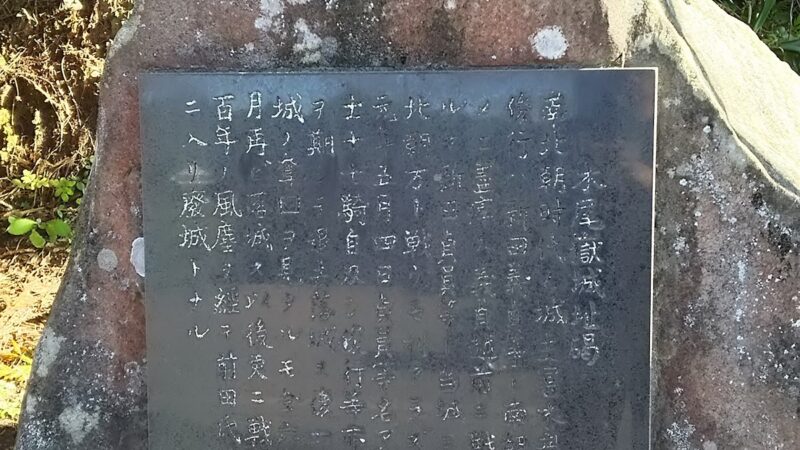
The main enclosure is regularly mowed, making it relatively well-maintained for visitors. A castle site monument is also installed, allowing visitors to confirm that it is Kio-dake Castle.
However, some remains, such as the triple moat, are overgrown with vegetation, so choosing the right time of year is necessary for detailed observation of the entire site. Since the grass grows tall from spring to summer, visiting from autumn to winter is ideal for observing the remains.
As it is a mountain castle, a certain level of physical fitness is required for the climb, but its size (approximately 100 meters in elevation) is standard for a medieval mountain castle, and those with good stamina can climb it without difficulty. However, since the path is mountainous, appropriate footwear and clothing are recommended.
Access to Kiotake Castle
Location and Basic Information
Location: Kaida, Shiga-machi, Hakui-gun, Ishikawa Prefecture
Alternate Names: Kio Castle, Jogane Castle
Castle Structure: Mountain Castle
Elevation: 127 meters
Relative Height: Approximately 100 meters
Access by Car
Kiotake Castle is easily accessible by car. It can be accessed from the prefectural road, a major road traversing the Noto Peninsula.
From Kanazawa City, head north on the Noto Satoyama Expressway (Noto Expressway) towards Shiga-machi. Once in Shiga-machi, take the prefectural road towards the Tomiki area. Near the intersection in the Kaida area, follow the signs and turn onto the road leading to the castle ruins.
Regarding parking, there is no large-scale parking lot specifically for the castle ruins, but there is space for a few cars near the entrance to the castle. However, to avoid inconveniencing local residents, please refrain from parking on the street and park in an appropriate location.
Access by Public Transportation
Using public transportation is somewhat inconvenient as it is a considerable distance from the nearest train station or bus stop. Since public transportation in the Noto region is limited, it is recommended to check the timetable in advance and plan your visit accordingly.
If using a taxi, it is best to contact a taxi company in Shiga Town beforehand and request a pick-up. Renting a car is also worth considering.
Ascent Route and Time Required
From the entrance to the main enclosure, you will need to hike up a mountain path. The ascent takes approximately 20 to 30 minutes. The path is not a well-maintained hiking trail and can be somewhat steep in places, so it is recommended to wear non-slip shoes such as hiking boots or athletic shoes.
Particular caution is needed during rainy weather or after rain, as the ground can become slippery. Also, bringing insect repellent spray during the summer months will make your visit more comfortable.
Nearby Tourist Attractions and Related Castles
Tomiki Castle
Tomiki Castle, visible from the main enclosure of Kiotake Castle, is a medieval castle also located in Shiga Town. Known as the residence of the Tomiki clan, it was captured along with Kiotake Castle during Uesugi Kenshin’s invasion of Noto. The two castles are closely related geographically and historically, and visiting them together will provide a deeper understanding of the medieval history of the Noto region.
Nanao Castle
Nanao Castle, the base of the Hatakeyama clan, the shugo (military governor) of Noto, is known as the largest mountain castle in the Noto region. Considering that Kiotake Castle was a subordinate castle of the Hatakeyama clan, its relationship with Nanao Castle is extremely important. Nanao Castle is designated a national historic site and is a magnificent castle with large stone walls and baileys remaining. When visiting Kiotake Castle, we highly recommend also visiting Nanao Castle to experience the castle culture of Noto comprehensively.
Suemori Castle
Suemori Castle is an important castle located near the border of Noto and Kaga Provinces, and is famous as the site of the Battle of Suemori Castle, fought between Maeda Toshiie and Sassa Narimasa. It has historical and geographical connections to Kiotake Castle and is one of the important castles for understanding the Sengoku period history of Noto.
Kumaki Castle and Tanaki Castle
These castles are also medieval castles located around Shiga Town, and together with Kiotake Castle, they formed a network of castles in the Noto region. If you have time, visiting these castles will give you a comprehensive understanding of the medieval mountain castles of the Noto Peninsula.
Shiga Town’s Tourist Resources
Besides Kiotake Castle, Shiga Town has many other tourist resources. The coastal scenic area known as Noto Kongo is a spectacular spot with a series of strangely shaped rocks and cliffs created by the rough waves of the Sea of Japan. Also nearby is the Chirihama Nagisa Driveway, where you can have the rare experience of driving on the sandy beach.
Shiga Town, where you can enjoy both history and nature, is a suitable area to explore at a leisurely pace over a day, especially when combined with a visit to Kio-dake Castle.
Points to Note When Visiting Kio-dake Castle
Clothing and Equipment
Since Kio-dake Castle is a mountain castle, appropriate clothing and equipment are necessary. Please note the following:
- Shoes: Hiking boots or athletic shoes are essential. Sneakers are acceptable, but choose ones with non-slip soles.
- Clothing: Long sleeves and long pants are recommended. This is to protect you from plants and insects.
- Items to Bring: Drinking water, towel, insect repellent, map or GPS device (smartphone apps are also acceptable)
- Seasonal Attire: In summer, don’t forget a hat and sunscreen; in winter, don’t forget warm clothing.
Visitor Etiquette
Kio-dake Castle is a valuable historical site. Please observe the following etiquette when visiting.
- Do not damage the ruins or take away soil or stones.
- Always take your trash with you.
- The use of fire is strictly prohibited.
- Do not trespass on private property.
- Avoid actions that may disturb local residents, such as shouting.
Safety Precautions
- Avoid climbing the castle alone; visit with others if possible.
- Refrain from visiting on days with bad weather or when bad weather is expected.
- Check your cell phone signal strength in advance.
- Confirm the location of the entrance to the castle and the descent route before climbing.
- Plan your trip with ample time to ensure you descend before sunset.
Research and Future Prospects of Kio-dake Castle
Current State of Academic Research
Kio-dake Castle has been investigated by local historians and castle researchers. In particular, its role in battle records from the Nanboku-cho period and Uesugi Kenshin’s invasion of Noto are mentioned in multiple documents.
However, detailed archaeological excavations have been limited, and many aspects of the castle’s overall structure and its transformations over time remain unclear. Further detailed surveys and excavations in the future could lead to new discoveries.
Challenges of Preservation and Utilization
While the remains of Kio-dake Castle are relatively well-preserved, some areas outside the main enclosure are overgrown with vegetation. Regular mowing and tree management will help maintain the preservation of the remains and ensure they are easily accessible to visitors.
How to utilize Kio-dake Castle as a regional historical heritage site and a tourist resource is a crucial issue for Shiga Town. Appropriate maintenance and information dissemination are expected to help more people understand the value of Kio-dake Castle.
Collaboration with the Community
Efforts to promote regional development utilizing Shiga Town’s historical heritage, including Kio-dake Castle, are also underway. If tours targeting castle enthusiasts and history buffs are planned, and local guides are trained, Kio-dake Castle will become a more familiar and beloved place for many people.
Furthermore, by collaborating with other castles in the Noto region, such as Nanao Castle, it is possible to develop a wider regional tourist route, such as a “Noto Castle Tour.” Such efforts are expected to further enhance the value of Kio-dake Castle.
Summary
Kio-dake Castle is a medieval mountain castle located in Shiga Town, Ishikawa Prefecture. It is a historically significant castle that played an important role from the Nanboku-cho period to the Sengoku period. Built by Tomigi Toshiyuki, it survived turbulent times, including three battles during the Nanboku-cho period and Uesugi Kenshin’s invasion of Noto, making it an indispensable part of the history of the Noto region.
The remains, such as the triple moats and outer baileys, are still well-preserved, allowing visitors to learn about the defensive systems of a medieval mountain castle firsthand. From the main keep’s watchtower platform, you can enjoy a panoramic view of the Sea of Japan and the town of Tomiki, experiencing its strategic importance at the time while also appreciating the beautiful scenery of Noto.
Access is convenient by car, accessible via a prefectural road from Kanazawa City. While appropriate clothing and equipment are necessary for the climb, the elevation difference of approximately 100 meters is manageable for those in good physical condition.
Nearby are many related castles, including Tomiki Castle, Nanao Castle, and Suemori Castle, making it a highly worthwhile castle to visit as part of a Noto castle tour. Why not begin your journey from Kiotake Castle, enjoying the rich nature and historical heritage of Shiga Town while reflecting on the history of medieval Noto?
Kiotake Castle quietly continues to convey the unique charm of Noto’s mountain castles and the weight of history etched within. For history buffs, castle enthusiasts, and those who love Noto’s nature, Kiotake Castle is a special place well worth visiting.