Futoge Castle, Hakusan City (Ishikawa Prefecture) | A Thorough Explanation of the History and Highlights of the Last Stronghold of the Ikko-ikki Rebellion
What is Futoge Castle?
Futogoe Castle is a medieval mountain castle site located in Deai-cho, Hakusan City, Ishikawa Prefecture. Built on an isolated peak 268 meters above sea level, across the Dainichi River from Torigoe Castle, this castle is historically significant as an important base for the Hakusan foothills Ikko-ikki rebellion, which resisted Oda Nobunaga’s offensive to the very end.
Also known as “Futogoe Castle,” this castle was designated a national historic site on September 3, 1985, as an annex to Torigoe Castle. Today, it is a valuable cultural asset that conveys the history of the Kaga Ikko-ikki rebellion, and is a popular tourist spot visited by many history enthusiasts and castle fans.
History of Nikyoku Castle
The Headquarters of the Hakusan Foothills Ikko-ikki and the Suzuki Clan
Nikyoku Castle served as the headquarters of the Suzuki clan, leaders of the Hakusan Foothills Ikko-ikki. Kaga Province was known as “a country owned by the peasants” due to the strong influence of the Ikko-ikki revolt, and Jodo Shinshu Buddhism was deeply rooted in this region.
The Suzuki clan was a central figure in the Ikko-ikki revolt at the foot of Mount Hakusan, and Nikyoku Castle occupied an important strategic position as a branch castle for the Dainichi River basin and the Komatsu area. The castle’s location was designed to play a part in a defensive network based on cooperation with Torigoe Castle, and the two castles, facing each other on opposite banks of the Dainichi River, created a mutually complementary defensive system.
Battle with the Oda Army in 1580
In 1580, Oda Nobunaga launched a full-scale campaign to suppress the Kaga Ikko-ikki revolt. In this year, Nikyoku Castle fell to a fierce attack by the Oda army.
For Oda Nobunaga, the Ikko-ikki rebellion in Kaga had been a long-standing threat. Alongside his battles with Ishiyama Hongan-ji Temple, suppressing the Ikko-ikki forces in Kaga was one of the Oda regime’s most important priorities. The Oda army, led by Shibata Katsuie, captured Nikyoku Castle along with Torigoe Castle, destroying the Ikko-ikki strongholds at the foot of Mount Hakusan.
With this fall, the history of the Kaga Ikko-ikki, which had lasted for over 100 years, came to an end. The fall of Nikyoku Castle marked a significant step in Oda Nobunaga’s path to unifying Japan.
Designation as a National Historic Site and Archaeological Excavation
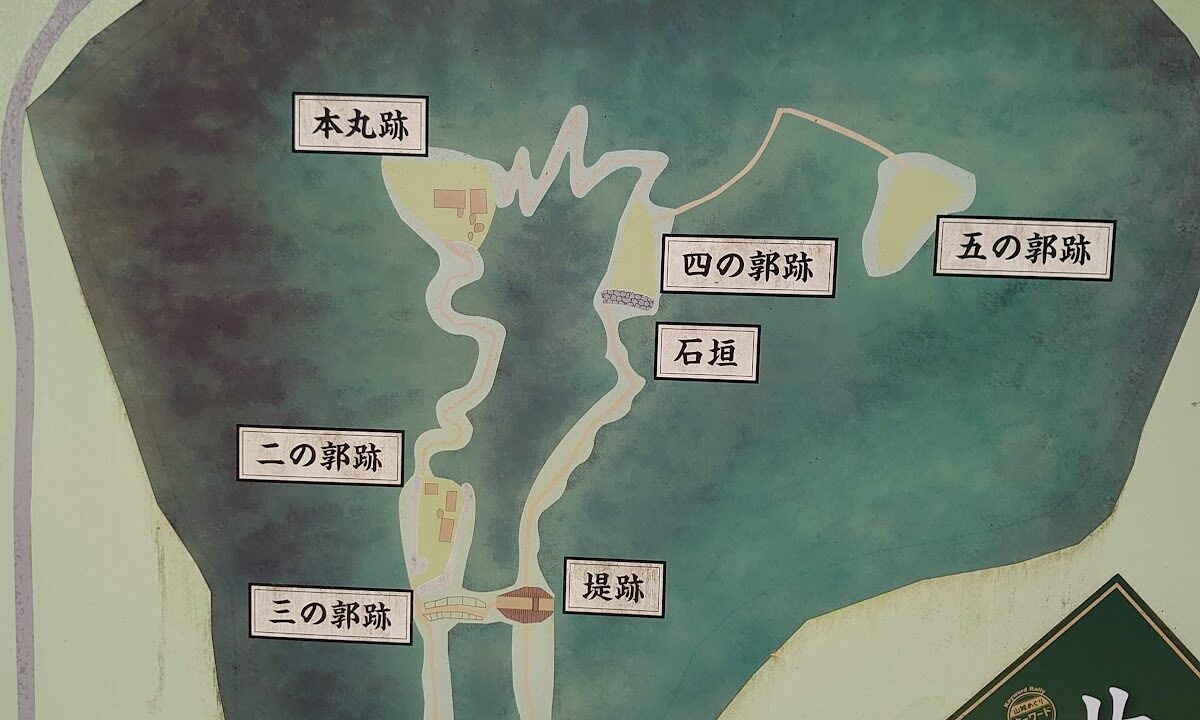
In 1985, the Nikyoku Castle ruins were designated a National Historic Site as an appendage to the Torigoe Castle ruins. This designation officially recognized the historical importance of the Kaga Ikko-ikki rebellion. From 2004 to 2009, the Hakusan City Board of Education conducted a full-scale archaeological excavation. This excavation confirmed the remains of the castle’s enclosures, from the main keep to the fifth enclosure, revealing the castle’s structure and scale. The results of the excavation have further enhanced the historical value of Nikyoku Castle.
Structure and Characteristics of Nikyoku Castle
Horseshoe-Shaped Layout
The most distinctive feature of Nikyoku Castle is its unique horseshoe-shaped layout. Cleverly utilizing the topography of the isolated peak at an elevation of 268 meters, multiple enclosures are arranged along the ridge.
This horseshoe-shaped structure offers superior defensive capabilities. It allows for repelling enemy attacks from multiple directions and facilitates easy coordination between enclosures. It can be said that this design maximizes the topographical advantages of a mountain castle.
Layout of Enclosures from the Main Enclosure to the Fifth Enclosure
Excavation surveys have confirmed that Futatsumagari Castle had at least six enclosures, from the main enclosure to the fifth enclosure.
The main enclosure was the most important base of the castle, built at the highest elevation. From here, the second and third enclosures continued along the ridge, each enclosure being demarcated by moats and earthworks.
The layout of each enclosure cleverly utilized the terrain, combining natural defensive walls utilizing the steep slopes with artificial defensive structures. This structure allowed for effective defense even with a small number of defending forces.
Highlights of the Remains
Currently, the following remains can be observed at the Futatsumagari Castle site:
Enclosure Remains: The flat surfaces of each enclosure remain clearly visible, allowing us to imagine the layout of the former buildings.
Moats: Multiple moats can be identified as defensive structures separating the enclosures. These played a crucial role in preventing enemy incursions.
Earthworks: Traces of earthworks remain in some enclosures, providing clues to the structure of the defensive facilities.
Castle Ascent Path: The currently maintained castle ascent path follows the former access route, allowing visitors to experience the terrain of the time.
A spring flows near the castle entrance, demonstrating how the abundant water resources of the Hakusan foothills were advantageous in siege warfare. The mountainous area of Hakusan offered ample crops, creating conditions for a prolonged siege.
Highlights and Attractions of Nikyoku Castle
Comparison with Torigoe Castle
When visiting Nikyoku Castle, it’s important to consider its relationship with Torigoe Castle, located across the Dainichi River. The two castles formed a complementary defensive network, allowing for covering fire from one castle when under attack.
From Torigoe Castle, you can see the entirety of Nikyoku Castle, and conversely, you can see Torigoe Castle from Nikyoku Castle. This geographical arrangement speaks to the ingenuity of the castle defense system during the Sengoku period. Visiting both castles will give you a deeper understanding of the defense strategy of the Kaga Ikko-ikki rebellion.
Natural Environment at the Foot of Mt. Hakusan
The foot of Mt. Hakusan, where Nikyoku Castle is located, is a region blessed with abundant nature. You can enjoy the beautiful scenery of each season: fresh greenery in spring, deep green in summer, autumn leaves in fall, and snowscapes in winter.
From the mountaintop at an altitude of 268 meters, you can enjoy a panoramic view of the Hakusan mountain range and the Kaga Plain, and on clear days, you can even see the Sea of Japan. This view was also enjoyed by the castle lords of the Sengoku period, and it evokes a sense of historical romance.
Learning the History of the Ikko-ikki Rebellion
The ruins of Nikyoku Castle have historical significance beyond just being a castle ruin. This is the last stronghold of the Ikkō-ikki, a popular uprising where people resisted authority for the sake of their faith, and a place that symbolizes a crucial turning point in Japanese history.
The image of people who remained true to their beliefs until the very end, even against the overwhelming military power of Oda Nobunaga, offers many insights even today. Walking through the castle ruins and reflecting on the thoughts of the people of that time will be a valuable experience in learning history.
Access Information
Location
Deai-machi, Hakusan City, Ishikawa Prefecture
Access by Public Transportation
By JR:
- Get off at Tsurugi Station on the JR Hokuriku Main Line
- Take the Hokuriku Railway bus bound for Seme or Kawachidani from Tsurugi Station
- Get off at the Ichirino Onsen bus stop and walk for approximately 20 minutes.
Public transportation is limited, so it is recommended to check the timetable in advance.
Access by Car
If using the Hokuriku Expressway:
- Approximately 30 minutes from “Hakusan IC” via National Route 157
- Approximately 40 minutes from “Mikawa IC” via National Route 157
Parking is available at the Torigoe Ikko Ikki Historical Museum parking lot (free of charge). It’s approximately a 7-minute walk from the museum to the entrance of Nikyoku Castle.
Precautions for Visiting the Castle
Since Nikyoku Castle is a mountain castle, the following preparations are necessary for visiting:
- Clothing: Comfortable clothing, non-slip shoes (hiking boots or trekking shoes recommended)
- Items to Bring: Drinking water, towel, insect repellent (summer)
- Estimated Time: Approximately 30-40 minutes from ascent to descent
- Season: Visiting the castle may be difficult in winter due to snow.
The climbing path is well-maintained, but there are steep slopes, so those without confidence in their physical fitness should not overexert themselves.
Nearby Tourist Attractions
Torigoe Ikko-ikki Historical Museum
When visiting Nikyoku Castle, we recommend visiting the Torigoe Ikko-ikki Historical Museum first. Here, you can learn about the history of the Kaga Ikko-ikki rebellion and details about Torigoe Castle and Nikyoku Castle through exhibits and videos.
The museum displays artifacts unearthed during archaeological excavations and a reconstructed model of the castle. Gaining this background knowledge before actually visiting the castle ruins will allow for a deeper understanding.
Torigoe Castle Ruins
Located on the opposite bank of the Dainichi River, the Torigoe Castle ruins are a historical site that should be visited together with Nikyoku Castle. Torigoe Castle is larger in scale than Nikyoku Castle, and the remains of the main keep, second bailey, and third bailey are well-preserved.
Visiting both castles will give you a complete understanding of the Kaga Ikko-ikki’s defense system. If you have time, be sure to visit both castle ruins.
Hot Springs at the Foot of Mt. Hakusan
After touring the castle ruins, we recommend relaxing and unwinding in the hot springs at the foot of Mt. Hakusan. There are many high-quality hot spring resorts in the area, such as Ichirino Onsen and Shiramine Onsen.
Combining historical exploration with hot springs is a unique way to enjoy Hakusan City.
Points to Note When Visiting Nikyoku Castle
Visiting Time
Allow an average of 30-40 minutes to visit Nikyoku Castle. However, if you plan to take photos or observe in detail, we recommend allowing about an hour.
Including time for a visit to the Torigoe Ikko-ikki Historical Museum, the total itinerary will be about 2-3 hours.
Best Season
The best seasons to visit Nikyoku Castle are spring (April-June) and autumn (September-November). The weather is mild during these times, and climbing the castle is relatively easy. The autumn foliage season, in particular, allows you to enjoy the castle ruins along with beautiful scenery.
During the summer months (July-August), the area is lush with greenery and full of insects, so insect repellent is necessary. During the winter months (December-March), snowfall may make climbing the castle difficult or impossible.
Photography Tips
Nikkyoku Castle offers the following photography opportunities:
- View from the Main Enclosure: A spectacular viewpoint offering panoramic views of the Hakusan mountain range and the Kaga Plain.
- Remains of the Moat: A close-up view of the defensive structures of this medieval mountain castle.
- Comparison with Torigoe Castle: A vantage point where both castles can be captured simultaneously across the Dainichi River.
- Climbing Path: The mountain path, surrounded by trees, displays different scenery throughout the seasons.
Historical Value of Nikkyoku Castle
Importance in Ikkō-ikki Research
Nikkyoku Castle is an extremely important historical site in the study of Japanese medieval history, particularly the Ikkō-ikki rebellion. The Ikkō-ikki rebellion in Kaga was a popular movement that lasted for approximately 100 years, and Nikyoku Castle is a valuable subject of research as a site symbolizing its final phase.
The castle’s structure and excavated artifacts revealed through archaeological excavations provide important clues to understanding the military power and living conditions of the Ikkō-ikki forces.
Connection to Oda Nobunaga’s Unification of Japan
Oda Nobunaga’s suppression of the Kaga Ikkō-ikki was a crucial step toward the unification of Japan. The fall of Nikyoku Castle can be seen as a symbolic event in which Nobunaga militarily suppressed religious forces and established the superiority of secular power.
In this historical context, Nikyoku Castle is not merely a local castle ruin, but a site that marks a major turning point in Japanese history.
Significance as a Regional Cultural Property
For Hakusan City, the Nikyoku Castle ruins are an important cultural property symbolizing the history and culture of the region. The designation as a National Historic Site has established the region’s historical identity and enhanced its value as a tourist resource.
Local efforts to preserve and utilize the Futago Castle ruins continue, playing an important role in historical education and tourism promotion.
Summary
Futago Castle is a valuable medieval mountain castle ruin remaining in Hakusan City, Ishikawa Prefecture. As a base for the Hakusan Ikko-ikki rebellion, which resisted Oda Nobunaga to the very end, it occupies an important position in Japanese history.
Futago Castle has many attractions, including its unique horseshoe-shaped layout, its cooperative system with Torigoe Castle, and its rich natural environment. In addition to its value as a National Historic Site, it is also attracting attention as a tourist spot where visitors can enjoy the beautiful scenery of the Hakusan foothills.
It is a recommended place not only for history enthusiasts but also for those who enjoy hiking and nature observation. Visiting it in conjunction with the Torigoe Ikko-ikki Historical Museum will allow you to gain a deeper understanding of the history of the Kaga Ikko-ikki rebellion.
When visiting Ishikawa Prefecture, be sure to visit the Futago Castle ruins. There, you will find the history of people who fought for their faith, and the beautiful nature of the foothills of Mount Hakusan.