Funaoka Castle (Hakusan City) Complete Guide | History, Highlights, and Access Information for Famous Castles in Ishikawa Prefecture
What is Funaoka Castle?
Funaoka Castle is a Sengoku period mountain castle located in Hachiman-cho, Hakusan City, Ishikawa Prefecture. Known by many names including Funaokayama Castle, Funaoka Castle, Tsurugi Castle, Ken Castle, Hakusan Castle, and Hachiman Castle, this castle was built on the southern tip of Funaokayama Mountain, at an altitude of 186.2 meters, in a strategic location overlooking the Tsurugi city area and the Tedori River alluvial fan.
The name “Funaoka” is said to have been derived from the mountain’s shape, which resembles an inverted boat. As a strategically important location overlooking the road leading to the foot of Mt. Hakusan and the Tedori River, it has witnessed the history of the Ikko-ikki forces, the Oda army, and the Maeda family. Currently designated as a historical site by Hakusan City, Funaoka Castle boasts remarkably well-preserved stone walls and earthworks, believed to have been reconstructed during the Oda-Toyotomi period, making it a valuable example of a Sengoku period mountain castle in Ishikawa Prefecture.
History of Funaoka Castle
From Construction to the Ikkō-ikki Era
The exact construction date of Funaoka Castle is uncertain, but it is believed to have existed by the late 15th century. From the late 15th to the 16th centuries, the Ikkō-ikki movement in Kaga Province became powerful, establishing a unique political system so distinctive that it was known as “a country ruled by peasants.”
Funaoka Castle was positioned as an important subsidiary castle, fortifying the entrance to Torigoe Castle, a stronghold of the Hakusan foothills’ mountain gentry, and played a vital role in the Ikkō-ikki’s defense network. While there are various theories regarding the castle’s lord at the time, records indicate that Wakabayashi Nagato-no-kami defended the castle.
Oda Nobunaga’s Invasion of Kaga and the Fall of the Castle
In 1580, the Oda army, led by Sakuma Morimasa and acting on orders from Oda Nobunaga, invaded Kaga Province. Funaoka Castle became a crucial target in this conquest of Kaga.
Sakuma Morimasa did not use a frontal assault, but rather a stratagem to capture the castle. He lured Wakabayashi Nagato-no-kami and his son out of the castle under the guise of peace negotiations, and then brutally murdered them, thus seizing Funaoka Castle. This incident severely weakened the Ikkō-ikki forces’ defenses, eventually leading to the fall of Torigoe Castle as well.
After the Oda army’s conquest of Kaga, Funaoka Castle fell into Oda hands. However, with the death of Oda Nobunaga in the Honnō-ji Incident of 1582, the situation in Kaga became unstable once again.
The Entry of Maeda Toshiie and the Era of Takabatake Sadayoshi
In 1583, after the Battle of Shizugatake, Maeda Toshiie was granted Kaga Province and entered Kanazawa Castle. To solidify his rule over Kaga Province, Toshiie placed trusted retainers in important locations.
Takabatake Sadayoshi (also known as Takahana Iwamori Sadayoshi), a senior retainer of the Maeda family, became the lord of Funaoka Castle and was granted 17,000 koku. Takabatake Sadayoshi extensively renovated Funaoka Castle, using castle construction techniques from the Azuchi-Toyotomi period to construct stone walls and earthworks. Many of the remaining structures are believed to have been built during this period.
Takabatake Sadayoshi was highly valued as a close confidant of Maeda Toshiie and governed the area from the foot of Mt. Hakusan to the Tedori River basin from Funaoka Castle. It is presumed that the castle town had some functions as a castle town, with residences for his retainers located in the town below.
Abandonment of the Castle and its Aftermath
In 1601 (Keicho 6), when Takabatake Sadakichi retired, Funaoka Castle ceased to serve its purpose and was abandoned. This is thought to be because the Maeda family’s rule stabilized, and the administration of the Hakusan foothills area became fully functional under the Kanazawa Castle system, thus diminishing Funaoka Castle’s military importance.
After its abandonment, the castle ruins were left neglected for a long time. However, in recent years, Hakusan City has been conducting surveys and restoration work, aiming to preserve and utilize it as a valuable Sengoku period mountain castle.
Structure and Layout of Funaoka Castle
Overall Structure
Funaoka Castle is a mountain castle with its main enclosure located at the southern end of Funaoka Mountain, at an altitude of approximately 190 meters. Multiple enclosures (kuruma) are arranged in a stepped pattern from the mountaintop to the southern slope, while the steep slopes on the north and east sides serve as natural defensive lines.
The castle grounds extend approximately 300 meters north-south and 200 meters east-west, making it a medium-sized castle for a medieval mountain castle. The main defensive structures are concentrated on the south side, with a layout that prioritizes defense of the direction most easily accessible to attackers.
Main Enclosure and Stone Walls
The main enclosure, the heart of the castle, is relatively flat and is believed to have housed the lord’s residence and important facilities. Stone walls surround the main enclosure, and the southern wall, in particular, remains to a height of 2-3 meters, demonstrating the castle-building techniques of the time.
These stone walls were constructed using the nozurazumi technique, resulting in a simple appearance using natural stones while possessing a solid structure. They are valuable remains that show how stone wall construction techniques from the Oda-Toyotomi period spread to regional mountain castles.
Earthworks and Moats
Earthworks surround the main enclosure, with some sections exceeding 2 meters in height still existing. It is presumed that fences and walls were erected on top of the earthworks, enhancing its defensive capabilities.
Multiple trenches blocking the ridgeline have also been identified, demonstrating ingenuity in preventing enemy intrusion. The trench on the south side, in particular, is large in scale, suggesting it functioned as a major defensive line.
Enclosure Layout
Several enclosures are arranged around the main enclosure. These enclosures were used as garrisons for soldiers and storage for supplies, as well as defensive positions to delay attacks on the main enclosure.
The enclosures are separated by steep slopes (artificially constructed embankments), enhancing defensive effectiveness by restricting movement. Depressions, believed to be the remains of wells, have been found in some enclosures, indicating that facilities were in place for siege defenses.
Highlights of Funaoka Castle
Excellent Stone Wall Remains
The greatest highlight of Funaoka Castle is its stone walls, constructed from the late Sengoku period to the Azuchi-Momoyama period. Among the castle ruins in Hakusan City, this one is particularly well-preserved, retaining a strong sense of its original appearance.
The stone wall on the south side of the main enclosure remains in a continuous 2-3 meter height, showcasing the simple yet powerful stonework created using the nozurazumi technique. With minimal collapse, its enduring strength after more than 400 years is truly impressive. Standing before the stone wall, one can experience the same view that Sengoku-era warlords must have gazed upon.
Clearly Preserved Earthworks
Alongside the stone wall, the earthworks surrounding the main enclosure are also noteworthy. Earthworks exceeding 1.5-2 meters in height remain over a wide area, clearly indicating the castle’s defensive line.
There are places where you can walk along the top of the earthworks, allowing you to relive the view from the watchtowers of the time. Even with the growth of trees, the shape of the earthworks remains remarkably clear, aiding in understanding the castle’s structure.
Excellent Views
From the castle ruins, you can see the town of Tsurugi, the Tedori River alluvial fan, and, on a clear day, even the Sea of Japan. During the Sengoku period (Warring States period), this view was extremely important for military surveillance.
The view from near the main enclosure is particularly magnificent, offering a panoramic view of the road leading to the foot of Mt. Hakusan and the flow of the Tedori River. It’s a moment to truly appreciate the strategic value of why the castle was built in this location.
Development of Walking Trails and Information Boards
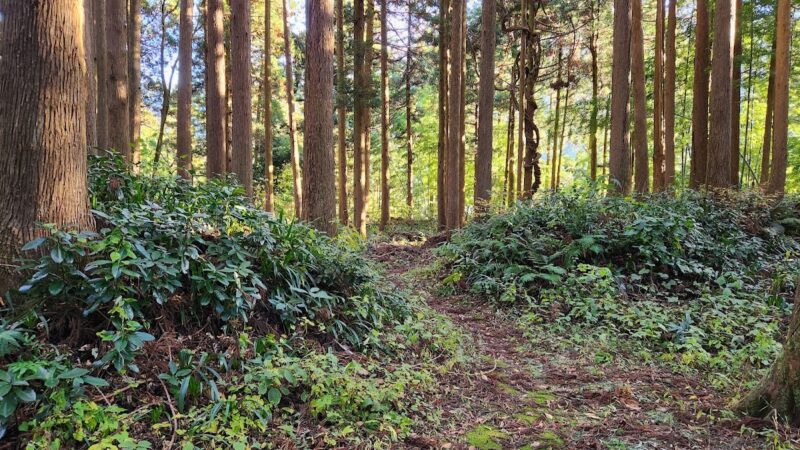
In recent years, Hakusan City has been developing the site, creating a walking trail from the entrance to the main enclosure. Information boards are placed at key points, allowing visitors to stroll while reading explanations of the castle’s history and remains.
The walking trail is relatively gentle, and anyone with average physical fitness can climb the castle. The required time is approximately 15-20 minutes on foot from the entrance to the main enclosure, making it an easy way to experience a Sengoku-era mountain castle.
Monument Marking the Founding Site of Hakusan Hime Shrine
A stone monument marking the founding site of Hakusan Hime Shrine has been erected near the castle ruins. Funayama has deep ties to the Hakusan faith, and possesses not only a history as a castle but also aspects of a religious sacred site.
Access Information
Location
Address: Hachiman-cho, Hakusan City, Ishikawa Prefecture
Access by Car
- From Hakusan IC on the Hokuriku Expressway: Approximately 30 minutes south on National Route 157
- From Kanazawa City: Approximately 40 minutes via National Route 157
Parking: Parking is available at the Hakusan Youth Center (free). The castle entrance is a short walk from here.
Access by Public Transportation
- From Tsurugi Station on the Hokuriku Railway Ishikawa Line: Approximately 10 minutes by taxi, approximately 40 minutes on foot.
- Route Bus: Hakusan City Community Buses and other services are available, but the number of services is limited, so prior confirmation is necessary.
Entrance to the Castle
The main entrance to the castle is located behind (north of) the Hakusan Youth Center building. A walking path is maintained from here, and you can reach the main enclosure in approximately 15-20 minutes. There is a signpost at the entrance, so you won’t get lost.
Nearby Tourist Attractions
Torigoe Castle Ruins
Torigoe Castle Ruins, the base of the Ikkō-ikki rebellion which had close ties to Funaoka Castle, is located in Betsumiya-cho, Hakusan City. It has been extensively renovated as a nationally designated historical site, and you can learn about the history of the Ikkō-ikki rebellion. It is approximately 20 minutes by car from Funaoka Castle.
Hakusan Hime Shrine
Hakusan Hime Shrine, the head shrine of the Hakusan faith, is located about 10 minutes by car from Funaoka Castle. As the head shrine of approximately 3,000 Hakusan shrines nationwide, it has long been revered. The magnificent shrine buildings and the atmosphere of the sacred grounds are a must-see.
Tedori Gorge
This beautiful gorge, carved by the Tedori River, is dotted with scenic spots, including Watagataki Falls. It’s about 15 minutes by car south of Funaoka Castle. Enjoy sightseeing that combines nature walks with castle visits.
Hakusan City Tsurugi Museum
This museum introduces the history and culture of the Tsurugi region, and also exhibits materials related to Funaoka Castle. Visiting before or after visiting the castle ruins will provide a deeper understanding.
Castle Stamp Information
Castle Stamp
The Funaoka Castle stamp is sold at the Tourist Information Center on the 1st floor of the Hakusan City Tsurugi Branch Office. The designs are inspired by the history and remains of the castle, making them popular collector’s items for castle enthusiasts.
Digital Stamp Rally
Hakusan City is holding the “Hakusan Castle Ruins Digital Stamp Rally,” and Funaoka Castle is included. You can collect stamps on-site using a smartphone app, and receive rewards for visiting multiple castle ruins.
Points and Advice for Visitors
Clothing and Equipment
- Footwear: Comfortable walking shoes such as sneakers or hiking boots are essential as you will be walking on mountain paths.
- Clothing: Comfortable clothing appropriate for the season. Insect repellent is also recommended in summer.
- Items to Bring: Drinking water, towel, camera, binoculars (for enjoying the view)
Estimated Visiting Time
A round trip from the castle entrance to the main enclosure takes approximately 40 minutes to 1 hour. If you want to carefully observe the remains, allow 1.5 to 2 hours.
Best Season
- Spring (April-May): Beautiful fresh greenery, mild weather, ideal for visiting the castle.
- Autumn (October-November): Enjoy the autumn foliage, clear air, and excellent views.
- Winter: It’s best to avoid visiting during the snowy season as climbing becomes difficult.
Precautions
- As it’s a mountain castle, the ground can become slippery during and after rain.
- Be careful of wild animals (wild boars, bears, etc.) and avoid traveling alone.
- To protect the ruins, please refrain from climbing on the stone walls or damaging the earthworks.
Funaoka Castle and the Sengoku History of Kaga
The Ikko-ikki and the Uniqueness of Kaga
Understanding the history of Funaoka Castle is essential, and this is where the Ikko-ikki in Kaga comes into play. The Kaga Ikko-ikki rebellion, which began in 1475 (Bunmei 7), overthrew the Togashi clan, the shugo (provincial governor), and established a “country ruled by the peasants” for approximately 100 years.
Funaoka Castle served as a crucial stronghold for the Ikko-ikki forces, playing a vital role in the defense of the Hakusan foothills. In particular, it functioned as the front line in the defense network of the Yamauchi clan, centered around Torigoe Castle, preventing invasions from the Tedori River basin.
Oda Nobunaga’s Pacification of Kaga
The Oda army’s invasion of Kaga in 1580 (Tensho 8) was the greatest crisis for the Ikko-ikki forces. The Oda army, led by Shibata Katsuie, Sakuma Morimasa, and Niwa Nagahide, overwhelmed the Ikko-ikki forces with its superior military power.
The fall of Funaoka Castle marked a crucial turning point in this Kaga pacification campaign. Sakuma Morimasa’s stratagem in seizing the castle significantly demoralized the rebel forces, eventually leading to the fall of Torigoe Castle.
Maeda Family’s Rule of Kaga
After Maeda Toshiie was granted Kaga Province, Funaoka Castle was reborn as a regional base within the Maeda family’s governing system. The major renovations by Takabatake Sadakichi not only strengthened the military facilities but also served as a symbolic demonstration of the Maeda family’s prestige.
The construction of the stone walls and earthworks incorporated the latest technology of the Oda-Toyotomi period, effectively showcasing the Maeda family’s economic and technological power to the region. The castle’s abandonment in 1601 (Keicho 6) is also evidence of the complete stability of the Maeda family’s rule.
Cultural Value of Funaoka Castle
Importance as a Hakusan City Designated Historic Site
The Funaoka Castle ruins are protected as a Hakusan City designated historic site. While numerous castle remains exist in Ishikawa Prefecture, Funaoka Castle is particularly valued for the following reasons:
- Well-preserved stone walls from the Oda-Toyotomi period: Few small to medium-sized mountain castles in rural areas retain such clearly preserved stone walls.
- Historical transition from the Ikkō-ikki to the Maeda family: A castle symbolizing the Sengoku period history of Kaga.
- Overall layout of the castle is understandable: Little later alteration makes it easy to understand the structure at the time.
Results of Research
Recent archaeological excavations and surveys have gradually revealed the structure and changes of Funaoka Castle. In particular, analysis of the stone wall construction techniques has provided clues to how Oda-Toyotomi period castle-building techniques spread to rural castles.
Although there are not many excavated artifacts, fragments of pottery and iron products allow us to infer the period of use of the castle and the lifestyle of its inhabitants.
Summary
Funaoka Castle is a valuable Sengoku period mountain castle remaining in Hakusan City, Ishikawa Prefecture. From a stronghold of the Ikkō-ikki rebels to a castle conquered by the Oda army and later the residence of a senior retainer of the Maeda family, its history embodies the very essence of Kaga’s Sengoku period history.
The stone walls and earthworks remaining on Funayama Hill, at an elevation of 186 meters, are still clearly visible after more than 400 years, conveying the castle-building techniques of the time and the spirit of the Sengoku warlords. The panoramic view overlooking Tsurugi city and the Tedorigawa alluvial fan eloquently explains why the castle was built in this location.
The climb from the entrance behind the Hakusan Youth Center to the main keep takes about 15-20 minutes. A well-maintained walking path allows for an easy experience of a Sengoku-era mountain castle. Castle stamps are also available, making it a popular destination for castle enthusiasts.
Why not combine a visit to this castle with other nearby historical spots such as Hakusan Hime Shrine and Torigoe Castle to enjoy a trip that explores the rich history and culture of Hakusan City? Funaoka Castle is a hidden gem in Ishikawa Prefecture, a place that deeply impresses visitors.