Isurugiyama Castle, Nakanoto Town (Ishikawa Prefecture): A Complete Guide | A Sacred Mountain Castle Built by Uesugi Kenshin
Isurugiyama Castle (also known as Sekidosan-jo or Isurugiyama-jo), located in Nakanoto Town, Kashima District, Ishikawa Prefecture, played a crucial role in the invasion of Noto during the Sengoku period. Built on Mount Isurugiyama, at an altitude of 564 meters, this castle is known as a base for Uesugi Kenshin, a renowned general of Echigo, during his conquest of Nanao Castle. This article provides a detailed explanation of Isurugiyama Castle’s history, remains, and the background of Mount Isurugiyama as a sacred site for Shugendo (mountain asceticism).
Overview and Location of Isurugiyama Castle
Isurugiyama Castle was a mountain castle built on Mount Isurugiyama in Kashima District, Noto Province (present-day Isurugiyama, Nakanoto Town, Kashima District, Ishikawa Prefecture). It was located south of Nanao Castle and east of Arayama Castle on the Noto-Echizen border. This location was militarily extremely important, a strategic stronghold overlooking the central part of the Noto Peninsula.
Mount Ishidō is a mountain range spanning Nakanoto Town and Nanao City in Ishikawa Prefecture, and Himi City in Toyama Prefecture. Its summit is located in Nakanoto Town, making it the highest peak in the town. This mountain has long flourished as a sacred site and center of mountain worship in Kaga, Noto, and Etchū provinces, and is said to have been opened approximately 1300 years ago by Taichō Taishi.
Geographical Features
The main enclosure of Ishidōyama Castle is built on a peak one step east from the 564-meter-high summit of Mount Ishidō, at an altitude of approximately 520 meters. Located almost in the center of the Noto Peninsula, it takes advantage of Nakanoto Town’s topography, bordering Hakui City to the south, Shiga Town to the west, Nanao City to the north, and Himi City to the east.
From the summit, a wide area of the Noto Peninsula can be seen, making it an excellent location for monitoring the movements of Nanao Castle and controlling the transportation routes connecting Noto and Etchū. This geographical advantage was one of the reasons Uesugi Kenshin chose Ishidoyama Castle as the construction site.
History of Ishidoyama Castle
Construction by Uesugi Kenshin
Ishidoyama Castle was constructed in 1576 (Tensho 4) during Uesugi Kenshin’s invasion of Noto Province. Kenshin built the castle on Ishidoyama Mountain, anticipating a long siege, in order to capture Nanao Castle, the stronghold of the Hatakeyama clan, a prominent family in Noto.
Nanao Castle was known as an impregnable fortress, and it was difficult to capture it through frontal attacks alone. Therefore, Kenshin built Ishidoyama Castle as a strategic base to control the rear of Nanao Castle, thus preparing to surround it. This strategy is considered a prime example of Kenshin’s military talent.
Placement of Naoe Kagetuna
Naoe Yamato-no-kami Kagetuna, a senior retainer of the Uesugi family, was placed as the first lord of Ishidoyama Castle. Naoe Kagetuna was a highly trusted general within the Uesugi family, and his entrustment of this important stronghold speaks to the high strategic value of Ishidoyama Castle.
Using Ishidoyama Castle as his base, Kagetuna played a role in cutting off supply lines to Nanao Castle and weakening the Hatakeyama clan’s power. It is also believed that he monitored the transportation routes connecting Noto and Etchu provinces, preventing reinforcements from the Hatakeyama clan.
Role in the Siege of Nanao Castle
In 1577 (Tensho 5), Uesugi Kenshin launched a full-scale attack on Nanao Castle. Ishidoyama Castle functioned as a crucial supply base during this siege, serving as a relay point connecting Kenshin’s headquarters with Nanao Castle.
Throughout the prolonged siege, Ishidoyama Castle allowed for constant monitoring of Nanao Castle’s movements, providing crucial information for the Uesugi army’s strategic planning. Ultimately, Nanao Castle fell due to internal divisions and food shortages, but the existence of Ishidoyama Castle undoubtedly contributed significantly to this outcome.
The Castle’s End
After the fall of Nanao Castle, the military importance of Ishidoyama Castle declined. Following the death of Uesugi Kenshin, Noto Province came under the control of the Maeda family, and it is believed that Ishidoyama Castle gradually ceased to play a vital role. While the exact date of its abandonment is unclear, it is presumed to have lost its function as a military base with the end of the Sengoku period.
The History of Ishidoyama as a Shugendo Site
Understanding Ishidoyama Castle requires knowing its history as a sacred site. Long before the castle was built, this mountain was a center of mountain worship in the Hokuriku region.
Tenpyo-ji Temple and the Ishidoyama Monks
Ishidoyama had a temple called Tenpyo-ji, which flourished as an imperial prayer site where prayers for the Emperor’s blessings were performed. During its peak in the Middle Ages, Ishidōyama had over 360 temples and it is said that approximately 3,000 ascetic monks (Shugenja) practiced asceticism on this mountain.
The Ishidōyama monks were not merely religious figures, but also possessed the characteristics of an armed group. During the Nanboku-chō and Sengoku periods, Ishidōyama became a battlefield numerous times, and the monks participated in the fighting each time. The history of Ishidōyama, caught up in the turmoil of Noto, illustrates the characteristic of medieval Japan where religion, politics, and military affairs were closely intertwined.
Relationship with the Maeda Family
From the late Sengoku period to the early Edo period, Ishidōyama had a deep relationship with the Maeda family. Even after the Maeda family brought Noto under their control, they respected the religious authority of Ishidōyama and implemented protective policies.
Ishidōyama continued to occupy an important position as a sacred mountain base of faith, crucial to the survival of both the Maeda family and Noto. However, due to the anti-Buddhist movement of the Meiji era, the temple complex on Mt. Ishido was destroyed, and almost all of the more than 360 sub-temples were lost.
The Existing Former Kanbo
The only building that survived the anti-Buddhist movement of the Meiji era is the “Former Kanbo.” This building is a valuable relic that conveys the former glory of Mt. Ishido and is open to the public as the Ishidoyama Museum. The Former Kanbo exhibits materials related to the history of Mt. Ishido and the culture of Shugendo (mountain asceticism), allowing visitors to learn about the religious and historical background of Mt. Ishido.
Remains and Highlights of Ishidoyama Castle
The remains of Ishidoyama Castle retain many characteristics of a mountain castle from the Sengoku period. The layout, centered on the main enclosure, is also valuable material for understanding the castle-building techniques of Uesugi Kenshin.
Structure of the Main Enclosure
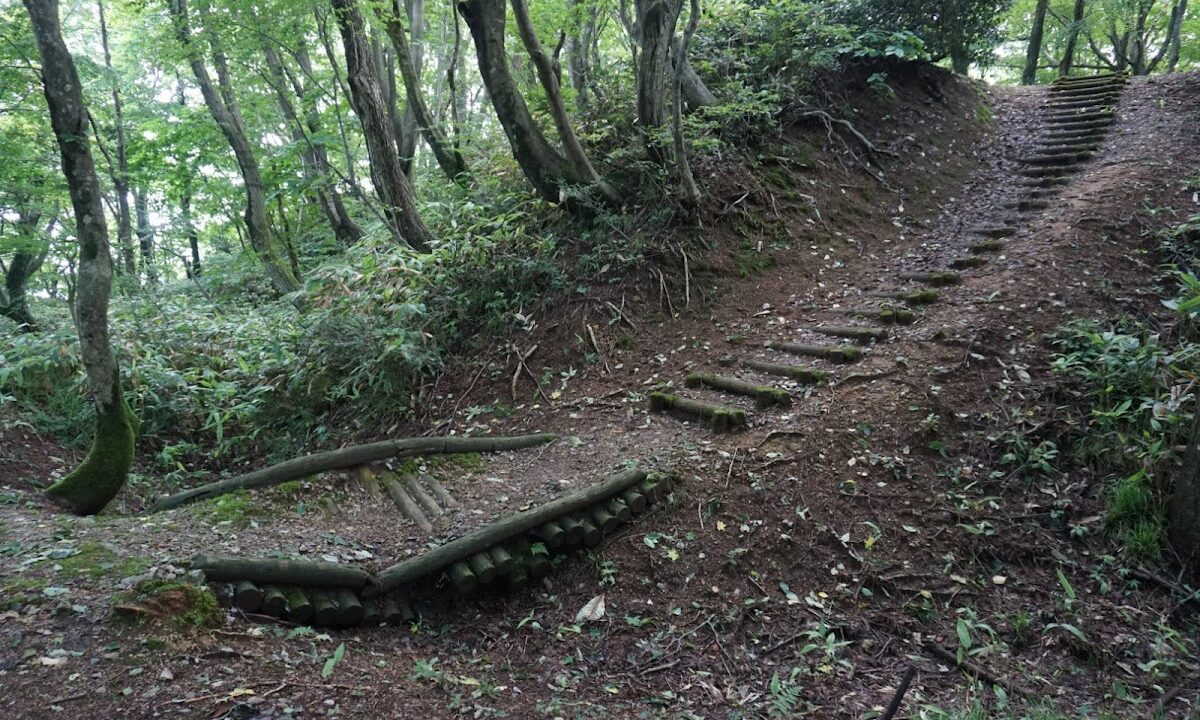
The main enclosure is located on the summit of a peak approximately 520 meters above sea level, and a low earthen embankment remains on the southwest side. This earthen rampart is a defensive structure designed to prevent enemy intrusion and is an important historical relic demonstrating the castle-building techniques of the time.
The main enclosure is not particularly large, which indicates that Ishidoyama Castle was not intended for long-term garrisoning but rather a temporary military base for the attack on Nanao Castle. From the main enclosure, one can see a panoramic view of the Noto Plain, and the direction of Nanao Castle is clearly visible.
Dry Moat and Defensive Structures
A dry moat is located below the east side of the main enclosure, serving to block enemy intrusion. This dry moat is an important defensive line separating the main enclosure from other enclosures, and its design takes advantage of the unique terrain of mountain castles.
The depth and width of the dry moat vary depending on the location, but in some places it can be clearly seen, making it a historical relic that allows one to appreciate the castle-building techniques of the Sengoku period. The combination of earthen ramparts and dry moats demonstrates the characteristics of the Uesugi-style castle-building technique, which efficiently enhanced defensive capabilities with limited time and resources.
Arrangement of Enclosures
In addition to the main enclosure, several other enclosures (flat areas) have been identified. These are believed to have been used as troop encampments and storage areas for supplies. The layout of the baileys follows the terrain, arranged in a stepped pattern, effectively utilizing the mountain slopes.
Each bailey is separated by steep, artificial slopes, a design intended to hinder enemy movement. These remains demonstrate that, despite being a castle built in a short period, it was designed based on meticulous planning.
Natural Environment of Ishidōyama
When visiting Ishidōyama Castle, the rich natural environment of Ishidōyama is also not to be missed. This mountain boasts the largest beech forest in Noto, preserving the natural beauty of a sacred mountain from the Tenpyō era.
Beech Forest Ecosystem
Beech forests are representative vegetation of Japan’s temperate forests and support a rich ecosystem. The beech forest of Ishidōyama is particularly large in scale even within the Hokuriku region, providing a habitat for diverse flora and fauna. You can enjoy the beautiful scenery of each season: the fresh green of spring, the deep green of summer, the autumn foliage, and the frost-covered trees of winter.
Hiking Trails and Nature Observation
Mt. Ishidō has several hiking trails, allowing visitors to enjoy both historical exploration and nature observation simultaneously. Information boards are installed along the trails, providing information about the history and nature of Mt. Ishidō.
Near the summit, you can enjoy a panoramic view of the vast Noto Peninsula, and on clear days, you can even see Toyama Bay and the Tateyama mountain range. This view makes it clear why Uesugi Kenshin chose this location as a strategic base.
Mt. Ishidō as a National Historic Site
Mt. Ishidō is designated as a national historic site, officially recognizing its historical and cultural value. This designation recognizes the religious and historical importance of the entire Mt. Ishidō, not just Ishidō Castle.
Scope and Preservation of the Historic Site
The designated area as a national historic site includes not only the remains of Ishidō Castle, but also the remains of the former temple buildings and Ishidō Tenpyō-ji Temple. These remains are important historical materials that comprehensively illustrate the history of Mt. Ishidō from the medieval to the early modern period.
Currently, preservation and utilization of the remains at Ishidōyama are underway, with some areas undergoing archaeological excavations and restoration work. These efforts have made the historical value of Ishidōyama clearer and more accessible to visitors.
Connection to the Amenomiya Kofun Cluster
In addition to Ishidōyama, the Amenomiya Kofun Cluster is also designated as a National Historic Site in Nakanoto Town. The Amenomiya Kofun Cluster is a Kofun period site believed to be the center of a powerful Noto clan, and together with Ishidōyama, it represents the historical importance of Nakanoto Town.
The historical flow from the ancient Amenomiya Kofun Cluster to the medieval Ishidōyama illustrates the significant role this region has played as a central hub of Noto since ancient times.
Ishidōyama Castle and the Surrounding Castle Network
Understanding Ishidōyama Castle requires knowing its relationship to surrounding castles. Many mountain castles were built in the Noto region, forming a interconnected defensive network.
Relationship with Nanao Castle
The most closely related castle to Ishidoyama Castle is Nanao Castle. Nanao Castle was the residence of the Noto Hatakeyama clan and the political and military center of Noto Province. Ishidoyama Castle is located approximately 10 kilometers south of Nanao Castle, making it an ideal location for besieging and monitoring the castle.
Uesugi Kenshin constructed Ishidoyama Castle to cut off supply lines to Nanao Castle and lower morale within the castle. The relationship between these two castles is a prime example of the skillful strategy employed in siege warfare during the Sengoku period.
Cooperation with Arayama Castle
To the west of Ishidoyama Castle lies Arayama Castle, which functioned as a defensive base on the Noto-Etchu border. It is believed that Arayama Castle and Ishidoyama Castle cooperated with each other, playing a role in monitoring the transportation routes connecting Noto and Etchu.
These castles shared information using communication methods such as signal fires, enabling them to respond quickly to enemy movements. Ishidoyama Castle functioned as an important hub within this network.
Access and Visiting Information for Ishidoyama Castle
This section introduces transportation options and points to note when visiting Ishidoyama Castle.
Transportation Access
Access by Car:
- Approximately 20 minutes from Takada IC on the Noto Satoyama Expressway (Noto Expressway)
- You can drive to the Ishidoyama trailhead, where a parking lot is available.
Public Transportation:
- Approximately 15 minutes by taxi from Noto Ninomiya Station on the JR Nanao Line
- Access by public transportation is limited, so using a car is recommended.
Hiking and Visiting Points
To see the remains of Ishidoyama Castle, you will need to hike the mountain trail. The hike from the trailhead to the main keep takes about an hour, so please note the following:
- Wear appropriate clothing and shoes for hiking.
- Bring drinking water and snacks.
- Check the weather beforehand and avoid hiking in rainy weather.
- In winter, there is a possibility of snow, so be prepared with appropriate equipment.
Ishidoyama Museum (Former Kanbo)
A visit to the Ishidoyama Museum (Former Kanbo) is also recommended in conjunction with your visit to Ishidoyama Castle. Here you can see exhibits on the history of Ishidoyama and the culture of Shugendo, allowing you to gain a deeper understanding of the historical background of Ishidoyama Castle.
Opening Hours: Normally 9:00-16:30 (may vary depending on the season)
Closed: Closed during the winter season (December-March)
Admission Fee: Charged (Please contact the Nakanoto Town Tourism Association for details)
Historical Significance of Ishidoyama Castle
Ishidoyama Castle is an important historical site for understanding the military history of Noto during the Sengoku period. This castle is particularly noteworthy for the following reasons:
Uesugi Kenshin’s Strategic Talent
The construction of Ishidoyama Castle demonstrates Uesugi Kenshin’s superior strategic vision. His multifaceted approach—not only a frontal assault but also a rear siege—against the seemingly impregnable Nanao Castle speaks volumes about Kenshin’s military prowess.
His efficient construction in a short period, along with the effective deployment of his retainers, demonstrates Kenshin’s strong organizational and execution skills.
The Intersection of Religion and Military Affairs
Ishidoyama, where Ishidoyama Castle was built, was originally a sacred site for Shugendo (mountain asceticism). The act of establishing a military base in a religiously sacred place is a characteristic phenomenon of the Sengoku period. Considering that the Ishidoyama monks also possessed military characteristics, this area was a place where religion and military affairs intersected in a complex way.
Uesugi Kenshin himself was a devout Buddhist, and it is believed that he understood the religious value of Ishidoyama. The way Ishidoyama Castle was operated, balancing considerations for using a sacred site as a battlefield with military necessity, is a fascinating point.
Position in the History of the Hokuriku Warring States Period
Ishidoyama Castle is a historical site that symbolizes a crucial event in the history of the Hokuriku Warring States period: Uesugi Kenshin’s invasion of Noto. Kenshin’s invasion of Noto was a strategic action taken amidst his conflict with Oda Nobunaga, and was part of the struggles between warring daimyo vying for national unification.
The fall of Nanao Castle marked the end of the Noto Hatakeyama clan, and Noto came under the control of the Uesugi clan, and later the Maeda clan. Ishidoyama Castle, as a castle that played a vital role in this historical turning point, is etched in the history of the Hokuriku Warring States period.
History and Culture of Nakanoto Town
Nakanoto Town, where Ishidoyama Castle is located, is situated almost in the center of the Noto Peninsula in Ishikawa Prefecture, and has an area of 89.45 square kilometers. It is an important region that conveys the history and culture of Noto to the present day. ### Ancient History
Nakanoto Town boasts numerous ancient ruins, including the Amenomiya Kofun Cluster, and has flourished as a central hub of Noto since ancient times. Its diverse history spans from the powerful clans of the Kofun period to the Shugendo practices of the medieval period and the turmoil of the Sengoku period.
Modern Nakanoto Town
Modern Nakanoto Town, while maintaining agriculture as its core industry, also focuses on promoting tourism by leveraging its historical heritage. Historical sites such as Mt. Ishidoyama and the Amenomiya Kofun Cluster are important tourist resources, attracting many history enthusiasts and tourists.
Nakanoto Town borders Hakui City to the south, Shiga Town to the west, Nanao City to the north, and Himi City in Toyama Prefecture to the east, maintaining its character as a vital transportation hub on the Noto Peninsula.
Summary
Ishidoyama Castle was a mountain castle built as a strategic base for Uesugi Kenshin’s conquest of Nanao Castle, and is a significant historical stage in Noto during the Sengoku period. Built on Mt. Ishidoyama, at an altitude of 564 meters, this castle not only served a military purpose but is also deeply connected to the history of Mt. Ishidoyama as a sacred site for Shugendo (mountain asceticism).
The remaining earthworks and dry moats are valuable historical materials that convey Uesugi Kenshin’s castle-building techniques and strategic thinking. Mt. Ishidoyama, designated a National Historic Site, is being preserved and utilized as an important historical heritage of Nakanoto Town.
Visiting Ishidoyama Castle offers a valuable opportunity to experience the history of the Hokuriku region during the Sengoku period, as well as to connect with the rich nature and religious culture of Noto. It is a recommended historical site not only for history enthusiasts but also for those who enjoy hiking and nature observation.
When visiting Nakanoto Town in Ishikawa Prefecture, be sure to explore Ishidoyama Castle and its surrounding historical heritage sites to experience the profound history and culture of Noto.