Kashima Castle (Kashima City, Ibaraki Prefecture) Complete Guide | History, Highlights, and Access Explained in Detail
Kashima Castle, located in Kashima City, Ibaraki Prefecture, is a castle built in the late Heian period by the Kashima clan, a branch of the Hitachi Taira clan. It is an indispensable part of the history of Kashima City, which flourished as a temple town for Kashima Shrine, and is now a beloved landmark for citizens as Kashima Castle Mountain Park. This article provides a detailed explanation of Kashima Castle, from its historical background to its current appearance.
History and Transformation of Kashima Castle
Construction in the Late Heian Period and the Kashima Clan
Kashima Castle was built in the late Heian period by Kashima Masamoto, a branch of the Hitachi Taira clan. The Hitachi Taira clan was a branch of the Taira clan that expanded its power in the Kanto region after the rebellion of Taira no Masakado, and the Kashima clan had a deep connection with Kashima Shrine.
Kashima Masamoto served as a Shinto priest at Kashima Shrine while also being active as a samurai. At that time, Kashima Shrine was an important center of faith in eastern Japan and also functioned as a base for the Yamato court’s eastern campaigns. The Kashima clan played a role in protecting this shrine while establishing control over the surrounding region.
The Kashima Clan and the Castle’s Development During the Sengoku Period
With the arrival of the Sengoku period (Warring States period), the Kashima clan established themselves as powerful local lords in southern Hitachi Province. During this period, Kashima Castle’s military function was strengthened, and its fortifications were expanded. The eastern edge of the castle is said to have extended to the vicinity of the current second torii gate of Kashima Shrine, suggesting its considerable size.
The Kashima clan maintained two roles for generations: Shinto priests of Kashima Shrine and samurai. They are particularly known for producing Tsukahara Bokuden (1489-1571), a renowned swordsman, during the Sengoku period. Bokuden, as the founder of the Kashima Shinto-ryu school of swordsmanship, left a significant mark on the history of Japanese swordsmanship.
Changes after the Edo Period
During the Edo period, the Kashima clan served Tokugawa Ieyasu and continued to exist as hatamoto (direct retainers of the Tokugawa shogunate). However, Kashima Castle lost its military importance and gradually followed the path to abandonment. From the mid-Edo period onward, its function as a castle was almost completely lost, and the site came to be used for fields and residential areas.
After the Meiji Restoration, the site of the main keep was developed into a park, becoming a place of relaxation for local residents. A school was built on the site of the second keep during the Meiji era, which continues to this day as Ibaraki Prefectural Kashima High School.
Structure and Layout of Kashima Castle
Scale and Arrangement of the Castle
Kashima Castle was a flatland castle built on a plateau, and had a basic structure consisting of the main keep, second keep, and third keep. The eastern side of the castle bordered the grounds of Kashima Shrine, suggesting that an integrated defensive system was in place with the shrine.
The main keep (Honmaru) was located in the center of the current Kashima Castle Park, on a plateau approximately 30 meters above sea level. From here, one could see Lake Kitaura and the surrounding plains, indicating a strategically advantageous location. The second bailey (Ninmaru) was located northwest of the main keep, and its site is now occupied by Ibaraki Prefectural Kashima High School.
Defensive Structures and Features
Kashima Castle’s defenses skillfully utilized the natural terrain. The eastern side faced the forested area of Kashima Shrine, and the western side faced a low-lying wetland, both serving as natural moats. It is also believed that a supply route utilizing water transport from Lake Kitaura was secured.
While earthen ramparts and dry moats surrounded the castle, large-scale stone structures such as stone walls were rarely seen. This is thought to be due to the Kashima clan’s role as Shinto priests and the geographical conditions of the plains in southern Hitachi Province.
Current State of Kashima Castle Hill Park
Park Overview and Development Status
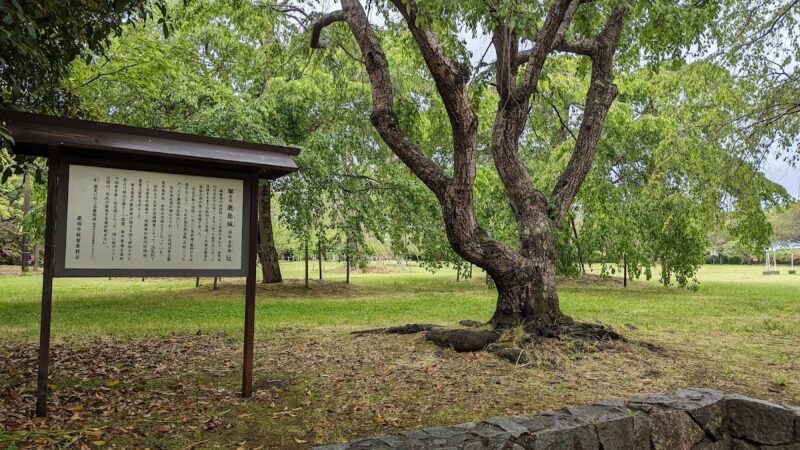
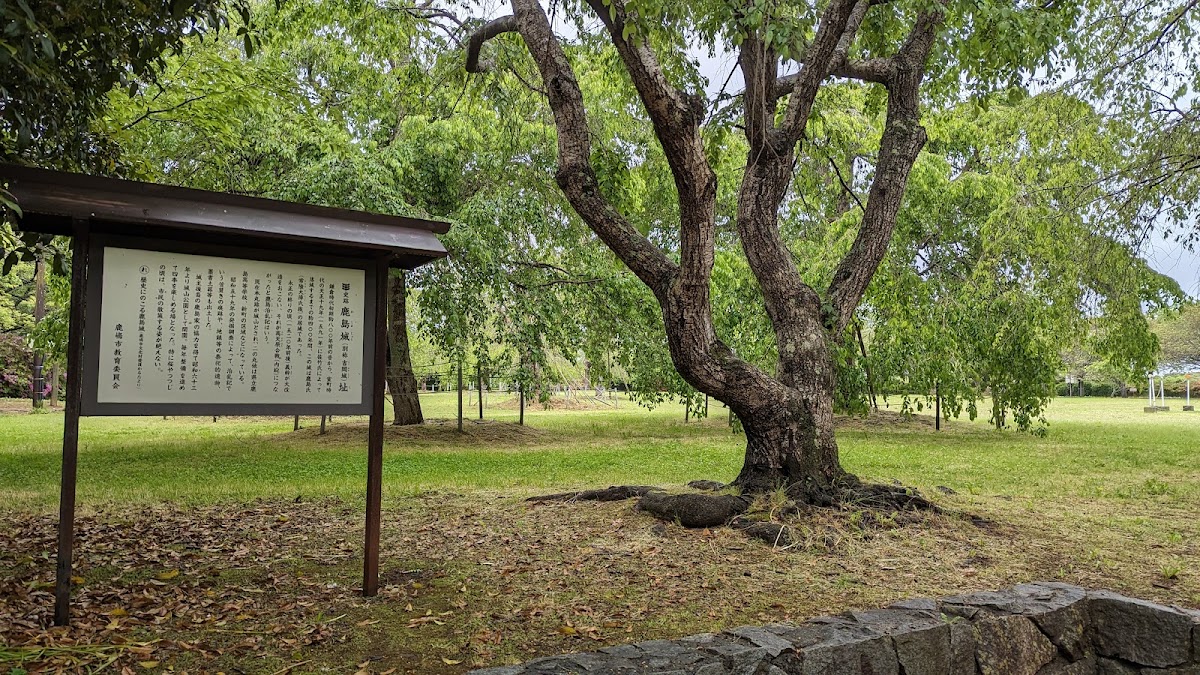
Currently, the site of the former main keep of Kashima Castle has been developed into Kashima Castle Hill Park, a place of relaxation for citizens. The park features playground equipment and open spaces, and is also known as a popular cherry blossom viewing spot in spring. Unfortunately, very few remains of the castle itself are left, but the topography allows for some imagination of its former appearance.
In the center of the park, there is an explanatory sign about Kashima Castle, where visitors can learn about the castle’s history and structure. Furthermore, statues of Tsukahara Bokuden and haiku monuments of Matsuo Basho are scattered throughout the area, making it an enjoyable historical walking course.
Highlights and Points of Interest
The main points of interest when visiting Kashima Castle Hill Park are as follows:
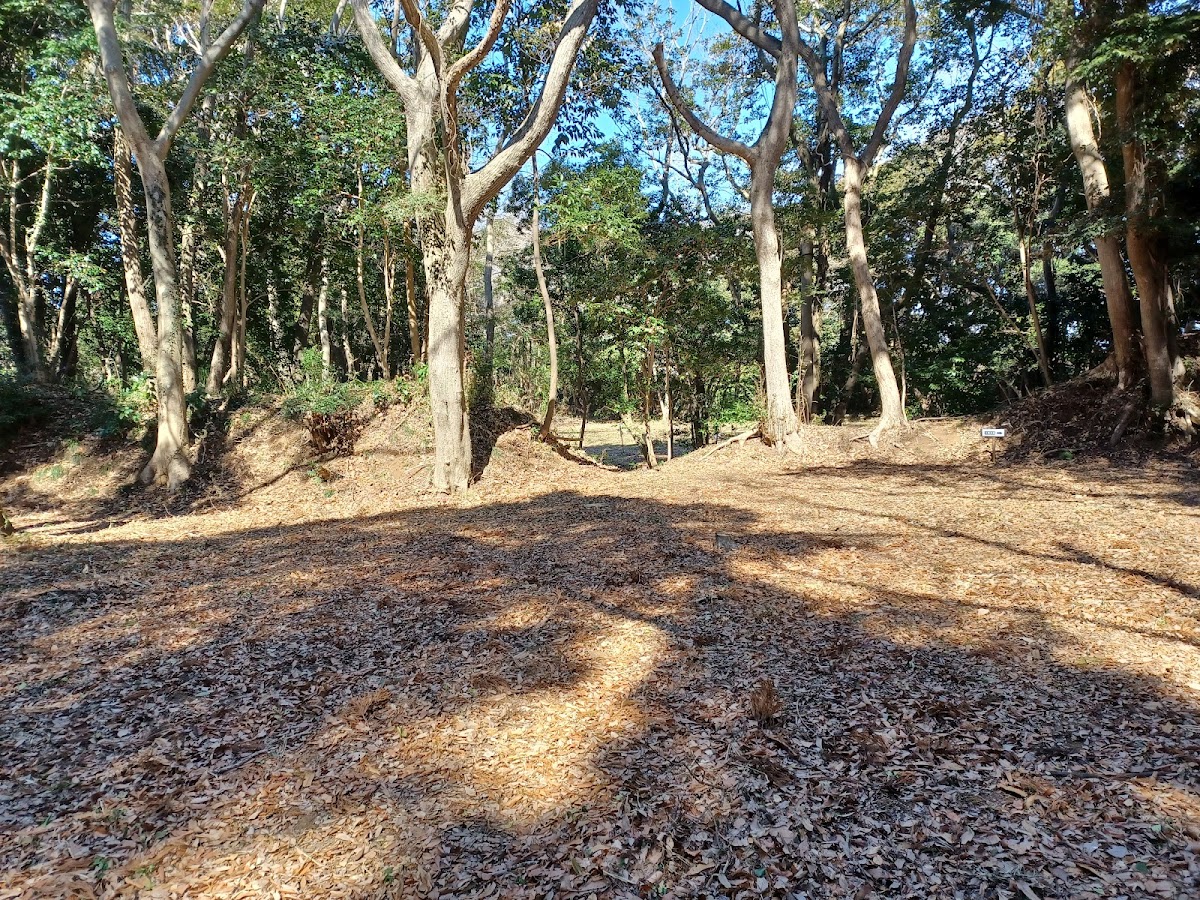
Observation of Topography: The remaining traces of earthworks and the elevation differences of the plateau allow you to imagine the structure of the castle. In particular, viewing the area towards Kashima Shrine from the east side of the park provides a good understanding of the relative positions of the castle and the shrine.
Views: From the main castle grounds, you can enjoy views of Kashima city and the Kitaura area. On clear days, you can even see the Pacific Ocean, giving you a real sense of this area’s importance as a hub for both water and land transportation.
Seasonal Scenery: You can enjoy the beauty of nature throughout the seasons, including cherry blossoms in spring, lush greenery in summer, and vibrant autumn foliage. The area is especially lively with locals and tourists during cherry blossom season.
Nearby Historical Spots and Tourist Information
Connection to Kashima Shrine
When visiting Kashima Castle, we highly recommend also visiting Kashima Shrine. Kashima Shrine, as the Ichinomiya (first-ranked shrine) of Hitachi Province, has long been considered one of the most important shrines in eastern Japan. It is said to have been founded in the first year of Emperor Jimmu’s reign (660 BC) and enshrines Takemikazuchi-no-Okami.
The grounds of Kashima Shrine are vast, with important buildings such as the main hall, worship hall, and gate tower scattered throughout. The vermilion-lacquered gate tower, in particular, was donated by Tokugawa Yorifusa in 1634 and is designated as a National Important Cultural Property. Further into the grounds is a mystical pond called “Mitarai Pond,” known for its constant water temperature throughout the year.
Tsukahara Bokuden Related Spots
Spots related to Tsukahara Bokuden, a swordsman produced by the Kashima clan, are scattered throughout Kashima City. A statue of Tsukahara Bokuden stands near Kashima Shrine, commemorating his achievements as a master swordsman. Bokuden is a legendary swordsman who, despite experiencing 19 duels and 37 battles in his lifetime, never suffered a single injury.
The Kashima Shinto-ryu school of swordsmanship, founded by Bokuden, had a significant influence on later Japanese swordsmanship. Even today, Kashima City continues to hold activities to honor Bokuden, including regular events such as sword fighting demonstrations.
Kamatari Shrine
Kashima City is also home to Kamatari Shrine, dedicated to Nakatomi no Kamatari (Fujiwara no Kamatari), known for the Taika Reforms. The Nakatomi clan served as priests of Kashima Shrine, and there is a theory that Kamatari was born in this area. The shrine is located in a quiet forest and is a must-see spot for history buffs.
Geography and Characteristics of Kashima City
Location and Topography
Kashima City is located in the southeastern part of Ibaraki Prefecture, in the Kashima region. It is approximately 80 kilometers from Tokyo, and faces the Kashima Sea of the Pacific Ocean to the east and Lake Kasumigaura and Lake Kitaura to the west. It has a long, narrow shape from north to south, with hilly areas below 40 meters in elevation stretching from the central to northern parts.
Due to its location on the Pacific Ocean, it is influenced by the Kuroshio Current and enjoys a relatively mild climate compared to other parts of Ibaraki Prefecture. Even in winter, there is almost no snowfall, making it a pleasant environment throughout the year. This mild climate has long supported the development of agriculture and fishing.
Industry and Modern Development
Kashima City has long flourished as a temple town for Kashima Shrine, but in modern times it has developed as an industrial city that forms part of the Kashima Coastal Industrial Zone. The Kashima Development project, which began in the 1960s, led to the construction of steel mills and petrochemical complexes, making it an important hub supporting the economy of Ibaraki Prefecture.
It is also nationally known as the home town of the J.League’s Kashima Antlers. Kashima Soccer Stadium was a venue for the 2002 FIFA World Cup, and functions as a stage for international sporting events.
History as a Key Point for Water Transportation
Kashima City is located surrounded by the Pacific Ocean, Lake Kitaura, Lake Kasumigaura, and the Tone River system, and has played an important role as a key point for water transportation since ancient times. During the Edo period, seafood caught in the Kashima Sea and agricultural products from Hitachi Province were transported to Edo (present-day Tokyo) via waterways.
Even today, Kashima Port functions as an important international trading port and continues to develop as a deep-water port capable of accommodating large vessels. This tradition of water transport is a significant characteristic of this region, dating back to the time when Kashima Castle was built.
Access Information
Access by Public Transportation
Train: The nearest station is Kashima-Jingu Station on the JR Kashima Line. From Tokyo Station, it takes approximately 2 hours by the limited express trains “Ayame” or “Kashima,” or approximately 2 hours by highway bus. It’s about a 15-minute walk from Kashima-Jingu Station to Kashima Castle Park.
Bus: Highway buses to Kashima-Jingu depart from the Yaesu South Exit of Tokyo Station. The journey takes approximately 2 hours. After alighting at the Kashima-Jingu bus stop, it’s about a 10-minute walk to Kashima Castle Park.
Access by Car
Expressway: Approximately 15 minutes from the Higashi-Kanto Expressway “Itako IC” or approximately 10 minutes from the “Kashima IC”. From Tokyo, the route via the Metropolitan Expressway and Higashi-Kanto Expressway is convenient.
Parking: Kashima Shiroyama Park does not have its own parking lot, but you can use the nearby Kashima Shrine parking lot (paid). There are also several private parking lots in the surrounding area.
Notes for Visitors
Kashima Shiroyama Park is generally open 24 hours, but lighting is limited at night, so daytime visits are recommended. The park has basic facilities such as toilets and vending machines, but there are no food or drink facilities, so please prepare accordingly.
Nearby Tourist Attractions
Shin-Jingu Bridge
The Shin-Jingu Bridge, connecting Kashima City and Itako City, is a beautiful bridge constructed in conjunction with the 2002 FIFA World Cup. It stands alongside the old bridge, and its reflection on the surface of Lake Kitaura makes for an excellent photo spot. From the bridge, you can enjoy a panoramic view of the vast expanse of Lake Kitaura and the surrounding nature.
Kashimanada Seaside Park
Facing the Pacific Ocean, Kashimanada Seaside Park is a nature-rich park with a vast sandy beach and pine forest. It is bustling with swimmers in the summer and attracts surfers and beach sports enthusiasts throughout the year. The park also boasts a large colony of Japanese roses (Rosa rugosa), with Ibaraki Prefecture being considered the southernmost limit of its habitat on the Pacific coast.
Collaboration with Itako City
The neighboring city of Itako retains a charming townscape known as a waterside town. In June, the “Iris Festival” is held, with colorful irises blooming along the waterways. Visiting both Kashima City and Itako City allows for a more fulfilling sightseeing experience.
The Significance of Visiting Kashima Castle
Because very few remains of Kashima Castle exist, it may seem at first glance that there are few points of interest. However, this castle is an important historical site that tells the story of the Hitachi Taira clan’s history, its deep connection to Kashima Shrine, and the development of samurai culture in eastern Japan.
By imagining the era when samurai flourished amidst the current tranquil park landscape, one can gain a deeper understanding of Japanese medieval history. Furthermore, visiting Kashima Castle in conjunction with Kashima Shrine, sites related to Tsukahara Bokuden, and Kamatari Shrine will allow you to experience the rich historical flow of this region, spanning from ancient times to the medieval and early modern periods.
Summary
Kashima Castle in Kashima City, Ibaraki Prefecture, is an important fortress that functioned as the residence of the Hitachi Taira clan and the Kashima clan from the late Heian period to the Sengoku period. Currently, it is maintained as Kashima Castle Mountain Park, and although very few castle remains exist, the topography and surrounding environment allow us to imagine its former appearance.
Many historical elements are condensed within this castle, including its deep connection to Kashima Shrine, its origins as the birthplace of the swordsman Tsukahara Bokuden, and its location as a key point for water transport. When visiting Kashima City, be sure to stop by the Kashima Castle ruins and reflect on the medieval history of the Kanto region.
Blessed with a mild climate and abundant nature, Kashima City is an attractive city offering a variety of activities, from historical exploration to leisure activities by the sea and lakes, and even soccer matches. Start your exploration from Kashima Castle Park and fully experience the history and culture of this region.