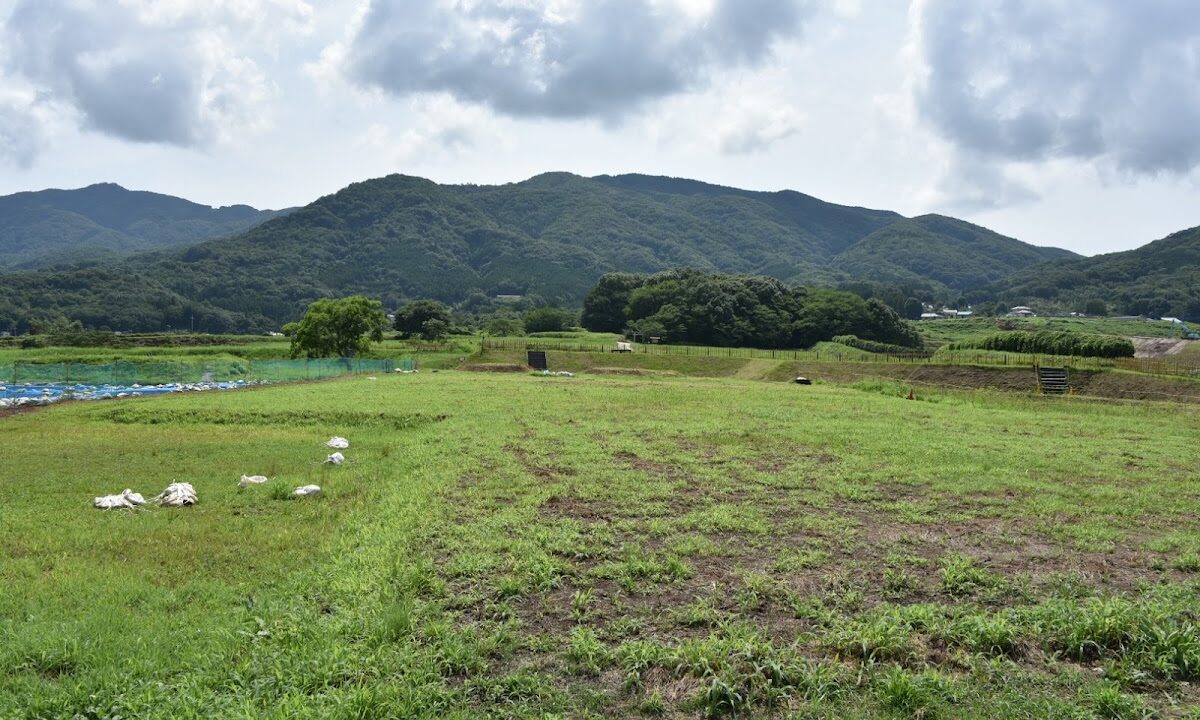
Complete Guide to Makabe Castle Ruins: History and Highlights of a National Historic Site in Sakuragawa City, Ibaraki Prefecture
Located in Kojō, Makabe-machi, Sakuragawa City, Ibaraki Prefecture, Makabe Castle Ruins is one of the representative castles of Hitachi Province from the medieval period to the Sengoku period. It was the residence of the Makabe clan, descendants of the Hitachi Taira clan, for generations. Even today, its four moats and earthworks remain in excellent condition, making it a valuable historical site designated as a national historic site. This article provides a detailed overview of Makabe Castle, from its history and structure to its highlights and access methods.
Overview of Makabe Castle
Makabe Castle was a flatland castle located in Kojō, Makabe-machi, Sakuragawa City, Ibaraki Prefecture (formerly Makabe-machi, Makabe-gun). Built skillfully on the slightly elevated ground of the Tsukuba Mountains, it was a flatland castle covering approximately 12.5 hectares. As a valuable historical site that conveys the typical structure of a medieval castle, it was designated a national historic site in 1975 (Showa 50). The most striking feature of Makabe Castle is the exceptionally well-preserved defensive structures, including the four-tiered moat and earthworks surrounding the main keep, as well as the earthen bridges. Such a clearly identifiable medieval castle structure is rare nationwide, making it of significant value in castle research. ### Basic Information on Makabe Castle
- Location: Kojō, Makabe-machi, Sakuragawa City, Ibaraki Prefecture
- Castle Type: Hilltop Castle (Flatland Castle)
- Construction Period: Estimated to be during the Eiroku era (1558-1570)
- Builder: Makabe Clan
- Main Lords: Makabe Clan, Asano Nagamasa
- Remains: Moat, earthworks, earthen bridge
- Designated Cultural Property: National Historic Site (designated in 1975)
- Size: Approximately 12.5 hectares
History of the Makabe Clan and Makabe Castle
Origins and Expansion of Power of the Makabe Clan
The Makabe clan was a branch of the Hitachi Taira clan (Ōjō clan), which ruled the southern part of Hitachi Province from the late Heian period to the Middle Ages. The Ōjō clan was a prestigious family descended from the Kanmu Taira clan and wielded great power in Hitachi Province. The Makabe clan, as a branch of the main clan, ruled the Makabe district and adopted the name Makabe from the local place name.
The first head of the Makabe clan is believed to be Taira no Nagamoto, who is thought to have established a power base in Makabe district in the late 12th century. Throughout the Kamakura period, the Makabe clan grew into a powerful samurai family in the region, and during the Muromachi period, they became one of the important local lords in Hitachi Province.
Construction and Development of Makabe Castle
Excavations by the Sakuragawa City Board of Education estimate that the current Makabe Castle was built during the Eiroku era (1558-1570). This period was in the midst of the Sengoku period (Warring States period), a time when castle construction and renovation were rampant throughout the country.
It is possible that the Makabe clan initially used an older castle as their base, but it is thought that they developed Makabe Castle into a more robust fortress in response to the advancements in military technology during the Sengoku period. The complex defensive structure, consisting of four layers of moats and earthen ramparts, can truly be said to represent the pinnacle of castle-building technology during the Sengoku period.
The Makabe and Satake Clans in the Sengoku Period
During the Sengoku period, the Satake clan gradually expanded its power in Hitachi Province. The Makabe clan initially maintained its power as an independent local lord, but eventually came under the influence of the Satake clan.
The Makabe clan held an important position as a vassal of the Satake clan and was entrusted with the defense of southern Hitachi Province. Makabe Ujimoto, the head of the Makabe clan, played an active role as a trusted retainer of the Satake clan and greatly contributed to the Satake clan’s unification of Hitachi Province.
The Battle of Sekigahara and the Transfer of the Makabe Clan
In the Battle of Sekigahara in 1600 (Keicho 5), the Satake clan did not clearly side with either the Eastern or Western Army, and was criticized by Tokugawa Ieyasu for their “ambiguous stance.” As a result, the Satake clan was ordered to undergo a significant reduction in territory and transfer, from 540,000 koku in Hitachi Province to 200,000 koku in Akita, Dewa Province.
Makabe Ujimoto also followed his lord, Satake Yoshinobu, to Akita in Dewa Province. This marked the end of the Makabe clan’s rule over Makabe Castle. The Makabe clan continued to serve as important retainers of the Akita Domain and served the Satake clan until the Meiji Restoration.
Asano Nagamasa and the Establishment of the Makabe Domain
After the Makabe clan moved to Akita, the land of Makabe was given to Asano Nagamasa, a senior retainer of Toyotomi Hideyoshi, as a retirement allowance. After the Battle of Sekigahara, Asano Nagamasa was granted 50,000 koku in Hitachi Makabe and established the Makabe Domain.
Asano Nagamasa was a prominent figure under the Toyotomi regime, serving as one of the Five Commissioners, and distinguished himself on the Eastern Army side in the Battle of Sekigahara. The Makabe Domain was established as the retirement territory of Nagamasa, but after Nagamasa’s death in 1611 (Keicho 16), the Asano family was transferred to Wakayama in Kii Province, and the Makabe Domain was abolished after a short period.
Makabe Castle After the Edo Period
After the Asano clan’s transfer, the Makabe area was divided into territories directly controlled by the shogunate and those of hatamoto (direct retainers of the shogun), and Makabe Castle was abandoned. Although it lost its function as a castle, the remains such as moats and earthworks were preserved relatively well, even though they were used as farmland and residential areas.
Even after the Meiji era, the Makabe Castle ruins were cherished as a historical symbol of the region, and in 1975 (Showa 50), it was designated a national historic site, leading to full-scale preservation and development efforts.
Makabe Castle’s Structure and Highlights
Quadruple Moats and Earthworks
The most distinctive feature of Makabe Castle is the quadruple moats and earthworks surrounding the main keep. This is an extremely complex and robust defensive structure for a medieval castle, demonstrating the military strength and advanced castle-building techniques of the Makabe clan.
The innermost moat is the main bailey moat, directly protecting the main keep, measuring approximately 10-15 meters wide and 3-4 meters deep. Beyond this are the second bailey moat, the third bailey moat, and the outer moat, with earthen ramparts 3-5 meters high built between each moat. This multi-layered defensive structure was designed to gradually thwart enemy advances.
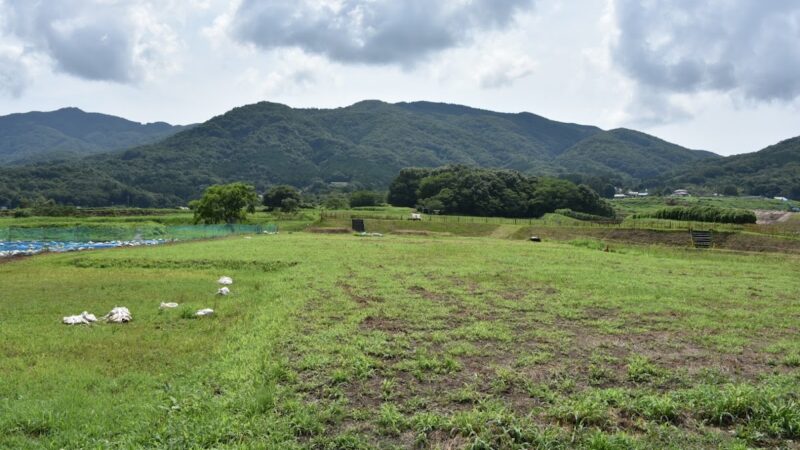
Even today, these moats and ramparts are clearly visible, allowing visitors to experience the structure of a medieval castle firsthand by walking through the castle ruins.
Main Bailey Site
The main bailey is the core area of Makabe Castle, believed to have housed the lord’s residence and other important buildings. Currently, it is a flat space surrounded by earthen ramparts and moats.
The main enclosure (Honmaru) measures approximately 100 meters east-west and 80 meters north-south, covering an area of about 8,000 square meters. Archaeological excavations have confirmed the remains of buildings and wells, confirming that it was the site of the lord’s daily life and administrative activities.
Earthen Bridges
Several earthen bridges were constructed to cross the moat. These bridges, built by leaving sections of the moat unexcavated, had the advantage of being resistant to fire attacks, unlike wooden bridges.
The earthen bridges at Makabe Castle are approximately 3-4 meters wide, intentionally built narrow for defensive purposes. Furthermore, entrances (koguchi) were provided at both ends of the earthen bridges, making it easier to prevent enemy intrusion.
Second and Third Enclosures
The second and third enclosures (Ninmaru and Sannomaru) were located outside the main enclosure. It is presumed that these areas contained the residences of retainers, warehouses, and barracks.
The second bailey (Ninomaru) was positioned to surround the east and south sides of the main bailey (Honmaru), and the third bailey (Sannomaru) further surrounded the outermost part. Each section was clearly demarcated by moats and earthen ramparts, which also served to control movement within the castle.
Outer Enclosures
It is believed that a castle town was formed outside the outermost moat. The town of Makabe developed south of the castle and flourished as a merchant and artisan settlement.
The present-day Makabe district retains many historical buildings from the Edo period to the early Showa period, and has been designated as an Important Preservation District for Groups of Traditional Buildings, known as “Makabe Townscape.” Visiting the townscape along with the castle ruins will allow for a deeper understanding of Makabe’s history.
Current Status and Development of Makabe Castle Ruins
Historic Site Designation and Preservation Activities
Makabe Castle Ruins were designated a National Historic Site on March 18, 1975 (Showa 50). This legally protects the preservation and maintenance of the castle ruins, and Sakuragawa City (formerly Makabe Town) is carrying out planned preservation activities.
The designated historical site covers approximately 12.5 hectares and includes the main remains of the main keep, second bailey, third bailey, and outer fortifications. Changes to the current state are restricted within the designated area, and mechanisms are in place to protect the remains from development activities.
Archaeological Excavations and Research
The Sakuragawa City Board of Education and the Ibaraki Prefectural Board of Education have conducted multiple archaeological excavations. These investigations have yielded much knowledge about the castle’s construction date, structure, and building layout.
The excavations have revealed traces of moat excavation techniques and renovations through cross-sectional investigations of the moats. Furthermore, investigations in the main keep and second bailey have unearthed building remains, well remains, pottery fragments, and iron artifacts. These unearthed items provide insights into daily life at Makabe Castle and the trade relations of the time.
Development and Public Access
Makabe Castle Ruins have been developed into a historical park and are open to the public. Walking paths have been established within the castle grounds, allowing visitors to stroll and observe the moats and earthworks up close.
Information boards are installed at major points of interest, allowing visitors to learn about the castle’s history and structure. Furthermore, an observation deck has been created at the site of the main keep, offering panoramic views of the entire castle grounds.
Sakuragawa City regularly holds guided tours and history lectures to widely promote the value of Makabe Castle Ruins. By receiving guidance from local volunteer guides, visitors can gain a deeper understanding of the history and charm of Makabe Castle.
Access and Tourist Information for Makabe Castle Ruins
Access by Public Transportation
By Train and Bus
- Get off at JR Mito Line “Iwase Station,” then take a taxi for approximately 20 minutes (approx. 10 km).
- From Tsukuba Express “Tsukuba Station,” take the Kanto Railway bus bound for “Tsukuba Yamaguchi,” get off at “Tsukuba Yamaguchi,” transfer to a Sakuragawa City bus, get off at “Makabe Castle Ruins,” and walk for approximately 5 minutes.
Makabe Castle Ruins is somewhat inconvenient to access by public transportation, so you may want to consider using a rental car or taxi.
Access by Car
Access from Major Roads
- Approximately 20 minutes (approx. 11 km) from Sakuragawa-Chikusei IC on the Kita-Kanto Expressway
- Approximately 40 minutes (approx. 25 km) from Tsuchiura-Kita IC on the Joban Expressway
- Accessible via National Route 50 and National Route 294
Parking
- Approximately 20 minutes on foot (approx. 1.3 km) from Makabe Takagami-cho Parking Lot (free)
- Limited parking space available around the castle ruins
Visiting Information
- Visiting Hours: Open at all times
- Admission Fee: Free
- Duration: Approximately 40 minutes to 1 hour
- Guide: Volunteer guides available by prior reservation at the Sakuragawa City Tourism Association
Nearby Tourist Spots
Makabe Townscape
The townscape of the Makabe district, within walking distance of the Makabe Castle ruins, has been designated as an Important Preservation District for Groups of Traditional Buildings. Over 100 historical buildings dating from the Edo period to the early Showa period still exist, with shophouses, storehouses, and gates conveying the atmosphere of the past.
The “Makabe Hina Matsuri” (Doll Festival), held annually from February to March, is a popular event where hina dolls are displayed throughout the town, attracting many tourists.
Makabe Folklore Museum
This facility introduces the history and culture of the Makabe area, and exhibits materials related to Makabe Castle and the Makabe clan. Visiting before visiting the Makabe Castle ruins will allow for a deeper understanding of the history.
Makabe Granite
The Makabe area is known as a production area for high-quality granite, “Makabe Granite.” The stone processing industry is thriving, and there are many stone shops and workshops in the town. Makabe Granite has been used in important buildings such as the National Diet Building and the Supreme Court.
Historical Value and Significance of Makabe Castle
Importance in Medieval Castle Research
Makabe Castle ruins hold extremely important value in castle research as a typical example of a flatland castle from the medieval to the Sengoku period. Examples of well-preserved quadruple moats and earthworks are rare nationwide, making it a valuable historical site that provides concrete insights into the castle construction techniques and defensive philosophies of the time.
In particular, the arrangement of moats and earthworks, the structure of earthen bridges, and the design of the gates reveal how Sengoku period castles were built with actual battle in mind. Furthermore, artifacts unearthed through archaeological excavations provide concrete information about life within the castle and the distribution of goods.
Significance in Regional History
Makabe Castle played a crucial role as the political and military center of Hitachi Province, particularly Makabe County, from the medieval to the early modern period. The history of the rise and fall of the Makabe clan, a powerful regional samurai family, is essentially the history of medieval Hitachi Province itself.
Furthermore, the town of Makabe, which developed around Makabe Castle, still retains its historical townscape and serves as the core of the region’s identity. The preservation of the castle ruins and townscape together is of great significance in comprehensively understanding the region’s history and culture.
Value as a Tourist Resource
Makabe Castle Ruins are a representative medieval castle historical site in Ibaraki Prefecture, and a popular spot for history and castle enthusiasts. It has received high praise on castle information websites such as Kojodan, and many castle lovers from all over Japan visit.
Visiting both the castle ruins and the townscape of Makabe allows visitors to experience the history of Makabe from the medieval to the early modern and modern periods, which is a major attraction as a tourist destination. Sakuragawa City is focusing on promoting tourism centered on the Makabe Castle Ruins and townscape of Makabe, positioning them as important resources for regional revitalization.
Points to Consider When Visiting Makabe Castle
Best Season for Visiting
Makabe Castle Ruins are open year-round, but the following are particularly recommended times:
Spring (March-May)
This is the season of fresh greenery, and the vegetation around the earthworks and moats is beautiful, making it ideal for a stroll. Also, the “Makabe Hina Matsuri” (Doll Festival) is held from late February to early March, which can be enjoyed in conjunction with sightseeing in the town.
Autumn (October-November)
This is the season of autumn leaves, and the scenery of the castle ruins becomes even more beautiful. The weather is mild, making it suitable for leisurely exploring the historical site.
Clothing and Items to Bring
Since there are many unpaved paths within the castle ruins, we recommend wearing comfortable shoes (such as sneakers). In the summer, insect repellent, sunscreen, and a hat are recommended for comfort.
Bringing a camera will allow you to capture the impressive scenery of the moats and earthworks. Binoculars will allow you to observe the details of the distant remains.
Estimated Visit Time
A visit to Makabe Castle Ruins usually takes about 40 minutes to 1 hour. If you want to carefully observe the ruins or enjoy taking photographs, we recommend allocating 1.5 to 2 hours.
If you also plan to visit the townscape of Makabe, planning a half-day to full-day schedule will allow you to leisurely enjoy the history and culture of Makabe.
Utilizing Guided Tours
The Sakuragawa City Tourism Association offers guided tours of the Makabe Castle ruins and the townscape of Makabe, led by volunteer guides (advance reservations required). Receiving guidance from a local history expert will allow you to gain a deeper understanding of the historical sites’ highlights and background.
To apply for a guided tour, please contact the Sakuragawa City Tourism Association or the Cultural Properties Division of the Sakuragawa City Board of Education.
Summary
The Makabe Castle ruins, located in Makabe-cho, Sakuragawa City, Ibaraki Prefecture, are a masterpiece of medieval castle architecture, serving as the residence of the Makabe clan, descendants of the Hitachi Taira clan. Designated as a national historic site, it is a valuable historical site with well-preserved quadruple moats and earthworks, and holds extremely important value for understanding the structure of medieval castles.
Makabe Castle played a crucial role in the history of Hitachi Province, from the rise and fall of the Makabe clan and their relationship with the Satake clan to the establishment of the Makabe Domain by Asano Nagamasa. Even today, it is carefully preserved as a historical symbol of the region, attracting many history enthusiasts and tourists.
When visiting the Makabe Castle ruins, be sure to also explore the historic townscape of Makabe. The history and culture of Makabe, conveyed through the castle ruins and townscape, will deeply impress visitors. If you have the opportunity to visit Ibaraki Prefecture, be sure to stop by the Makabe Castle ruins.