Complete Guide to Sukegawa Kaibojo Castle (Ibaraki Prefecture): A Coastal Defense Base in the Late Edo Period and the History of the Tengu Party Rebellion
What is Sukegawa Kaibojo Castle?
Sukegawa Kaibojo Castle was a Japanese castle located in Sukegawa-cho, Hitachi City, Ibaraki Prefecture (formerly Sukegawa, Taga District, Hitachi Province). Built during the Tenpo era in the late Edo period, it is known as a rare castle in Japan primarily built for coastal defense.
During the late Edo period, when foreign ships frequently appeared off the coast of Hitachi, it was built on a hill overlooking the Pacific Ocean by order of Tokugawa Nariaki, the lord of the Mito domain. However, less than 30 years after its construction, it became a battlefield during the Tengu Party Rebellion and met a tragic fate, falling and burning down.
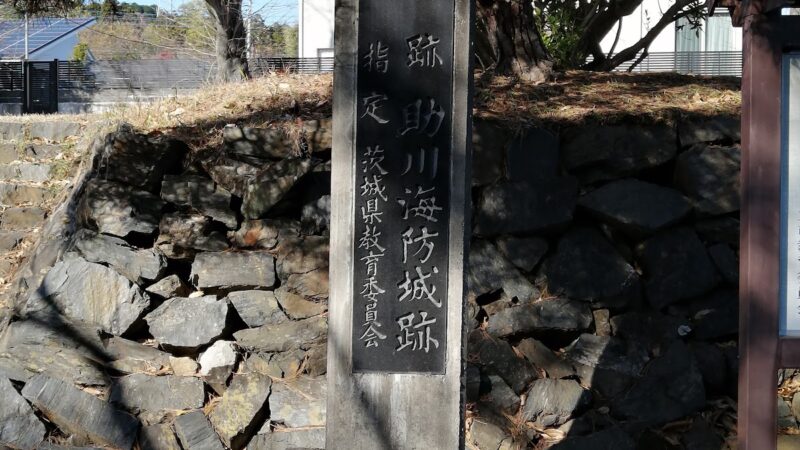
Currently, the castle ruins are designated as an Ibaraki Prefecture Historic Site and one of the 100 Scenic Views of Ibaraki, and serve as a place of relaxation for citizens as “Sukegawa Castle Ruins Park.” Although only a few remains are left around the site of the main keep, it is preserved as a valuable historical heritage site that conveys the turbulent period of the late Edo period.
Historical Background of the Construction of Sukegawa Coastal Defense Castle
The Appearance of Foreign Ships and the Need for Coastal Defense
From the early 19th century, ships of Western powers began to appear frequently in the waters around Japan. The waters off Hitachi, in particular, were an important sea area as part of the sea route to Edo, and sightings of foreign ships were frequent. Incidents such as the arrival of the Russian envoy Rezanov in 1804 and the Otsuhama Incident in 1824 showed an increasing number of contacts with foreign ships along the coast of Ibaraki Prefecture.
While the importance of coastal defense was recognized during the time of Tokugawa Narinobu, the 8th lord of the Mito domain, serious measures were not taken until the time of the 9th lord, Tokugawa Nariaki. Nariaki was known as a reformist lord with anti-foreign sentiments, and he worked to strengthen the coastal defense system as part of his domain reforms. ### Decision to Build a Castle by Tokugawa Nariaki
In May 1836 (Tenpo 7), Tokugawa Nariaki appointed his chief retainer, Yamanobe Yoshimi, to the newly created position of “Coastal Defense Supervisor.” This was a crucial position, responsible for the overall coastal defense policy of the Mito Domain. Nariaki ordered Yamanobe Yoshimi to reside in Sukegawa (also written as Kaikawa) and decided to establish a coastal defense base there.
The reason for choosing Sukegawa was its geographical advantage. From the high ground of Yogaiyama, which offered a panoramic view of the Pacific Ocean, it was possible to monitor a wide area of the sea, making it an ideal location for the early detection of foreign ships. Furthermore, its distance from Mito Castle was also suitable, allowing it to function as a frontline base in the domain’s coastal defense system.
Construction History and Project
Nariaki requested permission from the shogunate for Yoshimitsu Yamanobe to settle in Sukegawa as part of a “residence fortification,” and with this permission granted, construction of the castle officially began. In August of Tenpo 7 (1836), construction of a coastal defense castle began on Yogaiyama in Taihei, Sukegawa Village.
The construction proceeded while considering the financial situation of the Mito domain, but due to its important purpose of coastal defense, it was designed as a full-fledged castle with a main keep, second bailey, and third bailey. Because it was built in the late Edo period, it is believed to have incorporated the latest castle construction techniques and defensive theories of the time.
Sukegawa Coastal Defense Castle, along with Goryokaku (Hokkaido), Tatsuoka Castle (Nagano Prefecture), and Matsumae Castle (Hokkaido), is one of the castles built during the late Edo period and is the newest castle in Ibaraki Prefecture.
Structure and Characteristics of the Castle
Layout and Main Facilities
Sukegawa Coastal Defense Castle had its main enclosure located at the end of Yogaiyama, a ridge extending from southwest to northeast. This location allowed for a panoramic view of the Pacific Ocean, maximizing its function as a coastal defense castle.
The castle was a full-fledged structure with three layers: the main enclosure (Honmaru), the second enclosure (Ninmaru), and the third enclosure (Sanmaru). The Honmaru was located at the highest point and functioned as a command post and living quarters. The second and third enclosures were positioned as defensive structures, creating a tiered defensive system.
Due to its unique purpose as a coastal defense castle, securing a clear view of the sea was emphasized, and it is believed that its surveillance capabilities toward the Pacific Ocean were strengthened. Furthermore, a system for transmitting information in the event of a discovery of a foreign ship was also in place, with a rapid reporting system to Mito Castle established.
Uniqueness as a Coastal Defense Castle
The most distinctive feature of Sukegawa Coastal Defense Castle is that it was not a daimyo’s residence or base of power, but was built purely for the purpose of coastal defense. In the history of Japanese castles, examples of castles built for this purpose are extremely rare, and it is considered to have high historical value.
While typical castles have defensive structures designed to withstand attacks from land, Sukegawa Kaibo Castle’s primary purpose was maritime surveillance and intelligence gathering. Therefore, its design emphasized visibility and information transmission capabilities.
It is presumed that the castle contained facilities for surveillance and equipment for responding to the discovery of foreign ships. Furthermore, Yamanobe Yoshimi, the chief of coastal defense, and his subordinate samurai were stationed there, maintaining 24-hour maritime vigilance.
The Yamanobe Clan and Successive Castle Lords
First Castle Lord: Yamanobe Yoshimi
Yamanobe Yoshimi was a senior retainer of the Mito Domain and a person who enjoyed the absolute trust of Tokugawa Nariaki. Yoshimitsu, appointed as the Chief of Coastal Defense, served as the first lord of Sukegawa Coastal Defense Castle, playing a leading role in the Mito Domain’s coastal defense policy.
Yoshimitsu was not merely a military commander; he possessed deep knowledge and insight into coastal defense. He fulfilled his duties as Chief of Coastal Defense by formulating policies for dealing with foreign ships, establishing surveillance systems, and building information gathering systems. He also worked to build relationships with the local Sukegawa village, strengthening the coastal defense system with the cooperation of the community.
Yamanobe Yoshinori and the Tengu Party Rebellion
Yamanobe Yoshinori succeeded Yoshimitsu. During Yoshinori’s time, the Mito Domain was divided into two factions, the Tengu Party and the Shosei Party, and was embroiled in fierce internal conflict.
In 1864, when the Tengu Party, advocating reverence for the emperor and expulsion of foreigners, rose in rebellion, Sukegawa Coastal Defense Castle functioned as a base for the Shosei Party. Yamanobe Yoshinori belonged to the Shosei Party and became embroiled in the conflict with the Tengu Party. This conflict would determine the tragic fate of Sukegawa Coastal Defense Castle.
The Tengu Party Rebellion and the Fall of Sukegawa Coastal Defense Castle
The Outbreak of the Tengu Party Rebellion
In March 1864, the Tengu Party, a pro-emperor, anti-foreigner faction of the Mito Domain, rose in rebellion at Mount Tsukuba. Led by Fujita Koshirō, the Tengu Party took action demanding the implementation of expulsion of foreigners and reform of the shogunate’s administration, but they clashed fiercely with the Shosei Party, a conservative faction within the Mito Domain.
The Tengu Party initially aimed to directly appeal to the shogunate, but a military conflict with the Shosei Party became unavoidable. The Mito Domain descended into civil war, with battles raging in various locations.
Attack and Fall of Sukegawa Coastal Defense Castle
The Tengu Party successively captured Shosei Party strongholds, and in the process, Sukegawa Coastal Defense Castle also became a target. Defended by Yamanobe Yoshinori of the Shosei Party, Sukegawa Coastal Defense Castle was considered a crucial strategic location by the Tengu Party.
In 1864 (Genji 1), the Tengu Party attacked Sukegawa Coastal Defense Castle. After fierce fighting, the castle fell, and many of its buildings were destroyed by fire. Its fall, after only 28 years since its construction, marked a tragic end, completely contrary to its original purpose of coastal defense.
Following its fall, Sukegawa Coastal Defense Castle was abandoned. Having lost its function as a coastal defense base, it disappeared from the stage of history amidst the turmoil of the late Edo period. This fall is remembered as one of the tragedies brought about by internal conflicts within the Mito domain.
Aftermath of the Tengu Party Rebellion
The Tengu Party continued their actions, marching towards Kyoto, but ultimately surrendered to the shogunate forces in Echizen Province (present-day Fukui Prefecture). Many Tengu Party members, including Fujita Koshirō, were executed, and the Mito domain suffered a serious loss of talent.
Exhausted by this internal conflict, the Mito domain was unable to play a leading role in the Meiji Restoration, and its influence greatly declined. The fall of Sukegawa Coastal Defense Castle became one of the events symbolizing the decline of the Mito domain.
Current Sukegawa Castle Ruins Park
Current Status of the Remains
Currently, the site of Sukegawa Coastal Defense Castle has been developed as “Sukegawa Castle Ruins Park,” a place of relaxation for the citizens of Hitachi. Although almost all of the buildings were lost in the fire that fell to the castle, the topography of the main keep site, some earthworks, and traces of the baileys remain.
Information boards are installed within the park, allowing visitors to learn about the history of Sukegawa Coastal Defense Castle, the circumstances of its construction, and its fall during the Tengu Party Rebellion. From the main keep site, one can still enjoy a panoramic view of the Pacific Ocean, appreciating the castle’s strategic location as a coastal defense castle.
Hitachi Technical High School is located to the north of the castle ruins, and the main keep is situated on the mountain to the north. The topography of the ridge extending from the southwest to the northeast remains as it was in the past, allowing for an understanding of the castle’s basic structure.
Cultural Value
Sukegawa Coastal Defense Castle Ruins are designated as an Ibaraki Prefecture Historic Site and are protected as a valuable historical heritage site that tells the story of coastal defense policies during the late Edo period. It has also been selected as one of the “100 Scenic Views of Ibaraki,” and is valued for both its historical and scenic significance.
In the history of Japanese castles, castles built purely for coastal defense are extremely rare, and Sukegawa Coastal Defense Castle is a prime example of this, making it academically important. It is a subject of historical research as a place where multiple historical themes intersect, including the coastal defense policies of the late Edo period, the administrative reforms of the Mito Domain, and the Tengu Party Rebellion.
Access Information
Access by Public Transportation
The nearest station to Sukegawa Castle Ruins Park is Hitachi Station on the JR Joban Line. From Hitachi Station, you can access the park in the following ways:
By Bus:
Take a local bus from Hitachi Station and get off at the “Sukegawa Elementary School” or “Sukegawa-cho” bus stop, then walk for about 5 minutes.
By Taxi:
It takes about 10 minutes by taxi from Hitachi Station.
On Foot:
It takes about 25-30 minutes on foot from Hitachi Station. The route is north from the station towards Sukegawa-cho.
Access by Car
If using the Joban Expressway:
- Approximately 15 minutes from Hitachi Chuo Interchange
- Approximately 20 minutes from Hitachi Minami Ota Interchange
While the park has a parking lot, it is not very large and may be crowded on weekends and holidays. It is recommended to use the parking lot below the park and walk to the main keep ruins from there. The distance is short and can be reached in just a few minutes.
Points to Note During Your Visit
Sukegawa Castle Ruins Park is open to the public as a park, and visitors are free to come and see. There is no entrance fee, and it is open year-round. However, nighttime visits are not recommended for safety reasons.
The estimated time required for a visit is 30-40 minutes. This is a suitable amount of time to enjoy the view from the main keep ruins, learn about the history from the information boards, and observe the few remaining structures. Those interested in history are advised to spend more time exploring the park thoroughly.
While the park is well-maintained, there are some slopes and stairs, so comfortable walking shoes are recommended. Also, if you plan to take notes or photographs of the information boards, it’s a good idea to bring writing materials and a camera.
Nearby Tourist Attractions
Historical Sites in Hitachi City
When visiting Sukegawa Castle Ruins Park, you can also visit other historical sites in Hitachi City.
Kamine Park:
Located about 10 minutes by car from Sukegawa Castle Ruins Park, this is a comprehensive park with a zoo, amusement park, and leisure land. It’s ideal for family visits.
Hitachi City Local History Museum:
This facility allows you to learn about the history and culture of Hitachi City, and also has exhibits related to Sukegawa Coastal Defense Castle. Visiting before or after your castle ruins visit will give you a deeper understanding.
Historical Sites Related to the End of the Edo Period in Ibaraki Prefecture
If you are interested in the history of the Mito Domain and the end of the Edo period, a historical tour visiting related historical sites in Ibaraki Prefecture is also recommended.
Kodokan (Mito City):
This was a domain school founded by Tokugawa Nariaki and has deep connections to the Tengu Party Rebellion. It is designated as a National Special Historic Site.
Mito Castle Ruins (Mito City):
This is the site of the castle of the Mito Tokugawa family, one of the three main branches of the Tokugawa clan, and the headquarters of the Mito Domain.
Otsuhama (Kitaibaraki City):
This is a historical site where foreign ships drifted ashore, and is an important spot for understanding the background of the construction of Sukegawa Coastal Defense Castle.
Historical Significance of Sukegawa Coastal Defense Castle
Position in the History of Japanese Coastal Defense
Sukegawa Coastal Defense Castle is a castle of significant importance in the history of Japanese coastal defense. It is valued as an example of the advanced idea of developing a coastal defense base as one of the countermeasures against the external pressures faced by Japan in the 19th century.
The fact that a local domain independently established a coastal defense system during a period when the Edo Shogunate’s isolationist policy began to waver is also an example of the transformation of the shogunate system. Tokugawa Nariaki of the Mito Domain, while holding anti-foreign sentiments, recognized the need for practical coastal defense measures and, as a practical application, constructed Sukegawa Coastal Defense Castle.
Symbol of Mito Domain Reforms
Sukegawa Coastal Defense Castle was one of the symbolic projects of Tokugawa Nariaki’s reforms of the Mito Domain. In his domain reforms, Nariaki promoted various policies, including strengthening military power, promoting education, and developing industry, but the development of a coastal defense system was one of its important pillars.
The creation of a new position, the Chief of Coastal Defense, the establishment of a base in Sukegawa, and the construction of a full-fledged castle demonstrated Nariaki’s reformist ambition and ability to execute. Ironically, however, Sukegawa Coastal Defense Castle, a symbol of these reforms, was lost due to internal conflicts within the Mito Domain.
Lessons from the Tengu Party Rebellion
The fall of Sukegawa Coastal Defense Castle serves as a historical lesson illustrating the dangers of internal conflict. The fact that a castle originally built to defend against external enemies was destroyed due to internal conflict illustrates the importance of organizational unity.
The Tengu Party Rebellion was the result of the conflict between ideals and reality, and between radicals and moderates, reaching its extreme. The Mito Domain paid a heavy price, losing many talented individuals and significantly weakening its power. The ruins of Sukegawa Coastal Defense Castle remain a legacy that conveys this tragedy to the present day.
Summary
Sukegawa Coastal Defense Castle (Hitachi City, Ibaraki Prefecture) is a valuable historical site where two historical themes intersect: coastal defense policy during the late Edo period and internal conflict within the Mito Domain. Built in 1836 (Tenpo 7) by order of Tokugawa Nariaki, it functioned as a coastal defense base monitoring foreign ships from a hilltop overlooking the Pacific Ocean.
As a castle primarily intended for coastal defense, it is a rare example in the history of Japanese castles and is valued as an example of advanced initiatives during the turbulent late Edo period. However, the castle fell and burned down during the Tengu Party Rebellion in 1864, bringing its short history to an end after only 28 years since its construction.
Currently, the site is maintained as Sukegawa Castle Ruins Park and is designated as an Ibaraki Prefecture Historic Site and one of the 100 Scenic Views of Ibaraki. The view of the Pacific Ocean from the main keep remains unchanged, allowing visitors to appreciate the excellent location of this former coastal defense castle.
It is accessible by car in about 10 minutes or on foot in about 30 minutes from Hitachi Station on the JR Joban Line, and the estimated time for a visit is 30-40 minutes. When visiting Hitachi City, why not visit these historical castle ruins and reflect on the turbulent period at the end of the Edo period?