Complete Guide to Sagata Castle (Hiroshima Prefecture) | History and Highlights of a Sengoku Period Stone-Walled Mountain Castle
Sagata Castle (Sagata-jo) is a Sengoku period mountain castle site located in Sagata, Shin’ichi-cho, Fukuyama City, Hiroshima Prefecture. Also known as Sagata Castle and Onigataki Kayama Castle, it is known as a massive, all-stone-walled castle built on the summit of a mountain commonly called “Shiroyama” (Castle Mountain), at an altitude of 191 meters. Even today, the remains of the main enclosure’s stone walls, stone steps, and flanking defenses are well-preserved, making it a valuable historical site that conveys the appearance of a Sengoku period mountain castle.
History and Overview of Sagata Castle
Background of Construction and the Arichi Clan
Sagata Castle was built between the Eiroku era and the early Tensho era (1560s to early 1580s) by Arichi Motomori, the third generation of the Arichi clan, a local lord of Bingo Province. The Arichi clan originally based themselves in a narrow valley around present-day Arichi, Shin’ichi-cho, Fukuyama City. However, the construction of Aigata Castle marked their first expansion along the old highway in the Kannabe Plain.
This change in location represented a dramatic expansion of the Arichi clan’s power. By controlling the strategically important transportation hub on the south bank of the Ashida River, they were able to significantly increase their influence in the region. Furthermore, the construction of this castle was crucial in establishing their position as a samurai under the Mori clan.
Transition to a Mori Clan Directly Controlled Castle
After the Arichi clan submitted to the Mori clan, Aigata Castle increased in importance as a Mori clan directly controlled castle. It is believed that the main citadel underwent a major renovation during this period, resulting in the construction of a fully stone-walled structure. For the Mori clan, Aigata Castle held a strategically crucial position as a base controlling the Kannabe Plain, a vital strategic point in eastern Bingo Province.
The renovation to a fully stone-walled structure is presumed to have served not only to strengthen defensive capabilities but also as a symbolic demonstration of the Mori clan’s authority. At the time, castles using stone walls were the latest construction technology, and their adoption was a way for the lord to flaunt his power and wealth.
Castle Scale and Structure
The remains of Aigata Castle are distributed over a vast area of approximately 1,000 meters east-west and 500 meters north-south. Centered around the mountaintop at an elevation of 191 meters, the castle’s layout skillfully utilizes the steep terrain with a relative elevation difference of approximately 170 meters.
The narrow mountaintop of the castle mountain is densely packed with baileys, each surrounded by high stone walls. This fully stone-walled structure is noteworthy in castle history research as it exhibits characteristics of the transitional period to early modern mountain castles.
Highlights and Remains of Aigata Castle
The Complete Stone Wall of the Main Enclosure
The greatest highlight of Aigata Castle is undoubtedly the complete stone wall remaining in the main enclosure. Even today, on the mountaintop where a television tower stands, a magnificent stone wall remains in excellent condition, evoking the castle’s former glory.
The stone wall was constructed using the nozurazumi technique, a simple yet sturdy structure made by stacking natural stones as they were. The height varies depending on the location, but the highest points reach several meters, demonstrating the high level of stonework technology during the Sengoku period.
The construction of the stone wall reveals various ingenious methods to prevent enemy intrusion. In particular, in sections where the flanking fire technique was used, the stone wall curves to allow attacks from the side, indicating its high defensive capability.
Stone Stairs and Gate Entrance
Several stone staircases remain within the castle grounds, providing clues to the location of passageways and gate entrances (koguchi) at the time. These stone steps were designed for efficient movement on steep terrain, combining practicality and defensiveness.
The stone steps near the entrance are particularly sturdy, incorporating ingenious features to hinder enemy intrusion. Narrowing the steps and changing direction midway reduces the attacker’s momentum.
Arrangement of Enclosures
Multiple enclosures are arranged in a sequence along the long, narrow ridge of the castle mountain. The main enclosure is at the center, followed by the second and third enclosures, each separated by stone walls. Each enclosure differs in size and shape according to the terrain, suggesting they were used for different purposes.
The elevation differences between enclosures are also an important defensive element, making attacks from lower to higher enclosures difficult. This three-dimensional defensive structure clearly demonstrates the characteristics of mountain castles from the Sengoku period.
Technique of Flanking Fire
The stone walls of Aigata Castle skillfully utilize the technique of flanking fire. Yokoya is a defensive technique that involves bending castle walls and stone ramparts to allow attacks from the flanks.
The stone ramparts are bent at key points within the castle, creating a structure that allows arrows and gunfire to be fired from the side at enemies attacking from the front. This technique is a clever way to defend efficiently with limited forces and demonstrates the high level of castle-building technology of the time.
Views and Location
From the mountaintop at an altitude of 191 meters, you can enjoy a panoramic view of the Kannabe Plain. Its location overlooking the Ashida River and surrounding roads makes it clear that it was an extremely important military and strategic location.
On clear days, you can see as far as the Seto Inland Sea, providing a valuable perspective for understanding the geographical relationship of eastern Bingo Province. This excellent view was also an important element in the castle’s function of detecting enemy movements early.
Relocated Castle Gate and Susanoo Shrine
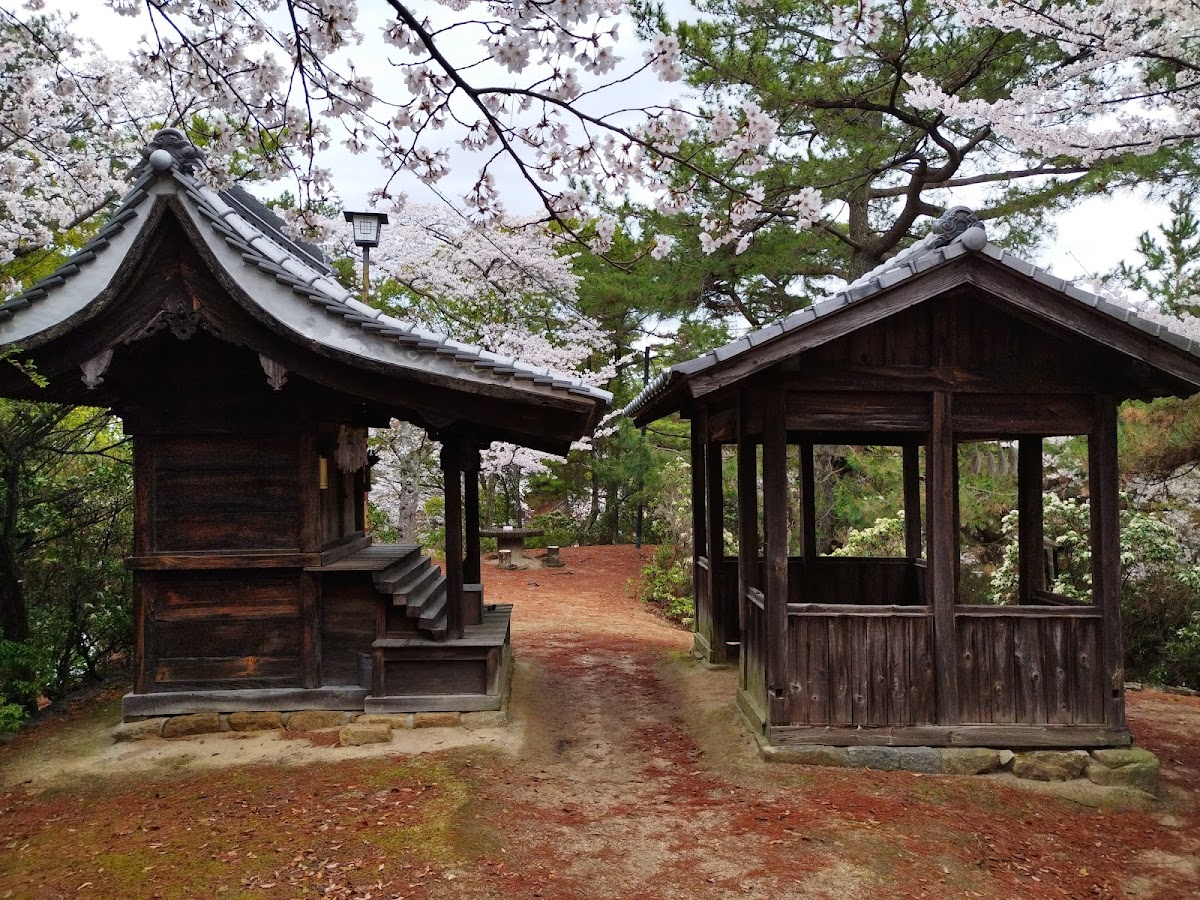
A notable relic of Aigata Castle is the castle gate that was relocated to Susanoo Shrine. Two gates relocated from Aigata Castle still exist at this shrine, making them valuable resources for understanding the architectural style of the time.
The relocated gate retains many characteristics of castle architecture from the Sengoku period, exhibiting a simple yet robust construction. Visiting the shrine allows you to learn about the architectural aspects of Aigata Castle that cannot be seen from the stone walls on the mountaintop alone.
Access and Visiting Information
Location
Aigata Castle ruins are located in Aigata, Shinichi-cho, Fukuyama City, Hiroshima Prefecture. Because a television tower has been constructed on the mountaintop, a forest road has been built, making it a relatively easily accessible mountain castle.
Parking and Access
There is parking space at the foot of the mountain, allowing access by car. However, the climb from the parking lot to the mountaintop is on foot. The path to the castle is well-maintained, but there are steep slopes typical of mountain castles, so we recommend wearing comfortable shoes.
If using public transportation, the nearest station is Shin-ichi Station on the JR Fukuen Line, but the castle ruins are a considerable distance from the station, so you will need to take a taxi or walk.
Points to Note When Visiting
As Aigata Castle Ruins is a mountain castle, please note the following points when visiting:
- Clothing: Wear comfortable clothing and walking shoes. The ground can be particularly slippery after rain.
- Season: Insect repellent is necessary in summer, and warm clothing is necessary in winter.
- Toilets: There are no toilet facilities on the mountaintop, so we recommend using the restroom beforehand.
- Drinking Water: Bring plenty of water, especially in summer.
- Safety Management: Be careful as the footing can be unstable in some areas near the stone walls.
Nearby Attractions and Tourist Spots
Fukuyama City Zoo
The Fukuyama City Zoo is located in the area surrounding Aikata Castle. Visiting it in conjunction with a castle ruin tour makes for a full day of enjoyment.
Historical Sites in Shin’ichi Town
Besides Aikata Castle, Shin’ichi Town has numerous historical sites associated with the Arichi clan. From the relocated castle gate of Susanoo Shrine to other sites, it offers a walking course that traces the region’s history.
Historical Sites of Kannabe Plain
The Kannabe Plain, visible from Aikata Castle, contains many historical sites from the medieval to early modern periods. Visiting these sites in conjunction with the Kannabe Castle ruins will provide a deeper understanding of the history of eastern Bingo Province.
Features and Historical Value of Aikata Castle
A Mountain Castle with All-Stone Walls
The most distinctive feature of Aikata Castle is its all-stone wall construction, despite its location on a steep mountaintop. While the use of stone walls is relatively easy for castles on flat land, constructing such a large-scale stone wall on a mountaintop at an elevation of 191 meters and a relative height of 170 meters demonstrates the high level of technology and labor mobilization capabilities of the time.
This all-stone wall construction holds an important position in castle history research as a valuable example of the development of castle construction technology during the transitional period from the Sengoku period to the early modern period.
From a Local Lord’s Castle to a Mori Clan Directly Controlled Castle
Aigata Castle has a history of being built by the local lord, the Arichi clan, before being converted into a castle directly controlled by the Mori clan, a powerful daimyo during the Sengoku period. During this process, the castle underwent extensive renovations, transforming into a more robust all-stone wall structure.
This transformation is a good example of the relationship between local samurai and daimyo during the Sengoku period, and the changes in the military and political functions of castles.
A Strategic Point in Eastern Bingo Province
Aigata Castle was strategically located in the eastern part of Bingo Province. Located on a strategically important transportation hub on the south bank of the Ashida River and overlooking the Kannabe Plain, Aikata Castle functioned as a key base for controlling the region.
For the Mori clan, Aikata Castle held significant importance as a defense against eastern forces (particularly the Amago clan and later the Oda clan). This geographical and strategic importance is believed to have justified the large-scale renovation, including the construction of a complete stone wall.
Aikata Castle and Bingo Province in the Sengoku Period
Expansion of the Arichi Clan’s Power
The Arichi clan, as local lords of Bingo Province, maintained and expanded their power throughout the Sengoku period. The construction of Aikata Castle marked a turning point, as the Arichi clan expanded from their base in a narrow valley into the plains.
This expansion allowed the Arichi clan to control a strategic transportation hub and strengthen their economic and military base. Their expansion into the fertile Kannabe Plain is thought to have led to an increase in the Arichi clan’s rice yield and an expansion of their mobilized forces.
The Mori Clan’s Management of Bingo Province
From the mid-16th century onward, the Mori clan strengthened their influence over Bingo Province. They established regional control by bringing local lords like the Arichi clan under their control.
The fact that they renovated Aigata Castle into a directly controlled castle is evidence of the Mori clan’s importance to this region. The renovation to a fully stone-walled structure required considerable expense and labor, indicating that the Mori clan judged it to be worthwhile.
Castle Construction Technology of the Sengoku Period
The stone walls of Aigata Castle are a valuable historical relic showcasing castle construction technology from the late Sengoku period. They utilize the latest techniques of the time, such as the rough-hewn stone masonry method and the use of flanking defenses.
In particular, the adoption of fully stone-walled construction in a mountain castle required overcoming different technical challenges than those faced in flatland castles, and can be considered the result of a culmination of advanced civil engineering and stonemasonry skills. The stone walls of Aigata Castle are a valuable historical document that conveys this process of technological development.
Current Status and Preservation
Current Castle Ruins
Although a television tower is currently constructed on the mountaintop of the Aigata Castle ruins, the main remains are well-preserved. The stone walls, stone steps, and layout of the baileys retain much of their original appearance, allowing visitors to fully experience the atmosphere of a Sengoku period mountain castle.
Investigations by local history enthusiasts and castle researchers are also underway, accumulating new knowledge about the castle’s history and structure.
Value as a Cultural Property
Aigata Castle possesses high historical and academic value as a historical site that well preserves the appearance of a Sengoku period mountain castle. Its characteristic as a mountain castle entirely constructed of stone walls is a rare example nationwide.
Further detailed investigations and research are expected to further clarify the historical value of Aigata Castle. If it is designated as a cultural property and preservation and maintenance work progresses, more people will be able to visit and learn about this valuable historical site.
Challenges to Preservation
There are several challenges in preserving Aigata Castle, a mountain castle. Stone walls in a natural environment are susceptible to the effects of wind, rain, and vegetation, requiring regular maintenance.
Furthermore, balancing visitor safety with the protection of the historical remains is a crucial challenge. This requires a balance between utilizing and preserving the historical site, including the development of appropriate viewing paths and the installation of informational signs.
A Visit to Aigata Castle
Aigata Castle is a historical site where you can fully experience the charm of a mountain castle from the Sengoku period. It boasts a massive stone-walled structure, a layout that utilizes the steep terrain, and stunning views from the mountaintop—all offering plenty to see.
It’s a recommended spot not only for castle enthusiasts, but also for history buffs and those who enjoy hiking. When visiting Fukuyama City in Hiroshima Prefecture, be sure to visit the Aigata Castle ruins. You’ll have a valuable experience feeling the spirit of the Sengoku period and reflecting on the history of Bingo Province.
Summary
Aigata Castle (Sagata Castle) is a representative Sengoku period mountain castle built entirely of stone walls on a 191-meter-high mountain in Shin’ichi-cho, Fukuyama City, Hiroshima Prefecture. Built by the Arichi clan, it later played an important role as a castle directly controlled by the Mori clan.
Even today, the remains of the main enclosure, including the stone walls, stone steps, and flanking defenses, are well-preserved, making it a valuable historical site that conveys the construction techniques and appearance of castles from the Sengoku period. The panoramic view of the Kannabe Plain and the sturdy stone walls built on the steep mountaintop deeply impress visitors.
Aigata Castle is indispensable for understanding the history of eastern Bingo Province. Be sure to experience its imposing stone walls and the historical romance of the Sengoku period firsthand.