Minowa Castle Complete Guide: A Thorough Explanation of the History and Highlights of the Famous Castle that Defeated Takeda Shingen
What is Minowa Castle?: A Representative Hilltop Castle of the Sengoku Period
Minowa Castle is a representative hilltop castle of the Sengoku period, located in Misato-cho, Takasaki City, Gunma Prefecture. Built on a river terrace at an altitude of approximately 240 meters on the southern foot of Mt. Haruna, this castle played an important role for about 80 years as a key point in the control of Kozuke Province (present-day Gunma Prefecture).
The castle grounds extend approximately 1,100 meters from north to south and 500 meters from east to west, boasting a vast area of approximately 36 hectares. The Haruna Shirakawa River on the west side and the Haruna Marsh on the south side functioned as natural moats, forming a solid defensive system. Designated a national historic site in 1987 (Showa 62), it was also selected as one of Japan’s Top 100 Castles (No. 16) in 2006 (Heisei 18).
History of Minowa Castle: From the Nagano Clan to the Ii Clan
The Era of the Minowa Nagano Clan: From Construction to its Golden Age
The history of Minowa Castle begins in 1512 (Eisho 9) when Nagano Narihisa built it. The Nagano clan was a prestigious family, descendants of Emperor Heizei and Ariwara no Narihira. Narihisa, a powerful local lord in western Kozuke Province, sought to expand his influence by establishing a base in this area.
The Nagano clan used Minowa Castle as their base for four generations:
- First Lord, Nagano Narimasa (circa 1502-1548): Builder of the castle
- Second Lord, Nagano Nobunari (circa 1548-1552): Improved the castle
- Third Lord, Nagano Norinari (1552-1552): Briefly resided at the castle
- Fourth Lord, Nagano Narimasa (circa 1552-1561): Famous general during Minowa Castle’s golden age
The Battle Between Nagano Narimasa and Takeda Shingen
The person who etched the name of Minowa Castle into history was the fourth lord, Nagano Narimasa. Nagano Narimasa was a renowned general known as the “Giant of Kanto,” and until his death in 1561, he repelled numerous attacks by Takeda Shingen of Kai Province.
Takeda Shingen considered the capture of Minowa Castle a crucial objective in his expansion from Shinano Province into the Kanto region. However, thanks to Narimasa’s skillful tactics and the castle’s strong defenses, Shingen was never able to capture Minowa Castle during his lifetime. This fact speaks to the military importance and high level of defense of Minowa Castle.
The Takeda Clan’s Attack on Minowa Castle
When Nagano Narimasa died of illness in 1561, the fate of Minowa Castle changed dramatically. His heir, Narimori, lacked the same caliber as his father, and in September 1566, Minowa Castle finally fell to a full-scale attack by Takeda Shingen’s army. Narimori committed suicide, marking the end of the Nagano clan’s rule over Minowa.
Minowa Castle, which came under the control of the Takeda clan, saw a succession of powerful Takeda retainers appointed as castle lords:
- Amari Masatada: One of the Twenty-Four Generals of the Takeda
- Sanada Yukitaka: Father of Sanada Masayuki
- Naito Masatoyo: One of the Four Heavenly Kings of the Takeda
- Asari Nobutane: The last castle lord on the Takeda side
Transition to Oda, Hojo, and Tokugawa
In 1582, when the Takeda clan fell, Minowa Castle came under the control of Takigawa Kazumasu, a retainer of Oda Nobunaga. However, after the Honnoji Incident in June of the same year, Takigawa Kazumasu was defeated by the Hojo clan at the Battle of Kannagawa, and Minowa Castle came under the control of Hojo Ujikuni.
In 1590, following Toyotomi Hideyoshi’s siege of Odawara and the subsequent downfall of the Hojo clan, Tokugawa Ieyasu, who was granted control of the Kanto region, appointed his senior retainer, Ii Naomasa, as the lord of Minowa Castle. Naomasa was granted a stipend of 120,000 koku and began a large-scale renovation of Minowa Castle.
Ii Naomasa and the Final Form of Minowa Castle
Ii Naomasa was a renowned general known as one of the Four Heavenly Kings of Tokugawa, and he renovated Minowa Castle into a modern castle. The current appearance of the Minowa Castle ruins is considered to be the closest to its appearance during Ii Naomasa’s time.
Naomasa strengthened the castle’s defenses by introducing stone walls and rearranging the baileys. He also focused on developing the castle town, aiming to transform Minowa into a modern castle town.
However, in 1598, Naomasa began construction of Takasaki Castle, and after the Battle of Sekigahara in 1600, he was transferred to Sawayama Castle (later Hikone Castle). examined, Minowa Castle was abandoned around 1601. Approximately 90 years after its construction, Minowa Castle had fulfilled its purpose.
Structure and Layout of Minowa Castle
Location and Utilization of Topography as a Hilltop Castle
Minowa Castle is a hilltop castle built on a river terrace at the southern foot of Mount Haruna. This location cleverly utilizes the terrain intermediate between plains and mountains, and has the following characteristics:
- Natural Fortress: The Haruna Shirakawa River to the west and Haruna Marsh to the south serve as natural moats.
- Secure Visibility: The elevated position offers a panoramic view, allowing for early detection of enemy movements.
- Utilization of Terraces: A multi-layered defensive structure utilizing the elevation difference of river terraces.
- Securing Water Sources: Multiple wells are placed within the castle grounds to prepare for sieges.
Arrangement and Structure of the Enclosures
Minowa Castle has a complex structure with multiple enclosures (kuruma) arranged within a vast castle area divided north and south by a large moat. The main enclosures include the following:
Honmaru (Main Enclosure)
Located in the center of the castle, it is the most important defensive stronghold. It measures approximately 120 meters east-west and 80 meters north-south, and is surrounded by earthen ramparts 5-6 meters high.
Ninokuruwa
Located south of the main enclosure (Honmaru), this is an important enclosure protecting the Honmaru. It is believed that a palace was built here during the time of Ii Naomasa.
Sannomaru
A vast enclosure located on the north side of the castle, it is presumed to have housed the residences of retainers and barracks.
Kuruwa Umadashi Nishi Toraguchi
A barbican protecting the western entrance to the castle, this is a highly advanced defensive structure believed to have been constructed during the time of Ii Naomasa.
Earthworks and Dry Moats: The Defensive System of Minowa Castle
The most distinctive feature of Minowa Castle is that it is an earthen castle that uses almost no stone walls. Its defenses consist of massive earthworks and deep dry moats.
Features of the Earthworks:
- A massive earthwork, 5 to 10 meters high, surrounds the entire castle.
- Fences and walls were installed on top of the earthworks to enhance its defensive capabilities.
- The height and shape of the earthworks varied for each enclosure, creating a multi-layered defense.
Features of the Dry Moats:
- Multiple large dry moats, over 10 meters deep, exist.
- Techniques such as ridges and shoji-bori (screen-like moats) were used in some areas of the moat bottom.
- The arrangement of the moats limited enemy incursion routes, enabling battles advantageous to the defenders.
The Great Moat: Minowa Castle’s Main Attraction
What impresses visitors to Minowa Castle the most is the “Great Moat,” which divides the castle grounds north and south.
- A massive structure, approximately 12 meters deep and 20 meters wide.
- A defensive line to prevent attacks from the rear (north) of the castle.
- It still largely retains its original form, demonstrating the advanced civil engineering techniques of the Sengoku period.
The large moat formed the core of Minowa Castle’s defensive structure, making it extremely difficult to reach the main keep beyond it.
Introduction of Stone Walls: Renovations during the Ii Naomasa Era
Although Minowa Castle was fundamentally an earthen castle, stone walls were introduced in some areas during the time of Ii Naomasa. In particular:
- Stone walls were built around the rear gate (karameteguchi).
- Stone walls were used to reinforce the entrances (koguchi).
- Valuable remains showing the transitional period to early modern castles.
These stone walls are important evidence of the change from earthen castles of the Sengoku period to early modern castles that primarily utilized stone walls.
Highlights of Minowa Castle: On-site Visit Guide
Points of Viewing for Major Remains
Main Enclosure Site
Currently a plaza, the surrounding earthworks remain well-preserved. From the main enclosure, you can enjoy a panoramic view of Mount Haruna and the surrounding scenery, experiencing the landscape seen by the castle former lords. An information board is installed within the main enclosure, explaining the layout of the buildings in the past.
Gozen-kuruwa and Rear Gate
Located north of the main enclosure, the Gozen-kuruwa is believed to be the site of the castle lord’s residence. The rear gate (karate-guchi) retains stone walls built during the time of Ii Naomasa, showing the transition from an earthen castle to a stone castle.
West Enclosure of the Enclosure’s Outwork
The West Enclosure, the castle’s main entrance, has a complex structure equipped with defensive structures called “umadashi.” Passing through this entrance requires multiple turns, demonstrating an effective design to prevent enemy intrusion.
Kimata Kuruwa and Storehouse
These kuruwa (enclosures) located on the south side of the castle served as a place for storing and managing supplies. The vast flat areas that remain allow us to imagine the economic functions of the castle in its heyday.
The Legendary Well: The Last Stand of Nagano Narimasa
Within the castle grounds remains a well said to be the place where Nagano Narimasa died. While Narimasa is believed to have died of illness, this well was one of the castle’s important water sources and a lifeline during sieges. The remains of the well can still be viewed today, allowing visitors to imagine life in a castle during the Sengoku period.
Restored Castle Gate
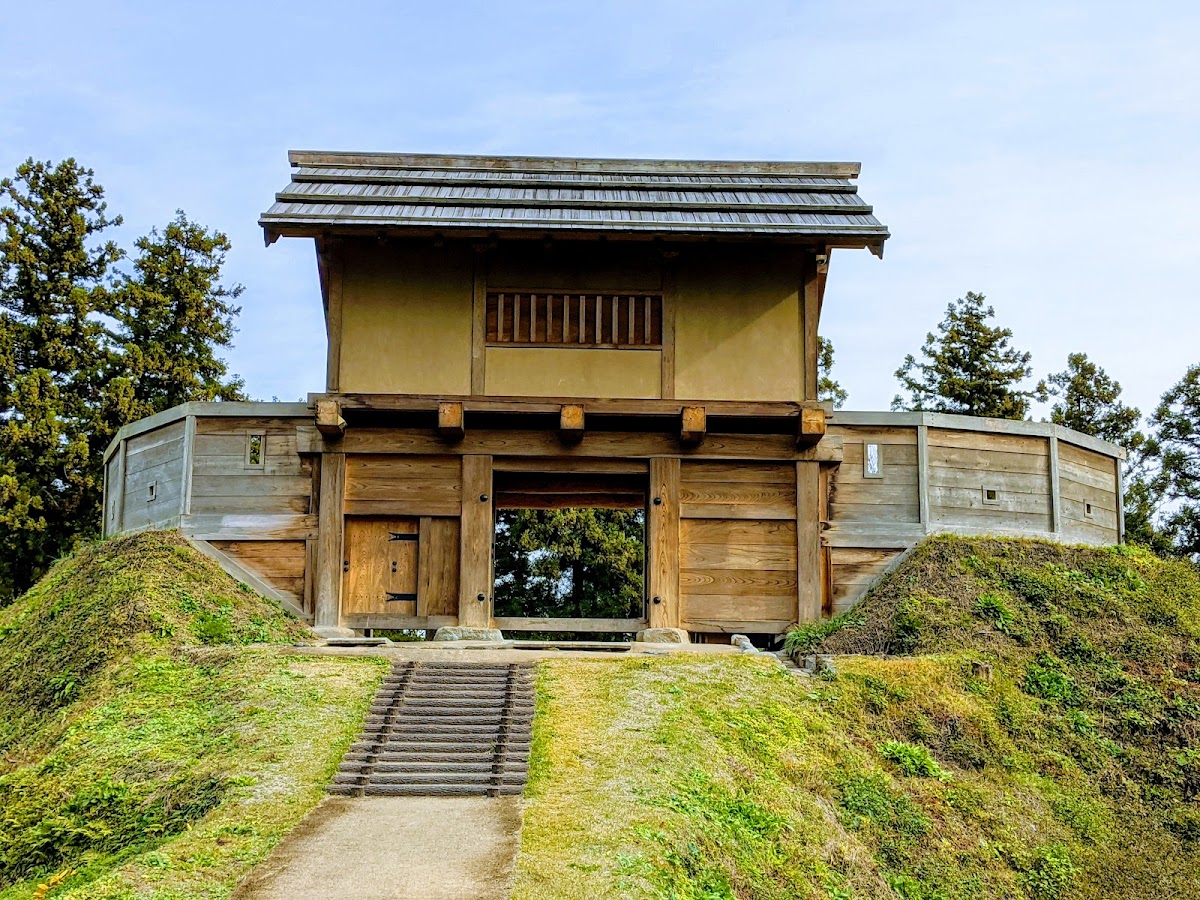
In 2015, the castle gate was restored at the west entrance of the Kuruwa Umadashi. This gate was faithfully recreated based on the results of archaeological excavations, and features:
-A magnificent structure in the style of a turret gate
- Construction using traditional methods employing the architectural techniques of the time
- A clue to imagining the former appearance of Minowa Castle
This reconstructed gate is a valuable structure that conveys to the present day the grandeur of the castle, which is difficult to imagine from just the earthworks and dry moats.
Minowa Castle in Every Season
Minowa Castle ruins show different faces throughout the four seasons:
Spring: During cherry blossom season, the entire castle site is dyed in a pale pink, and the contrast between the earthworks and cherry blossoms is beautiful.
Summer: Covered in lush green trees, it is a pleasant place to stroll in a cool atmosphere.
Autumn: Autumn leaves color the earthworks and moats, making it ideal for reflecting on the history of the Sengoku period.
Winter: The snow-enveloped castle ruins are in silence, allowing one to imagine the harsh siege battles of yesteryear.
Access and Visiting Information
Location and Access Method
Location: Higashi-Myoya, Misato-cho, Takasaki City, Gunma Prefecture
Access by Car:
- Approximately 30 minutes from Maebashi IC on the Kan-Etsu Expressway
- Approximately 30 minutes from Takasaki IC on the Kan-Etsu Expressway
- Parking: Free parking is available at the Misato Branch Office parking lot and the Karamete-guchi parking lot.
Access by Public Transportation:
- Approximately 30 minutes by bus from JR Takasaki Station, get off at “Misato Honmachi” bus stop, then approximately 15 minutes on foot.
- Approximately 25 minutes by taxi from JR Takasaki Station.
Visiting Hours and Fees
- Visiting Hours: Open all day (however, daytime visits are recommended due to darkness at night).
- Admission Fee: Free
- Estimated Time Required: Approximately 2-3 hours for a thorough visit.
Minowa Castle Ruins Guidance Facility
To deepen understanding of the castle ruins, the “Minowa Castle Ruins Guidance Facility” has been established:
- Location: Higashi-Myoya, Misato-cho, Takasaki City
- Opening Hours: 9:00 AM – 4:00 PM
- Closed Days: Tuesdays (or the following day if Tuesday is a public holiday), New Year holidays
- Exhibition Contents: History of Minowa Castle, results of archaeological excavations, reconstructed models, excavated artifacts, etc.
- Admission Fee: Free
Guidance facilities offer guided tours by volunteer guides (advance reservation required).
Minowa Castle and Surrounding Historical Spots
Relationship with Takasaki Castle
Takasaki Castle, whose construction was begun by Ii Naomasa in 1598 (Keicho 3), is positioned as the successor to Minowa Castle. Naomasa built a new castle in Takasaki, a location with better transportation access and on flat land, and relocated the town castle. The foundation of the current Takasaki city area begins with the construction of Takasaki Castle by Ii Naomasa.
Visiting the Takasaki Castle ruins will allow you to understand the transition from Minowa Castle to Takasaki Castle, and the changes in castle architecture from the Sengoku period to the Edo period.
Temples and Shrines Associated with the Nagano Clan
Near Minowa Castle, several temples and shrines associated with the Nagano clan are scattered:
Nencho-ji Temple: The family temple of Nagano Narimasa, and his tomb is located there.
Ryumon-ji Temple: The Nagano clan’s prayer temple, where the memorial tablets of successive castle lords are enshrined.
Minowa Suwa Shrine: A shrine revered by the Nagano clan and considered important as the guardian deity of the castle.
Visiting these sites will allow you to gain a deeper understanding of the history of Minowa Castle.
Other Famous Castles in Gunma Prefecture
Gunma Prefecture has many castle ruins besides Minowa Castle:
- Kanayama Castle (Ota City): One of Japan’s 100 Famous Castles, a mountain castle with beautiful stone walls
- Iwagutsu Castle (Higashiagatsuma Town): A mountain castle associated with the Sanada clan
- Numata Castle (Numata City): A flatland castle where Sanada Nobuyuki served as lord
Visiting these castles together with Minowa Castle will give you a more comprehensive understanding of Gunma Prefecture’s Sengoku period history.
The Cultural Value of Minowa Castle
Significance of National Historic Site Designation
Minowa Castle Ruins were designated a National Historic Site on October 15, 1987. This designation was based on the following criteria:
- Possesses high historical value as a representative castle ruin of the Sengoku period in Gunma Prefecture.
- A typical example of a Sengoku period castle, primarily composed of earthworks and dry moats.
- Remains from multiple periods, from the Nagano clan to the Ii clan, are preserved in layers.
- Excellent state of preservation and high academic research value.
Selection as one of Japan’s Top 100 Castles
In 2006, it was selected as the 16th castle in the “Japan’s Top 100 Castles” list chosen by the Japan Castle Association. This means:
- Possesses particularly outstanding historical and cultural value among castles nationwide.
- A must-see castle for castle enthusiasts and tourists.
- Serves as a model case for preservation and utilization.
The 100 Castles stamp is located at the Minowa Castle Ruins Guidance Facility.
Progress of Archaeological Excavations and Research
The Takasaki City Board of Education is continuously conducting archaeological excavations, and new discoveries are being made:
- Discovery of stone walls and foundation stone building remains from the Ii Naomasa period
- Confirmation of remains from the Takeda clan period
- Clarification of the castle structure from the Nagano clan period
- Clarification of daily life based on excavated artifacts
These research results play an important role in more accurately understanding the history of Minowa Castle.
Resources for Learning About Minowa Castle
Recommended Books
The following books are recommended for learning about Minowa Castle:
- “Minowa Castle and Nagano Narimasa” (Takasaki City Board of Education)
- “Minowa Castle: A Formidable Fortress of the Warring States Period” (Akagi Publishing)
- “Nagano Narimasa and Minowa Castle” (Ebisu Kosho Publishing)
These books are available at the Minowa Castle Ruins Guidance Facility and bookstores in Takasaki City.
Online Information
The Takasaki City official website publishes the latest information on Minowa Castle, event announcements, and the results of archaeological excavations. We recommend checking it before your visit.
Summary: The Charm and Modern Significance of Minowa Castle
Minowa Castle holds an extremely important position in the history of Japanese castles, as the residence of Nagano Narimasa, who repeatedly repelled Takeda Shingen, the strongest warlord of the Sengoku period, and as a castle that retains traces of renovations to a modern castle by Ii Naomasa.
While the current Minowa Castle ruins lack the flashiness of stone walls and keeps, the landscape created by the massive earthworks and deep dry moats is a valuable legacy that conveys the essence of Sengoku period castles to the present day. Standing at the large moat and being overwhelmed by its scale, we can contemplate the skill and effort of the castle’s builders 500 years ago.
The value of Minowa Castle lies not only in its status as a tourist destination, but also in its extremely high value as a “teaching material” for learning about Japanese history and understanding the wisdom and efforts of our ancestors. When visiting Gunma Prefecture, be sure to visit this magnificent castle and experience the atmosphere of the Sengoku period.
Exploring the castle ruins will not only deepen your interest in history but also provide a pleasant walk amidst nature. Visiting in spring during the cherry blossom season or in autumn during the fall foliage season will allow you to fully enjoy both history and nature, making for a truly fulfilling experience.