Complete Guide to Shimogoya Castle (Gunma Prefecture): A Thorough Explanation of the Remains and Highlights of this Sengoku Period Mountain Castle
What is Shimogoya Castle?
Shimogoya Castle is a Sengoku period mountain castle located near the border of Yunako, Ikaho-machi, Shibukawa City, Gunma Prefecture, and Higashiagatsuma Town. Built on a tongue-shaped plateau at the confluence of the Numao River and its tributary, the Nishizawa River, it is known as a fortified stronghold that skillfully utilizes the natural terrain.
Although only the remains of the castle exist today, defensive structures such as moats, earthworks, and gates are well-preserved, making it a valuable historical site for understanding the structure of Sengoku period mountain castles.
Historical Background of Shimogoya Castle
Construction Period and Lord
Shimogoya Castle is believed to have been built during the Sengoku period, with its activities around the 1570s being particularly recorded in “The Complete Guide to Japanese Castles, Vol. 4.” This period was a time of fierce conflict between the Takeda and Uesugi clans for control of northern Kanto, and Shimogoya Castle is believed to have played a crucial role in this strategic struggle.
While there are few clear records regarding the castle’s lord, it is presumed to have been built and maintained by a local powerful family that controlled the region. Its location near Ikaho Onsen suggests it served as a strategically important military base controlling a key transportation hub.
Role in the Sengoku Period
During the Sengoku period, the Gunma Prefecture area was the front line where the forces of the Kai Takeda clan, led by Takeda Shingen, and the Echigo Uesugi clan, led by Uesugi Kenshin, were evenly matched. Shimogoya Castle is thought to have functioned as a forward base to monitor the road leading from Shibukawa City to Higashiagatsuma Town and prevent enemy invasions.
The Numaogawa River basin, in particular, was a vital transportation route, and controlling this area was strategically extremely important. Shimogoya Castle was a military facility that made maximum use of this geographical advantage.
Layout and Structure of Shimogoya Castle
Location and Topographical Features
Shimogoya Castle is located on a tongue-shaped plateau with a relative elevation of approximately 40 meters. The plateau measures approximately 350 meters east-west and 150 meters north-south. The Numao River flows along the north side, and its tributary flows along the south side, with the two rivers converging on the east side.
This terrain features cliffs carved by the rivers on both sides, forming a natural stronghold. Only the western side is connected to the land by a meandering river, approximately 30 meters wide, and this section served as the main approach route to the castle.
Arrangement of the Main Enclosure and Baileys
The main enclosure is located in the center of Shimogoya Castle, surrounded by multiple baileys (enclosures). The layout takes advantage of the plateau’s shape, with particularly strong defensive structures concentrated on the western landward section.
While the main enclosure is relatively compact, including the surrounding lower and outer baileys reveals that it was a considerably large castle complex. These baileys were arranged in terraces, utilizing the difference in elevation, to form an effective defensive line.
Moats and Defensive Structures
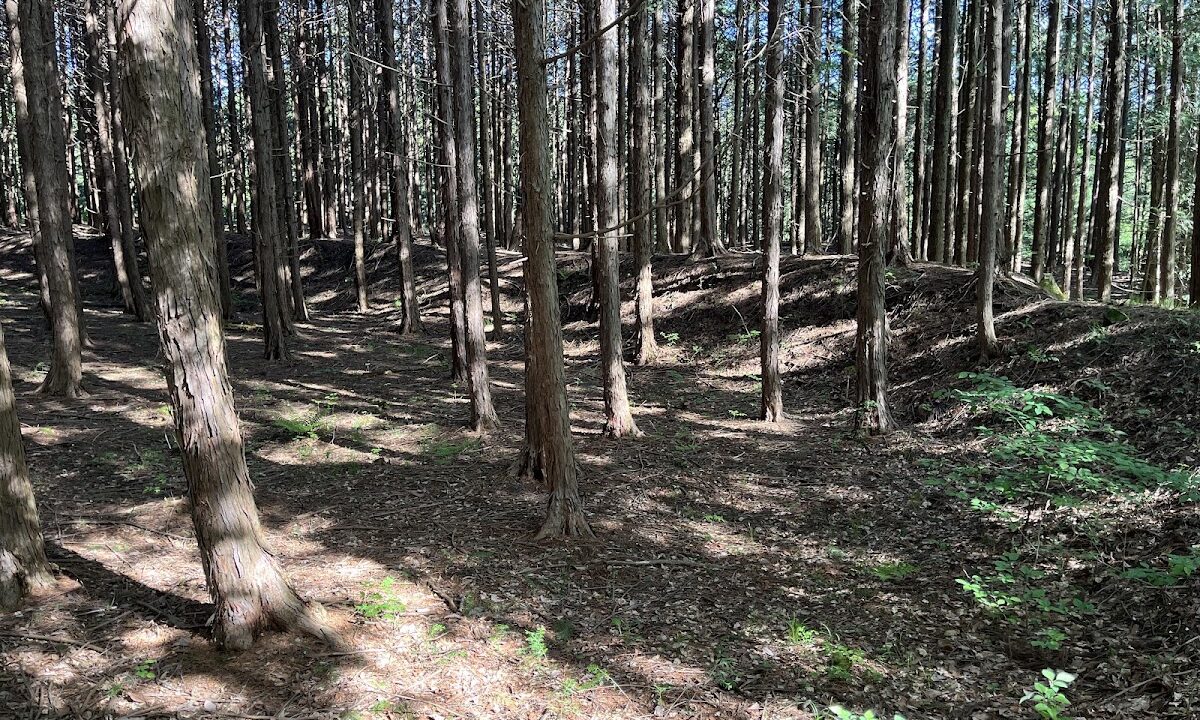
One of the greatest highlights of Shimogoya Castle is the well-preserved moats. Moats are dry moats dug to cut across ridges, serving as important defensive structures to prevent enemy intrusion.
In particular, multiple moats can be seen on the western, land-connected section, and their scale and construction techniques demonstrate the high level of castle-building technology of the time. The depth varies depending on the location, but in the deepest parts, it reaches several meters, creating a strong defensive line when combined with the steep slopes.
Earthworks and Revetments
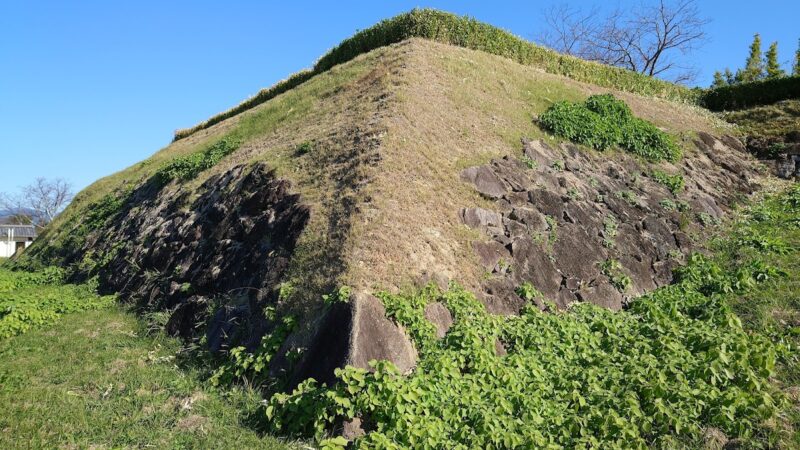
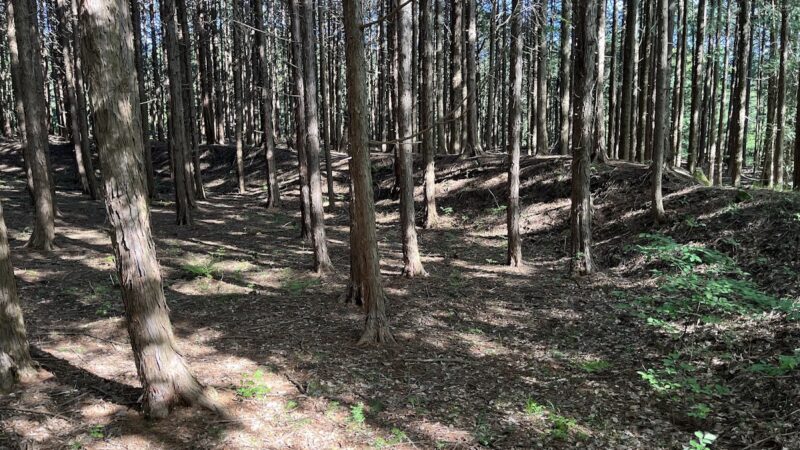
Earthworks and revetments are placed throughout the castle. Earthworks are defensive walls made by piling up earth, protecting against enemy arrows and firearms, and also serving to clearly define the boundaries within the castle.
The earthworks of Shimogoya Castle still remain today, approximately 1-2 meters high, allowing us to imagine their appearance at the time. The earthworks around the main enclosure, in particular, are preserved in relatively good condition, providing important clues for understanding the castle’s defensive structure.
Structure of the Entrance (Koguchi)
The koguchi, the entrance to the castle, is also an important defensive structure. At Shimogoya Castle, a special structure called a kata-koguchi has been identified. The koguchi was not merely an entrance; it was designed to restrict enemy intrusion and give the defenders an advantage.
Earthworks were placed around the koguchi, and in some places, small enclosures called umadashi were also constructed. These were clever defensive systems designed to temporarily hold back the enemy, allowing for attacks from above or the flanks.
Water Supply: Wells and Moats
Securing water was a matter of life and death for mountain castles. At Shimogoya Castle, the remains of a well have been confirmed, indicating that a system for obtaining water even during sieges was in place.
Furthermore, traces of a moat remain in some areas. Moats offer even greater defensive effectiveness than dry moats, serving as a powerful barrier that physically prevented enemy approach. It has also been suggested that the castle may have utilized water drawn from the Numaogawa River.
Highlights of Shimogoya Castle
Preservation of the Remains
The greatest appeal of Shimogoya Castle is that the remains of this Sengoku period mountain castle are preserved in relatively good condition. Because it was not developed, the basic structures such as moats, earthworks, and baileys are still clearly visible.
The moats on the west side are particularly impressive in their depth and scale, allowing one to appreciate the high level of castle-building technology of the time. The earthworks, though crumbling, retain their shape, allowing one to trace the castle’s outline.
Views and Scenery
The views from the plateau are another attraction of Shimogoya Castle. From an altitude of 181.8 meters, you can overlook the surrounding area and experience how the castle lords of the Sengoku period monitored the surroundings.
The flow of the Numaogawa River and the scenery of the surrounding mountains are particularly beautiful in every season, making it a spot where you can enjoy both historical exploration and nature appreciation.
Photography Tips
Many visitors enjoy taking photos of the castle ruins. Recommended photography spots are as follows:
- Cross-section of the moat: Photographing the deeply excavated moat from the side conveys its scale and impressive presence.
- View from the main enclosure: A spectacular viewpoint offering panoramic views of the surrounding mountains and river.
- Lines of the earthworks: The series of earthworks surrounding the enclosures is an important subject for understanding the castle’s structure.
- Structure of the entrance: The complex terrain around the entrance allows for a visual understanding of the defensive ingenuity.
Estimated Visit Time and Difficulty
Average Visit Time
A visit to Shimogoya Castle typically requires approximately 26 minutes. However, this is the minimum time needed to see the entire castle site. If you wish to carefully observe the remains and enjoy photography, allow about an hour.
Those who want to examine the details of the moats and earthworks, or who wish to compare them with a castle layout map, are advised to spend more time on their visit.
Difficulty of Visiting
Shimogoya Castle is a mountain castle, so a certain level of physical fitness and equipment is required. Please note the following:
- Footwear: Hiking boots or trekking shoes are recommended.
- Season: Spring to autumn is suitable for visiting, but in summer, vegetation can be overgrown and make the ruins difficult to see.
- Weather: Avoid visiting during or after rain, as the ground can become slippery.
- Solo Travel: Visiting with others is safer if possible.
Access Information
Location
Address: Yunakago, Ikaho-machi, Shibukawa City, Gunma Prefecture (near the border with Higashiagatsuma Town)
Access by Car
The most convenient way to access Shimogoya Castle is by car:
- Approximately 15 minutes from the Kan-Etsu Expressway “Shibukawa-Ikaho IC”
- Accessible via prefectural road from the Ikaho Onsen area
- Parking space is limited, so you will need to find a safe place to park on the shoulder of the road.
Access by Public Transportation
If using public transportation:
- Take a bus from JR “Shibukawa Station” towards Ikaho Onsen.
- The castle is accessible on foot from the nearest bus stop, but due to the distance, using a car is recommended.
Points to Note When Visiting
- There are no clear signs or well-maintained paths leading to the castle, so it is important to check maps and layout diagrams beforehand.
- You may pass through private property, so please observe proper etiquette during your visit.
- Cell phone reception may be poor in some areas, so please prepare accordingly.
Nearby Tourist Attractions
Ikaho Onsen
Ikaho Onsen, located about 10 minutes by car from Shimogoya Castle, is one of Gunma Prefecture’s leading hot spring resorts. After exploring the castle ruins, you can relax and soothe your fatigue in the hot springs. There are also plenty of other sightseeing activities to enjoy, such as strolling along the stone steps and trying hot spring steamed buns.
Surrounding Castle Ruins
Gunma Prefecture has many remaining mountain castles, and visiting them along with Shimogoya Castle will allow you to gain a deeper understanding of the history of the Sengoku period:
- Iwagutsu Castle Ruins: A famous castle associated with the Sanada clan
- Nagurumi Castle Ruins: The stage of conflict between the Hojo and Sanada clans
- Minowa Castle Ruins: A large-scale mountain castle designated as a national historic site
The “Gunma Prefecture Mountain Castle Tour,” which visits these castle ruins, is an attractive route for castle enthusiasts.
Shimogoya Castle Evaluation and Reviews
Evaluation by Castle Enthusiasts
On castle information websites such as Kojodan, the average evaluation from approximately 28 castle enthusiasts nationwide is 2.50. This reflects the evaluation of the state of preservation of the remains and their historical importance.
Visitors have commented, “The scale of the moats is impressive,” and “The layout that utilizes the natural terrain is interesting,” indicating that it has received a certain level of approval from mountain castle fans.
Visitor Feedback
Here are some comments from visitors:
- “The remains are well-preserved, and I was able to understand the structure of a mountain castle from the Sengoku period very well.”
- “Access is a little difficult, but that means you can visit in peace and quiet.”
- “I was surprised by the depth of the moat. You can really appreciate the high level of castle-building technology at the time.”
- “I think it would be more helpful for beginners if there were more signs.”
Checklist for Visiting Shimogoya Castle
To visit Shimogoya Castle comfortably and safely, please prepare the following items:
Essential Items
- Hiking boots or trekking shoes: Essential for ensuring your feet are safe.
- Drinking water: Sufficient hydration is especially necessary in the summer.
- Map or castle layout: A paper map is also recommended in case your smartphone battery runs out.
- Insect repellent spray: Essential from spring to autumn.
- Long-sleeved shirt and long pants: To protect yourself from plants and insects.
Useful Items
- Camera: For recording the remains and taking photos of the scenery.
- Binoculars: Useful for checking distant views and observing terrain.
- Notebook and writing utensils: For recording observations.
- Snacks: For energy replenishment if you spend a lot of time sightseeing.
- First-aid kit: In case of injury.
Research and Materials on Shimogoya Castle
References
For those who wish to learn more about Shimogoya Castle, the following resources are helpful:
- “Comprehensive Survey of Japanese Castles 4: Ibaraki, Tochigi, and Gunma”: Contains basic information about Shimogoya Castle.
- Various castle-specialized websites: Detailed diagrams of remains, such as the layout of the Yogo clan’s castle, are available.
- Local history research journals: May contain relevant information in local history materials of Shibukawa City and Higashiagatsuma Town.
Excavation and Research Status
While large-scale excavations have not been conducted at Shimogoya Castle, the confirmation and recording of remains through surface observation is progressing. Further detailed investigations are expected to shed more light on the construction period, lord, and specific usage.
The Mountain Castle Culture of Gunma Prefecture and the Position of Shimogoya Castle
Characteristics of Mountain Castles in Gunma Prefecture
During the Sengoku period (Warring States period), Gunma Prefecture was a strategically important location where the Takeda, Uesugi, Hojo clans, and local powerful families were intricately intertwined. As a result, there are over 200 mountain castles within the prefecture, each possessing unique characteristics.
Shimogoya Castle, among them, occupies an important position in the history of castles in Gunma Prefecture as a typical Sengoku mountain castle that skillfully utilizes the natural terrain. Although small in scale, it boasts well-developed defensive facilities such as moats and earthworks, making it a valuable example for learning about the castle-building techniques of the time.
The Situation in Northern Kanto During the Sengoku Period
The late 16th century, when Shimogoya Castle was active, was a time of great transformation in the Kanto region. The expansion of the Odawara Hojo clan’s power, Takeda Shingen’s invasion of western Kozuke Province, and Uesugi Kenshin’s campaigns in Kanto forced local powerful families to make choices for survival amidst these major forces.
It is believed that Shimogoya Castle functioned as a regional defense base or as a boundary marker for a sphere of influence within this historical context.
Summary: The Charm of Shimogoya Castle and Recommendation for Visiting
Shimogoya Castle is a Sengoku period mountain castle ruin located in Ikaho-machi, Shibukawa City, Gunma Prefecture. Built on a natural stronghold—a tongue-shaped plateau where the Numao River and Nishizawa River converge—its remains, including moats, earthworks, and gates, are well-preserved.
With a relative height of 40 meters and a size of 350 meters east-west by 150 meters north-south, this castle is a valuable historical site that conveys the military tensions of northern Kanto during the Sengoku period. The clearly visible multiple moats are a major attraction for castle enthusiasts.
While access can be somewhat difficult, this allows for a quiet environment to carefully observe the remains. It is also close to Ikaho Onsen, making it an ideal historical exploration route combined with hot spring sightseeing.
For those interested in Sengoku period mountain castles, those who want to learn more about the history of Gunma Prefecture, or those who simply want to reflect on history in a tranquil natural setting, Shimogoya Castle is a place well worth visiting. With appropriate equipment and preparation, be sure to visit this hidden gem of a castle.
Walking through the castle ruins, you’ll be able to feel firsthand how the warlords and soldiers of the Sengoku period defended and fought on this land. Enjoy a journey through time at Shimogoya Castle, where the breath of history still lingers.