Maniba Castle (Gunma Prefecture) Complete Guide: Exploring the Sacred Site of Maniba Nen-ryu and the Remains of the Sengoku Period
Located in Maniba, Yoshii-cho, Takasaki City, Gunma Prefecture, Maniba Castle is a flatland castle that served as the residence of the Maniba clan from the Kamakura period to the Sengoku period. Currently used as a Maniba Nen-ryu dojo, it is known as an important sacred site in the history of Japanese swordsmanship. The remains, such as earthworks and dry moats, are well-preserved, making it a valuable historical site that conveys the appearance of a medieval castle.
History and Transformation of Maniba Castle
Construction in the Kamakura Period and the Maniba Clan
The construction of Maniba Castle dates back to the Kamakura period. The Maniba clan, the builders of the castle, were local lords who governed the region in Kozuke Province (present-day Gunma Prefecture). The Maniba clan, who adopted the place name Maniba as their surname, established this castle as a regional base.
From the Kamakura period to the Muromachi period, Maniba Castle functioned as the residence of the Maniba clan and served as the center of governance for the surrounding area. The flatland castle design reflects the topographical features of the region and the characteristics of castle architecture at the time.
The Maniba Clan and the Kanto Region in the Sengoku Period
During the Sengoku period, Maniba Castle became one of the important strongholds in Kōzuke Province. The name of the castle lord, Maniba Nakatsukasa-shōyū Ieshige, is listed as a member of the Sōsha-shū in the Kanto Shogunate Order of 1561. This is an important historical document indicating that the Maniba clan was recognized as a powerful local lord in Kōzuke Province.
The Sōsha-shū refers to a group of samurai centered around Sōsha in Kōzuke Province (present-day Sōsha-machi, Maebashi City). At that time, Kōzuke Province was a frontline where the forces of the Kantō Kanrei Uesugi clan, the Hōjō clan, and the Takeda clan were intricately intertwined. It is believed that the Maniba clan, while being tossed about by the movements of these Sengoku daimyo, continued to protect their territory.
The Founding of the Maniba Nen-ryu School and the Holy Site of Swordsmanship
The existence of the Maniba Nen-ryu school is indispensable when discussing the history of Maniba Castle. The Maniba Nen-ryu is one of the ancient schools of Japanese swordsmanship, and it developed with Maniba Castle as its base. This school of swordsmanship transmitted the practical sword techniques of the Sengoku period and had a great influence on later generations.
Even after the castle lost its function as a military base, it was preserved as a Maniba Nen-ryu dojo, which led to the preservation of the castle’s buildings and remains. This is a rare example in the history of Japanese castles, making it a valuable place where martial arts culture and castle culture are fused.
The Abandonment and its Aftermath
While there are no clear records of the year Maniba Castle was abandoned, it is believed to have ended its role as a military base with the end of the Sengoku period. In the Edo period, while many castles were demolished, Maniba Castle maintained its appearance by taking on a new role as a Maniba Nen-ryu dojo.
Because it is still used as a dojo for the Maniba Nenryu school of martial arts, it has a unique atmosphere that differs from typical castle ruins. Castle ruins that are still actively used as training grounds for martial arts are rare nationwide.
Structure and Layout of Maniba Castle
Characteristics as a Flatland Castle
Maniba Castle is a typical flatland castle. A flatland castle is a castle built on flat land, and has a different defensive system than mountain castles or hill castles. Utilizing the flat terrain of Maniba, Yoshii-cho, Takasaki City, Gunma Prefecture, it formed a defensive line with earthworks and dry moats.
Flatland castles are often built in strategically important locations or economically significant places, and it can be inferred that Maniba Castle also functioned as a regional center. Compared to mountain castles, it was easier to live in and its structure emphasized its function as a lord’s residence.
Arrangement and Structure of Earthworks
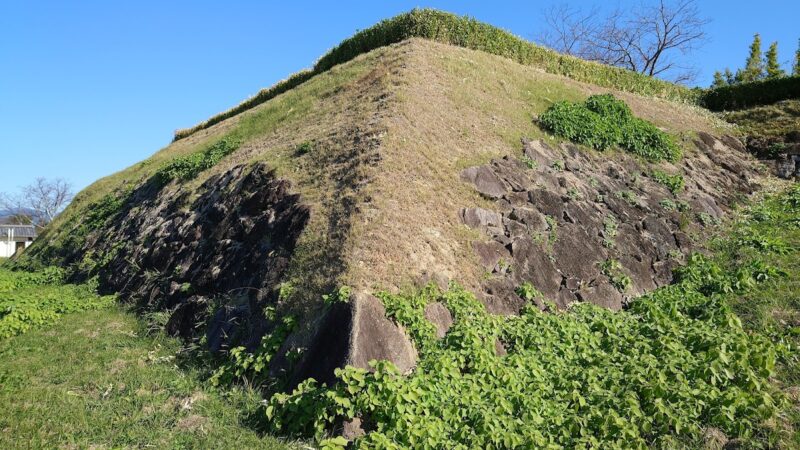
The most impressive remains of Maniba Castle are the earthworks. Earthworks are defensive structures built by piling up earth, which served to prevent enemy intrusion and ensure visibility from within the castle.
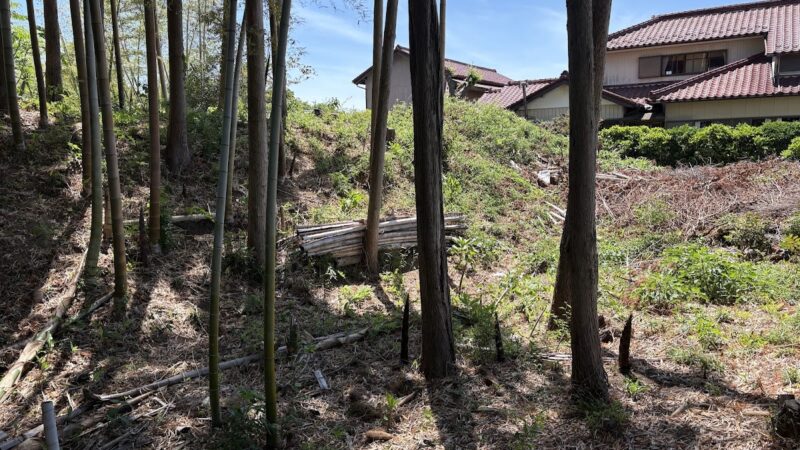
The existing earthen rampart is approximately 2-3 meters high and retains much of its original form. The top of the rampart is flat, suggesting that soldiers were positioned there during defensive operations. Buildings were located inside the rampart, while a dry moat surrounded the outside.
The rampart’s excellent state of preservation is due to its continuous management as the Maniba Nenryu dojo. Maintenance, including weed removal and soil erosion prevention, is carried out, making it a valuable example of a medieval castle rampart.
Dry Moat and Defensive System
A dry moat was located outside the rampart. A dry moat is a moat that does not hold water and is a common defensive feature in flatland castles in the Kanto region. It physically hindered enemy approaches and enhanced defensive effectiveness through the difference in elevation from the bottom of the moat to the top of the rampart.
Some traces of the dry moat can still be seen today, allowing us to infer the original layout. The dry moat is thought to have been approximately 5-8 meters wide, a standard size for a medieval castle.
Watchtower Bases and Lookout Facilities
Traces of watchtower bases remain within the castle grounds. These bases served as foundations for watchtowers and functioned as lookout facilities to survey the surrounding area. It is presumed that the watchtower bases at Maniba Castle were strategically placed along the earthworks, serving as crucial defensive points.
From the watchtower bases, it was possible to overlook surrounding roads and settlements, allowing for early detection of enemy movements. The importance of such lookout facilities was likely heightened due to the castle’s flatland terrain.
Stone Walls and Monuments
Stone walls can also be seen in some areas of Maniba Castle. While medieval castles generally featured earthworks rather than full-fledged stone walls, Maniba Castle utilized stone walls in important locations. This may be due to later renovations, but it indicates the castle’s status.
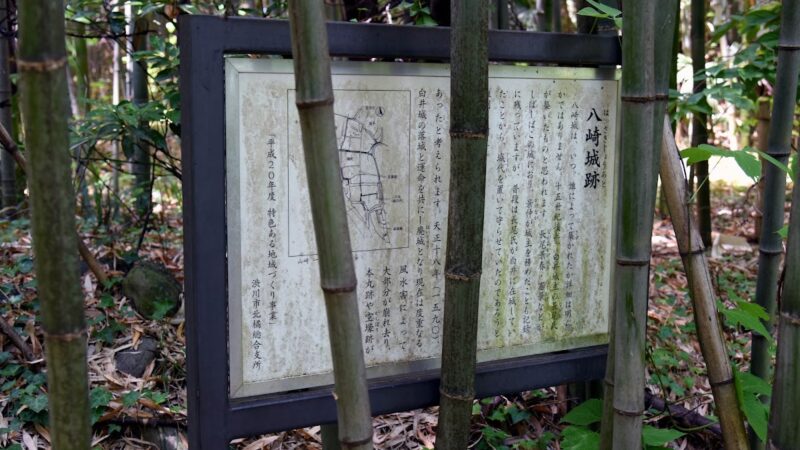
A stone monument has also been erected at the castle site, providing visitors with information along with an information board detailing the history of Maniba Castle. The stone monument inscribes the castle’s history and its connection to the Maniba Nenryu school of swordsmanship, illustrating the historical importance of this site.
Highlights of the Maniba Nenryu Dojo
Nagaya Gate and Dojo Architecture
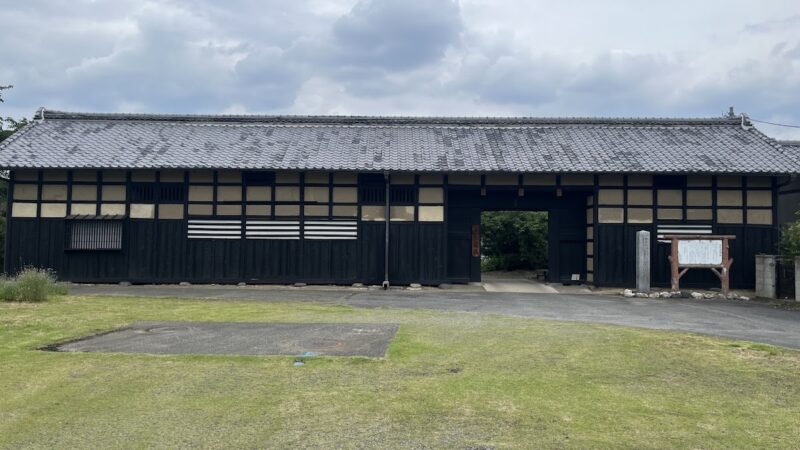
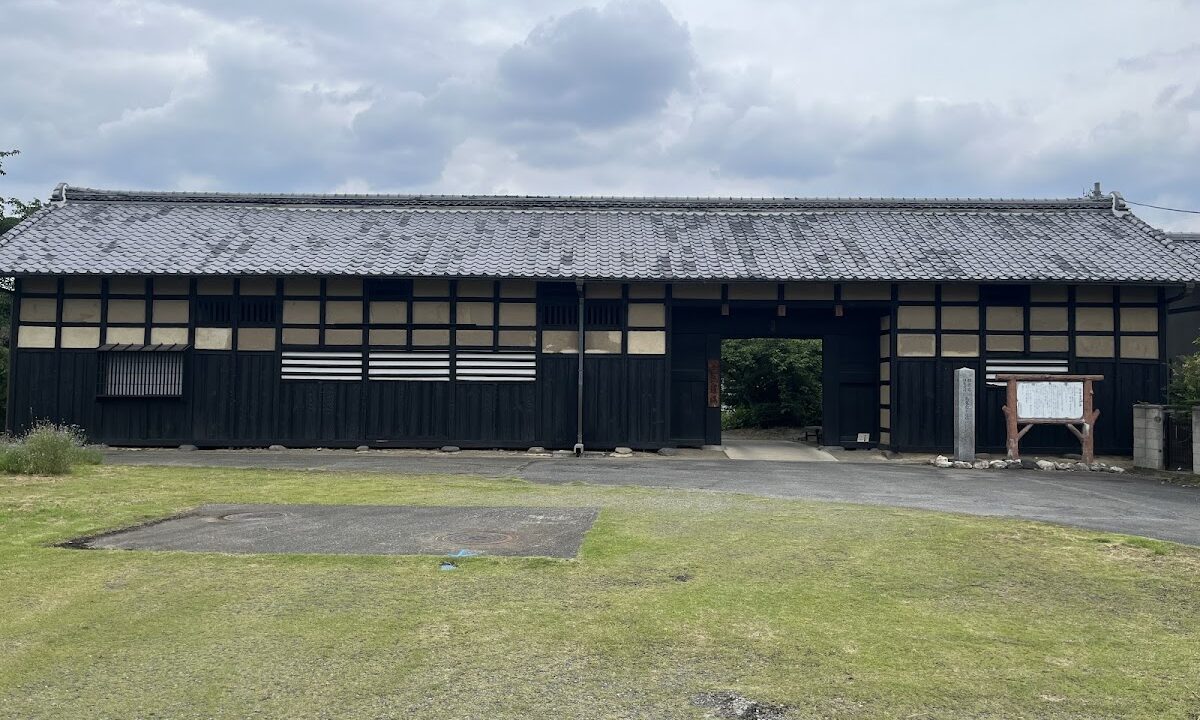
One of the greatest highlights of Maniba Castle is the group of buildings used as the Maniba Nenryu dojo. The Nagaya Gate, in particular, is a magnificent gate befitting a samurai residence, welcoming visitors.
The Nagaya Gate exhibits characteristics of Edo-period samurai architecture, with rooms on both sides of the gate. Passing through this gate leads to the dojo grounds. The wood and tiles of the gate exude a sense of history, making it a popular spot for photography.
The dojo architecture maintains the style of traditional Japanese architecture while also possessing functionality as a place for swordsmanship training. The floor is made of wood, making it suitable for swordsmanship practice.
Value as an Active Martial Arts Facility
The Maniba Nenryu dojo is still used as a martial arts training ground, preserving the tradition of swordsmanship. This is not merely a historical site, but rather a place of value as a “living cultural asset.”
Regular training sessions are held at the dojo, preserving the techniques of the Maniba Nenryu school of martial arts. Visitors may be able to observe the training sessions, offering a valuable opportunity to experience Japanese martial arts culture firsthand.
Information Boards and Historical Explanations
Detailed information boards are installed at the castle ruins, allowing visitors to learn about the history and structure of Maniba Castle. The boards include layout maps and historical timelines, making it easy for first-time visitors to understand the overall structure of the castle.
The information on the boards is supervised by local history researchers and the board of education, providing accurate historical information. Combining this with photographs will create a memorable record of your visit.
Access and Visiting Guide
Access by Public Transportation
The nearest station to Maniba Castle is Maniba Station on the Joshin Electric Railway Joshin Line. Maniba Station is a historic station that opened on May 10, 1897 (Meiji 30). It is located at 191-1 Maniba, Yoshii-machi, Takasaki City, Gunma Prefecture.
From Maniba Station to Maniba Castle is approximately a 10-15 minute walk. Exit the station and head north; after passing through a residential area, you will reach the castle ruins. There are signs along the way, so you are unlikely to get lost.
The Joshin Electric Railway operates from Takasaki Station towards Shimonita, offering scenic views characteristic of a local line. You can enjoy sightseeing along the line in conjunction with your castle visit.
Access by Car
If traveling by car, the Yoshii Interchange on the Joshinetsu Expressway is convenient. Maniba Castle is approximately 10 minutes from the interchange.
Regarding parking, there is some space on the dojo grounds, but it is recommended to check in advance. There are also public parking lots in the surrounding area that you can use.
When searching using a car navigation system, searching for “Maniwa Nenryu Dojo” or “Maniwa, Yoshii-cho, Takasaki City, Gunma Prefecture” will display the accurate location.
Notes for Visitors
Maniwa Nenryu Dojo is an active martial arts facility, so certain considerations are necessary when visiting. Please observe quietly during training sessions, and obtain permission before taking photographs.
The grounds are private property, so please check which areas are accessible before visiting. Some remains, such as earthworks and dry moats, can be seen from the perimeter.
The best time to visit is during the daytime. Early mornings and evenings may coincide with training times for the dojo members, so 10:00 AM to 3:00 PM is recommended.
Estimated Time and Tour Route
A visit to Maniwa Castle takes approximately 20-30 minutes, even if you take your time to look around. While it’s a compact castle site, carefully observing the earthworks, gatehouses, and information boards will allow for a deeper understanding.
The recommended viewing route is as follows:
- Take a photo of the entire site in front of the Nagayamon gate.
- Check the history on the information board.
- Observe the earthworks from the outer perimeter.
- View the stone monument and stone walls.
- Check the remains of the watchtower base.
- Explore the traces of the dry moat.
If photography is a priority, the morning light is beautiful and makes the Nagayamon gate and earthworks stand out.
Nearby Tourist Spots
Medieval Yoshii Castle Sites
Several medieval Yoshii castle sites exist around Maniba Castle. Yoshii Town was an important area in the Middle Ages, and many samurai groups established their bases there. Visiting these castle sites will give you a deeper understanding of what Kōzuke Province was like during the Sengoku period.
Some nearby castle sites have information boards, and visiting them together with Maniba Castle will allow you to systematically learn about the history of the entire region.
Minowa Castle (Takasaki City)
Minowa Castle is one of Gunma Prefecture’s representative famous castles. Located in Misato-cho, Takasaki City, it’s about a 30-minute drive from Maniba Castle. Minowa Castle is also selected as one of the Continued Top 100 Japanese Castles, and its remains from the Sengoku period mountain castle are remarkably well-preserved.
Minowa Castle has a history of successive lords, including the Nagano, Takeda, and Hojo clans, and is a castle that symbolizes the Sengoku period history of Kozuke Province. You can experience the essence of a mountain castle with its large-scale moats, earthworks, and the layout of the baileys.
Kanayama Castle (Ota City)
Kanayama Castle, located in Ota City, Gunma Prefecture, is another representative castle of the prefecture. It’s also selected as one of the Top 100 Japanese Castles and is known as a mountain castle with some of the finest stone walls in the Kanto region.
It’s about an hour’s drive from Maniba Castle, and is a must-see spot when touring castles in Gunma Prefecture. The restored stone walls and gates are impressive, allowing you to truly appreciate the high level of castle construction technology of the Sengoku period.
Historical Sites in Maebashi City
Maebashi City, the capital of Gunma Prefecture, boasts numerous historical sites. Sites such as the ruins of Maebashi Castle and Soja Castle, which tell the history of Kozuke Province, are scattered throughout the area.
Maebashi City is approximately a 40-minute drive from Maniwa Castle, making it a convenient base for castle tours. With ample accommodation and restaurants, it’s a good base for multi-day castle tours.
The Charm and Value of Visiting Maniwa Castle
The Fusion of Martial Arts Culture and Castle Culture
The greatest charm of Maniwa Castle lies in its fusion of martial arts culture and castle culture. While many castle ruins are developed as historical parks, Maniwa Castle continues to function as an active martial arts facility.
This uniqueness is a noteworthy example in the history of Japanese castles. The sight of the castle not merely as a relic of the past, but as a living culture, deeply impresses visitors.
Well-Preserved Medieval Ruins
The earthworks and dry moats of Maniba Castle are remarkably well-preserved as remnants of a medieval castle. While many flatland castles have disappeared due to urban development and conversion to agricultural land, Maniba Castle has been preserved by being used as a dojo (training hall).
Many elements remain that allow us to imagine the castle’s appearance at the time of its construction, such as the shape and height of the earthworks and the arrangement of the dry moats. It is a valuable learning site for those interested in castle archaeology and medieval history.
A Hub for Conveying Local History
Maniba Castle is an important hub for conveying the history of Yoshii Town and Takasaki City. The history of the region from the Kamakura period to the Sengoku period, the footsteps of the local lord Maniba clan, and the inheritance of the Maniba Nen-ryu martial arts culture—all of these are condensed in one place.
The castle ruins, carefully preserved by the local people, are also a symbol of the region’s identity. Visiting allows you to experience the history and culture of the region.
Value for Castle Enthusiasts
Although not widely known, this castle receives high praise from visitors nationwide. While it lacks a large keep or stone walls, it’s valued for offering an authentic glimpse into the essence of a medieval castle.
It also offers plenty of photogenic elements, such as the long gatehouse, earthworks, and stone monuments. It’s a suitable castle site for social media sharing and adding to your castle photo collection.
Summary: Recommendation for Visiting Maniba Castle
Maniba Castle is a valuable medieval castle site remaining in Maniba, Yoshii-cho, Takasaki City, Gunma Prefecture. Built by the Maniba clan during the Kamakura period, it played an important role in the region as a member of the Sōsha-shū during the Sengoku period. Currently used as a Maniba Nenryū dojo, it possesses a unique charm, blending martial arts culture with castle culture.
With scattered points of interest such as earthworks, dry moats, watchtower bases, stone walls, and the long gatehouse, its compact size—allowing for a 20-30 minute walk—is also a major attraction. Easily accessible on foot from Joshin Electric Railway’s Maniwa Station, Maniwa Castle is located near other famous castles in Gunma Prefecture, such as Minowa Castle and Kanayama Castle, making it an ideal stop on a castle tour.
Japanese castles are not just about keeps and stone walls. Medieval flatland castles like Maniwa Castle embody the history and culture of the region. When visiting Gunma Prefecture, be sure to visit Maniwa Castle and experience the spirit of the Sengoku period and the traditions of martial arts.