Complete Guide to Yokoo Hachiman Castle (Gunma Prefecture) | History, Remains, and Access Information
Yokoo Hachiman Castle is a Sengoku period mountain castle located in Yokoo, Nakanojo-machi, Agatsuma-gun, Gunma Prefecture. This castle, which served as an important base for Sanada Masayuki’s control of the Agatsuma region and repelled the Hojo clan’s invasion, still retains its original remains. This article comprehensively covers information useful for castle enthusiasts and history fans, from the historical background and layout of Yokoo Hachiman Castle to on-site highlights and access methods.
Basic Information on Yokoo Hachiman Castle
Location and Geographical Features
Yokoo Hachiman Castle is located in Yokoo, Nakanojo-machi, Agatsuma-gun, Gunma Prefecture, approximately 3 km northeast of Nakanojo Station on the JR Agatsuma Line. It is a mountain castle that utilizes the elevation difference, built on a strategically important location overlooking the Agatsuma River basin.
Basic Data
- Location: Yokoo, Nakanojo-machi, Agatsuma-gun, Gunma Prefecture
- Classification/Structure: Mountain Castle
- Builder: Shiritaka Mikawa-no-kami
- Year of Construction: Daiei era (1521-1528)
- Main Lords: Shiritaka clan, Shiobara clan, Tomizawa clan
- Remains: Earthworks, baileys, moats, outer baileys
- Designated Cultural Property: None
- Common Name/Alternate Name: None in particular
Strategic Positioning in the Agatsuma Region
Yokoo Hachiman Castle functioned as a branch castle of Iwagutsu Castle, the Sanada clan’s base of operations in Agatsuma-gun. Located in a strategic position controlling the transportation route connecting Kozuke Province (present-day Gunma Prefecture) and Shinano Province, it played a particularly important role as a border castle with the Hojo clan. The surrounding area was dotted with related castles such as Nakayama Castle and Takayama Castle, forming a castle network in the Agatsuma region.
History of Yokoo Hachiman Castle
Construction Period: Founded by the Shiritaka Clan (Daiei Era)
Yokoo Hachiman Castle is believed to have been built by Shiritaka Mikawa-no-kami during the Daiei era (1521-1528). The Shiritaka clan were local lords in the Agatsuma region and were under the influence of the Uesugi clan, the Kanto Kanrei (governor of the Kanto region) at this time. It is thought that initially, the castle functioned as the residence or a branch castle of the Shiritaka clan, a powerful local lord.
Shiobara Gentaemon, a vassal of Shiritaka Mikawa-no-kami, served as the castle lord and was responsible for the daily management and operation of the castle. During this period, Yokoo Hachiman Castle is positioned as one of the Shiritaka clan’s power bases in the Agatsuma region.
The Sanada Clan’s Expansion into Agatsuma and the Change of Castle Lord (1580)
In 1580, when Sanada Masayuki, a vassal of the Takeda clan, advanced into the Agatsuma region, the system of control at Yokoo Hachiman Castle changed dramatically. Sanada Masayuki established Iwagutsu Castle as his base and gained control of Agatsuma County, appointing Tomizawa Buzen-no-kami as the castle lord of Yokoo Hachiman Castle.
Sanada Masayuki’s rule over Agatsuma was carried out at the command of Takeda Katsuyori, but even after the fall of the Takeda clan in 1582, the Sanada clan continued to rule the Agatsuma region as an independent force. Yokoo Hachiman Castle, as a subsidiary castle of Iwagutsu Castle, became an important military base in the Sanada clan’s territorial management.
Confrontation with the Hojo Clan: Role as a Border Castle
In the late Tensho era, the Sanada clan and the Hojo clan, the dominant powers of the Kanto region, were in a tense relationship. Yokoo Hachiman Castle, situated on the border with the Hojo clan’s sphere of influence, was heavily fortified as a “border castle.” The appointment of Tomizawa Buzen-no-kami as castle lord was also rooted in this military tension.
Sanada Masayuki skillfully conducted diplomacy between the Uesugi, Tokugawa, and Hojo clans, and Yokoo Hachiman Castle served as crucial military support for his diplomatic strategy.
The Hojo Invasion and Repelling Battle in 1589
In 1589, the Hojo clan invaded the Agatsuma region. At this time, the local lords of Agatsuma, including the Shiritaka and Kamahara clans, holed up in Yokoo Hachiman Castle and waged a defensive battle against the Hojo army.
As a result, Yokoo Hachiman Castle successfully repelled the Hojo attack. This successful defense was of great importance in maintaining the Sanada clan’s control over Agatsuma. The unity of the local lords of Agatsuma Province against the Hojo clan demonstrated the success of Sanada Masayuki’s domain management.
Under the Toyotomi Regime and the Abandonment of the Castle
After the Hojo clan’s downfall in Toyotomi Hideyoshi’s Odawara campaign in 1590, the political situation in the Kanto region changed dramatically. Sanada Masayuki established Ueda Castle as his base, and the Agatsuma region remained under Sanada control. However, as military tensions eased, the strategic importance of Yokoo Hachiman Castle declined.
After the Keicho era, with the establishment of the stable rule of the Edo Shogunate, Yokoo Hachiman Castle lost its function as a military base and is believed to have been abandoned. While the exact date of its abandonment is unclear, it is highly likely that it was already out of use around the time of the Battle of Sekigahara (1600).
Layout and Remains of Yokoo Hachiman Castle
Overview of Castle Structure
Yokoo Hachiman Castle has a typical mountain castle structure, with multiple enclosures arranged around a central main enclosure. The main enclosure is surrounded by earthen ramparts, and a double layer of enclosures is arranged around it. It is characterized by a defensive structure that skillfully utilizes the mountainous terrain.
Main Enclosure and its Defensive Facilities
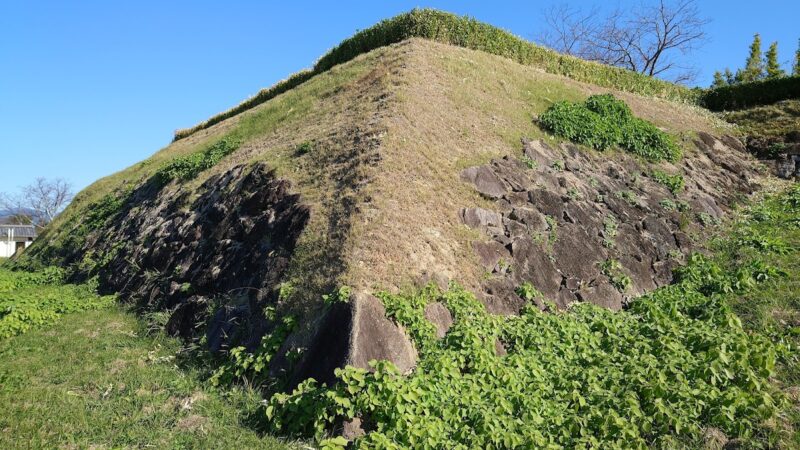
The main enclosure is the core of the castle and is surrounded by earthen ramparts. These ramparts remain in good condition today, making them valuable remains for understanding the castle construction techniques of the time. While the main enclosure is relatively compact, it is of a standard size for a mountain castle.
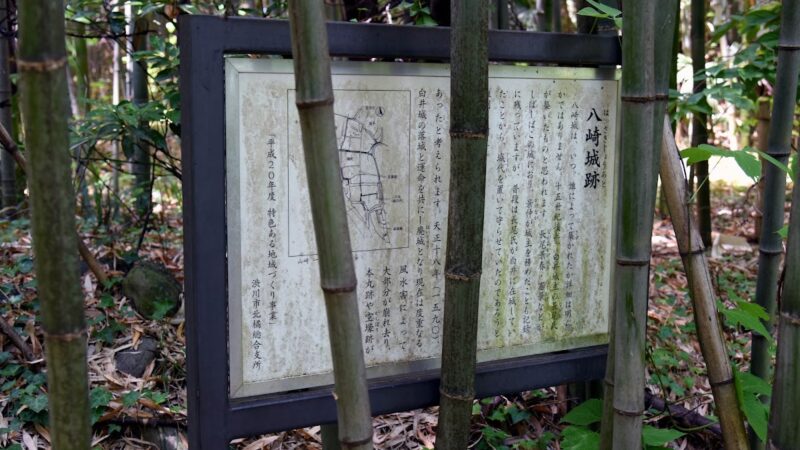
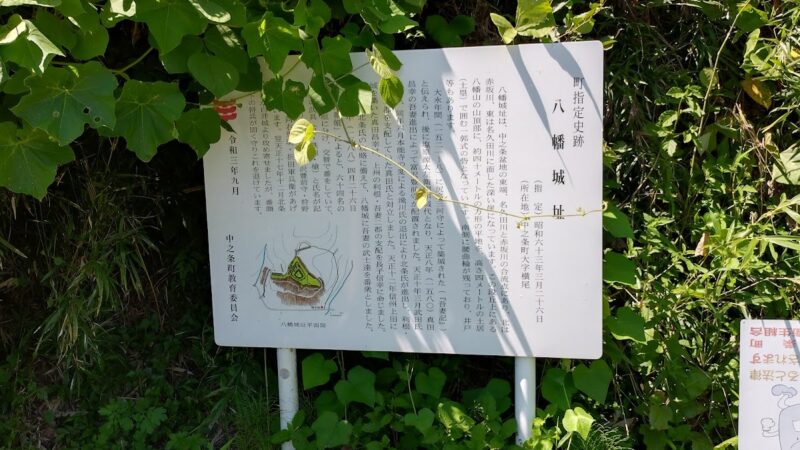
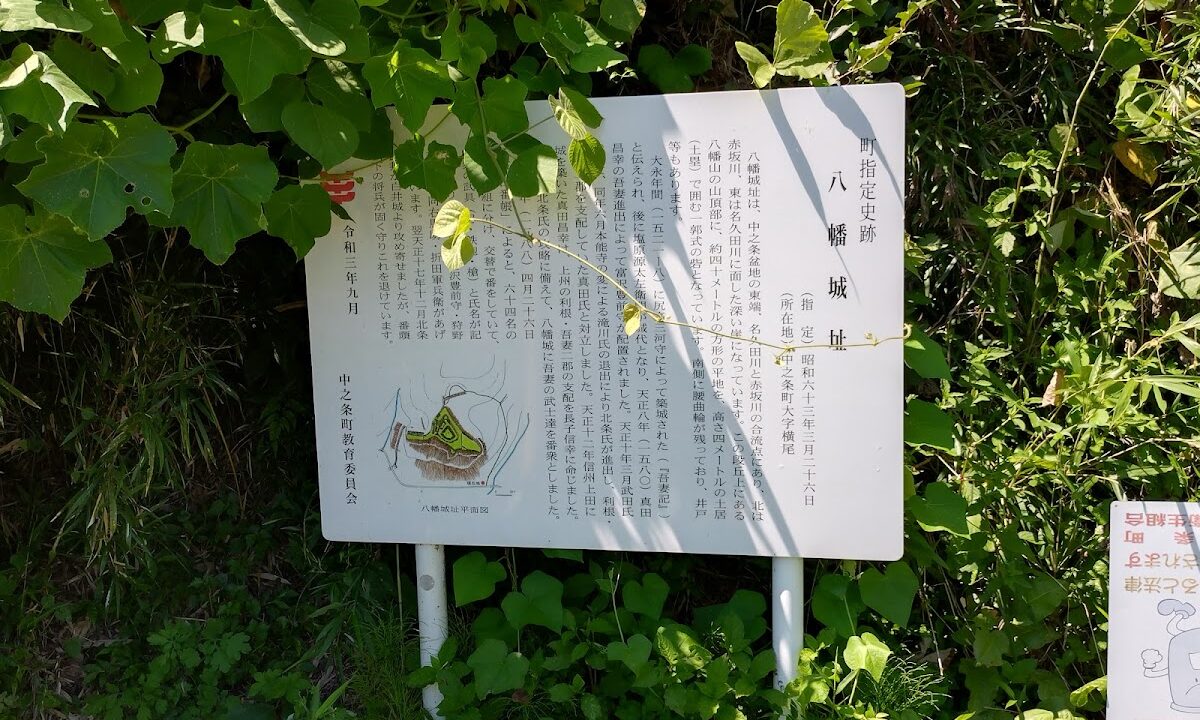
Currently, a gazebo is installed within the main enclosure, which can be used as a resting space. Information boards are also installed, making it easy for first-time visitors to understand the history and structure of the castle.
Outer Enclosure and Enclosure Arrangement
Outer enclosures (obi-guruma) are arranged around the main enclosure. The outer bailey is a long, narrow enclosure surrounding the main bailey, serving as a layer of defense and a space for deploying troops. At Yokoo Hachiman Castle, this outer bailey is a crucial element of the main bailey’s defense.
Further outside, flat areas believed to be the second and third baileys can be identified, indicating the formation of a tiered defensive line. The arrangement of these baileys forces the attacking side to employ multiple lines of defense.
Earthworks and Moats
The most prominent remains at Yokoo Hachiman Castle are the earthworks. The earthworks surrounding the main bailey are well-preserved in both height and width, allowing us to imagine their appearance at the time. The earthworks prevented enemy intrusion and also functioned as firing positions from within the castle.
Moats are thought to have been used to demarcate the castle grounds and block ridgelines, but some parts are unclear due to vegetation and age-related changes. Nevertheless, with careful observation, traces of the moats can be seen as breaks in the terrain.
Condition of the Remains Observable on Site
The Yokoo Hachiman Castle ruins are currently maintained like a park, making it relatively easy to view the main enclosure and surrounding remains. However, due to the undulating terrain characteristic of mountain castles, comfortable walking shoes are recommended.
The ground can become slippery in rainy weather, so visiting on a fine day is ideal. Also, depending on the season, overgrown vegetation can make detailed observation of the remains difficult. Spring to early summer, or autumn, are considered the best times to visit.
Related Castles in the Surrounding Area
Relationship with Iwabitsu Castle
Indispensable to understanding Yokoo Hachiman Castle is Iwabitsu Castle, which was the core base of Sanada Masayuki’s rule over Agatsuma. Iwabitsu Castle is a strong mountain castle located southwest of Nakanojo Town, and served as the Sanada clan’s headquarters when they ruled Agatsuma County.
Yokoo Hachiman Castle functioned as a subsidiary castle of Iwagutsu Castle, playing a role in preparing for attacks from the Hojo clan. The two castles worked together to form a defensive system for the Agatsuma region, forming part of the castle network used by the Sanada clan in their territorial management.
Nakayama Castle and Takeyama Castle
Several castles, including Nakayama Castle and Takeyama Castle, existed around Yokoo Hachiman Castle. These castles were also built by local lords in the Agatsuma region and were incorporated under the control of the Sanada clan during the Sengoku period.
Takeyama Castle is a mountain castle located in the eastern part of Nakanojo Town, and was also one of the defensive strongholds of Agatsuma County. It is believed that these castles communicated with each other and cooperated to deal with enemy invasions.
Agatsuma Region Castle Network
During the Sengoku period, numerous castles of various sizes were built in the Agatsuma region. Sanada Masayuki effectively utilized these castles, creating a system to control a vast area with a small army. Yokoo Hachiman Castle played a crucial role in this system.
Access and Visiting Information for Yokoo Hachiman Castle
Access by Car
Access to Yokoo Hachiman Castle is convenient by car.
Route Guide
- Use National Route 145 (Japan Romantic Road)
- Proceed approximately 400m north from the “Taira” intersection and turn left
- Enter Prefectural Road 231
- There is a signpost approximately 100m west of “Nakanojo Nakuta Post Office” (207-1 Akasaka, Nakanojo-machi)
- There is parking space near the signpost
Parking Information
There is a small parking space near the castle ruins. Parking for large vehicles is difficult, so visits by regular passenger cars are recommended. Parking is free, but space is limited, so caution is advised during busy times.
Access by Public Transportation
The nearest station is Nakanojo Station on the JR Agatsuma Line. The castle ruins are approximately 3km from the station, taking about 40 minutes on foot. Taxis are available, but availability is limited, so it’s recommended to check in advance.
Renting a bicycle is also an option; you can rent one from the Nakanojo Town Tourism Association, etc. Enjoying the Agatsuma nature while traveling is also a great option.
Notes for Visitors
- Clothing: As it is a mountain castle, comfortable walking shoes and clothing are essential.
- Season: Spring and autumn are the best times to visit. In summer, the area is overgrown with vegetation, and in winter, there is a possibility of snowfall.
- Weather: It is best to avoid visiting in rainy weather as the ground can be slippery.
- Equipment: Insect repellent, drinking water, and a map or GPS device are recommended.
- Time: 30 minutes to 1 hour for a visit around the main enclosure.
Nearby Tourist Spots
When visiting Yokoo Hachiman Castle, we recommend also visiting the following nearby spots.
- Iwagutsu Castle Ruins: The central base of the Sanada clan’s rule over Agatsuma
- Nakanojo Town Museum of History and Folklore “Musee”: A facility where you can learn about the history of the Agatsuma region
- Shima Onsen: A famous hot spring designated as a national health resort
- Sawado Onsen: A hot spring resort known as the finishing touch to Kusatsu Onsen
Historical Significance and Evaluation of Yokoo Hachiman Castle
Positioning in the Sanada Clan’s Domain Management
Yokoo Hachiman Castle is an important historical site for understanding Sanada Masayuki’s domain management strategy. The Sanada clan started as a small local lord and grew into a Sengoku daimyo through skillful diplomacy and military power. In that process, the control of the Agatsuma region played an important role as the economic and military base of the Sanada clan.
Yokoo Hachiman Castle can be evaluated as a concrete example of how the Sanada clan managed their domain while incorporating local lords. The history of this castle reflects the skill of Sanada Masayuki, who utilized local forces such as Tomizawa Buzen-no-kami, the Shiritaka clan, and the Kamahara clan to build an efficient system of control.
Function as a Border Castle
During the Sengoku period, castles located on the borders between the territories of daimyo were called “border castles” and were considered particularly important. Yokoo Hachiman Castle was located on the border between the Sanada and Hojo clans, placing it on the front lines of military tension.
The fact that it repelled the Hojo invasion in 1589 indicates that this castle was not merely a formal base, but possessed practical defensive capabilities. The geographical advantage of being a mountain castle and the unity of local lords are thought to have been key factors in its success.
Value as a Historical Heritage Site in Modern Times
The Yokoo Hachiman Castle ruins preserve valuable remains as a medieval castle in Gunma Prefecture. The fact that earthworks and baileys remain without major alterations makes it important material for studying Sengoku period castle construction techniques and castle structures.
While relatively small compared to other castles nationwide, Yokoo Hachiman Castle holds a significant place in local history and is an indispensable historical site for understanding the Sanada clan and the Sengoku period history of the Agatsuma region.
Advice for Castle Enthusiasts Visiting Yokoo Hachiman Castle
Points to Note During Your Visit
When visiting Yokoo Hachiman Castle, paying attention to the following points will help you understand the castle’s charm more deeply:
- Structure of the Earthworks: Experience the height and width of the earthworks surrounding the main enclosure.
- Layout of the Enclosures: Confirm the defensive line extending from the main enclosure to the outer enclosure and beyond.
- View: Understand the area the castle monitored from the view of the main enclosure.
- Utilization of Topography: Observe how the natural terrain of the mountains was utilized.
- Information on the Signboards: Check the historical background on the on-site signboards.
Recommended Photography Spots
When taking photos of the castle, the following angles are recommended.
- A shot capturing the main enclosure’s earthen rampart from the front.
- A composition combining the gazebo and the earthen rampart.
- An angle looking up at the main enclosure from the outer enclosure.
- View from the main enclosure (Azuma mountain range).
Because it shows different expressions depending on the season, one way to enjoy it is to visit multiple times and record the changes of the seasons.
Comparison with other castles related to the Sanada clan
Those interested in the Sanada clan can gain a deeper understanding of the Sanada clan’s castle strategy by visiting the following castles in conjunction with Yokoo Hachiman Castle.
- Ueda Castle (Ueda City, Nagano Prefecture): The main castle built by Sanada Masayuki
- Iwagutsu Castle (Agatsuma District, Gunma Prefecture): The central base for controlling Agatsuma
- Nagurumi Castle (Tone District, Gunma Prefecture): The stage of conflict between the Sanada and Hojo clans
- Toishi Castle (Ueda City, Nagano Prefecture): An important base near the birthplace of the Sanada clan
By visiting these castles, you can see the overall picture of the castle network used by the Sanada clan in managing their territory.
References and Information Sources
For those who want to learn more about Yokoo Hachiman Castle, we recommend referring to the following references and information sources.
- *Comprehensive Survey of Japanese Castles*, Volume 4: Gunma and Tochigi (Shin Jinbutsu Oraisha)
- *Medieval Castle Sites in Gunma Prefecture* (Gunma Prefectural Board of Education)
- Local historical materials published by Nakanojo Town Board of Education
- Detailed reports from various castle research websites
Information about Yokoo Hachiman Castle can also be obtained from local information boards and the Nakanojo Town Museum of History and Folklore, “Musee”.
Summary
Yokoo Hachiman Castle is the site of a Sengoku period mountain castle remaining in Nakanojo Town, Agatsuma District, Gunma Prefecture. Built during the Daiei era by Shiritaka Mikawa-no-kami, it later played an important role in Sanada Masayuki’s rule of Agatsuma. It demonstrated its function as a practical defensive base, such as repelling an invasion by the Hojo clan in 1589 (Tensho 17).
Even today, the remains of the earthworks surrounding the main enclosure and the outer enclosures are well-preserved, making it a valuable historical site for understanding the structure of Sengoku period mountain castles. With relatively easy access, this is a place worth visiting not only for castle enthusiasts but also for anyone interested in the Sanada clan and the history of the Sengoku period.
Why not visit the ruins of Yokoo Hachiman Castle, nestled in the rich natural environment of Agatsuma, and feel the spirit of the Sengoku period? Visiting it along with other nearby castles, such as Iwagutsu Castle, will allow you to gain a deeper understanding of the Sanada clan’s territorial management and the Sengoku history of the Agatsuma region.