Hosshin Castle (Fukuoka Prefecture) Complete Guide: The Last Mountain Castle of the Kusano Clan and the Full Extent of its Magnificent Remains
What is Hosshin Castle?: A Strong Mountain Castle Built by the Kusano Clan, a Prominent Family of Chikugo, in the Late Sengoku Period
Hosshin Castle is a mountain castle built in the late Sengoku period on Mount Hosshin (elevation 697.5m) in the Mino Mountains, spanning the cities of Kurume, Yame, and Ukiha in Fukuoka Prefecture. It is protected as a Fukuoka Prefecture designated historical site and possesses high historical value as a representative medieval mountain castle of the Chikugo region.
The castle’s total size extends approximately 380m east-west and 200m north-south, and it was a large-scale mountain castle with a main enclosure at the summit, surrounded by a group of enclosures on the ridges extending in three directions: north, west, and east. The most distinctive feature of Hosshin Castle is its multi-layered defensive structure: the main castle (summit), the storehouse on the mountainside, and the upper, middle, and lower castles at the northern foot of the mountain.
Even today, the remains of the castle, including ridged trenches, stone walls, earthworks, and moats, are well-preserved, making it a valuable historical site for understanding the castle construction techniques of the Sengoku period (Warring States period).
History of Hosshin Castle: From the Otomo Clan to the Ryuzoji Clan, and to the Destruction of the Kusano Clan by Toyotomi Hideyoshi
History of the Kusano Clan and Their Rule of Chikugo
The Kusano clan was a prominent family that held power in the Chikugo region from the Kamakura period, and their residence was Takei Castle for generations. During the Sengoku period, they were subordinate to the Otomo clan, a powerful daimyo of Kyushu, and functioned as an important base of operations for the Otomo clan in Chikugo.
The Battle of Mimikawa and the Catalyst for the Construction of Hosshin Castle
Hosshin Castle was built in 1578 (Tensho 6), directly triggered by the Otomo clan’s crushing defeat against the Shimazu clan in the “Battle of Mimikawa” in Hyuga Province. This defeat led to a rapid decline in the power of the Otomo clan, and numerous local lords throughout Kyushu defected.
Kusano Shigenaga (Iekiyo), the head of the Kusano clan at the time, also seized this opportunity to defect from the Otomo clan and defected to the Ryuzoji clan of Hizen Province. To prepare for a retaliatory attack by the Otomo clan, Shigenaga abandoned his previous castle, Takei Castle, and built a new castle on Hosshinzan, a more defensible location. This was Hosshin Castle.
Toyotomi Hideyoshi’s Kyushu Campaign and the Downfall of the Kusano Clan
In 1587 (Tensho 15), Toyotomi Hideyoshi’s Kyushu campaign began. Faced with Hideyoshi’s overwhelming forces, the various daimyo of Kyushu surrendered one after another.
However, for some reason, Kusano Shigenaga incurred Hideyoshi’s wrath during Hideyoshi’s conquest of Kyushu. According to historical records, Shigenaga was lured into a trap and killed by Hideyoshi, thus ending the Kusano clan, which had existed since the Kamakura period. With the fall of the Kusano clan, Hosshin Castle was also abandoned, bringing its short history of only nine years to an end.
Structure of Hosshin Castle: A multi-layered defensive system consisting of the main castle, storehouse, and upper, middle, and lower castles
Structure of the Main Castle (Summit)
The main castle, the core of Hosshin Castle, was built on the summit of Mount Hosshin, at an altitude of 697.5m. The summit, marked by a triangulation point, served as the main enclosure, and the layout consisted of enclosures arranged along the ridges extending in three directions: north, west, and east.
Earthworks surrounded the main enclosure, and trenches were constructed at key points on each ridge. Particularly noteworthy are the ridge-shaped vertical trenches, where multiple trenches running along the slopes were designed to hinder enemy lateral movement. Furthermore, the remains of stone walls have been confirmed, indicating that advanced castle construction techniques for the time were employed.
The relative height from the summit reached approximately 650m, making it an extremely difficult fortress to attack.
Kurasho: An Important Base on the Mountainside
One of the distinctive features of Hosshin Castle is the group of enclosures called “Kurasho,” located midway between the main castle on the mountaintop and the upper, middle, and lower castles at the foot of the mountain. It is situated alongside the hiking trail leading from Hosshin Park to the mountaintop.
Kurasho consists of two levels of enclosures, upper and lower, and as its name suggests, it is believed to have been a storage facility for supplies. Although there is no large-scale moat blocking the ridge, it played an important role as a relay point connecting the main castle with the residences and outposts at the foot of the mountain.
Upper, Middle, and Lower Castles: A Vanguard Position Consisting of Three Peaks
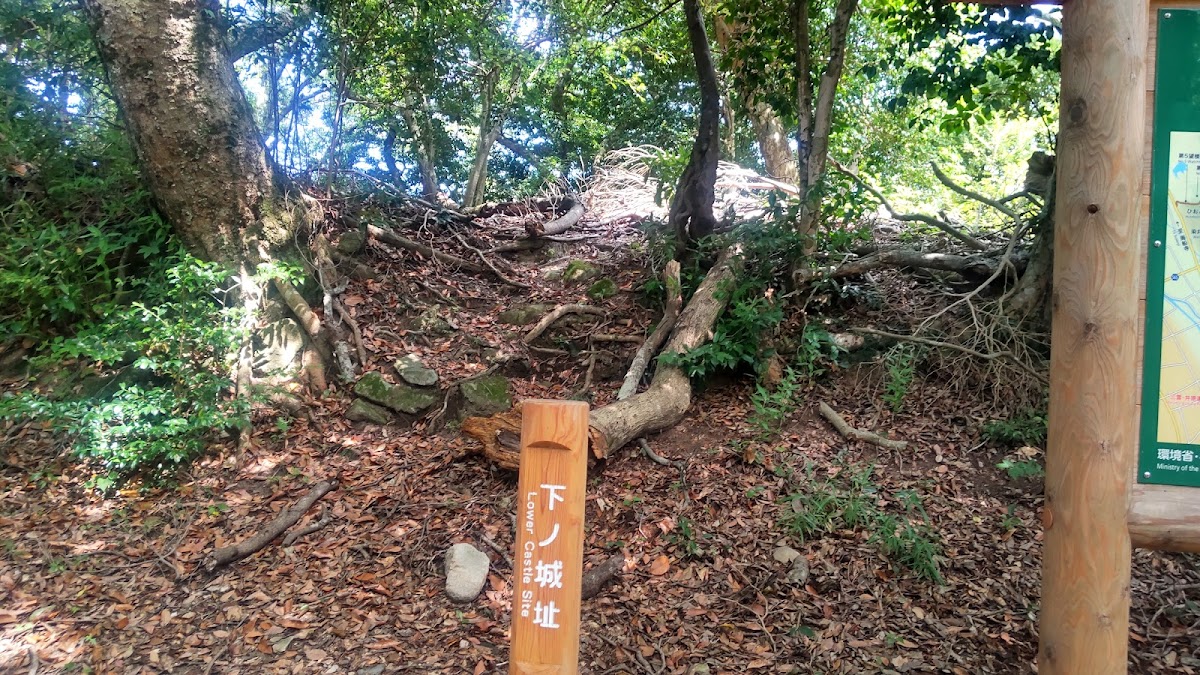
On the northern foot of Hosshin Castle, east of the current Hosshin Park (site of the Kusano clan’s residence), are three outposts called “Kami-no-shiro,” “Naka-no-shiro,” and “Shimo-no-shiro.” These functioned as vanguard positions for the main castle.
Kami-no-shiro is the highest elevation, at approximately 190m, and is the closest of the three outposts to the main castle.
Nakanojo was built on a peak approximately 160m above sea level on the northeast side, serving as a defensive base against invasions from the east.
Shimonojo was located on a peak with a triangulation point at an elevation of 148.9m on the northwest side, responsible for monitoring and defending the northwest.
These three outposts each form an independent group of baileys, designed to provide multiple layers of defense against attack routes to the main castle.
Hosshin Park: Site of the Kusano Clan’s Residence
Hosshin Park, located at the northern foot of Hosshin Castle, is believed to be the site of the Kusano clan’s residence during peacetime. Unlike the main Hosshin Castle itself, which is a mountain castle, it functioned as a place for daily administrative affairs and living.
Currently, it is maintained as a park and serves as a base for climbing Hosshin Castle.
Highlights of Hosshin Castle: Existing Remains and the Charm of the Castle
Ridge-Shaped Vertical Moats: Advanced Defensive Techniques of the Sengoku Period
One of the most noteworthy remains at Hosshin Castle is the ridge-shaped vertical moats. By arranging multiple vertical moats in parallel on the mountain slope, it was made difficult for enemy soldiers to move laterally, thus hindering sieges.
These ridge-shaped vertical moats are characteristic of castle construction techniques from the late Sengoku period and are important remains that demonstrate the technological level of 1578, the year Hosshin Castle was built.
Stone Wall Remains: A Valuable Example of Stone Wall Use in a Mountain Castle
Partial remains of stone walls have been confirmed at Hosshin Castle. The use of stone walls in mountain castles is relatively rare, indicating that the Kusano clan invested considerable effort and skill in building Hosshin Castle.
While some parts of the stone walls have collapsed due to later destruction and weathering, they are valuable resources for understanding the stonework techniques of the time.
Earthworks and Moats: Basic Defensive Structures of a Mountain Castle
Earthworks were constructed around the main enclosure and each bailey, enhancing its defensive capabilities. Multiple moats cutting across the ridges can also be seen, demonstrating ingenuity in hindering enemy advances.
These remains are relatively well-preserved, making this a valuable site for experiencing the structure of a mountain castle from the Sengoku period.
Views: A Spectacular Panoramic View of the Chikugo Plain
From the mountaintop at an altitude of 697.5m, a magnificent panoramic view of the Chikugo Plain unfolds. On a clear day, you can see the city of Kurume, the Chikugo River, and even the Ariake Sea.
This view not only has aesthetic value but also held military significance during the Sengoku period, allowing for the monitoring of enemy movements.
Access Information: How to Get to Hosshin Castle and the Climbing Route
Location
Main Castle (Summit): Kusano, Kusano-machi, Kurume City, Fukuoka Prefecture (Border of Kurume City, Yame City, and Ukiha City)
Hosshin Park (Trailhead): Kusano, Kusano-machi, Kurume City, Fukuoka Prefecture
Access by Car
- Approximately 20 minutes from the Kyushu Expressway “Kurume IC”
- Approximately 15 minutes from the Oita Expressway “Haki IC”
- Parking available at Hosshin Park (free)
Access by Public Transportation
- Approximately 30 minutes on foot from JR Kyudai Main Line “Chikugo-Kusano Station” to Hosshin Park
- Buses are also available from Nishitetsu Kurume Station (limited service)
Climbing Route and Estimated Time
From Hosshin Park to the Main Castle Summit:
- The hiking trail is well-maintained, approximately 60-90 minutes one way
- Elevation difference approximately 650m, mountain climbing equipment is necessary
- There are remains of a storehouse along the way
Routes to Upper, Middle, and Lower Castles:
- There are routes to each castle from the east side of Hosshin Park
- Each route takes approximately 30-60 minutes
Precautions when climbing the castle
- As this is a full-fledged mountain castle, hiking boots and comfortable clothing are essential
- Bring drinking water and snacks
- Take insect repellent in summer
- There is a possibility of snow and ice in winter
- Avoid solo climbing as there are areas with poor cell phone reception
- Submitting a climbing plan is recommended
Tourist spots and related historical sites around Hosshin Castle
Takei Castle Ruins
The residence of the Kusano clan before they built Hosshin Castle. It is located approximately 3km northeast of Hosshin Castle. By comparing it with Hosshin Castle, you can understand the reasons why the Kusano clan moved their residence and the changes in their castle-building philosophy.
Takatori Castle Ruins
One of the important mountain castles in the Chikugo region. This castle was active around the same time as Hosshin Castle and is important for understanding the castle network of the Sengoku period in Chikugo.
Kurume City Kusano Historical Museum
Exhibits include materials related to the Kusano clan and Hosshin Castle. Visiting before climbing the castle will provide a deeper understanding.
Mino Mountain Range
Hosshin Mountain is part of the Mino Mountain Range and can be included in a mountain traverse route. Many other mountain castle ruins are scattered throughout the area besides Hosshin Castle.
Research and Preservation Activities of Hosshin Castle
Value as a Fukuoka Prefecture Designated Historic Site
Hosshin Castle is protected as a Fukuoka Prefecture designated historic site and occupies an important position in the study of Sengoku period mountain castles. In particular, the ridged vertical moats and multi-layered defensive structures are valuable resources for understanding castle construction techniques of the late 16th century.
Archaeological Excavations and Research Results
Partial archaeological excavations have been conducted in the past, and detailed records of excavated artifacts and remains exist. These investigations have revealed the construction date, period of use, and circumstances surrounding the abandonment of Hosshin Castle.
Challenges in Preservation and Maintenance
Due to its nature as a mountain castle, the remains are undergoing weathering and erosion by vegetation. Regular surveys and appropriate preservation measures are required, and preservation activities are ongoing by local history enthusiasts and researchers.
Points to Note When Visiting Hosshin Castle
Best Time to Visit
Spring (March-May): Mild weather, ideal for hiking. The fresh greenery is also beautiful.
Autumn (October-November): Beautiful autumn foliage, and temperatures suitable for hiking.
Summer (June-August): Best avoided due to heat and numerous insects. Early morning hikes are possible.
Winter (December-February): Possibility of snow and ice; suitable for experienced hikers.
Estimated Time Required
- Round trip from Hosshin Park to Honjoyama summit: 3-4 hours
- Exploring the entire site including Upper, Middle, and Lower Castles: 5-6 hours
- If you want to carefully observe the remains: 1 day
Equipment to Bring
- Hiking boots (trekking shoes)
- Drinking water (1 liter or more)
- Snacks
- Map and compass (GPS app is also useful)
- Headlamp (just in case)
- First-aid kit
- Rain gear
- Gloves (useful when touching the remains)
- Camera (for recording the remains)
Hosshin Castle Tells the Story of Chikugo in the Sengoku Period
The Era of the Three Great Powers of Kyushu: The Otomo, Ryuzoji, and Shimazu Clans
In the late 16th century, when Hosshin Castle was built, Kyushu was in a turbulent era where the three major powers—the Otomo clan (Bungo), the Ryuzoji clan (Hizen), and the Shimazu clan (Satsuma)—were vying for supremacy. The Chikugo region was situated at the border of these three powers, and local lords like the Kusano clan were forced to move between these forces in order to survive.
The Impact of the Battle of Mimikawa
The crushing defeat of the Otomo clan at the Battle of Mimikawa in 1578 was an event that completely changed the balance of power in Kyushu. The Otomo clan, which had previously boasted the greatest power in Kyushu, rapidly declined, and this became the catalyst for the rise of the Shimazu clan. The Kusano clan’s defection was also a choice made within this larger trend.
Unification of Kyushu under the Toyotomi Regime
Toyotomi Hideyoshi’s conquest of Kyushu meant the complete unification of Kyushu by the central government. Many local lords, like the Kusano clan, who had existed since the Middle Ages, perished or declined during this process, and a new system of rule by early modern daimyo was established. The history of Hosshin Castle symbolizes this transition period from the Middle Ages to the early modern period.
Summary: The Historical Significance and Modern Value of Hosshin Castle
Hosshin Castle, though with a short history of only nine years, is an important historical site that reflects the situation in Kyushu at the end of the Sengoku period, the end of the noble Kusano clan, and the pinnacle of mountain castle construction technology.
The multi-layered defensive structure, consisting of the main castle built on the mountaintop at an altitude of 697.5m, the storehouse on the mountainside, and the upper, middle, and lower castles at the foot of the mountain, represents the pinnacle of castle construction technology of the time. Remains such as the ridged trenches and stone walls are still well-preserved today.
When visiting Kurume City, Fukuoka Prefecture, be sure to visit Hosshin Castle and experience the spirit of the Sengoku period. The view from the mountaintop and the historically romantic remains will surely captivate visitors.
It is our responsibility as modern people to properly prepare for the climb, prioritize safety, and pass on this valuable historical heritage to future generations.