Complete Guide to Chausu-date Castle (Akita Prefecture) | History, Remains, and Access to the Hiyama Ando Clan Castle Site
What is Chausu-date Castle?
Chausu-date Castle is a medieval mountain castle site located in Komagi, Hiyama, Noshiro City, Akita Prefecture. Also known as Hiyama Chausu-date Castle, it functioned as an important branch castle located west of Hiyama Castle, the main castle of the Hiyama Ando clan. Built on the edge of a hill approximately 50 meters above sea level, this castle site was designated a national historic site on March 21, 1980 (Showa 55) as part of the “Hiyama Ando Clan Castle Site,” and is a valuable historical site for understanding the history of castles in the Tohoku region during the medieval period.
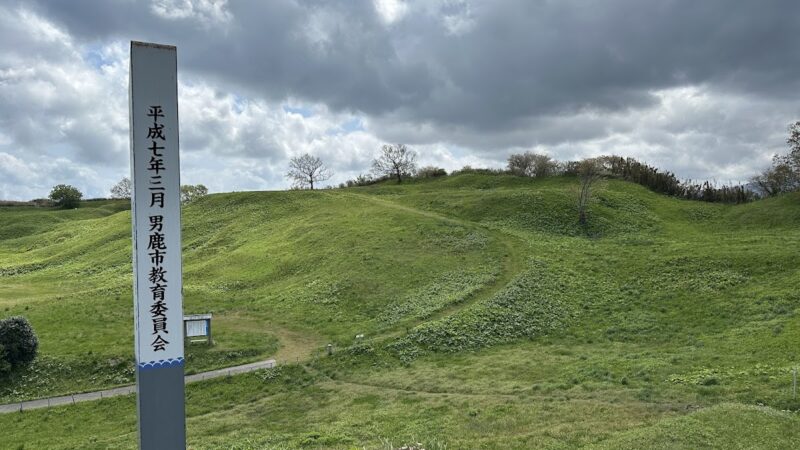
The most distinctive feature of Chausu-date Castle is its clearly defined enclosure structure, separated by moats and continuous vertical trenches. Even today, the remains of enclosures known as Kodate and Nakadate still exist, conveying the defensive system of that time. Chausu Castle, which formed part of a group of castles centered around Hiyama Castle, is attracting attention from castle enthusiasts and history researchers as an important historical site that tells the story of the Ando clan’s sphere of influence and defensive system.
History of Chausu Castle
The Hiyama Ando Clan and the Establishment of Chausu Castle
Chausu Castle was built by the Hiyama Ando clan, who ruled northern Akita Prefecture from the Muromachi period to the Sengoku period. The Hiyama Ando clan was a branch of the Ando clan that held power in northern Dewa Province, and they governed a vast territory with Hiyama Castle as their base. Chausu Castle, located west of Hiyama Castle, is thought to have played an important role in defending the main castle.
It is believed that the castle’s defense was handled by the vassal Otaka Sagami-no-kami Yasuzumi, indicating an organized defensive system by the Hiyama Ando clan’s retainers. The location of Chausu-kan was a strategic point for monitoring and preventing invasions of Hiyama Castle from the west. Along with the Odachi ruins located to the northwest, it formed a defensive line protecting Hiyama Castle.
Legend of Kitabatake Akimura’s Escape
A noteworthy aspect of the history of Chausu-kan is the legend related to the fall of Namioka Castle in 1578 (Tensho 6). Kitabatake Akimura, the lord of Namioka Castle in Mutsu Province, lost his castle to an attack by Tsugaru Tamenobu, a Sengoku daimyo of the Tsugaru region. Legend says that at this time, Akimura fled to Hiyama, relying on his father-in-law (his wife’s father), Ando Yoshisue, and lived at Chausu-kan.
Ando Yoshisue was the head of the Hiyama Ando clan, who built the clan to its peak, expanding his power from northern Dewa Province to the Tsugaru region. It is said that Yoshisue, who had married the daughter of Kitabatake Akimura, protected his stepson, Akimura. This legend suggests that Chausu Castle may have functioned not merely as a military facility, but also as a residence for the Ando clan and their important retainers.
Positioning within the Hiyama Ando Clan Castle Complex
Chausu Castle was strategically placed as part of a castle complex centered around Hiyama Castle. The Hiyama Ando clan constructed a multi-layered defense system by placing Odachi to the northwest and Chausu Castle to the west, in addition to their main castle, Hiyama Castle. These subsidiary castles are thought to have each possessed independent defensive functions while coordinating with each other to protect the main castle.
According to archaeological surveys, the Odachi site has been excavated in six phases since 1971, confirming long-term use from the Muromachi period to the early Edo period. It is presumed that Chausukan also functioned during a similar period, and is thought to have shared the history from the heyday to the decline of the Hiyama Ando clan.
Structure and Remains of Chausukan
Topography and Location
Chausukan was built on the edge of a hill approximately 50 meters above sea level. This location combines visibility from the plains with defensive capabilities, utilizing an ideal terrain for a medieval mountain castle. It features a structure that skillfully utilizes the natural topography of the hill while enhancing defensive capabilities through artificial civil engineering.
The surrounding terrain has relatively gentle undulations, and the distance from Hiyama Castle is kept at a suitable level. This arrangement allows Chausukan to maintain visual contact with Hiyama Castle while functioning as an independent defensive base. The remaining terrain reveals the strategic thinking behind the castle design of that time.
Moats and Continuous Vertical Ditches
The most prominent remains of Chausukan are the moats and continuous vertical ditches. A moat (horikiri) is a defensive structure dug to cut across a ridge, playing a crucial role in preventing enemy incursions. Several moats have been identified at Chausu Castle, serving as clear boundaries defining the different enclosures.
Continuous vertical moats (tatebori) are moats dug vertically along a slope, preventing attacks from the enemy’s flanks and restricting the movement of enemy soldiers climbing the slope. The continuous vertical moats at Chausu Castle are relatively well-preserved, making them valuable remains that allow for concrete observation of medieval castle defensive techniques. These moats, combined with earthworks, formed a stronger defensive system.
Enclosure Arrangement: Small Enclosure and Medium Enclosure
The enclosures of Chausu Castle are clearly separated by moats and earthworks, and sections known as the Small Enclosure and Medium Enclosure still remain today. These enclosures are arranged in a stepped pattern, suggesting that each functioned as an independent defensive unit.
The Small Enclosure is a relatively small enclosure, possibly used as a lookout post or a base for frontline defense. On the other hand, the Nakadate (middle enclosure) had a larger area and is presumed to have been used for garrisoning soldiers and storing supplies. The differences in elevation and layout between the enclosures suggest a design philosophy that forced multi-stage defenses on the attacking side.
However, the current state of preservation at the Chausu Castle site is not entirely good, and some remains are affected by weathering and vegetation. Nevertheless, the basic enclosure structure and the arrangement of the moats can be confirmed, allowing us to imagine the appearance of the castle in its heyday.
Structure of Earthworks
Traces of earthworks also remain at the Chausu Castle. These earthworks were earthen walls built by piling up soil excavated for the moats, serving both as defensive walls and as a screen to conceal the interior of the enclosures from the outside. The earthworks of the Chausu Castle, combined with the moats, formed a more effective defensive line.
The height and width of the earthworks vary depending on the location, but it is thought that relatively large earthworks were constructed along the main defensive lines. Although weathering has reduced its original height, the width and arrangement of its base suggest it possessed considerable defensive capabilities.
Highlights of Chausu Castle
Clear Moat Remains
The greatest highlight of a visit to Chausu Castle is the clearly preserved moat remains. Several moats are dug across the ridge, and their depth and width demonstrate the advanced civil engineering techniques of the time. By observing the cross-sectional shape and arrangement of the moats, one can gain a concrete understanding of how medieval castles enhanced their defensive capabilities.
In particular, the moat separating the main enclosure and the second enclosure is large in scale, indicating its crucial defensive role. Standing at the bottom of the moat and looking up, one can truly appreciate its depth and the steepness of the cliffs on both sides, experiencing firsthand the difficulty of attacking the castle.
Observation of Continuous Vertical Moats
The continuous vertical moats carved into the slope are also unmissable remains. These were ingenious defensive structures designed to restrict the movement of enemies climbing the slope and enable flanking attacks. The continuous vertical moats at Chausu Castle are relatively well-preserved, making them a valuable example of actual slope defense.
By following the vertical moats and moving along the slope, you can understand the castle’s structure from the defender’s perspective. Where multiple vertical moats are dug in parallel, it can be inferred that a tactic of dividing and defeating enemy soldiers individually was employed.
Arrangement and Structure of Enclosures
At the remains of the enclosures known as Kodate and Nakadate, you can learn how medieval castles divided space and arranged functions. By observing the flat surfaces of the enclosures and the surrounding cliffs, you can imagine the building layout and circulation plans.
By examining the size, shape, and relative positions of each enclosure, you can gain insight into the overall design philosophy of the castle. In particular, by inferring the locations of the connecting routes and entrances between enclosures, you can understand the design that balanced defense and convenience.
Ashina Clan Retainers’ Cemetery
Near the access road to Chausukan, there is a monument marking the “Ashina Clan Retainers’ Cemetery,” a historical site worth visiting. This cemetery is linked to legends concerning Kitabatake Akimura and is an important place for understanding the historical background of Chausukan.
A sign is also installed at the cemetery, and visiting before or after visiting Chausukan allows you to feel the layered history etched into this place.
Access Information
Access by Car
Access to Chausukan is convenient by car. From the “Hiyama Entrance” intersection on National Route 7, proceed south along Prefectural Road 4 for approximately 3.7 km. You will see the monument marking the “Ashina Clan Retainers’ Cemetery” on the right-hand side of the road. This monument serves as a landmark for Chausukan.
There is parking space on the shoulder of the road, but it is narrow, so please park carefully and pay attention to surrounding traffic. There is no dedicated parking lot, so please be considerate and avoid interfering with farm work.
Approach on Foot
Walk approximately 50 meters west from the parking area along a path between fields. From the point where the “Ashina Clan Retainers’ Cemetery” sign is located, ascend south to reach the Chausukan ruins. The path to the castle is not a well-maintained walking trail, but rather a path utilizing the natural terrain, so comfortable walking shoes are recommended.
The climb itself takes about 10 minutes each way, but including observation of the ruins and photography, allow 30 minutes to an hour for the entire visit.
Precautions for Visiting
The Chausukan ruins are located in a forest, and depending on the season, vegetation can make the ruins difficult to see. Visiting from spring to autumn is relatively easier, but insect repellent is necessary during the summer. Also, the ground can become slippery during and after rain, so it is recommended to check the weather before visiting.
Since there are limited information boards and explanatory signs at the site, researching the history and structure beforehand will lead to a deeper understanding. Furthermore, because the preservation is not perfect, it is important to observe the remains carefully to avoid damaging them.
Related Historical Sites in the Surrounding Area
Hiyama Castle Ruins
If you visit Chausukan, you should definitely also visit the Hiyama Castle Ruins, the main castle site. Hiyama Castle was a large mountain castle used as the base of the Hiyama Ando clan from the Muromachi period to the early Edo period. It is located a few kilometers east of Chausukan, and visiting both will allow you to understand the structure of the entire castle complex.
Hiyama Castle Ruins are larger in scale than Chausukan, with multiple baileys such as the main bailey, second bailey, and third bailey arranged in a stepped pattern. The remains such as stone walls, moats, and earthworks are well-preserved, making it a valuable historical site where you can observe the changes in castle architecture from the medieval to the early modern period.
Odachi Ruins
The Odachi Ruins, located northwest of Hiyama Castle, are also an important component of the Hiyama Ando clan’s castle complex. Similar to Chausu-kan, it was built on the edge of a hill at an elevation of around 50 meters and has a structure divided by several moats and earthen ramparts.
The Odachi site has undergone multiple archaeological excavations since 1971, yielding abundant archaeological results. Visiting it together with Chausu-kan and Hiyama Castle will allow you to grasp the overall picture of the Ando clan’s defense system.
Historical Facilities in Noshiro City
There are facilities in Noshiro City where you can learn about the history of the Hiyama Ando clan and the region. You may be able to view materials related to local history at the Noshiro City Hall and library. Also, you can get information on access to the castle site and nearby attractions at the city’s tourist information center.
Preservation and Current Status of Chausu-kan
Significance of National Historic Site Designation
Chausu-kan was designated a national historic site on March 21, 1980 (Showa 55) as part of the “Hiyama Ando Clan Castle Site.” This designation signifies that Chausu-kan was evaluated not as a standalone site, but as part of a unified group of castles and fortifications, including Hiyama Castle and the Odachi ruins.
With the designation as a National Historic Site, Chausu-kan has received legal protection and will be safeguarded from development. This designation officially recognizes the importance of Chausu-kan in the history of castles in the Tohoku region during the medieval period.
Current State of Preservation
Unfortunately, the state of preservation of Chausu-kan is not entirely good. According to visitor records, while dry moats and bailey remains exist, overgrown vegetation and natural weathering have obscured parts of the remains.
Despite being designated a National Historic Site, active preservation, maintenance, and utilization are currently lacking. Signboards and explanatory panels are limited, making it difficult for general visitors to understand the remains. Further appropriate preservation and utilization as a regional historical asset is hoped for in the future.
Future Challenges
Future challenges for Chausu Castle include the proper preservation and management of the remains, improving visibility through vegetation management, installing information boards and explanatory signs, and developing access roads. Furthermore, it is important to enhance the overall appeal of the Hiyama Ando clan castle complex by utilizing it in conjunction with Hiyama Castle and the Odachi ruins.
A comprehensive preservation and utilization plan is desirable, taking into account its use as a resource for local history education and tourism. Creating an environment where not only castle enthusiasts but also general tourists and local residents can easily visit and learn about history is a key challenge for the future.
Historical Background of the Hiyama Ando Clan
Origins and Development of the Ando Clan
The Ando clan was a samurai family that ruled the northern part of Dewa Province (present-day northern Akita Prefecture) during the medieval period. While there are various theories about their origins, it is believed that they established their power in this region from the late Heian period to the Kamakura period. The Ando clan controlled trade along the Sea of Japan and played an important role in trade with Ezo (Hokkaido). During the Muromachi period, the Ando clan split into the Minato Ando and Hiyama Ando clans, and the two were in conflict. The Hiyama Ando clan, based at Hiyama Castle, controlled a vast territory stretching from the Noshiro River basin to the northern Akita region.
The Era of Ando Yoshisue
The Hiyama Ando clan reached its peak during the time of Ando Yoshisue in the late 16th century. Yoshisue unified the Ando clan by integrating the rival Minato Ando clan. He further expanded his influence into the Tsugaru and Nanbu regions, reigning as the dominant power in northern Dewa Province.
It is believed that the Chausu Castle was also developed and expanded during Yoshisue’s time, and that he protected Kitabatake Akimura during this period. Yoshisue was also skilled in diplomacy, maintaining relations with the central government while preserving regional independence.
Transition to the Edo Period
After the death of Ando Yoshisue, the Ando clan gradually lost power. After the Battle of Sekigahara, the Ando clan (later the Akita clan) was transferred to Shishido in Hitachi Province. Later, they returned to Akita and became the lords of the Akita Domain, but Hiyama Castle was abandoned. It is believed that Chausukan also ceased to function around the same time.
The castle complex of the Hiyama Ando clan became unnecessary during the peaceful Edo period and gradually faded into obscurity. However, advances in historical research in the latter half of the 20th century led to a renewed recognition of its importance, resulting in its designation as a National Historic Site.
Significance of Visiting Chausukan
Understanding the Reality of Medieval Castles
The greatest significance of visiting Chausukan is the opportunity to learn firsthand how medieval mountain castles were built and how they functioned. You can experience and observe things that are difficult to understand from textbooks and documents alone, such as the depth of the moats, the arrangement of the baileys, and the use of the terrain, by actually walking around and observing.
In particular, the civil engineering remains such as continuous vertical moats and trenches have an impact that cannot be conveyed through photographs or drawings alone. Standing on the site allows you to experience firsthand the medieval castle-building techniques and strategic thinking.
Understanding Local History
Chausukan is an indispensable historical site for understanding the medieval history of northern Akita Prefecture. It is an important archaeological site that tells the story of the region’s historical characteristics, including the rule of the Hiyama Ando clan, its role as a base for trade on the Sea of Japan, and its relationships with Tsugaru and Nanbu.
Visiting Chausukan allows you to learn about the unique historical development of the Tohoku region, which differs from the central Sengoku period history. Furthermore, the legend of Kitabatake Akimura’s escape illustrates the importance of personal networks and marriage relationships in the samurai society of the Tohoku region.
Considering the Preservation of Historical Heritage
The current state of Chausukan symbolizes the challenges faced by local historical heritage. Despite being designated a national historical site, the reality that sufficient preservation, maintenance, and utilization have not progressed demonstrates the difficulty of cultural property protection.
Visiting Chausukan provides an opportunity to consider the preservation and utilization of historical heritage. This will be an opportunity to consider firsthand how to pass on the historical heritage, a treasure of the region, to future generations, and how visitors can engage with it.
Summary
Chausukan is a medieval mountain castle site remaining in Noshiro City, Akita Prefecture, and played an important role as a branch castle of the Hiyama Ando clan. Built on a hill approximately 50 meters above sea level, this castle site features defensive structures such as moats, continuous vertical trenches, and earthworks, and the baileys known as Kodate and Nakadate are clearly separated.
There is also a legend that Kitabatake Akimura, who lost Namioka Castle in 1578, fled to this area seeking refuge with Ando Yoshisue, giving it historical significance beyond a mere military facility. Designated a national historic site in 1980, Chausukan, along with Hiyama Castle and Odate Ruins, is a valuable cultural asset that conveys the history of castles in the medieval Tohoku region as part of the “Hiyama Ando Clan Castle Sites.”
While the current state of preservation is not necessarily good, the main remains can be identified, and it is possible to learn about the structure of medieval castles. With relatively easy access from National Route 7, this historical site is well worth visiting for castle enthusiasts and history buffs.
Visiting Chausu Castle offers an opportunity to deeply consider local history not found in textbooks, medieval castle construction techniques, and the modern challenge of preserving historical heritage. Visiting it along with Hiyama Castle and the Odachi ruins will provide a comprehensive understanding of the Hiyama Ando clan’s rule and defense system.