
Complete Guide to Yoshida-Koriyama Castle | The Full Picture of Mori Motonari’s Residence and One of the Largest Mountain Castles in the Chugoku Region
What is Yoshida-Koriyama Castle?
Yoshida-Koriyama Castle, located in Yoshida-cho, Aki-Takata City, Hiroshima Prefecture, is one of Japan’s leading mountain castles representing the Sengoku period. It served as the residence of the Mori clan, a powerful daimyo family of Aki Province, for generations, and during the time of Mori Motonari, it developed into a massive mountain castle, one of the largest in the Chugoku region.
Currently, the castle ruins are designated as a national historic site as “Mori Clan Castle Ruins, Tajihisarugake Castle Ruins, Koriyama Castle Ruins,” and are also selected as one of Japan’s Top 100 Castles (No. 72). Located in the northern part of the Yoshida Basin, nestled between the Kawai River (Gono River) and the Tajihisa River, it is characterized by its magnificent scale, fortifying the entire Koriyama mountain, which stands approximately 400m above sea level with a relative height of approximately 200m.
History of Yoshida-Kōriyama Castle
Up to the Muromachi Period: The Castle’s Birth and the Establishment of the Mōri Clan
The origins of Yoshida-Kōriyama Castle date back to the Nanboku-chō period. It is believed to have begun in 1336 (Kenmu 3rd year/Engen 1st year), when Mōri Tokichika, who had settled as the jitō (land steward) of Yoshida-shō in Aki Province, built a small, fort-like castle on a southeastern ridge of Kōriyama.
The initial castle was small, limited to the area now known as the Old Main Castle. The Mōri clan, after the turmoil of the Nanboku-chō period, built their power in this area throughout the Muromachi period, growing into a powerful local lord in Aki Province. At this time, the castle was not yet a large-scale structure utilizing the entire Kōriyama, but rather a limited defensive facility.
Sengoku Period: The Great Expansion by Mōri Motonari
Yoshida-Kōriyama Castle truly transformed into a massive mountain castle during the time of Mōri Motonari (1497-1571). Motonari inherited the family headship at a young age and expanded his power through repeated conflicts with surrounding forces.
The Battle of Yoshida-Kōriyama Castle (1540-1541)
The Battle of Yoshida-Kōriyama Castle, which took place from 1540 to 1541, is what made Yoshida-Kōriyama Castle particularly famous. A large army of approximately 30,000 men, led by Amago Akihisa (later Amago Haruhisa), who ruled Izumo, Hōki, and Mimasaka, besieged the castle of the Mōri clan, who were then subordinate to the Ōuchi clan of Suō and Nagato.
Motonari waged a siege and guerrilla warfare for about 18 months, and with reinforcements from the Ōuchi clan, he overcame the overwhelming numerical disadvantage and succeeded in repelling the Amago army. This victory became a turning point for the Mōri clan’s rise to power, and Motonari began his path to becoming the ruler of the Chūgoku region.
From this battle, Motonari keenly felt the importance of strengthening the castle’s defenses and began a large-scale expansion project to fortify the entire Koriyama mountain. The castle expanded to a vast area of approximately 1.1 km east-west and 0.9 km north-south, with over 270 enclosures.
Azuchi-Momoyama Period: Peak and Relocation to Hiroshima Castle
During the time of Mori Motonari, the Mori clan grew into a powerful daimyo ruling over 12 provinces in the San’in and Sanyo regions. Yoshida Koriyama Castle functioned as the political and military center of the Chugoku region, with many retainers residing in the castle town, and commerce and industry also flourishing.
After Motonari’s death, his grandson, Mori Terumoto, inherited the family headship. Terumoto served Toyotomi Hideyoshi and became a daimyo with a domain of 1.2 million koku, serving as one of the Five Great Elders. However, Yoshida-Koriyama Castle, being a mountain castle, was inconvenient as a political and economic center. Therefore, in 1591, Terumoto built Hiroshima Castle on a plain facing Hiroshima Bay and moved his residence there.
This marked the end of Yoshida-Koriyama Castle’s role as the ancestral castle of the Mori clan for approximately 250 years.
After the Edo Period: Castle Abandonment and Preservation as a Historic Site
After the relocation to Hiroshima Castle, Yoshida-Koriyama Castle was abandoned. Throughout the Edo period, the castle’s structures gradually disappeared, leaving only the stone walls and remnants of the baileys. However, the castle ruins were cherished locally as an important historical site that conveyed the glory of the Mori clan.
In 1940, the Koriyama Castle ruins were designated a national historic site. Later, in 1981, the area of the historic site was expanded to include the Tajihisarugake Castle ruins, becoming known as the “Mori Clan Castle Ruins,” and remains so to this day. In 2006, it was selected as one of Japan’s Top 100 Castles, increasing its national recognition.
Structure and Layout of Yoshida-Koriyama Castle
Overall Structure of the Castle
Yoshida-Koriyama Castle is a magnificent mountain castle utilizing the entire Koriyama mountain. The main keep, second bailey, and third bailey are located at the central summit, and numerous baileys are spread out along the branch ridges extending in multiple directions from there.
Major Enclosures and Facilities:
- Honmaru, Ninomaru, and Sannomaru: The central part of the castle, located near the mountaintop.
- Umaya-no-dan: A place where horses were kept.
- Kamaya-no-dan: An enclosure where the kitchen was located.
- Hago-no-maru: One of the defensive strongholds.
- Hime-no-maru-dan: Presumed to be a women’s living area.
- Tsuri-i-no-dan: The location of a well.
- Ichii-no-dan: One of the important enclosures.
- Okura-yashiki-ato: A group of warehouses where weapons and food were stored.
- Sedama-no-dan: A place where soldiers gathered.
- Ozaki-maru: A defensive stronghold on the outer perimeter.
- Yagura-no-dan: The location of a watchtower.
Furthermore, temples such as Manganji, Myojuji, and Joeiji were also located within the castle grounds, and religious facilities were incorporated into the castle’s defensive system. Multiple gates, including the Niomon Gate, were constructed to prevent enemy intrusion.
Characteristics of Defensive Structures
The defensive structures of Yoshida-Koriyama Castle clearly demonstrate the characteristics of mountain castles from the Sengoku period.
Stone Walls: Stone walls were built at key points within the castle, particularly around the main keep and important enclosures. However, the castle was not entirely fortified with stone walls; a combination of stone and earthworks was the norm.
Moats: Multiple moats cutting across the ridges were constructed, limiting enemy intrusion routes and facilitating defense.
Arrangement of Enclosures: Over 270 enclosures were arranged in a stepped pattern, making it difficult for enemies to advance. While each enclosure was relatively small, their large number enhanced the defensive capabilities.
Road Network: A complex road network crisscrossed the castle grounds, allowing for efficient movement for the defenders while making it easy for attackers to get lost.
Formation of the Castle Town
A castle town developed at the foot of Yoshida-Koriyama Castle, with residences for retainers and a district of merchants and artisans. The Yoshida Basin, nestled between the Kawai River and the Tajihi River, was a strategically important transportation hub, and the castle town prospered economically.
Besides samurai residences, many temples and shrines were built in the castle town, giving it a religious center function. Even today, place names and temples and shrines that reflect the past remain in the town of Yoshida.
Highlights of Yoshida-Koriyama Castle
Main Enclosure Ruins
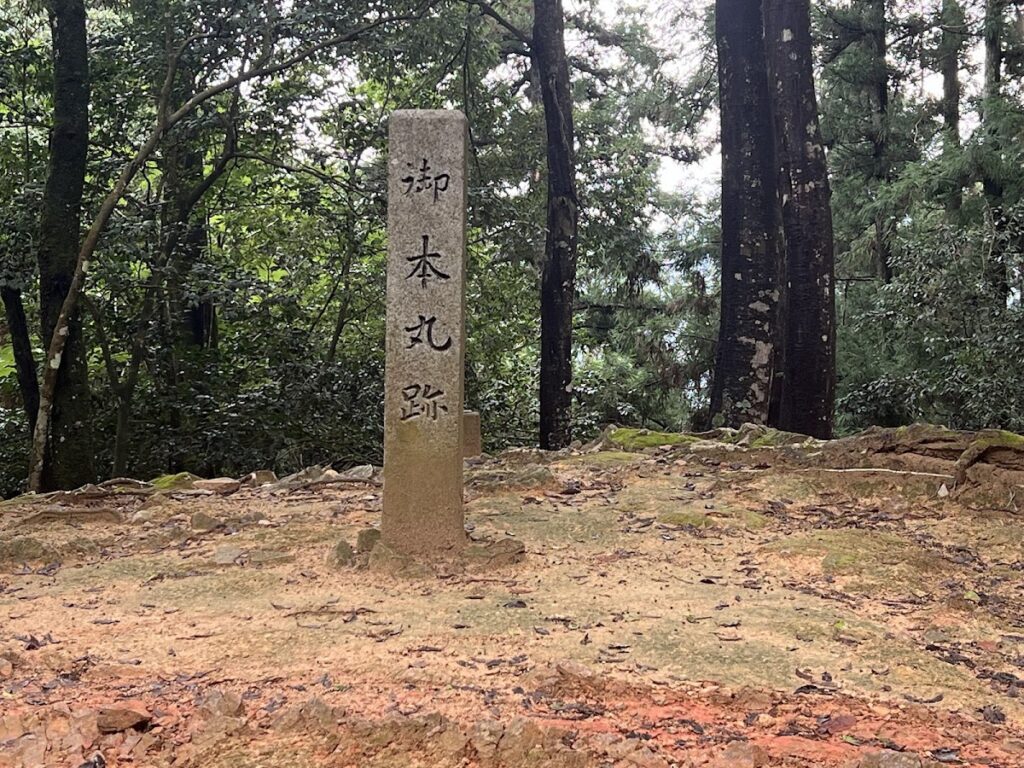
The main enclosure, located on the mountaintop at an altitude of approximately 400m, was the central part of the castle. Currently, it is a plaza, with remnants of stone walls remaining around it. From the main enclosure, one can enjoy a panoramic view of the Yoshida Basin, imagining Mori Motonari looking down on this land as he aimed for hegemony over the Chugoku region.
The main enclosure is relatively compact, due to the limited flat land available for a mountain castle. Even so, it was spacious enough to function as the lord’s residence.
Site of the Storehouse
Located slightly below the main keep, the site of the storehouse was an important facility for storing weapons and food. In a mountain castle designed for sieges, the stockpiling of supplies was vital, and this location played a crucial role in supporting the castle’s defenses.
A relatively large, flat area remains today, allowing us to imagine the scale of the former storehouses.
Stone Walls and Moats
The stone walls remaining throughout the castle are valuable relics demonstrating the castle-building techniques of the Sengoku period. The stone walls around the main keep, in particular, are well-preserved, providing insight into the level of technology at the time.
The moats are constructed to cut across the ridge, reaching several meters in depth. Attacking across these moats would not have been easy, demonstrating their effectiveness as defensive structures.
Burial Site of Mori Motonari
Near the castle ruins is the burial site of Mori Motonari. Motonari died in 1571 at the age of 75 and was buried in this place. His tomb is located in a quiet forest, and as the resting place of a renowned general who became the ruler of the Chugoku region, it attracts many history enthusiasts.
Historical and Folk Museum
At the foot of the castle ruins is the Aki-Takata City Historical and Folk Museum, which exhibits materials related to Yoshida-Koriyama Castle and the Mori clan. It features a reconstructed model of the castle, excavated artifacts, and panels explaining the history of the Mori clan. Visiting before or after visiting the castle ruins will deepen your understanding.
Local Information: Access and Visiting Points
Access Methods
Access by Car:
- Approximately 10 minutes from Takada IC on the Chugoku Expressway
- Approximately 15 minutes from Yoshida-Kakeai IC on the San’in Expressway
- Parking: Free parking available at the Aki-Takata City Historical and Folk Museum (approximately 50 spaces)
Access by Public Transportation:
- Approximately 20 minutes by bus from Mukaihara Station on the JR Geibi Line, get off at Aki-Takata City Hall, and walk approximately 5 minutes to the trailhead
- Approximately 1 hour by express bus from Hiroshima Bus Center
Climbing Routes and Estimated Time
There are mainly the following routes to climb Yoshida-Koriyama Castle:
1. Route from Aki-Takata City Historical and Folk Museum (Most Common)
- Estimated Time: Approximately 30-40 minutes one way (on foot)
- Difficulty: Intermediate (Requires physical fitness to climb mountain paths)
- The road is well-maintained, but there are steep slopes.
2. Route via Mori Motonari’s Mausoleum
- Time required: Approximately 40-50 minutes one way (on foot)
- Difficulty: Intermediate to Advanced
- This route goes to the main keep via Motonari’s mausoleum.
As it is a mountain castle, a certain level of physical fitness is required to climb it. Wearing athletic shoes or hiking boots and bringing drinking water is recommended. Insect repellent is also essential in summer.
Points to Note During Visits
- Time Required: Ideally, allow 3-4 hours, including a visit to the museum.
- Clothing: Comfortable clothing and non-slip shoes are essential.
- Season: Spring (cherry blossom season) and autumn (autumn foliage season) are especially recommended. Summer requires heat protection, and winter requires warm clothing.
- Toilets: Available near the museum and the trailhead. None inside the castle, so please use the restroom beforehand.
- Food: There are no food or drink facilities inside the castle. There are restaurants in Yoshida Town at the foot of the mountain.
Stamp and Guide
The stamp for the “100 Famous Castles of Japan” is located at the Aki-Takata City Historical and Folk Museum. Opening hours are 9:00 AM to 5:00 PM (last entry at 4:30 PM). Closed on Mondays (or the following day if Monday is a public holiday) and during the New Year holidays.
Volunteer guides are also available (advance reservation required). Visiting while listening to explanations from a knowledgeable guide will significantly deepen your understanding of the castle’s history and structure.
Historical Value of Yoshida-Koriyama Castle
The reason Yoshida-Koriyama Castle was selected as one of the “100 Famous Castles of Japan” and protected as a national historic site is its high historical and cultural value.
1. Historical Importance as the Base of the Mori Clan
Yoshida-Koriyama Castle was the political and military center of the Chugoku region from the Sengoku period to the Azuchi-Momoyama period. It was the residence of Mori Motonari, an outstanding Sengoku warlord, and it was from here that strategies for unifying the Chugoku region were formulated. This is an important historical site indispensable when discussing the history of the Mori clan.
2. Scale as one of the largest mountain castles in the Chugoku region
With over 270 enclosures, Yoshida-Kōriyama Castle is one of the largest mountain castles in the Chugoku region and a valuable historical site representing the pinnacle of mountain castle construction during the Sengoku period. Its magnificent scale demonstrates the construction techniques and labor mobilization capabilities of the time.
3. The site of the Battle of Yoshida-Kōriyama Castle
The Battle of Yoshida-Kōriyama Castle, where the 30,000-strong Amago army was repelled, is one of the most important battles of the Sengoku period. The castle ruins, the site of this battle, are a valuable historical site for understanding the military history of the Sengoku period.
4. Excellent state of preservation
Although more than 400 years have passed since the castle was abandoned, the layout of the enclosures, stone walls, and moats remain in relatively good condition. Recent archaeological excavations and restoration projects have revealed even more information.
Nearby Tourist Attractions
When visiting Yoshida-Koriyama Castle, exploring the surrounding related historical sites will allow you to gain a deeper understanding of the Mori clan’s history.
Tajihisarugake Castle Ruins: Designated as a national historical site, it is part of the Mori clan’s castle ruins, just like Yoshida-Koriyama Castle.
Kiyojinja Shrine: A shrine associated with the Mori clan, it is said that Mori Motonari also visited it.
Kaguramonzen Hot Spring Village: A tourist facility in Aki-Takata City where you can enjoy hot springs, local cuisine, and Kagura performances.
Hiroshima Castle: A castle built by Mori Terumoto after he moved from Yoshida-Koriyama Castle. Visiting both will allow you to truly experience the flow of the Mori clan’s history.
Summary
Yoshida-Koriyama Castle occupies an extremely important position in the history of Japanese castles, as the residence of Mori Motonari, a representative warlord of the Sengoku period, and as one of the largest mountain castles in the Chugoku region. With its magnificent scale featuring over 270 enclosures, its history as the stage for the Battle of Yoshida-Kōriyama Castle, and its well-preserved remains, Yoshida-Kōriyama Castle conveys the spirit of the Sengoku period to visitors.
Located in Yoshida-cho, Aki-Takata City, Hiroshima Prefecture, this castle ruin boasts a superb location overlooking the Yoshida Basin, nestled between the Kawai River and the Tajihi River. It is a valuable historical site where one can experience the stage from which Mōri Motonari once aimed to unify the Chūgoku region.
Climbing the castle requires physical stamina, but the view of the Yoshida Basin from the main keep, the remains such as stone walls and moats, and the atmosphere imbued with the weight of history will more than reward the effort. As one of Japan’s 100 Famous Castles and an important historical site that tells the history of the Mōri clan, Yoshida-Kōriyama Castle is a castle ruin that history buffs should visit at least once.
By gaining some background knowledge at the Aki-Takada City Historical and Folk Museum before climbing to the castle and touring the grounds while listening to explanations from volunteer guides, you can gain a deeper understanding of the realities of mountain castles during the Sengoku period and the great achievements of Mori Motonari. Immersing yourself in the romance of history amidst the changing seasons will surely be an unforgettable experience.
