Yonago Castle Complete Guide | A Thorough Explanation of the History, Highlights, and Access to San’in’s Most Famous Castle
What is Yonago Castle? – A Famous Castle in the Sky Representing San’in
Yonago Castle is a Japanese castle built on Minatoyama Mountain, approximately 90 meters above sea level, in the heart of Yonago City, Tottori Prefecture. Also known as “Kume Castle” and “Minatoyama Castle,” it was designated a National Historic Site in 2006.
Once, a five-story main keep and a four-story secondary keep (four-story turret) stood side-by-side on the mountaintop, creating a magnificent fortress praised as “San’in’s most famous castle.” While the main keep no longer remains, the impressive stone walls and the 360-degree panoramic view from the main keep site continue to captivate many visitors as a representative scenic spot of Yonago City.
Located overlooking Lake Nakaumi, it is also known as the “Castle in the Sky Overlooking the Sea,” and is a beloved landmark of Yonago, offering panoramic views of Yonago city, Mt. Daisen, Lake Nakaumi, the Sea of Japan, and the Shimane Peninsula.
History of Yonago Castle – From the Sengoku Period to the Edo Period
Origins and Early History of Yonago Castle
The origins of Yonago Castle date back to the Ōnin War period of the Muromachi era. It is believed that during this time, Yamana Muneyuki built a fort on Minatoyama. Initially a small mountain castle, it was gradually expanded throughout the Sengoku period.
During the Sengoku period, it was under the control of the Amago clan, but in the Eiroku era (1558-1570), it was attacked and captured by Kikkawa Motoharu of the Mōri clan. Afterward, it came under the control of the Mōri clan.
Full-Scale Construction by Kikkawa Hiroie
Yonago Castle was reborn as a full-fledged modern castle in 1591 (Tenshō 19). By order of Toyotomi Hideyoshi, Kikkawa Hiroie, who became the lord of Hoki Province with a 120,000 koku domain, began full-scale construction of Minatoyama and Iiyama as a subsidiary castle in western Hoki.
Kikkawa Hiroie was a Sengoku period warlord and grandson of Mori Motonari, who played an important role in the Battle of Sekigahara. He positioned Yonago Castle as an important base in the San’in region and laid the foundation for the castle, including constructing a four-story turret. The stone walls and layout built during this period form the basic structure of Yonago Castle as it is today.
Completion and Golden Age under Nakamura Kazutada
After the Battle of Sekigahara in 1600, Hiroie Kikkawa was transferred to Iwakuni in Suo Province, and Nakamura Kazutada, from Sunpu in Suruga Province, became the lord of Yonago Castle with a 175,000 koku domain in Hoki Province.
Between 1601 and 1602, Nakamura Kazutada constructed a new five-story keep, completing Yonago Castle. Its magnificent appearance, with two keeps—a five-story keep and a four-story turret—truly made it worthy of being called “the finest castle in the San’in region.” This unique structure with two keeps is a rare feature nationwide.
The Kato and Ikeda Eras and the Castle’s Abandonment
Nakamura Kazutada died young in 1609 without an heir, leading to the extinction of the Nakamura family. Subsequently, in 1617, Kato Sadayasu became the lord of Yonago Castle in Hoki Province, with a domain of 60,000 koku.
In 1632, Ikeda Mitsumasa entered Tottori Castle as the lord of Inaba and Hoki Provinces with a domain of 320,000 koku, and Yonago Castle became a branch castle of the Tottori Domain. At this time, a castle lord was appointed to Yonago Castle, and the Arao family as castle lords for generations served.
After the Meiji Restoration, in 1869 (Meiji 2), Yonago Castle was abandoned due to the abolition of the feudal domains and the establishment of prefectures. In 1875 (Meiji 8), most of the buildings, including the keep, were demolished. However, the magnificent stone walls still remain, preserving their original appearance and evoking the grandeur of the past.
Structure and Characteristics of Yonago Castle
Layout and arrangement of enclosures
Yonago Castle is a flatland castle built around the summit of Minatoyama Mountain, which is 90 meters above sea level. The main keep at the summit was surrounded by the second and third enclosures arranged in a stepped fashion, with enclosures such as Naizenmaru and Iiyamamaru spreading out at the foot of the mountain.
The main keep consisted of the keep enclosure, lookout enclosure, and guardhouse enclosure, and was a sturdy structure surrounded by high stone walls. Taking advantage of its location facing Lake Nakaumi, it also functioned as a key point for water transport.
Two Keeps – A Five-Story Keep and a Four-Story Turret
The most distinctive feature of Yonago Castle is the presence of two keeps within its main enclosure. The sight of a five-story keep and a four-story secondary keep (four-story turret) standing side-by-side was unique and rarely seen in other castles.
The five-story keep was built by Nakamura Kazutada and is believed to have had a five-story exterior and five floors inside. The four-story turret was constructed during the time of Kikkawa Hiroie and effectively functioned as a secondary keep. Contemporary drawings and records suggest that the landscape created by these two keeps was extremely magnificent.
Stone Wall Techniques and Highlights
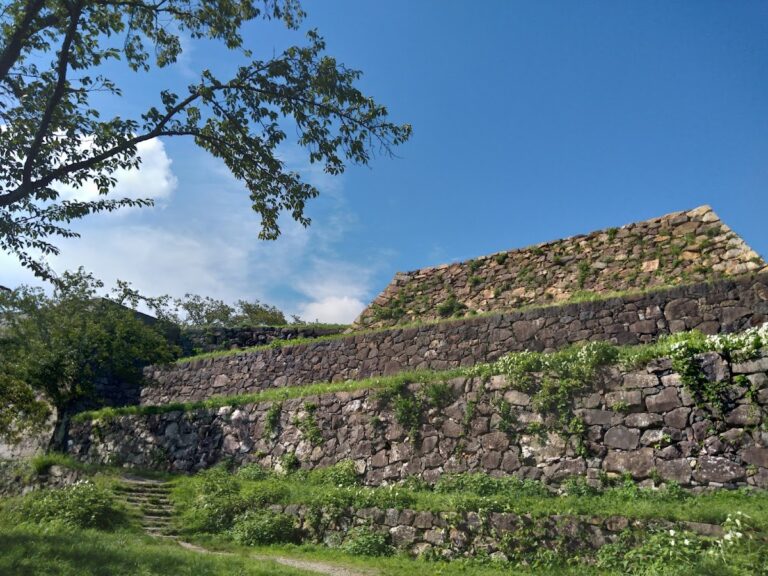
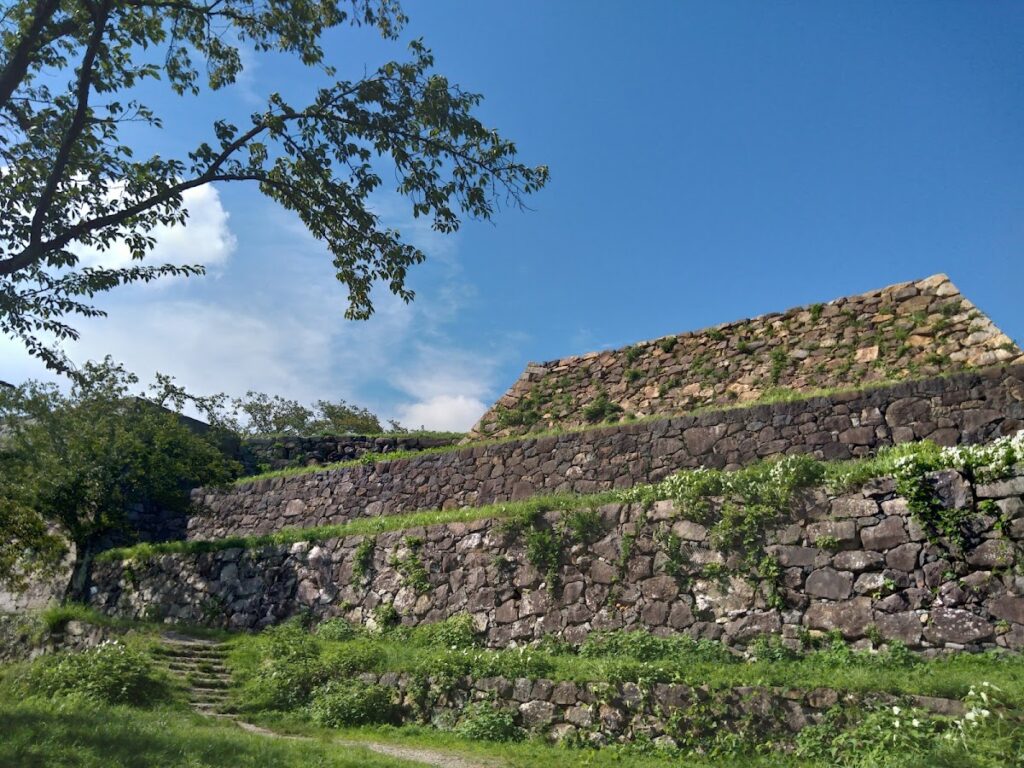
The stone walls of Yonago Castle are valuable relics that convey the castle-building techniques of the early modern period. The stone walls around the main enclosure exceed 10 meters in height in some sections and are constructed using techniques such as cut-stone and fitted stonework.
The stone wall on the north side of the main enclosure, in particular, exhibit a magnificent curve, demonstrating the high level of craftsmanship. The stonework primarily uses locally sourced andesite, with some granite also found. Archaeological excavations have revealed the evolution of the stone wall’s structure and construction methods, providing important information for understanding the techniques used during its construction.
Highlights of Yonago Castle – Experiencing History Firsthand
360-Degree Panoramic View from the Main Keep Ruins
The greatest highlight of Yonago Castle is undoubtedly the breathtaking view from the main keep ruins. From the 90-meter-high summit, a 360-degree panoramic view unfolds, offering a sweeping vista of Yonago city.
To the north lie Lake Nakaumi and the Shimane Peninsula; to the east, the majestic Mt. Daisen; to the west, the Sea of Japan; and to the south, the Yumigahama Peninsula—each surrounded by distinct scenery. The view is particularly magnificent on a clear day, truly demonstrating why it’s called the “Castle in the Sky.” The views at sunset and early morning are also exceptional, making it a popular spot for photography.
Magnificent Stone Walls
Although the keep is gone, the stone walls of Yonago Castle retain much of their original appearance. The towering stone walls surrounding the main enclosure are breathtaking, demonstrating the high level of castle construction technology of the early modern period.
Even while climbing the path to the castle, you can see various stone walls up close. Observing the details—the way the stones are stacked, the treatment of the corners, the drainage systems—will reveal the masterful castle-building techniques. The stone walls on the north side of the main enclosure are particularly well-preserved, almost completely retaining their original form.
Sites of the Lookout Tower and Guardhouse
Besides the keep enclosure, the main enclosure also contains the lookout tower and guardhouse enclosure. The lookout tower was a watchtower used to monitor the movement of ships in Lake Nakaumi and the Sea of Japan. The guardhouse was where samurai responsible for guarding the castle were stationed.
These enclosure sites offer magnificent views, allowing you to stroll around and imagine the functions of the castle in its time.
Naizenmaru and Ninomaru
Naizenmaru, located at the foot of the mountain, is believed to have been the site of the lord’s residence. Currently, it is a park and a well-known cherry blossom viewing spot. In spring, it is bustling with many visitors enjoying the blossoms.
Ninomaru, located south of the main keep, housed the residences of senior retainers. This area is also now a park and a place of relaxation for citizens.
New Facts Revealed by Archaeological Excavations
Continued archaeological excavations by the Yonago City Board of Education are revealing new aspects of Yonago Castle. Excavated artifacts such as building foundations, roof tiles, and ceramics are shedding light on the lifestyle and structure of the castle at the time.
The research findings are made public as they are released, further enhancing the historical value of Yonago Castle. Tours of the excavation sites are also held, providing valuable opportunities for history enthusiasts.
Access and Tourist Information for Yonago Castle
Basic Information
Location: Kume-cho, Yonago City, Tottori Prefecture
Designation: National Historic Site (Designated in 2006)
Admission Fee: Free
Opening Hours: 24 hours (However, nighttime visits are not recommended)
Parking: Available (Use the Minatoyama Park parking lot)
Access Methods
Access by Train:
- Approximately 15 minutes on foot from JR San’in Main Line “Yonago Station”
- Approximately 10 minutes on foot from JR Sakai Line “Goto Station”
Access by Car:
- Approximately 10 minutes from Yonago IC on the Yonago Expressway
- Approximately 15 minutes from Yonago Nishi IC on the San’in Expressway
- Minatoyama Park parking lot (free) is available
Access by Bus:
- Take the “Dandan Bus” inner loop from Yonago Station and get off at “Minatoyama Park” (immediately adjacent)
Points to Note When Visiting the Castle
The path to the main keep is well-maintained and takes approximately 15-20 minutes on foot. The path is relatively gentle, but comfortable walking shoes such as athletic shoes are recommended.
There are several paths to the castle, but for first-time visitors, the main route from Minatoyama Park is easy to follow and recommended. There are signposts along the way, so you won’t get lost.
Estimated Time Required for Visiting
The round trip to the main keep and sightseeing should take approximately 1 to 1.5 hours. If you want to carefully observe the stone walls and enjoy the scenery, allow about 2 hours.
Nearby Tourist Attractions
Yonago City San’in History Museum: Features materials and exhibits related to Yonago Castle; visiting before or after your visit will deepen your understanding.
Minatoyama Park: A park located at the foot of the ruin castles, known for its cherry blossoms.
Yonago City Museum of Art: Within walking distance of the ruined castles, offering a chance to experience local arts and culture.
Yonago City Center: You can stroll through the streets that retain the atmosphere of a castle town.
Seasons and Ways to Enjoy Yonago Castle
Spring – A Famous Castle of Cherry Blossoms
Yonago Castle in spring is known as a famous cherry blossom viewing spot. Approximately 500 Somei Yoshino cherry trees are planted in Minatoyama Park and Naizenmaru, reaching their peak bloom from late March to early April.
The contrast between the cherry blossoms and the stone walls is beautiful, attracting many visitors. The castle is also illuminated at night, creating a magical atmosphere. The carpet of cherry blossoms viewed from the main keep is a spectacular sight.
Summer – Castle Ruins Surrounded by Greenery
In summer, Yonago Castle is enveloped in deep green. The trees’ greenery becomes denser, creating a vivid contrast with the stone walls. Visiting early in the morning may allow you to encounter the fantastic combination of the morning mist rising from Lake Nakaumi and the castle ruins.
Although it’s a hot time of year, there are plenty of shady spots, making for a relatively cool stroll. However, heatstroke prevention is essential.
Autumn – Autumn Leaves and Crisp Air
In autumn, Yonago Castle is beautifully adorned with autumn leaves, coloring the stone walls. The best time to see them is from early to mid-November. Also, the air is clear in autumn, making it the most beautiful season for views from the main keep.
Enjoy seasonal scenery such as the contrast between the first snowfall on Mt. Daisen and the autumn leaves, and the sunset reflected in Lake Nakaumi.
Winter – A Fantastical Snow-Covered Appearance
In winter, Yonago Castle is covered in snow, presenting a scene reminiscent of an ink painting. Caution is needed on snowy days as the ground can be slippery, but the combination of snow and stone walls is exceptionally beautiful.
On clear winter days, the air is incredibly clear, allowing for panoramic views. The rough waves of the winter Sea of Japan and the snow-capped Mt. Daisen are breathtaking.
The Cultural Value of Yonago Castle
Significance of National Historic Site Designation
Yonago Castle ruins were designated a National Historic Site in 2006. This was due to the high historical and academic value of the castle, as the first full-fledged early modern castle built in the San’in region, and as a castle with a unique structure featuring two keeps.
The designation as a National Historic Site legally protects the preservation and utilization of the castle ruins, making it possible to protect this valuable cultural property for future generations.
Efforts for Preservation and Development
Yonago City is continuously working on development projects to preserve and utilize the National Historic Site of Yonago Castle ruins. Efforts are being made to create an environment where visitors can safely and comfortably view the site, including the restoration of stone walls, improvement of the approaching paths, and the installation of information boards.
At the same time, archaeological excavations are being continuously conducted, leading to the discovery of new remains and clarification of the castle’s structure. These findings are being made public through exhibitions and lectures, providing opportunities to deepen understanding of local history.
The Role of Yonago Castle in the Region
Yonago Castle is not merely a historical site; it plays a vital role in modern Yonago City. As a symbol of the city and a tourist resource, it forms the core of the region’s identity.
For citizens, it is a familiar place of relaxation, and for children, it is a place for learning history. Through Yonago Castle, opportunities are provided to learn about local history and culture, fostering a love for one’s hometown.
Resources and Guides for Deeper Understanding of Yonago Castle
Guided Tours and Events
The Yonago City Tourism Association and local volunteer guide groups regularly conduct guided tours. With expert guides, you can learn in detail about the history and highlights of Yonago Castle.
Special events are held in spring and autumn, offering programs that allow you to experience the history of Yonago Castle, such as samurai processes and historical lectures.
Museums and Exhibition Facilities
Yonago City San’in History Museum: Exhibits detailed materials and models related to Yonago Castle. You can also view CG videos recreating the castle’s appearance at the time of its construction, making it ideal for pre-visit preparation and post-visit review.
Yonago City Buried Cultural Properties Center: Artifacts unearthed during archaeological excavations are stored and displayed here.
Official Website and Information Dissemination
The official Yonago Castle website (yonagocastle.com) provides the latest information, event announcements, and detailed guide maps. Checking this before your visit will allow for a more fulfilling experience.
The Yonago City Hall website also provides regularly updated historical information and maintenance status regarding Yonago Castle.
Historical Walks Around Yonago Castle
Visiting the Remnants of the Castle Town
Around Yonago Castle, the townscape retains traces of its former castle town. Many temples are clustered along Teramachi Street, and the sites of samurai residences are scattered throughout.
Along the former Kamo River, there is an area that once flourished as a merchant town, and old townhouses can still be seen. Strolling through the castle town allows you to imagine what Yonago was like during the Edo period.
Related Historical Sites
Goto Family Residence: A residence of a wealthy merchant from the Edo period, designated as an Important Cultural Property.
Temples and Shrines in Yonago City: Temples and shrines deeply connected to Yonago Castle are scattered throughout the area, each with its own historical story.
Food and Souvenirs
After visiting Yonago Castle, enjoying local cuisine is highly recommended. You can savor the unique flavors of the San’in region, such as fresh seafood from the Sea of Japan and dishes made with the bounty of Mt. Daisen.
Popular souvenirs include goods featuring Yonago Castle and local specialty sweets. Many souvenir shops can be found around Yonago Station and in the city center.
Summary – Experience the Charm of Yonago Castle
Yonago Castle is a national historical site boasting a history as one of the finest castles in the San’in region, magnificent stone walls that still remains today, and breathtaking views from the main keep. Yonago Castle possesses high historical and academic value due to its unique structure with two keeps—a five-story keep and a four-story turret—its location facing Lake Nakaumi, and its early modern castle construction techniques.
Although the keep is gone, the stone walls and layout of the baileys allow us to imagine its former glory, and the 360-degree panoramic view offers a new kind of appeal for modern visitors. You can also enjoy the changing seasons: cherry blossoms in spring, lush greenery in summer, vibrant autumn leaves, and snowy winter landscapes.
Located in the heart of Yonago City, Yonago Castle is easily accessible. It’s a spot that everyone can enjoy, from history buffs to those seeking breathtaking views and those who simply want to stroll around. When you visit the San’in region, be sure to visit Yonago Castle and experience its charm.
The history etched into the stone walls of Yonago Castle and the magnificent view from the main keep will surely leave a deep impression on visitors.