Yodoe Castle (Yonago City, Tottori Prefecture) Complete Guide: History, Highlights, and Access Explained in Detail
Located in Yodoe-cho, Yonago City, Tottori Prefecture, Yodoe Castle is a historical castle site that served as an important military base in the San’in region during the Sengoku period, and was the stage for conflicts between powerful daimyo such as the Yamana, Amago, and Mori clans. Currently, traces of the castle remain near JR Yodoe Station, making it a valuable historical site that conveys the history of the region.
This article will introduce the charm of this castle site in its entirety, from its detailed history, structure, highlights, to useful access information for your visit.
What is Yodoe Castle?: Basic Information and Overview
Basic Castle Data
Yodoe Castle (Yodoe-jo) was a flatland castle located in Yodoe-cho, Yonago City, Tottori Prefecture. It was also known by various other names such as “Yodoi Castle,” “Yodoi Castle,” “Yodo Fortress,” and “Yodoe Fortress,” and was affectionately called by different names depending on the region.
The current castle ruins are located near Yodoe Station on the JR San’in Main Line, and it is believed that the former castle grounds extended to the area around the station. Although not registered as a designated cultural property, it is recognized as an important historical site that tells the story of the region.
Geographical Location and Strategic Importance
Yodoe-cho, Yonago City, Tottori Prefecture, where Yodoe Castle was built, is located at the foot of Mt. Daisen and was a crucial transportation hub connecting the San’in and Sanyo regions. This geographical condition was the main reason why Yodoe Castle became an important military base during the Sengoku period.
Controlling a key point on east-west transportation in Hoki Province (present-day central-western Tottori Prefecture) was essential for controlling the region. Therefore, under the control of the Yamana clan, Yodoe Castle, along with the nearby Inayoshi Castle and Sueyoshi Castle, functioned as an important fortress for regional defense.
History of Yodoe Castle: A Stage in the Turmoil of the Sengoku Period
The Yamana Clan Era: From Construction to Prosperity
While the exact construction date of Yodoe Castle is unclear, it is believed to have been built by the Yamana clan, who were the shugo (military governor) of Hoki Province, sometime between the Muromachi period and the early Sengoku period. The Yamana clan, as a powerful shugo daimyo (feudal lord) of the Muromachi Shogunate, boasted such power at its peak that they were known as “Rokubun-ichi-dono” (Lord of Six-tenths).
Yodoe Castle served as one of the important fortresses within the Yamana clan’s system of rule, acting as a base for regional control. Records show that Yamana Moriyuki resided there as the castle lord, suggesting its important role in the Yamana clan’s rule of Hoki Province.
The May Collapse of Daiei: The Amago Clan’s Invasion and the Fall of Yodoe Castle
The greatest turning point in the history of Yodoe Castle was the “May Collapse of Daiei,” which occurred in 1524 (Daiei 4). This was a large-scale invasion of Hoki Province by Amago Tsunehisa, a Sengoku daimyo of Izumo Province.
The Amago clan was rapidly expanding its power and was planning to advance into Hoki Province in order to seize hegemony in the San’in region. In May of Daiei 4, the Amago army, led by Amago Tsunehisa, invaded Hoki Province and successively captured castles belonging to the Yamana clan.
Yodoe Castle was no exception; the castle, defended by Yamana Moriyuki, fell under the fierce attack of the Amago army. This “May Collapse of Daiei” led to the collapse of the Yamana clan’s control over Hoki Province, and Hoki Province was incorporated into the Amago clan’s sphere of influence.
From the Amago Clan to the Mori Clan: A Change of Rulers
After its fall, Yodoe Castle came under the control of the Amago clan and functioned as one of the Amago clan’s bases in Hoki Province, which was based in Izumo Province. However, in the mid-16th century, the Mori clan, based in Aki Province (present-day western Hiroshima Prefecture), rapidly rose to power.
Mori Motonari fiercely clashed with the Amago clan over hegemony in the Chugoku region, and during the Eiroku era (1558-1570), he began his invasion of Izumo Province, the Amago clan’s stronghold. In this process, Hoki Province also came under the Mori clan’s influence, and Yodoe Castle came under their control.
As a Base for the Amago Restoration Movement
In 1569 (Eiroku 12), Yamanaka Yukimori (Yamanaka Shikanosuke) and other former retainers of the Amago clan raised an army aiming to restore the fallen Amago clan. Yodoe Castle played a crucial role in this Amago restoration movement.
Yamanaka Yukimori and others, in order to oppose the Mori clan, used Yodoe Castle, along with Inayoshi Castle and Sueyoshi Castle in Hoki Province, as one of their bases to wage war for the restoration of the Amago clan. During this period, Yodoe Castle was once again embroiled in conflict.
The Amago restoration movement achieved temporary success, but ultimately, it was defeated by the overwhelming military power of the Mori clan. Yamanaka Yukimori was also killed by a Mori general in 1578, and the dream of restoring the Amago clan was shattered.
After the Tensho Period: The Castle’s Demise
Entering the Tensho period (1573-1593), the situation in the Chugoku region changed even more dramatically. Oda Nobunaga’s influence extended to the Chugoku region, and the Mori clan found themselves in conflict with Hashiba Hideyoshi (later Toyotomi Hideyoshi), who was on Oda’s side.
Detailed records of Yodoe Castle become scarce after this period. With the end of the Sengoku period, many small and medium-sized castles were abandoned, and it is believed that Yodoe Castle also ceased to serve its purpose.
During the Edo period, this region came under the control of the Tottori Domain, and Yodoe developed not as a castle town, but as a post town and rural town.
Structure and Layout of Yodoe Castle
Characteristics as a Flatland Castle
Yodoe Castle is classified as a flatland castle. A flatland castle is a castle built on flat land, and compared to mountain castles and hill castles, it has the following characteristics:
Because it is located on flat land, it was possible to construct a large-scale castle, and it was also suitable for the development of a castle town. On the other hand, because it lacked natural defensive capabilities, it was necessary to enhance artificial defensive facilities such as moats and earthworks.
In the case of Yodoe Castle, it is thought that its defensive capabilities were enhanced by utilizing the surrounding terrain while also employing moats and earthworks. Currently, urbanization has progressed, and many of the original remains have been lost. However, the remaining topographical features allow us to imagine the former appearance of the castle.
Castle Grounds and Main Facilities
The area around JR Yodoe Station is thought to be the central part of the castle site, and it is estimated that the area around the station was the former castle grounds. It is thought to have been a medium-sized castle for a flatland castle of the Sengoku period, and it is presumed that multiple enclosures (kuruma) were arranged around the main enclosure (honmaru).
Within the castle, there would have been facilities such as the lord’s residence, soldier garrisons, armory, and food storage. It is also thought that a certain amount of space was provided for surrounding residents to take refuge within the castle in times of emergency.
Defensive Structures: Moats and Earthworks
The defenses of Yodoe Castle, a flatland castle, consisted mainly of moats and earthworks. The moats were likely water moats, and it is thought that water was drawn from surrounding rivers and irrigation canals.
The earthen ramparts were built inside the moat, serving to prevent enemy intrusion and also to obscure the castle’s interior from outside view. Fences and walls were likely built on top of the ramparts, further enhancing its defensive capabilities.
Currently, most of these defensive structures have been lost, but attempts to reconstruct the castle’s former appearance continue based on the testimonies of local elders and the analysis of old maps.
Highlights and Current Status of Yodoe Castle
Current Status of the Castle Ruins
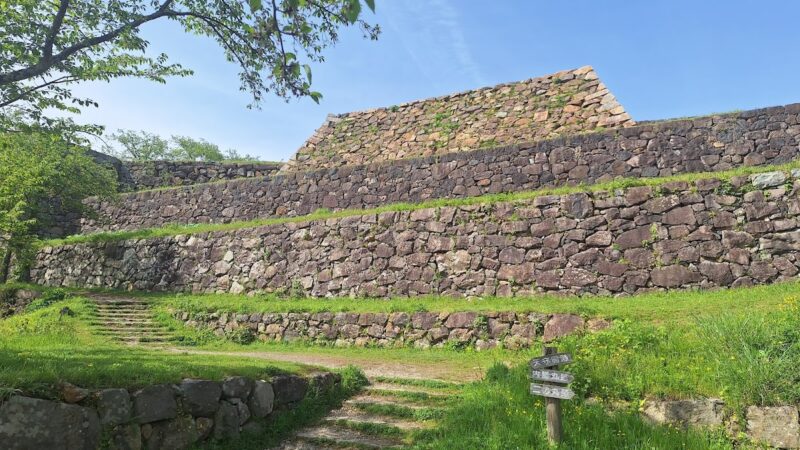
The Yodoe Castle ruins are now an urban area centered around JR Yodoe Station, and unfortunately, very few visible remains remain. Due to development around the station and residential areas, traces of the former castle have almost completely disappeared from the surface.
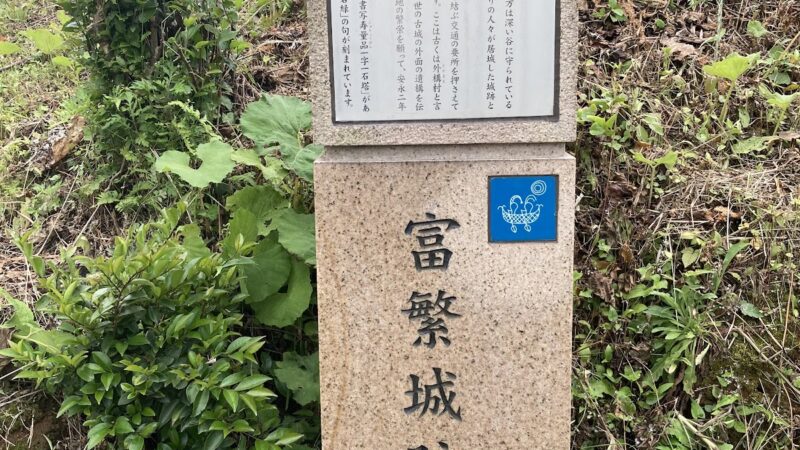
However, among those interested in local history, the historical value of Yodoe Castle is recognized, and efforts are being made to install information boards and conduct research on local history.
Historical Atmosphere Around the Castle Ruins
Walking around JR Yodoe Station, you can encounter remnants of the old townscape and place names that evoke a sense of history. It’s enjoyable to stroll through this area while imagining the atmosphere of the former castle town.
A tourist information sign is installed in front of Yodoe Station, where you can read a brief explanation of the history of Yodoe Castle. Local historians and history enthusiasts also occasionally hold guided tours.
Points to Note When Visiting
When visiting the Yodoe Castle ruins, keeping the following points in mind will allow you to experience history more deeply.
Importance of Prior Study: Since very few remains are left, it is recommended to study the history and structure of Yodoe Castle beforehand. Referencing information sources like this article, as well as local historical materials, is recommended.
Observation of the Surrounding Topography: By carefully observing the topography around the station, you may be able to find traces of the former castle in subtle undulations and road curves.
Interacting with Locals: By interacting with people knowledgeable about local history, you may be able to hear oral histories not found in written documents, as well as local legends.
Tourist Attractions Around Yodoe Castle
When visiting the Yodoe Castle ruins, exploring the surrounding tourist attractions will make your trip even more fulfilling. The area around Yodoe-cho in Yonago City boasts numerous historically and culturally valuable tourist spots.
Tsumaki-Banda Ruins
A representative tourist spot in Yodoe-cho is the Tsumaki-Banda Ruins, a nationally designated historical site. It is a large-scale Yayoi period settlement site, one of the largest in western Japan.
You can visit reconstructed pit dwellings and raised-floor warehouses, experiencing the lives of ancient people. It is a valuable historical site that allows you to realize that this area was a place of human habitation long before Yodoe Castle was built.
Kamiyodo Temple Ruins
The Kamiyodo Temple Ruins, dating from the Asuka to Nara periods, are an important historical site in Yodoe Town. Excavated Buddhist statues and roof tiles offer insights into the Buddhist culture of the time.
This is an important archaeological site demonstrating the cultural development of this region even before the medieval period when Yodoe Castle was built, allowing visitors to feel the continuity of the region’s history.
Mukoyama Tumulus Cluster
The Mukoyama Tumulus Cluster, a site from the Kofun period, is also an indispensable historical site when discussing the history of Yodoe Town. The concentration of multiple tumuli indicates that this area was a residential area for powerful figures from ancient times.
Kotobuki Castle Confectionery
A must-visit during your historical sightseeing is Kotobuki Castle Confectionery, with its exterior modeled after Yonago Castle. You can purchase famous sweets and local products from Tottori Prefecture, and it also has a Sunaba Coffee shop, making it an ideal rest stop.
The building recreating the keep of Yonago Castle differs from that of Yodoe Castle, but it still offers a glimpse into the atmosphere of castle architecture.
Yonago Castle Ruins
If you visit Yonago City, be sure to also visit the Yonago Castle Ruins. While different in scale and character from Yodoe Castle, it’s an important castle ruin located within Yonago City. Comparing them allows you to understand the evolution of castle architecture from the Sengoku period to the Edo period.
Yonago Castle, as a castle from the early modern period, boasts well-preserved remains such as stone walls, and from the keep’s base, you can enjoy spectacular views of Yonago city, the Sea of Japan, and Mount Daisen.
Kaike Onsen
If you want to relax and unwind after sightseeing, we recommend Kaike Onsen, a representative hot spring resort in Yonago City. This hot spring resort facing the Sea of Japan offers fresh seafood and hot springs.
It’s about a 20-minute drive from the Yodoe Castle Ruins, making it easy to combine historical sightseeing with a hot spring trip.
Access Information: How to Get to Yodoe Castle
Access by Public Transportation
Using the JR San’in Main Line
Access to Yodoe Castle Ruins is very convenient. JR San’in Main Line’s “Yodoe Station” is located very close to the castle ruins, with the area in front of the station being the center of the castle grounds.
- From JR Yonago Station to Yodoe Station: Approximately 10 minutes by local train
- From JR Matsue Station to Yodoe Station: Approximately 40 minutes by local train
- From JR Tottori Station to Yodoe Station: Approximately 1 hour 30 minutes by express train
Yodoe Station is an unmanned station, but the station building is well-maintained, and facilities such as toilets are available.
Access by Car
Using the San’in Expressway
If you are visiting by car, the San’in Expressway is convenient.
- From Yonago IC: Approximately 15 minutes via National Route 9
- From Yodoe IC: Approximately 5 minutes (nearest interchange)
Parking Information
There is a public parking lot in front of JR Yodoe Station, but the number of spaces is limited. Please consider using nearby coin-operated parking lots. If you need to park for a long period, we recommend checking the location of the parking lot in advance.
Access from Yonago Airport
From Yonago Kitaro Airport
From Yonago Airport (Yonago Kitaro Airport), the gateway to western Tottori Prefecture, you can access the destination using the following methods:
- Take the airport shuttle bus to JR Yonago Station (approx. 25 minutes), then take the JR San’in Main Line to Yodoe Station (approx. 10 minutes).
- Take a taxi directly to Yodoe Station (approx. 20 minutes, fare approximately 3,000 yen).
- Rent a car (approx. 15 minutes).
Information on Tourist Information Centers
Yonago City International Tourist Information Center
For detailed information on Yodoe Castle and surrounding tourist attractions, please visit the “Yonago City International Tourist Information Center” located on the 1st floor of JR Yonago Station.
- Address: 2 Yayoi-cho, Yonago City, Tottori Prefecture 683-0036, 1st floor of JR Yonago Station
- Business Hours: 9:00 AM – 5:30 PM
- Closed: December 31st, January 1st
- Phone Number: 0859-22-6317
In addition to Japanese, information is also available in English, and brochures and maps are available.
Points to Note and Advice When Visiting Yodoe Castle
Best Time to Visit
Yodoe Castle Ruins are an outdoor historical site and are generally accessible year-round. However, please consider the following points:
Spring (March-May): The weather is mild and pleasant, making it an ideal season for sightseeing. The surrounding scenery is beautiful during cherry blossom season, making for enjoyable walks.
Summer (June-August): Rain gear is necessary during the rainy season. The sun is strong in mid-summer, so sun protection such as a hat and sunscreen is necessary.
Autumn (September-November): The weather is stable and suitable for sightseeing. The surrounding nature is beautifully colored during the autumn foliage season.
Winter (December-February): The San’in region experiences snowfall in winter, and the weather can be unstable. Please take thorough precautions against the cold.
Estimated Time Required
Visiting the Yodoe Castle ruins themselves only requires about 30 minutes to an hour, as very few remains are left. However, if you plan to visit other nearby tourist spots as well, we recommend allocating half a day to a full day.
Clothing and Items to Bring
- Comfortable Walking Shoes: You will be exploring the area around the station, so we recommend wearing comfortable walking shoes, as you will be doing some walking for your historical exploration.
- Camera: Bring a camera or smartphone for taking commemorative photos and recording your experience.
- Notebook and Writing Utensils: These are useful for taking notes on historical information.
- Rain Gear: In the San’in region, where the weather can change quickly, it’s a good idea to bring rain gear such as a folding umbrella.
Books and Reference Materials on Yodoe Castle
For those who wish to learn more about Yodoe Castle, we introduce some recommended books and materials.
Recommended Books
“Castles of Tottori Prefecture” (Tottori Prefectural Board of Education)
A comprehensive collection of materials introducing castles in Tottori Prefecture, including detailed descriptions of Yodoe Castle.
“The Sengoku Period History of Hoki Province” (Regional Local History Research Association)
A book that provides a detailed explanation of the Sengoku period in Hoki Province, allowing for a deeper understanding of the battles and political situations involving Yodoe Castle.
“Castles of San’in” Series
A series introducing castles in the San’in region, explaining local castles, including Yodoe Castle, with photographs and diagrams.
Online Resources
National Diet Library Digital Collection
A digital archive of old maps and documents, where historical materials related to Yodoe Castle may be available for viewing.
Yonago City Library
Has a rich collection of local history materials, allowing access to literature and materials related to Yodoe Castle.
Surrounding Castles Related to Yodoe Castle
Understanding the surrounding castles will lead to a deeper understanding of Yodoe Castle’s history.
Inayoshi Castle
Like Yodoe Castle, this castle served as a base for the Amago restoration movement. It was an important base used by Yamanaka Yukimori and others along with Yodoe Castle, and understanding the relationship between the two castles reveals the military strategy of the time.
Sueyoshi Castle
This castle also played an important role in the Amago restoration movement, functioning as one of the “Three Castles” along with Yodoe Castle and Inayoshi Castle. It appears that these castles cooperated to form a defensive network.
Yonago Castle
A representative castle of Yonago City, it developed as the residence of a daimyo (feudal lord) in the early modern period. While Yodoe Castle was a small to medium-sized flatland castle from the Sengoku period, Yonago Castle was a large-scale castle developed as an early modern castle. Comparing the two castles allows us to understand the changes in castle architecture over time.
Kusaka Castle, Nanao Castle, and Kannonji Castle
Several other castle ruins exist within Yonago City. Visiting these castles, along with others, allows you to truly appreciate how important a military stronghold this region was during the Sengoku period (Warring States period).
Summary: The Historical Value and Modern Significance of Yodoe Castle
Although very few visible remains of Yodoe Castle remain, it is a castle ruin of high historical value as a stage for important historical events in the San’in region during the Sengoku period.
From the rule of the Yamana clan, through the Amago clan’s invasion following the “May Collapse of Daiei,” to the subsequent rule by the Mori clan, and its role as a base for the Amago restoration movement, this castle encapsulates the history of the San’in region during the Sengoku period.
In modern times, the historical value of Yodoe Castle is being re-recognized as a resource for local history education and tourism, and as a subject of local history research. Because there are few remaining structures, there is the enjoyment of learning history by using one’s imagination, making it a place where each visitor can feel their own historical romance.
When visiting Yodoe-cho in Yonago City, Tottori Prefecture, be sure to stop by the Yodoe Castle ruins and reflect on the history of the Sengoku period that unfolded in this area. Conveniently located in front of JR Yodoe Station, Yodoe Castle, steeped in history, is a historical site well worth visiting for history enthusiasts.
By visiting nearby ancient ruins such as the Tsumaki-Banda Ruins and the Kami-Yodo Temple Ruins, you can experience the flow of regional history from ancient times through the medieval and early modern periods. Be sure to plan a visit to the Yodoe Castle ruins as part of your trip to enjoy the rich history and culture of Yonago City.