Hachimanyama Castle Complete Guide | The History of the Fortress and Castle Town Built by Toyotomi Hidetsugu in Omi Province
What is Hachimanyama Castle?
Hachimanyama Castle is a mountain castle built at the end of the Sengoku period on the summit of Mt. Hachimanyama, located in Omihachiman City, Shiga Prefecture, at an elevation of 271.9 meters (some sources say 283 meters). It was built in 1585 by Toyotomi Hidetsugu, nephew of Toyotomi Hideyoshi, as the residence of his 430,000-koku domain in Omi Province.
Constructed just three years after the fall of Azuchi Castle, this castle played a crucial role as a new central base for Omi Province and as a defensive line against the eastern provinces. Currently, remnants such as stone walls remain, and the Murakumo Gosho Zuiryuji Temple Gate stands on the site of the main keep.
Hachimanyama, also known as “Kakuyokuzan” (Crane Wing Mountain), stands as an isolated hill towering over the Omi Basin, once boasting the imposing presence of a fortress surrounded by an inland lake of Lake Biwa.
History and Development of Hachimanyama Castle
Background of Construction and Toyotomi Hideyoshi’s Strategy
On June 2, 1582 (Tensho 10), Oda Nobunaga committed suicide in the Honnoji Incident. Azuchi Castle fell just six years after its construction, and its main keep was destroyed. This event meant the loss of the political center of Omi Province.
Three years after the Honnoji Incident, in 1585 (Tensho 13), Hashiba Hideyoshi (later Toyotomi Hideyoshi) subdued Oda Nobuo and gained control of Omi. Hideyoshi granted Omi to his nephew, Hanezaki Hidetsugu, whom he expected to be his successor, and had him build a new castle on Hachimanyama, located within easy reach of Azuchi. The castle’s construction took place the year after the Battle of Komaki and Nagakute, and before the peace treaty with Tokugawa Ieyasu. Therefore, this castle strongly embodied the role of a defensive line against the eastern provinces. Its strategic importance is further evident from the fact that Hideyoshi himself oversaw its construction.
The Reign of Toyotomi Hidetsugu
In 1586 (Tensho 14), Toyotomi Hidetsugu entered Hachimanyama Castle and began governing Omi Province. Hidetsugu relocated the people from Azuchi Castle town and began construction of a new castle town. During this period, Hachimanyama Castle flourished as the political, economic, and cultural center of Omi Province.
To develop the castle town, Hidetsugu introduced the Rakuichi-rakuza system (free market system) to promote commerce and industry. He also improved the Hachimanbori Canal, connecting Lake Biwa and the castle town, strengthening its function as a key point for water transport. This policy laid the foundation for Omihachiman to become a commercial city that would continue to thrive for generations, establishing it as the birthplace of Omi merchants.
The Hidetsugu Incident and the Castle’s Abandonment
In July 1595 (Bunroku 4), Toyotomi Hidetsugu was ordered by Hideyoshi to commit seppuku (ritual suicide) at Mount Koya. This is known as the “Hidetsugu Incident.” It is believed that the birth of Hideyoshi’s biological son, Hideyori, shook Hidetsugu’s position as successor.
After Hidetsugu’s death, Hachimanyama Castle closed its doors after a short history of only 10 years and was abandoned. Many of the castle’s structures were relocated to Kyoto and other regions, and today, only the stone walls and remnants of the baileys remain, preserving a glimpse of its former glory.
Structure and Layout of Hachimanyama Castle
Characteristics as a Mountain Castle
Hachimanyama Castle is a steep mountain castle built on the southern half of a solitary hill, commonly known as Hachimanyama (elevation 283 meters, relative height 100 meters), located approximately 2.5 kilometers northwest of Omihachiman Station.
At the time of its construction, there were inland lakes to the east and west of Hachimanyama, and the castle town was situated on the southern plain, a layout similar to that of Azuchi Castle. This topographical feature gave Hachimanyama Castle excellent accessibility by both water and land routes.
Arrangement and Structure of Enclosures
The layout of Hachimanyama Castle features a main enclosure (honmaru) at the highest point, surrounded by multiple enclosures (kuruma).
Main Enclosure Layout:
- Honmaru: The main enclosure located at the highest point of the mountaintop
- Ninokuruwa: Located southeast of Honmaru
- Nishi-no-maru: Located west of Honmaru
- Kita-no-maru: Located north of Honmaru
- Demaru: Located on the southwestern ridge, at a lower level
Small enclosures are arranged along the ridge that spreads out in a figure-eight shape from the mountaintop. On the middle of the southern slope, sandwiched between the ridges, remains a series of enclosures believed to be the site of Hideyoshi’s residence and the residences of his retainers, arranged in a stepped pattern. This stepped arrangement of enclosures demonstrates skillful fortification techniques that maximized the use of the limited mountainous area.
Hideyoshi’s Residence and Retainer Residence Sites
On the southern slope of Hachimanyama, in the valley between the two ridges extending south from the mountaintop, there is a straight passage believed to be the main approach. On both sides of the castle, rectangular enclosures are arranged in a stepped pattern, and at the back of the valley, a large enclosure believed to be the residence of the castle lord, Hashiba Hidetsugu, was constructed.
This Hidetsugu residence site, while a mountain castle, was designed with an emphasis on habitability, exhibiting characteristics of a transitional period towards early modern castles under the Toyotomi regime. These remains, including the sites of the retainers’ residences, are valuable historical sites that tell the story of the hierarchical structure of samurai society at the time.
Characteristics of the Stone Walls
Hachimanyama Castle retains well-preserved stone walls from the time of Toyotomi Hideyoshi. While primarily constructed using the nozura-zumi (rough-stone masonry) method, some sections also show the san-gi-zumi (stacked stone masonry) technique, making them important remains that demonstrate the developmental stage of stone wall technology during the Azuchi-Momoyama period.
The stone walls around the main enclosure are particularly large in scale, with some sections reaching several meters in height. The stone materials mainly consisted of locally quarried granite, and a robust defensive structure was constructed using the nozura-zumi technique, where natural stones were stacked as they were.
Discovery of Gold-Leaf Tiles
Gold-leaf tiles have been unearthed from the Hachimanyama Castle ruins, making them valuable artifacts symbolizing the authority of the Toyotomi regime. Gold-leaf tiles were used in major castles associated with Toyotomi Hideyoshi, such as Azuchi Castle and Osaka Castle, indicating that Hachimanyama Castle was not merely a regional base, but an important castle close to the center of power.
These tiles are thought to have adorned the roofs of the keep and main buildings, allowing us to imagine the magnificent appearance of the castle at that time.
Hachiman Canal and Castle Town
The Role of Hachiman Canal
Hachiman Canal is a canal developed by Toyotomi Hidetsugu at the same time as the construction of Hachimanyama Castle. Connecting Lake Biwa and the castle town, this canal functioned as a major artery for the transport of goods, greatly contributing to the commercial development of Omihachiman.
The Hachiman Canal, stretching approximately 6 kilometers, enabled trade with Kyoto and Osaka using Lake Biwa’s water transport, forming the foundation for Omihachiman’s development into a major commercial city. Along the moat, warehouses and merchant houses line the street, conveying the prosperity of yesteryear.
Currently, Hachimanbori is designated as a National Important Preservation District for Groups of Traditional Buildings and is a popular filming location for historical dramas. The scenery, with its stone walls and white-walled warehouses reflected in the water, is a valuable cultural heritage that strongly retains the atmosphere of the Edo period.
Development of the Castle Town
Toyotomi Hidetsugu actively relocated residents from Azuchi Castle town to the castle town of Hachimanyama Castle. He introduced the Rakuichi-Rakuza system, abolishing restrictions imposed by checkpoints and guilds (associations of merchants and artisans), thereby promoting free commercial activity.
This policy allowed Omihachiman to rapidly develop into a vibrant commercial city. In particular, merchants known as Omi merchants, guided by the principle of “Sanpo-yoshi” (good for the seller, good for the buyer, and good for society), played a significant role throughout Japan, contributing greatly to the development of Japanese commerce.
The castle town was laid out in a neat grid pattern, with samurai residences, merchant districts, and temple grounds systematically arranged. This urban plan was maintained even after Hideyoshi’s death and forms the basis of the present-day Omihachiman city center.
Current Site of Hachimanyama Castle
Murakumo Gosho Zuiryuji Temple
Currently, Murakumo Gosho Zuiryuji Temple stands on the site of the former main keep of Hachimanyama Castle. This temple was founded to commemorate Toyotomi Hideyoshi and was originally located in Murakumo, Kyoto (present-day Ukyo-ku, Kyoto City), but was relocated to the summit of Hachimanyama in 1961.
Zuiryuji Temple is a prestigious nunnery of the Nichiren sect with deep ties to the Imperial family. From the temple grounds, one can enjoy a panoramic view of Lake Biwa and the Omi Basin, appreciating the beautiful scenery throughout the seasons. The site is particularly bustling with visitors during the cherry blossom season in spring and the autumn foliage season.
Preservation of Stone Walls and Remains
At the Hachimanyama Castle ruins, the remains of various baileys, including the main bailey, second bailey, west bailey, north bailey, and outer bailey, are well-preserved. In particular, many stone walls from the time of Toyotomi Hideyoshi remain, making them valuable relics that convey the castle-building techniques of that era.
Around the main bailey at the mountaintop, stone walls reaching 3-4 meters in height remain, offering a glimpse into the formidable defensive structures of the time. Furthermore, the remains of Hideyoshi’s residence and the baileys of his retainers are clearly preserved as stepped terrain, providing important resources for castle research.
Hachiman Park and Surrounding Area Development
At the foot of Hachimanyama, Hachiman Park has been developed and is a popular recreational area for citizens. A bronze statue of Toyotomi Hideyoshi stands in the park, and information boards explaining the castle’s history are also installed.
The Hachimanyama Ropeway operates, connecting the base station to the summit station in approximately 4 minutes. Using the ropeway, you can easily visit the castle ruins and Zuiryuji Temple at the summit and enjoy the magnificent views of Lake Biwa and the Hira mountain range.
Access to Hachimanyama Castle Ruins
Access by Public Transportation
By Train:
The nearest station is JR Biwako Line’s “Omihachiman Station.” From the station to the Hachimanyama Ropeway base station, there are the following options:
- Walking: Approximately 2.5 kilometers from the north exit of Omihachiman Station, about 30-35 minutes on foot.
- Bus: Take the Omi Railway Bus “Chomeiji Line” or “Kyukamura Omihachiman” bound bus, get off at the “Osugicho” bus stop, and walk for about 5 minutes.
- Taxi: Approximately 10 minutes from Omihachiman Station.
Ropeway Operation Information:
The Hachimanyama Ropeway operates year-round (except for maintenance days), and the journey from the base station to the summit station takes about 4 minutes. From the summit station to Zuiryuji Temple (the site of the former castle keep) is about a 5-minute walk.
Access by Car
Using the Expressway:
- Approximately 15 minutes from the Meishin Expressway “Ryuo Interchange” via National Route 8.
- Approximately 30 minutes from the Meishin Expressway “Hikone Interchange” via National Route 8.
The Hachimanyama Ropeway base station has a free parking lot (capacity of approximately 100 cars). During peak tourist seasons and on weekends, it can get crowded, so we recommend visiting early.
Access via Hiking Trails
It is also possible to reach the summit by hiking the trails without using the ropeway. The main hiking routes are as follows:
- Omotesando Route: Approximately 40-50 minutes from Hachiman Park to the main keep
- Urasando Route: Approximately 30-40 minutes from the northern trailhead
The hiking trails are well-maintained, but there are steep slopes characteristic of mountain castles, so we recommend wearing comfortable shoes and clothing. Along the way, you can observe the remains of stone walls and baileys up close, making this route especially recommended for castle enthusiasts.
Highlights of Hachimanyama Castle
View from the Main Keep Site
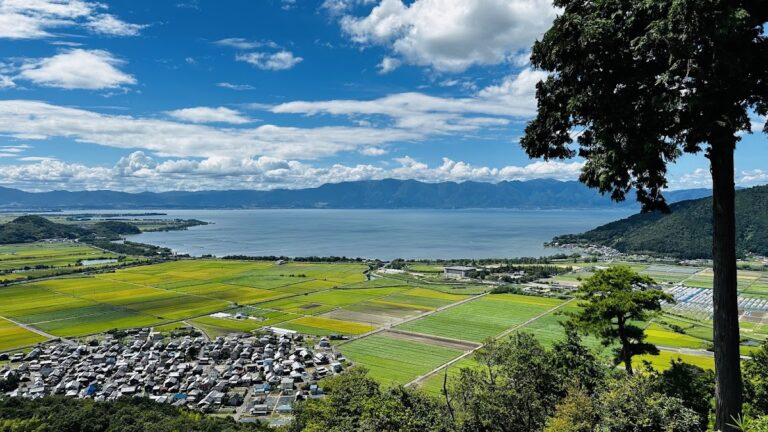
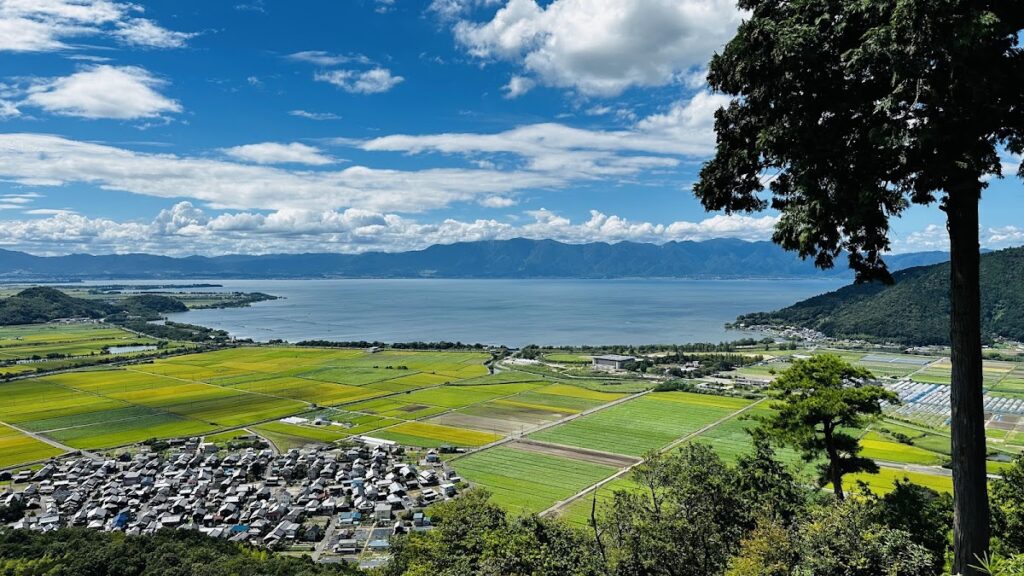
From the main keep site, at an altitude of 271.9 meters, a 360-degree panoramic view unfolds. From here, you can see the town of Omihachiman and the Hachiman Canal below, and in the distance, Lake Biwa, the Hira Mountains, and Mount Ibuki. On a clear day, you can enjoy a spectacular view.
The sunset over Lake Biwa at dusk is particularly breathtaking and is counted as one of the “Eight Views of Omihachiman.” Perhaps Toyotomi Hidetsugu also gazed upon this view while contemplating the governance of Omi Province.
Points to Note Regarding the Stone Walls
The stone walls of Hachimanyama Castle are valuable teaching materials for learning about castle construction techniques from the Toyotomi era. You can observe different stacking methods and scales of stone walls around the main keep, the second bailey, and the western bailey.
The stone walls on the north side of the main keep are particularly well-preserved, allowing for detailed observation of the natural stone combinations characteristic of the Nozurazumi (rough-stone masonry) method. Furthermore, some sections exhibit the Sanukizumi (stacked stone masonry) technique, illustrating the technological development towards early modern castles.
Hideyoshi’s Residence Ruins and Enclosures
The Hideyoshi’s Residence Ruins, located on the mid-slope of the southern slope, are characterized by a design that prioritized habitability despite being a mountain castle. The enclosures, with their wide, flat areas, are large enough to fully function as a residence.
The surrounding retainer residences are arranged in a stepped pattern, providing a visual understanding of the hierarchical structure of the samurai society at the time. These remains are important historical sites that illustrate the changes in castle architecture during the transition from the Sengoku period to the early modern period.
Nature Through the Seasons
Hachimanyama offers beautiful natural scenery throughout the four seasons. Cherry blossoms bloom in spring, fresh greenery covers the mountain in summer, autumn leaves color the summit, and in winter, the snow-covered Lake Biwa and Hira mountain range unfold before your eyes.
The autumn foliage season, in particular, offers a spectacular view combined with the grounds of Zuiryuji Temple, attracting many tourists. Hachimanyama, where nature and history harmonize, reveals a different face with each season.
Relationship between Hachimanyama Castle and Azuchi Castle
Similarities in Location
Hachimanyama Castle and Azuchi Castle are located only a few kilometers apart and share many similarities in their locations. Both castles were built on isolated hilltops and situated at strategic water transportation points surrounded by inland lakes and Lake Biwa.
They also share the common structure of having their castle towns located on the plains to the south. It is believed that Hachimanyama Castle was clearly built with Azuchi Castle’s urban planning as a reference. Toyotomi Hideyoshi’s reason for choosing Hachimanyama Castle as the new central base of Omi Province, replacing Azuchi Castle, was precisely this advantageous location.
Political Succession
Hachimanyama Castle inherited the role of the political center of Omi Province that Azuchi Castle had played. Toyotomi Hidetsugu attempted to transplant the commercial base and culture cultivated in Azuchi to Hachimanyama Castle by relocating the residents of Azuchi Castle town.
This policy led to the rapid prosperity of the Hachimanyama castle town, and the commercial traditions of Azuchi Castle town were passed on to Omihachiman. It can be said that the foundation for the success of Omi merchants was formed during this period.
Development of Castle Construction Techniques
Comparing Azuchi Castle and Hachimanyama Castle, it is clear that castle construction techniques advanced significantly in just a few years. Techniques attempted at Azuchi Castle, such as stone wall construction methods, bailey layouts, and castle town planning, were further refined at Hachimanyama Castle.
In particular, in stone wall techniques, a shift from rough-hewn stonework to san-gi-zumi (a type of stonework) was observed, resulting in the construction of stronger and more beautiful stone walls. Hachimanyama Castle is an important example of the transitional period from the Azuchi-Momoyama period to the early Edo period’s modern castles.
Points to Note When Visiting Hachimanyama Castle
Clothing and Items to Bring
When visiting the Hachimanyama Castle ruins, we recommend the following preparations.
- Comfortable walking shoes: When viewing the stone walls and baileys, some areas have unstable footing.
- Seasonal clothing: The mountaintop is cooler and windier than the lowlands.
- Drinks: Hydration is especially important in summer.
- Hat and sunscreen: Essential on sunny days.
- Rain gear: The weather can change quickly, so a folding umbrella is recommended.
Estimated Visiting Time
If using the ropeway, the estimated time spent at the mountaintop is 1-2 hours. This is sufficient time to visit Zuiryuji Temple, view the stone walls and baileys, and enjoy the view.
If using the hiking trail, allow 2-3 hours for the round trip. Castle enthusiasts who want to carefully observe the remains are advised to allocate half a day.
Combining with Nearby Sightseeing
We recommend visiting the following nearby tourist spots in conjunction with your visit to the Hachimanyama Castle Ruins.
- Hachimanbori: Within walking distance of the castle ruins, a canal and townscape that retains the atmosphere of the Edo period.
- Former Nishikawa Residence: The residence of a wealthy Omi merchant, a designated Important Cultural Property.
- Kawara Museum: A museum where you can learn about the history of Hachiman roof tiles.
- Azuchi Castle Ruins: Approximately 15 minutes by car, the site of Oda Nobunaga’s castle.
- Kannonshoji Temple: The 32nd temple of the Saigoku Thirty-Three Kannon Pilgrimage.
By combining these spots, you can gain a deeper understanding of the history and culture of Omihachiman.
Summary
Hachimanyama Castle, despite its short history of only 10 years, played an important role as the political, economic, and cultural center of Omi Province. The castle and castle town built by Toyotomi Hidetsugu inherited the traditions of Azuchi Castle while developing in its own unique way.
The remaining stone walls and baileys are valuable historical sites that convey the castle-building techniques of the Toyotomi era, and the view from the mountaintop is an excellent spot to experience the history of Omi. Visiting the Hachiman-bori moat and the castle town together will allow you to imagine the ideal castle town that Toyotomi Hidetsugu envisioned.
When you visit Omihachiman, be sure to visit the Hachimanyama Castle ruins and trace the footsteps of Toyotomi Hidetsugu’s dream, who lived during the transition from the Sengoku period to the early modern period. It’s a fascinating historical site that will satisfy not only history buffs but also those seeking beautiful scenery.