Complete Guide to Yamamotoyama Castle (Shiga Prefecture): A Sengoku Period Fortress Overlooking Lake Biwa and the History of the Abe Clan
What is Yamamotoyama Castle?
Yamamotoyama Castle is a mountain castle located in Yamamoto, Kohoku-cho, Nagahama City, Shiga Prefecture. Built on the summit of Mt. Yamamoto, at an altitude of 325 meters, it offers a panoramic view of the eastern shore of Lake Biwa. Situated at the southern end of the mountain range extending south from Mt. Shizugatake, this mountain, with its distinctive bowl-shaped form, is also a sacred mountain associated with the ancient legend of Omi Takamagahara.
Unusually for the Kohoku region, Yamamotoyama Castle boasts a long history dating back to the late Heian period. During the Sengoku period, it served as an important branch castle of the Asai clan, playing a key role in the defense of Odani Castle. In particular, the surrender of its lord, Abe Sadayuki, during Oda Nobunaga’s attack on the Asai clan is known as one of the factors contributing to their downfall.
Currently, the Yamamotoyama Castle ruins are selected as one of the “50 Best Castles of Omi Province,” and the remains of the main keep, second keep, and horse training ground are well-preserved, making it a valuable historical site where defensive structures such as moats and earthworks can be observed. From the mountaintop, you can enjoy a panoramic view of Lake Biwa, Chikubu Island, and Shizugatake, making it an attractive spot where you can enjoy both historical exploration and nature walks.
History of Yamamotoyama Castle
Late Heian Period: Built by Yamamoto Yoshitsune
There are various theories regarding the construction date of Yamamotoyama Castle, but the most likely tradition is that it was built during the Jisho era (1177-1181) at the end of the Heian period by Yamashita Hyoe-no-jo Yoshitsune (Yamamoto Yoshitsune), a member of the Minamoto clan. This Yamamoto Yoshitsune is a different person from Kuro Yoshitsune, the younger brother of Minamoto no Yoritomo, and is referred to as “Yamamoto Yoshitsune” to avoid confusion.
In 1180, during the Genpei War, Yamamoto Yoshitsune raised the banner of defeating the Taira clan. However, on December 16th of the same year, Yamamotoyama Castle fell to an attack by the Taira army led by Taira no Tomomori. This castle was also known as “Yamashita Castle,” and it is believed that the current Yamamotoyama Castle was located on that site.
Sengoku Period: The Era of the Kyogoku and Abe Clans
From the Muromachi period to the Sengoku period, Yamamotoyama Castle came under the control of the Kyogoku clan, the shugo (military governor) of Omi Province, and the Abe clan, their vassals, became the castle lords. The Abe clan, as powerful retainers of the Kyogoku clan, held influence in the Kohoku region, controlling the surrounding area from Yamamotoyama Castle.
Records also show that the Asami clan briefly resided there around the Eisho era (1504-1521). During this period, Yamamotoyama Castle functioned as a base of operations for the Kyogoku clan in Kohoku.
The Asai Clan Era and the Key to the Defense of Odani Castle
In the late Sengoku period, as the Asai clan rose to power, Yamamotoyama Castle became an important branch castle of the Asai clan. Especially during the time of Asai Nagamasa, it was positioned as a strategic stronghold protecting the east of their main base, Odani Castle, and the Abe clan continued to serve as its lords.
In 1570, when Asai Nagamasa became an enemy of Oda Nobunaga, Yamamotoyama Castle became one of the front lines of Odani Castle’s defense. The castle’s presence on the eastern shore of Lake Biwa played a crucial role in deterring Nobunaga’s northward advance.
The Surrender of Abe Sadayuki and the Downfall of the Asai Clan
In 1573, when Oda Nobunaga’s attack on the Asai clan intensified, Abe Sadayuki (also known as Abe Sadahide), the lord of Yamamotoyama Castle, was forced to make a critical decision. Faced with Nobunaga’s overwhelming military power, Abe Sadayuki betrayed his lord, the Asai clan, and surrendered to the Oda forces.
With the surrender of Yamamotoyama Castle, Odani Castle lost support from the east and became isolated. Abe’s betrayal contributed to the downfall of the Asai clan, and in August of the same year, Odani Castle fell, Asai Nagamasa committed suicide, and the Asai clan was destroyed.
Fate and Abandonment After the Honnoji Incident
Abe Sadayuki, who surrendered to Oda Nobunaga, continued to be the lord of Yamamotoyama Castle, but the situation changed dramatically with the Honnoji Incident in 1582. Sadayuki sided with Akechi Mitsuhide, but when Mitsuhide was defeated at the Battle of Yamazaki, he was held responsible and executed.
It is believed that Yamamotoyama Castle was abandoned as a result of this incident. Later, the castle lost its function, and its remains gradually returned to nature over time. However, valuable remnants that convey its original appearance still remain on the mountaintop.
Structure and Layout of Yamamotoyama Castle
A New Interpretation: A Alliance of Four Castles
Recent research, particularly the work of Hiromi Hasegawa, suggests that Yamamotoyama Castle was not a single castle, but rather a alliance of four castles. Because some remains were destroyed by heavy machinery during the park’s development, the entire site was treated as a single castle. However, detailed investigations have revealed that multiple independent castles worked together to form a defensive system.
This structure demonstrates the castle-building techniques of the Sengoku period, making maximum use of Yamamotoyama’s complex terrain, and indicates that a sophisticated defensive system beyond that of a simple mountain castle was constructed.
Structure of the Main Enclosure (Honmaru)
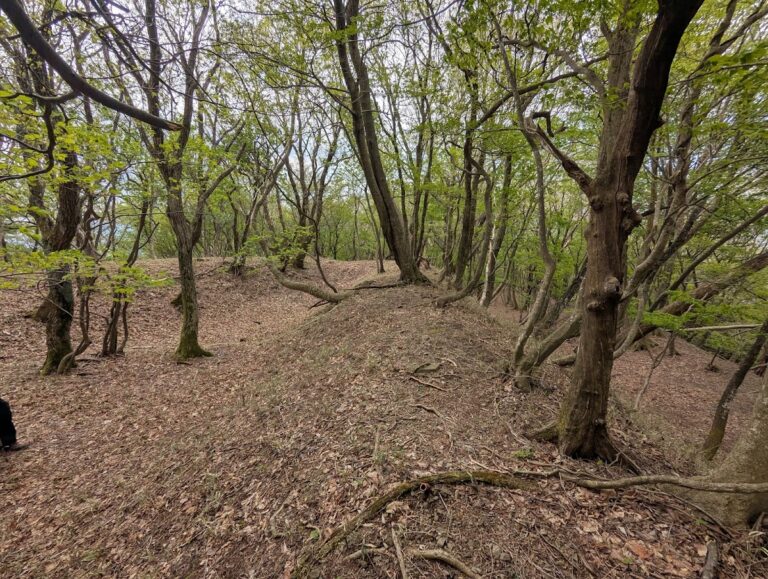
The main enclosure, located on the mountaintop, has a nearly square plan and is surrounded by earthen ramparts. This main enclosure is located on the mountaintop at an altitude of 325 meters, with a relative height of approximately 235 meters from the base. The earthworks of the main enclosure remain clearly visible today, confirming its defensive function as the core of the castle. The rectangular layout is a well-organized design for a medieval mountain castle, indicating planned construction.
Continuous Defensive System on the North Ridge
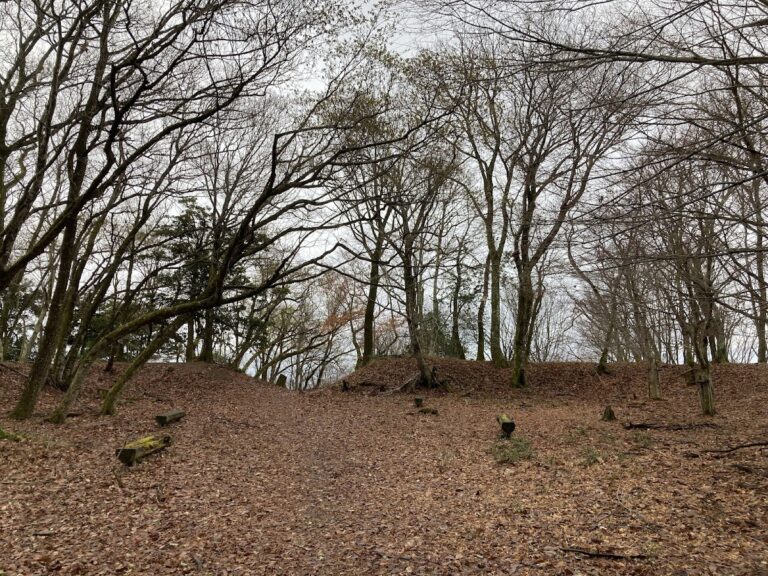
The most distinctive feature of Yamamotoyama Castle is its continuous defensive system built on a narrow ridge extending northward. Six trenches and eight enclosures are alternately arranged along this ridge, creating a structure designed to gradually halt enemy advances.
Many of the enclosures are surrounded by earthworks, indicating that they were not merely flat areas but functioned as independent defensive strongholds. The trenches were dug to completely block the ridge, serving as strong physical barriers to prevent enemy intrusion.
This continuous defensive system is an important historical site demonstrating the development of mountain castle technology during the Sengoku period, indicating that advanced castle construction techniques were employed to defend Odani Castle.
Second Enclosure and Horse Training Ground
Adjacent to the main enclosure is the second enclosure (Ninokuruwa), and further on is a flat area called the horse training ground (Baba). These enclosures provided the necessary space for castle operations and are thought to have been used for troop garrisoning, supply storage, and horse management.
The existence of the horse training ground indicates that the castle, despite being a mountain castle, was designed with cavalry in mind, suggesting it functioned not merely as a siege facility but also as a base for active military operations.
Preservation of the Remains
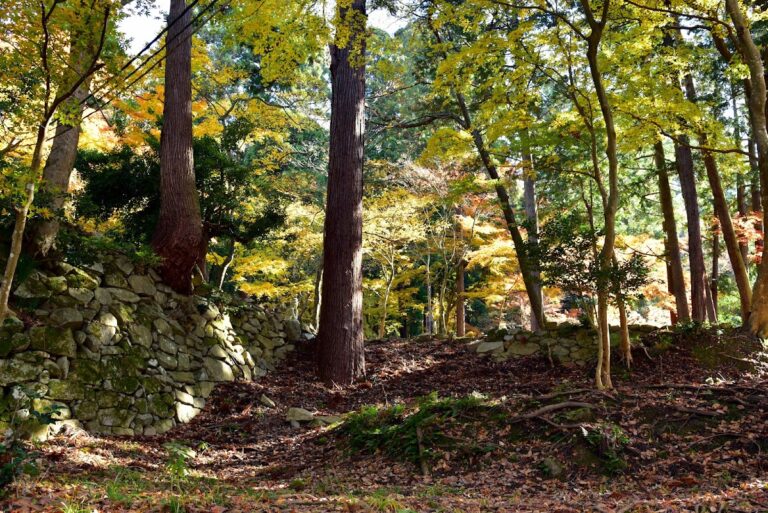
Although some destruction occurred due to the development of a park, the remains of Yamamotoyama Castle are generally well-preserved. Earthworks and moats remain clearly visible, making it a valuable historical site that conveys the appearance of a Sengoku period mountain castle to the present day.
In particular, the continuous defensive system on the northern ridge remains almost completely intact, making it an extremely important teaching material for learning about the castle construction techniques and defensive philosophies of the time.
Highlights of Yamamotoyama Castle
Spectacular Panoramic View from the Summit
One of the greatest attractions of Yamamotoyama Castle is the 360-degree panoramic view from the summit. From the 325-meter-high summit, the magnificent scenery of Lake Biwa unfolds below, and you can see Chikubu Island floating on the lake up close.
To the north, the Shizugatake mountain range stretches out, offering a panoramic view of the historical landscape that was the site of the Battle of Shizugatake during the Sengoku period. To the east are the mountains of the Ibuki mountain range, and to the south, the Kohoku Plain stretches out, overlooking the former territory of the Asai clan.
This view makes you realize that Yamamotoyama Castle was not merely a military facility, but a strategic point that monitored and controlled the entire Kohoku region.
Clearly Remaining Earthworks and Moats
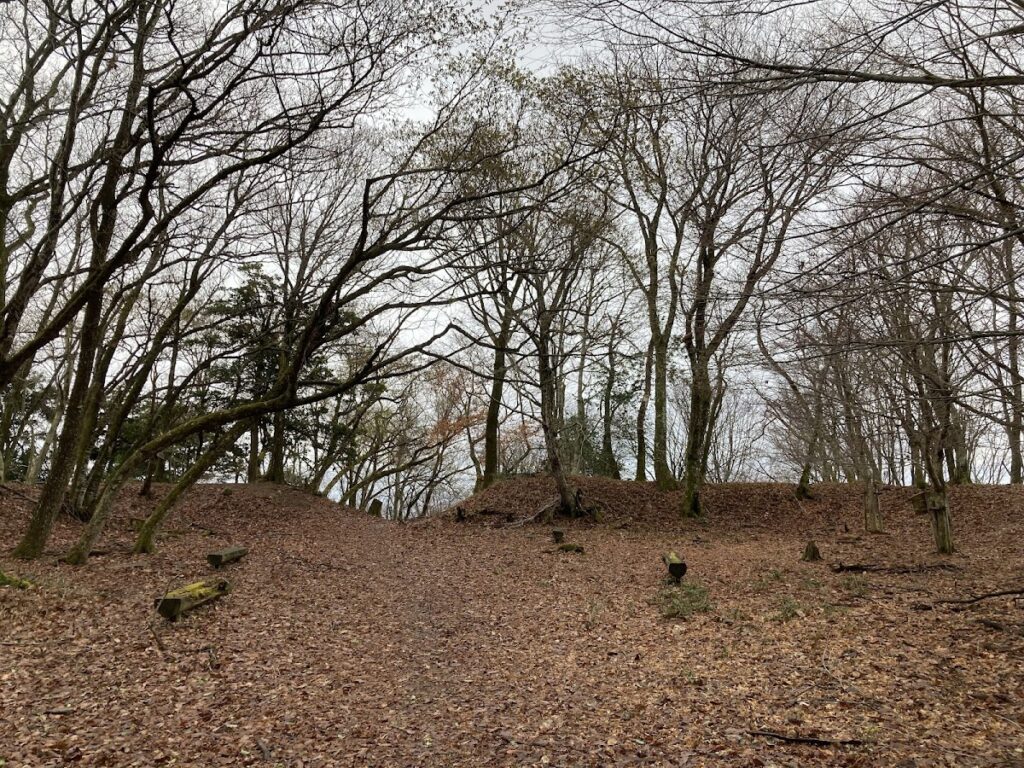
At Yamamotoyama Castle, you can clearly observe earthworks and moats, defensive structures from the Sengoku period. The earthen ramparts surrounding the main enclosure maintain their height, demonstrating the level of castle-building technology at the time.
The six trenches on the northern ridge, each with its own depth and width, effectively block the ridge, and walking through them allows one to experience firsthand how difficult an enemy advance would have been. The enclosures positioned between the trenches functioned as defensive strongholds, forming a multi-layered defensive line.
These remains serve as valuable educational materials, allowing visitors to directly learn about the realities of mountain castles, which are difficult to understand from textbooks and documents alone.
Uga Shrine and Traces of Mountain Worship
Uga Shrine is located on Mount Yamamoto, preserving the history of mountain worship. This mountain, associated with the legend of Omi Takamagahara, has been revered as a sacred mountain since ancient times.
The landscape, where the castle and shrine coexist, demonstrates the close relationship between military affairs and faith in the medieval period, indicating that Mount Yamamoto was not merely a military base but also a spiritual center of the region.
Well-maintained walking trails and access
Yamamotoyama Castle is accessible via well-maintained walking trails, making it relatively easy to reach. The trails are clearly marked and guide signs are installed, making it safe even for beginners.
Along the way up, you can enjoy views of Lake Biwa, combining castle exploration with a nature walk. However, as it is a mountain castle, it is recommended to prepare appropriate equipment (trekking shoes, drinking water, etc.).
Visitor Guide: Access and Visiting Information for Yamamotoyama Castle
Location
Address: Yamamoto, Kohoku-cho, Nagahama City, Shiga Prefecture
Yamamotoyama Castle is located in the northern part of Nagahama City, on the eastern shore of Lake Biwa. The nearest station is Kawage Station on the JR Hokuriku Main Line.
Access Methods
By Public Transportation:
- Get off at Kawage Station on the JR Hokuriku Main Line, then walk for approximately 40 minutes to the trailhead.
- Taxis are also available from the station (approximately 10 minutes to the trailhead).
By Car:
- Approximately 20 minutes from Nagahama IC on the Hokuriku Expressway.
- Parking is available near the trailhead (limited number of spaces).
Ascent Time and Difficulty
- Ascent Time: Approximately 30-40 minutes from the trailhead to the summit.
- Descent Time: Approximately 25-30 minutes.
- Difficulty: Beginner to Intermediate (well-maintained trail, but involves an elevation gain of approximately 235m).
- Total Time Required: Approximately 2-3 hours round trip and sightseeing.
Notes for Visitors
- Clothing and Equipment: Trekking shoes or athletic shoes, comfortable clothing, drinking water, towel.
- Season: Spring to autumn is the best time to visit. Caution: Snowfall is possible during winter.
- Weather: The ground can become slippery in rainy weather, so visiting on a sunny day is recommended.
- Insect repellent: Bringing insect repellent spray is recommended during summer.
- Toilets: There are no toilets at the summit, so please use the restroom beforehand.
Points to Note During Your Visit
- Estimated Time Required: Allow about an hour at the summit if you want to thoroughly examine the ruins.
- Best Season: April-May (fresh greenery), October-November (autumn leaves)
- Photo Spots: Views of Lake Biwa and Chikubu Island from the summit, the moat on the north ridge.
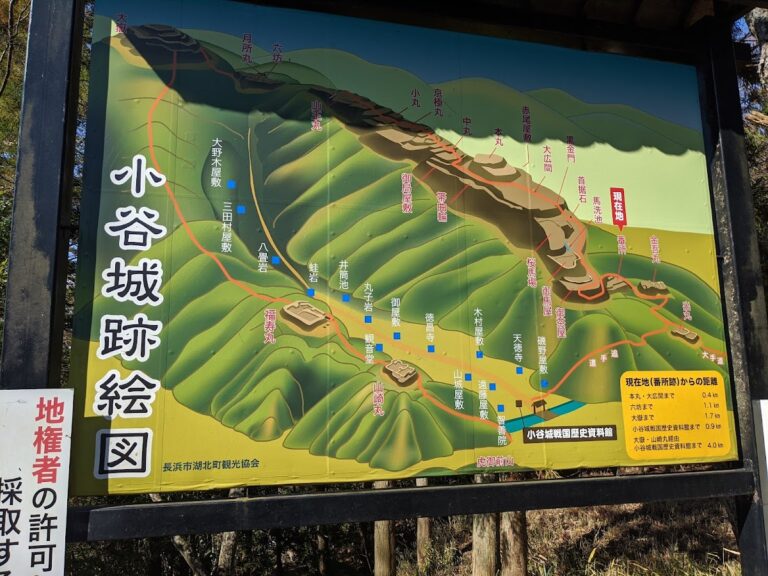
- Map: Obtaining a castle layout map beforehand will enhance your understanding.
Nearby Tourist Spots
Odani Castle Ruins
Located approximately 7km northwest of Yamamotoyama Castle, the Odani Castle Ruins, the base of the Asai clan, are an important historical site that should be visited along with Yamamotoyama Castle. Known as the residence of Asai Nagamasa, it is designated as a national historical site. Visiting both castles is highly worthwhile for understanding their historical relationship.
Shizugatake Battlefield
Located north of Yamamotoyama, Shizugatake was the site of the Battle of Shizugatake in 1583. This battle, where Hashiba Hideyoshi and Shibata Katsuie clashed, was a crucial step in Hideyoshi’s quest for national unification. You can reach the summit by lift and enjoy the scenery of northern Lake Biwa.
Chikubu Island
Chikubu Island, floating in Lake Biwa, is visible from Yamamotoyama Castle and has long been an object of worship. Tourist boats operate from Nagahama Port and Imazu Port, allowing visitors to see historical buildings such as Hogonji Temple and Tsukubusuma Shrine.
Nagahama Castle Historical Museum
This museum is a reconstruction of Nagahama Castle, the first castle owned by Toyotomi Hideyoshi, and offers a glimpse into the history of the Kohoku region. It also features exhibits on castles in Kohoku, including Yamamotoyama Castle, making a visit before or after your main visit a valuable opportunity for a deeper understanding.
Joraku-ji Temple
Located at the foot of Mount Yamamoto, Joraku-ji Temple is known for its connection to Yamamoto Yoshitsune. A valuable temple that conveys the history of the late Heian period, it’s an important spot for understanding the historical background of Yamamotoyama Castle.
Yamamotoyama Castle and the History of Kohoku
Strategic Importance of the Eastern Shore of Lake Biwa
The eastern shore of Lake Biwa, where Yamamotoyama Castle is located, was a crucial transportation hub connecting Kyoto and the Hokuriku region from ancient times to the early modern period. This region, where water transport on Lake Biwa and land routes intersected, has always held a strategically important position both militarily and economically.
Yamamotoyama Castle was strategically important, situated in an ideal location for monitoring and controlling this transportation route, allowing it to control a wide area including lake transportation. The Asai clan’s emphasis on it as a subsidiary castle of Odani Castle stemmed from this geographical importance.
Role in the Conflict Between the Asai and Oda Clans
After the Battle of Anegawa in 1570, the conflict between Asai Nagamasa and Oda Nobunaga intensified. In this conflict, Yamamotoyama Castle functioned as a crucial subsidiary castle supporting Odani Castle from the east.
The existence of Yamamotoyama Castle, controlling the eastern shore of Lake Biwa, was essential for deterring the Oda army’s northward advance and securing supply routes to Odani Castle. The fact that Abe Sadayuki’s surrender dealt such a blow to the Asai clan demonstrates the high strategic value of Yamamotoyama Castle.
Castle Network of Omi Province
Yamamotoyama Castle played a part in the castle network that unfolded in the northern Omi region. Centered around Odani Castle, various castles such as Yokoyama Castle and Toragozenyama Castle formed a coordinated defensive system, with Yamamotoyama Castle positioned as a key strategic point in the east.
This castle network demonstrates that even small individual castles could form a strong defensive system through mutual cooperation, clearly illustrating the characteristics of castle strategy during the Sengoku period.
Cultural Value of Yamamotoyama Castle
Selection as one of the 50 Best Castles of Omi
Yamamotoyama Castle has been selected as one of the “50 Best Castles of Omi,” and is recognized as one of Shiga Prefecture’s representative castles. This selection comprehensively evaluates the historical importance of the castle, the state of preservation of its remains, and its value as a cultural property in the region.
Importance in Medieval Mountain Castle Research
Yamamotoyama Castle is a valuable example that allows us to trace the long-term changes from the late Heian period to the Sengoku period. In particular, the new interpretation of it as a confederation of four castles provides a new perspective on understanding the structure of medieval mountain castles.
The continuous defensive system on the northern ridge is an important historical site demonstrating the development of castle construction techniques during the Sengoku period, making it a site of high academic value for castle researchers and history enthusiasts.
Preservation as a Regional Historical Heritage Site
Nagahama City is working on the preservation and utilization of regional castle heritage sites, including Yamamotoyama Castle. Efforts are underway to create an environment where visitors can safely view the sites, including the development of walking trails and the installation of guide signs.
On the other hand, lessons learned from the destruction of historical remains due to park development have highlighted the importance of balancing development and preservation, and this is being utilized in future preservation activities.
Summary: The Charm of Yamamotoyama Castle and the Significance of Visiting It
Yamamotoyama Castle is a mountain castle located on the eastern shore of Lake Biwa, at an altitude of 325 meters. It is an important historical site with a long history spanning from the late Heian period to the Sengoku period. It played a key role in the defense of Odani Castle as a branch castle of the Asai clan, and holds a dramatic history in which the surrender of Abe Sadayuki was a contributing factor to the downfall of the Asai clan.
The remains of Yamamotoyama Castle, which retains the characteristics of a Sengoku period mountain castle well, such as the earthen ramparts surrounding the main enclosure and the continuous defensive system of six trenches and eight enclosures on the northern ridge, are a must-see for castle enthusiasts. Furthermore, the spectacular views of Lake Biwa, Chikubu Island, and Shizugatake from the mountaintop offer the charm of enjoying both historical exploration and nature walks simultaneously.
Selected as one of the 50 best castles in Omi Province and preserved as an important cultural property of the Kohoku region, Yamamotoyama Castle is a valuable spot to learn about the history of Kohoku during the Sengoku period and experience the reality of a medieval mountain castle. Visiting it in conjunction with surrounding historical sites such as Odani Castle and Shizugatake will allow for a deeper understanding of the rise and fall of the Asai clan and the Sengoku history of Kohoku.
With its relatively easy access via well-maintained walking trails, Yamamotoyama Castle is a recommended destination not only for history buffs but also for those who enjoy hiking. Come and experience the spectacular views of Lake Biwa and the romance of Sengoku history at Yamamotoyama Castle.