A Thorough Explanation of the History and Highlights of Wakasa Onigajo Castle | The Charm of a National Historic Site and One of Japan’s Top 100 Castles
What is Wakasa Onigajo Castle?
Wakasa Onigajo Castle is a mountain castle built on Tsuruoyama Mountain (elevation 452m, relative height 252m) in Wakasa-cho, Yazu-gun, Tottori Prefecture, dating from the medieval to early modern period. It is counted as one of the Three Famous Castles of Inaba (along with Tottori Castle and Shikano Castle), designated a National Historic Site in March 2008, and registered as one of Japan’s Top 100 Castles in 2017, making it a castle ruin of high historical value.
The Wakasa area is located at the intersection of roads leading to Harima and Tajima provinces, making it an important military and transportation hub in the Inaba region. Even today, the original stone walls remain in good condition in the main keep, second bailey, and third bailey, preserving the typical form of a mountain castle.
Formerly known as “Oniyama” (Demon Mountain), this area is also a legendary site where demons are said to have lived, a legacy reflected in the castle’s name, “Onigajo” (Demon Castle). The castle ruins, towering behind Wakasa-juku, still stand today, watching over the historic townscape and forming a cultural landscape integrated with the town of Wakasa, which was designated an Important Preservation District for Groups of Traditional Buildings in 2021.
History of Wakasa Onigajo Castle
Kamakura to Muromachi Periods: The Yabe Clan Era
There are various theories regarding the construction date of Wakasa Onigajo Castle, but it is believed to have been opened around 1200 (Shoji 2) by Yabe Terutane, whose ancestral home was Yabe Village, Abe District, Suruga Province. The Yabe clan was a branch of the Irie clan and a local lord of Yabe, Suruga Province.
The Yabe clan entered Inaba Province during the Kamakura period and established their castle in Wakasa. Historical records from the late 15th century mention “Yabe-kan Wakasa (Sakura),” confirming that the Yabe clan had a base in Wakasa during this period. The Yabe clan served as castle lords for 16 generations, maintaining their power as influential lords in the Wakasa region.
Records also indicate that Yamana Masazane and Yabe Yamashiro-no-kami committed suicide at “Yabe-kan Wakasa (Sakura)” during the Ōnin War (1467-), illustrating their involvement in the turmoil of the Sengoku period.
Sengoku Period: The Struggle Between the Amago, Mōri, and Oda Clan
With the arrival of the Sengoku period, Wakasa Onigajō became a crucial stronghold in Inaba Province, the stage for fierce battles between powerful daimyo such as the Amago, Mōri, and Oda clans. Its strategic location controlling the roads to Harima and Tajima provinces made it a coveted castle for each power.
Of particular note is the period when Yamanaka Shikanosuke (Yamanaka Shikanosuke) was the lord of the castle. Known as a loyal retainer aiming for the restoration of the Amago clan, Yamanaka Shikanosuke is recorded as having captured the lord of Wakasa Castle (possibly the Yabe clan), and for a time, he controlled this castle.
During this period, the castle experienced numerous battles, and each time, its structure was renovated and expanded. The remaining stone wall remains exhibit a unique characteristic from the perspective of castle history research: the presence of separate sections for older and newer castle ruins.
Early Modern Period: Residences of the Kinoshita and Yamazaki Clans and Abandonment
After the Tensho era, when Oda Nobunaga’s influence extended to Inaba Province, Wakasa Onigajo Castle came under Oda control. Subsequently, the Kinoshita clan and the Yamazaki clan served as lords of the castle.
With the establishment of the Edo Shogunate, Wakasa Onigajo Castle was abandoned in 1617 due to the One Castle Per Province decree. At this time, the castle underwent a process called “hajō” (destruction), where it was intentionally destroyed. The traces of this destruction are clearly visible in some of the stone walls today, making them important historical documents for castle archaeology.
Even after the castle’s abandonment, the remains such as the stone walls and baileys were well-preserved, remaining intact for over 400 years.
Highlights of Wakasa Onigajo Castle
Stone Walls of the Main Bailey, Second Bailey, and Third Bailey
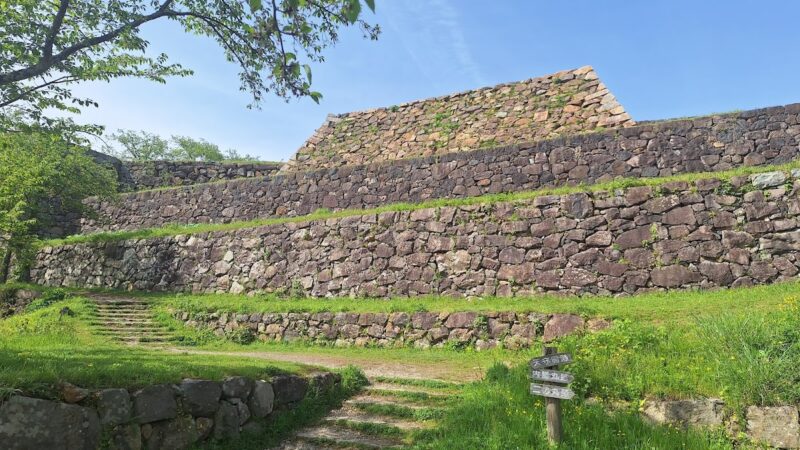
The greatest highlight of Wakasa Onigajo Castle is the group of baileys and their stone walls that unfold from the mountaintop to the ridge. The baileys, including the main bailey, second bailey, third bailey, and Hōzuki-dan, remain clearly visible, and the stone walls separating each bailey retain their original appearance.
The main bailey is located at the highest point of the castle, offering a magnificent panoramic view of the town of Wakasa and the surrounding mountains. While the stone walls are primarily constructed using the rough-hewn stone method, processed stones were also used in some sections, revealing differences in construction periods and traces of renovations.
The stone walls of the second and third baileys are also impressive, reaching several meters in height, and are valuable remains demonstrating the development of stonework techniques during the transition period to early modern castles.
Corridor Bridge Entrance: A Nationally Rare Remains
Of particular note at Wakasa Onigajo Castle is the remains known as the corridor bridge entrance. A koguchi (entrance) is the entrance to a castle, but this corridor bridge entrance has an extremely rare structure with few examples nationwide.
This entrance, with its bridge-like passage between baileys, is a cleverly designed structure for controlling attackers and strengthening defenses. It is an extremely important remains for considering the history of castle architecture and is one of the grounds for its designation as a National Historic Site.
Dead-End Gate: A Clever Defensive Structure
Another unusual historical feature is the “dead-end gate”. While appearing to be a passageway, it is actually a dead end, a clever defensive structure designed to lure the enemy in and then attack.
Such complex gate structures are ingenious features unique to castles that experienced actual battles during the Sengoku period, and speak to the history of Wakasa Onigajo Castle as the stage for fierce battles.
Traces of Demolition
The traces of demolition carried out when the castle was abandoned are also an important point of interest at Wakasa Onigajo Castle. Clear evidence remains of intentionally collapsing parts of the stone walls and removing stones.
Demolition was not simply destruction, but a planned process to render the castle unusable, and the methods and extent varied from castle to castle. The remains of Wakasa Onigajo Castle provide valuable archaeological evidence of how the Edo Shogunate’s “One Castle Per Province” decree was implemented.
Hexagonal Stone Wall
Wakasa Onigajo Castle also features a hexagonal stone wall. This is a very rare shape and is thought to correspond to a specific enclosure or facility, but its exact purpose is still under research.
This unique stone wall structure is noteworthy not only for showcasing the individuality of Wakasa Onigajo Castle but also as a relic illustrating the diversity of castle construction techniques.
Access and Climbing Route
Access by Public Transportation
If using the Wakasa Railway, alight at Wakasa Station. Wakasa Station is a historical station building designated as a nationally registered tangible cultural property, boasting a charming atmosphere full of warmth and nostalgia.
From Wakasa Station to the Wakasa Onigajo Castle ruins, if climbing on foot, it takes approximately 15 minutes to the trailhead, and then another 40-50 minutes to the main keep at the summit.
Detailed information and materials about the ruin castles can be obtained at the Wakasa Town Tourism Association (located inside Wakasa Station). It is recommended to stop by before climbing. ### Access by Car
If you are visiting by car, there are parking lots around Wakasa-juku. It is also possible to drive up to near the summit using the forest road. However, it is recommended to check the condition and accessibility of the forest road with the Wakasa Town Tourism Association in advance.
There is a parking space near the summit, and from there it is about a 10-15 minute walk to The main keep.
Precautions for Climbing the Castle
Wakasa Onigajo is a mountain castle at an altitude of 452m, and climbing it requires appropriate physical fitness and equipment. Please note the following points:
- Please wear non-slip footwear such as hiking boots or athletic shoes.
- Don’t forget insect repellent during spring and autumn.
- Bring plenty of drinking water.
- Prepare rain gear in case of changing weather.
- The path to the castle is well-maintained, but there are steep slopes and stone steps.
- Extra caution is needed during winter due to the possibility of snow and ice.
Tourist Information and Guide Services
Wakasa Town Tourism Association Guide Services
The Wakasa Town Tourism Association offers guide services for the Wakasa Onigajo Castle Ruins. Professional guides provide detailed explanations of the castle’s history and remains, allowing you to gain a deeper understanding of its charm.
Guide fees and application methods can be found on the Wakasa Town Tourism Association’s official website. Advance reservations are often required, so it is recommended to inquire as soon as your visit plans are finalized.
Continued Top 100 Japanese Castles Stamp
Wakasa Onigajo Castle is registered as one of the Continued Top 100 Japanese Castles (number 170), and the stamp is located at the tourist information center inside Wakasa Station. Those visiting the 100 castles can get a stamp as a memento of their visit.
Admission Fee and Hours
Admission to the Wakasa Onigajo Castle ruins is free. While the castle ruins themselves are always open, for safety reasons, visiting during daylight hours is recommended.
Nearby Tourist Attractions
Wakasa-juku Townscape
Wakasa-juku, located at the foot of Wakasa Onigajo Castle, is a historical townscape designated as an Important Preservation District for Groups of Traditional Buildings in August 2021. Traditional buildings line the street, retaining the atmosphere of an Edo-period post town, creating a time-traveling experience.
Visiting both the castle ruins and the townscape allows for a deeper experience of Wakasa’s history and culture.
Wakasa Railway
The Wakasa Railway is a local railway connecting Koge Station to Wakasa Station. It’s popular with railway enthusiasts for its retro trains, station buildings, and railway heritage. At Wakasa Station, you can see valuable railway facilities such as a turntable and engine shed.
Mount Hyonosen
To the south of Wakasa Town stands Mount Hyonosen. At 1,510m, it’s the second highest peak in the Chugoku region, offering opportunities for outdoor activities such as mountain climbing and skiing.
Cultural Value of Wakasa Onigajo Castle
Reasons for Designation as a National Historic Site
The reasons for the designation of the Wakasa Onigajo Castle ruins as a National Historic Site in 2008 are as follows:
- It is a valuable historical site that shows the evolution of the castle, as the ruins of the old castle and the ruins of the new castle remain separately.
- It has unique remains not seen in other castles, such as corridor bridge gates and dead-end gates.
- Evidence of castle destruction remains clearly, providing archaeological evidence of castle policies in the early modern period.
- Major remains such as stone walls remain in good condition.
- It is an important historical site that tells the history of the Sengoku period in the Inaba region.
These factors were comprehensively evaluated, and it was designated as a National Important Cultural Property.
Registration as one of the Continued Top 100 Japanese Castles
The registration as one of the Continued Top 100 Japanese Castles in 2017 signifies that the historical and cultural value of Wakasa Onigajo Castle has been recognized nationwide. As a result, its recognition among castle enthusiasts and history fans has increased, and many people now visit the site.
Recommended Itineraries for Visiting Wakasa Onigajo Castle
Half-Day Course
Arrive at Wakasa Station via the Wakasa Railway, gather information and get your stamp at the tourist information center (approx. 30 minutes) → Stroll through the townscape of Wakasa-juku (approx. 30 minutes) → Climb to Wakasa Onigajo Castle (approx. 2 hours round trip) → Lunch near Wakasa Station
Full-Day Course
Climb to Wakasa Onigajo Castle in the morning → Lunch → In the afternoon, take a leisurely stroll through the townscape of Wakasa-juku → Visit the railway heritage of the Wakasa Railway → Shop for local specialties
Experience-Focused Course
Join a guided tour by the Wakasa Town Tourism Association to learn more about the castle ruins → Experience traditional culture in Wakasa-juku (advance reservation required) → Enjoy local cuisine at a local restaurant
Summary
Wakasa Onigajo Castle is a mountain castle of high historical value, built on Tsuruo Mountain in Wakasa Town, Tottori Prefecture. From the Kamakura period to the early Edo period, it functioned as an important base in Inaba Province, and during the Sengoku period, it became the stage for fierce battles between powerful daimyo such as the Amago, Mori, and Oda clans.
Even today, magnificent stone walls remain in the main keep, second bailey, and third bailey, and you can see rare remains such as the corridor bridge gate and dead-end gate, which are rare even nationwide. Clear traces of its destruction are also preserved, making it an extremely valuable historical site for castle history research. It was designated a National Historic Site in 2008 and registered as one of the Continued Top 100 Japanese Castles in 2017.
The cultural landscape, integrated with the historic townscape of Wakasa-juku, is also attractive, and the view from the ruin castles is magnificent. With easy access via the Wakasa Railway, it’s a recommended spot not only for history buffs and enthusiast castles, but also for those who want to enjoy hiking and strolling through the town.
Using the Wakasa Town Tourism Association’s guide service will allow you to understand the castle’s history and charm more deeply. Why not visit this famous castle in Inaba and experience the atmosphere of the Sengoku period?