Urado Castle and Kochi: A Thorough Explanation of the Fortified Castle Ruins Behind Katsurahama Beach, from the Residence of Chosokabe Motochika to Yamauchi Kazutoyo
Behind Katsurahama Beach, a representative scenic spot of Kochi Prefecture, lie the mountains. In this area stood Urado Castle, the residence of Chosokabe Motochika, a Sengoku period daimyo who unified Tosa Province. Although only a portion of the stone walls remains today, this castle is an important historical site indispensable to understanding Kochi’s history. This article provides a detailed explanation of Urado Castle, from its history and remains to surrounding tourist information—all essential information for anyone visiting Kochi City.
Overview and Location of Urado Castle
Uradō Castle was a Japanese castle located in Urado, Kochi City, Kochi Prefecture (formerly Urado, Agawa District, Tosa Province). Built on a hill approximately 100 meters above sea level, north of the current Katsurahama Park, it was a natural stronghold surrounded by the sea on three sides: east, south, and north.
Geographical Advantage
The location where Urado Castle was built was extremely important both militarily and economically. It boasted the port of Urado, which appears in Ki no Tsurayuki’s “Tosa Diary,” and functioned as a crucial point for maritime traffic with the Kyoto/Osaka region. Furthermore, its coastal terrain was well-suited for defense, providing ideal conditions for a naval base.
Overlooking the entrance to Urado Bay, it played a role in monitoring incursions from the sea and protecting Tosa’s maritime gateway. While the magnificent view of the Pacific Ocean unfolds from present-day Katsurahama, this view played a military surveillance role during the Sengoku period.
History and Development of Urado Castle
Construction by the Motoyama Clan
The origins of Urado Castle date back to the Tenbun era (1532-1554). It is believed that the Motoyama clan, a powerful local family in Tosa Province whose base was Asakura Castle (present-day Asakura, Kochi City), built Urado Castle as a branch castle in the early 16th century. It is thought that by the time of Motoyama Baikei, it already functioned as a fortress.
While it is believed that there were fortresses belonging to local families in this area since ancient times, the development of a full-fledged castle began during the time of the Motoyama clan. The Motoyama clan was a powerful daimyo who controlled the central part of Tosa Province, but they eventually became embroiled in conflicts with the rising Chosokabe clan.
The Era of Chosokabe Motochika
During the Tensho era (1573-1592), Chosokabe Motochika, who unified Tosa Province, destroyed the Motoyama clan and positioned Urado Castle as an important branch castle. Motochika initially attempted to build a castle on Mount Otakasaka, where the present-day Kochi Castle stands, but abandoned the plan after failing to control the Kagami River. Subsequently, around 1591 (Tensho 19), Motochika significantly renovated and expanded Urado Castle, making it his main residence.
There were several reasons why Motochika made Urado Castle his base. Firstly, after unifying Shikoku, the need to directly control a strategically important maritime transportation hub increased in his domain administration. Secondly, amidst Toyotomi Hideyoshi’s unification of Japan, securing maritime routes to the Kyoto/Osaka region was necessary to maintain close contact with the central government. Thirdly, a base was needed to maintain and strengthen the Chosokabe clan’s naval power.
Motochika also developed the castle town around Urado Castle. For approximately 10 years, from 1591 (Tensho 19) until Motochika’s death in 1599 (Keicho 4), Urado Castle served as the Chosokabe clan’s main castle and the political and military center of Tosa Province.
Chosokabe Morichika and the Battle of Sekigahara
After the death of Motochika, his fourth son, Chosokabe Morichika, inherited the family headship and became the lord of Urado Castle. However, in the Battle of Sekigahara in 1600, Morichika sided with the Western Army (Ishida Mitsunari’s side), and after the war, he was dispossessed of his territory by Tokugawa Ieyasu. This marked the end of the Chosokabe clan’s rule over Urado Castle.
Yamauchi Kazutoyo’s Entry into the Castle and Relocation to Kochi Castle
Yamauchi Kazutoyo, who distinguished himself by siding with the Eastern Army in the Battle of Sekigahara, was granted the entire province of Tosa (202,600 koku) in 1601, moving from Kakegawa in Totomi Province (present-day Kakegawa City, Shizuoka Prefecture), and entered Urado Castle.
However, Kazutoyo judged that Urado Castle was too small to develop a castle town. In August of the same year, it was decided to build a new castle on Mount Otakasaka (present-day Kochi Castle), a site where Chosokabe Motochika had previously attempted to build a castle. In 1603 (Keicho 8), the main and second baileys of Kochi Castle were completed, and Kazutoyo moved there. Urado Castle was abandoned.
The reason Yamauchi Kazutoyo abandoned Urado Castle was not simply because it was too small. It is believed that he made a political decision to solidify his control over Tosa Province by building a new castle town in an area where many former retainers of the Chosokabe clan lived. Furthermore, Mount Otakasaka, situated between the Kagami River and the Enokuchi River, had become a feasible location due to advancements in flood control technology.
Urado Castle After Abandonment
After the move to Kochi Castle, Urado Castle was abandoned, and its buildings were demolished. It is said that some of the stone walls were reused in the construction of Kochi Castle. Throughout the Edo period, the Urado Castle site gradually returned to nature, but it continued to be remembered locally as “Shiroyama” (Castle Mountain). Since the Meiji era, as the area around Katsurahama Beach has been developed as a tourist destination, the historical value of the Urado Castle ruins has also been re-recognized. Currently, it is designated as a historical site by Kochi Prefecture, and preservation efforts are underway.
Remains of Urado Castle
Existing Stone Walls
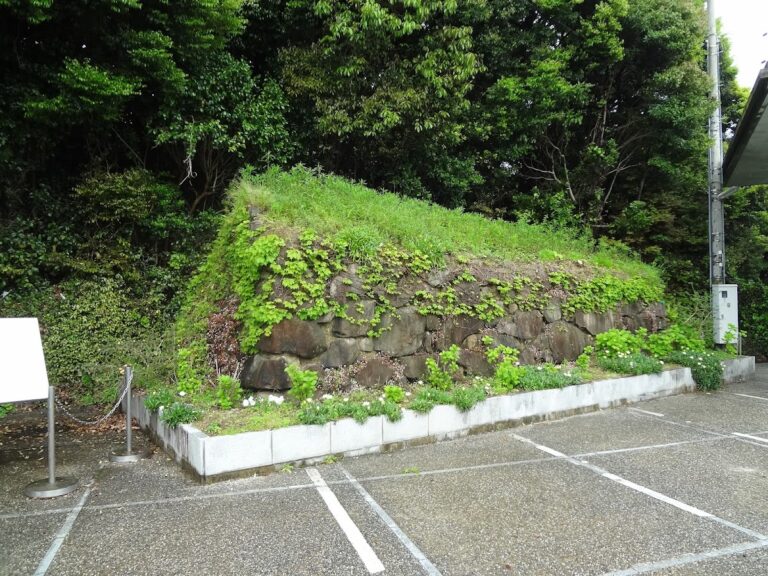
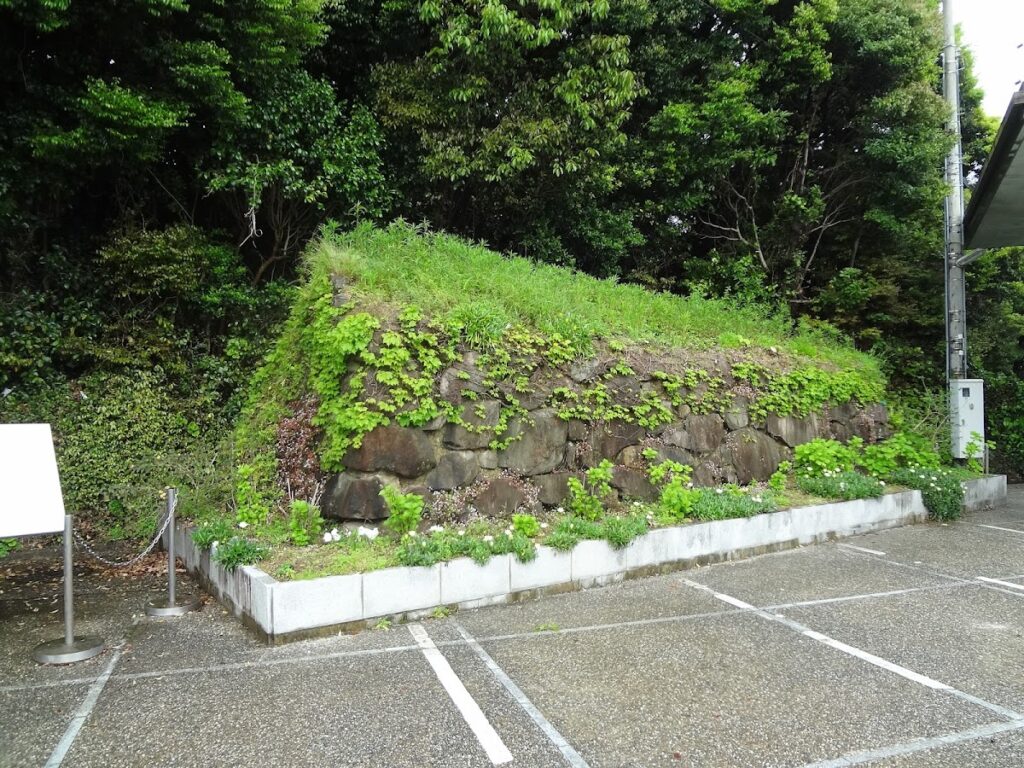
The remains of Urado Castle that can currently be confirmed are mainly the stone walls around the main keep (castle tower ruins). In Kochi City’s cultural property designation, it is protected as “Urado Castle Keep Ruins, Attached to the Eastern and Southeastern Stone Walls and Stone Fortifications.”
The stone walls were built using the nozurazumi technique, where natural stones are stacked as they are, making them valuable remains that convey the castle-building techniques of the Chosokabe clan era. Traces of sanukizumi (a technique of stacking corners at right angles) can also be seen in some areas, suggesting the possibility of remnants of renovations during the time of Yamauchi Kazutoyo.
The height of the stone walls varies depending on the location, but the best-preserved sections are approximately 3-4 meters high. The stone walls, having withstood over 400 years of wind and rain, speak to the high level of stonemasonry skills of the time.
Layout of the Enclosures
Urado Castle had a linear layout with multiple enclosures arranged around the main enclosure (Honmaru). The Honmaru was located at the highest point, and it is believed that the second and third enclosures were arranged in a stepped fashion around it.
Although the clear divisions of the enclosures are now lost, their original layout can be inferred from the topography. Even now, as Katsurahama Park, several flat areas believed to be the remains of former enclosures can be identified.
Moats and Earthworks
As a mountain castle, Urado Castle had moats (Horikiri) that cut through the ridges and earthworks for defense. While many areas are now covered in vegetation, careful observation reveals traces of artificially carved terrain and earthworks.
Well Sites
It is believed that there were several wells within the castle grounds, and some of these can still be seen today as depressions. Despite its location surrounded by the sea, securing a supply of fresh water was vital to the castle’s survival. It is believed that multiple water sources were secured to withstand a prolonged siege.
The Relationship Between Urado Castle and Katsurahama
The Urado Castle ruins are located on the mountain behind Katsurahama, a representative tourist spot in Kochi Prefecture. Many tourists visiting Katsurahama are captivated by the magnificent view of the Pacific Ocean and the statue of Sakamoto Ryoma, but it is not widely known that the mountain behind it is the site of a historically important castle.
Urado Castle Ruins as Seen from Katsurahama
Looking north from the sandy beach of Katsurahama, a range of green-covered mountains can be seen. The main keep of Urado Castle was located on the summit of these mountains. During the Sengoku period, Chosokabe Motochika likely gazed upon the Pacific Ocean from this mountaintop, envisioning the future of Tosa.
While there is a Sakamoto Ryoma Memorial Museum within Katsurahama Park, approximately 300 years before Ryoma’s time, this land was the residence of a Sengoku daimyo who unified Tosa. The history of Kochi Prefecture stretches from the Chosokabe clan to the Yamauchi clan, and then to the patriots of the late Edo period.
Ryuo Cape and Urado Castle
Ryuo Cape, which juts out to the east of Katsurahama Beach, may have once been part of Urado Castle’s defensive line. There is a theory that a watchtower was located there to monitor incursions from the sea. Currently, Ryuo Cape is home to Ryuo Shrine, a place where people pray for safety at sea.
Comparison with Kochi Castle
Urado Castle and Kochi Castle are two castles with a continuity in the history of Tosa Province. Comparing the two allows us to understand the changes in castle architecture during the transition from the Sengoku period to the Edo period.
Differences in Location
Urado Castle is a mountain castle facing the sea and functioned as a base for the navy. On the other hand, Kochi Castle is an inland flatland castle, strategically located to prioritize the development of the castle town. This difference reflects the shift in policy from a military-first approach in the Sengoku period to a focus on governance and economics in the Edo period.
Advances in Castle Construction Techniques
While Urado Castle’s stone walls primarily utilize the “nozurazumi” (rough-stone masonry) method, Kochi Castle employs a highly advanced stone-laying technique called “kirikomi-hagi” (cut-stone masonry). Castle construction techniques advanced significantly within just a few years. This was due to the efforts of the group of engineers brought from Kakegawa by Yamauchi Kazutoyo.
Scale of the Castle Town
Uradō flourished as a port town, but its topography limited the ability to form a large castle town. Kochi Castle town was systematically laid out, with samurai residences, merchant districts, and temples and shrines neatly arranged. The foundation of the current Kochi city center was laid at this time.
Access and Visiting Information for Urado Castle Ruins
Access Methods
Public Transportation
- From JR Kochi Station, take the Tosa Electric Railway bus bound for Katsurahama (approximately 40 minutes), and get off at the Katsurahama bus stop.
- From the bus stop, it’s approximately a 15-20 minute walk to the Urado Castle Ruins (main keep ruins).
By Car
- Approximately 30 minutes from Kochi IC on the Kochi Expressway.
- Use the Katsurahama Park parking lot (paid parking, approximately 400 yen for a regular car).
Points to Note When Visiting
The Urado Castle Ruins are located in a mountainous area, and there are no clearly defined climbing paths. If you wish to see the ruins in detail, please note the following:
- Clothing: Appropriate clothing and shoes for mountain walking are necessary. The ground can be particularly slippery after rain.
- Season: In summer, the vegetation is dense, making the ruins difficult to see. Autumn to spring is the best time to visit.
- Estimated Time: Allow approximately one hour for a round trip from Katsurahama Park to the main keep ruins. 4. Safety Precautions: Avoid climbing the castle alone; it is recommended to travel in groups.
Views from Katsurahama Park
Even if a full-scale exploration of the mountain castle is difficult, you can view the mountain where Urado Castle ruins are located from the high ground within Katsurahama Park. The observation deck at the Sakamoto Ryoma Memorial Museum provides a clear view of the location of Urado Castle ruins.
Nearby Tourist Attractions
When visiting Urado Castle ruins, it is recommended to also visit nearby tourist attractions.
Katsurahama
A well-known and representative tourist spot in Kochi. Also known as a famous moon-viewing spot, it is even sung about in the Yosakoi folk song. It features a beautiful crescent-shaped sandy beach and five-colored pebbles.
Sakamoto Ryoma Memorial Museum
A modern museum renovated in 2018. You can learn about Ryoma’s life and Tosa during the late Edo period. The observation deck offers spectacular views of the Pacific Ocean.
Katsurahama Aquarium
A historic aquarium that opened in 1931. Interacting with sea lions and penguins is a popular activity. The retro atmosphere is also one of its charms.
Ryuo-gu Shrine
A shrine located on Ryuo Cape. It is revered as the god of maritime safety. The view from the shrine grounds is also magnificent.
Historical Significance of Urado Castle
Symbol of the Glory of the Chosokabe Clan
Uradō Castle was the residence of Chosokabe Motochika, who achieved the unification of Shikoku from Tosa Province, and symbolized the glory of a Sengoku-era daimyo. Motochika used Urado Castle as his base to manage his territory under the Toyotomi regime.
Stage of the Power Transfer in Tosa
After the Battle of Sekigahara, Urado Castle became the stage for the power transfer from the Chosokabe clan to the Yamauchi clan. This power transfer had a significant impact on the history of Tosa, creating a social hierarchy between vassals of the Yamauchi clan (upper samurai) and former vassals of the Chosokabe clan (lower samurai). This conflict continued until the end of the Edo period and became the backdrop for the actions of patriots of lower samurai origin, such as Sakamoto Ryoma.
Position in the History of Castle Construction Technology
The stone walls of Urado Castle are valuable historical materials that demonstrate castle construction technology from the late Sengoku period to the early modern period. They showcase the transitional technology from rough-hewn stone masonry to san-gi-zumi (a type of stone masonry).
Legends and Anecdotes Regarding Urado Castle
Chosokabe Motochika’s Decision
An anecdote tells of when Motochika abandoned the construction of Otakasaka Castle (Kochi Castle) and made Urado Castle his base. It is said that Motochika, lamenting the many laborers sacrificed during the flood control work on the Kagami River, decided that “a castle should not be built at the expense of the lives of the people.”
Yamauchi Kazutoyo’s Anguish
The background to Yamauchi Kazutoyo’s decision to move from Urado Castle to Kochi Castle was the political challenge of improving relations with former retainers of the Chosokabe clan. Urado is remembered as the base of the Chosokabe clan, and in order to establish themselves as new rulers in Tosa, a fresh start in a new land was necessary.
The Phantom Keep
It is unclear whether Urado Castle had a keep, as there are few historical records. While the name “Keep Ruins” remains, the actual structure that stood there is shrouded in mystery. Further archaeological excavations are hoped to shed light on this.
Preservation of Urado Castle and Future Prospects
Protection as a Cultural Property
The Urado Castle ruins are designated as a historical site of Kochi Prefecture and are being protected. In particular, the “Urado Castle Keep Ruins, Attached to the Eastern and Southeastern Stone Walls and Stone Fortifications” are important remains and are managed by the Kochi City Board of Education.
The Need for Research
Regarding Urado Castle, very little full-scale archaeological excavation has been conducted, and the overall structure of the castle remains unclear. It is hoped that further academic research will shed more detail on the history of Tosa during the Chosokabe era.
Utilization as a Tourism Resource
Katsurahama Beach is a representative tourist destination in Kochi Prefecture, attracting many visitors annually. However, it is not widely known that an important castle ruin lies behind it. Developing a historical tourism route that includes the Urado Castle ruins could create a new attraction for Kochi tourism.
The Position of Urado Castle in Kochi City
Kochi City is a castle town that developed around Kochi Castle, built by the Yamauchi clan. However, understanding the existence of Urado Castle, built by the Chosokabe clan, as a pre-Katsurahama is essential to understanding Kochi’s history.
Kochi City currently positions the Urado Castle ruins as an important historical resource within its “Basic Concept for Historical Culture.” The city plans to promote the preservation and utilization of the Urado Castle ruins in conjunction with tourism development around Katsurahama Beach.
Summary: The History of Tosa as Told by Urado Castle
Urado Castle is a castle ruin that symbolizes the history of Tosa during the transition period from the Sengoku period to the Edo period. Urado Castle was the residence of Chosokabe Motochika, who harbored ambitions of unifying Tosa and conquering Shikoku, and also the place where Yamauchi Kazutoyo took his first steps into a new era of rule.
Although only a portion of the stone walls remain of Urado Castle today, the mountain towering behind Katsurahama Beach continues to quietly watch over the history of Tosa. When you visit Kochi, why not reflect not only on the statue of Sakamoto Ryoma and the magnificent view of the Pacific Ocean, but also on the history of Urado Castle behind them?
By learning the stories of these two castles, Kochi Castle and Urado Castle, you can gain a deeper and more comprehensive understanding of Tosa’s history. Following the paths of Chosokabe Motochika, the turbulent figure of the Sengoku period, and Yamauchi Kazutoyo, who survived the Battle of Sekigahara, is also a journey to learn about Japanese history.