
Ueno Castle (Iga Ueno Castle) Complete Guide | A Thorough Explanation of History, Highlights, and the Charm of its High Stone Walls
What is Ueno Castle (Iga Ueno Castle)?
Ueno Castle (Ueno-jo) is a Japanese castle located in Ueno Marunouchi, Iga City, Mie Prefecture, and is also known as Iga Ueno Castle or Hakuhō Castle. Built in Iga, a region known as the home of ninjas, this castle attracts many tourists with its exceptionally high stone walls and beautiful keep.
The castle ruins were designated a National Historic Site on December 27, 1967, and the current keep was designated an Iga City Tangible Cultural Property on March 18, 1985. Built on a hill approximately 184 meters above sea level, this flatland castle boasts a strategic location and robust defensive structure, showcasing the finest castle architecture from the Sengoku period to the early Edo period.
History of Ueno Castle
Construction by Tsutsui Sadatsugu (Tensho Period)
The history of Ueno Castle dates back to 1585 (Tensho 13). Tsutsui Sadatsugu, acting on orders from Toyotomi Hideyoshi, was transferred from Yamato-Koriyama Castle to Iga Province. He constructed Iga Ueno Castle as a modern castle on the plateau where Heiraku-ji and Yakushi-ji temples once stood.
Tsutsui Sadatsugu made the top of the hill the main keep and constructed a three-story castle tower to the east. During this period, Ueno Castle primarily served as a military base to guard against threats from the east, especially rebellions by Iga ninjas. The castle town developed mainly around the northern side (present-day Oda-machi), which had been developed since ancient times.
Major Renovations by Todo Takatora (Keicho Period)
In 1608 (Keicho 13), when Todo Takatora, renowned as a master castle builder, was transferred from Imabari in Iyo Province to Iga and Ise Provinces, Ueno Castle underwent extensive renovations. During this period, Tokugawa Ieyasu was increasingly wary of the Toyotomi family in Osaka, and Todo Takatora was ordered to undertake a major renovation of Ueno Castle to serve as an outpost to keep a watchful eye on Osaka Castle to the west.
Takatora began large-scale expansion work in 1611 (Keicho 16), and in particular, to strengthen the western defenses, he constructed a high stone wall reaching approximately 30 meters in height. This stone wall boasts one of the highest heights in Japan and remains Ueno Castle’s greatest attraction today.
Furthermore, Takatora planned the construction of a magnificent five-story keep, but in 1612 (Keicho 17), a storm caused the keep, nearing completion, to collapse. Following the fall of the Toyotomi family in the Siege of Osaka, the castle keep was never rebuilt, and only the keep’s foundation remained throughout the Edo period.
As the Todo Family’s Residence
Although the keep was never rebuilt, Ueno Castle continued to function as the residence of the Todo family until the end of the Edo period. The Todo family, as daimyo ruling over 320,000 koku in Iga and Ise provinces, managed their domain from Ueno Castle. The castle town developed mainly on the north side, flourishing as a center of commerce and culture.
After the Meiji Restoration and the Reconstruction of the Keep
After the Meiji Restoration, many castles were demolished, and Ueno Castle was no exception. However, major remains such as the stone walls and moats were preserved, and the castle site was developed into a park.
In 1935 (Showa 10), Katsu Kawasaki, a local representative and member of the House of Representatives, invested his private funds to reconstruct the three-story wooden keep. This reconstructed castle tower is not an accurate restoration based on historical facts, but rather a replica managed by the Iga Cultural and Industrial Association (now the Iga Cultural and Industrial Association, a public interest incorporated foundation). However, it is a valuable structure that conveys the warmth unique to wooden architecture and the atmosphere of the Sengoku period, and is beloved by many people.
Ueno Castle’s Fortification Structure
Layout and Arrangement
Ueno Castle is a flatland castle, with a layout that skillfully utilizes the topography of the hilly area. The main keep (Honmaru) is at the center, surrounded by the second and third baileys, and is heavily defended by moats and stone walls.
After renovations by Todo Takatora, the defenses, especially on the west side, were strengthened, creating a structure designed to withstand attacks from the Osaka direction. To the west of the main keep, a towering stone wall approximately 30 meters high rises, its imposing presence overwhelming visitors.
One of Japan’s Foremost High Stone Walls
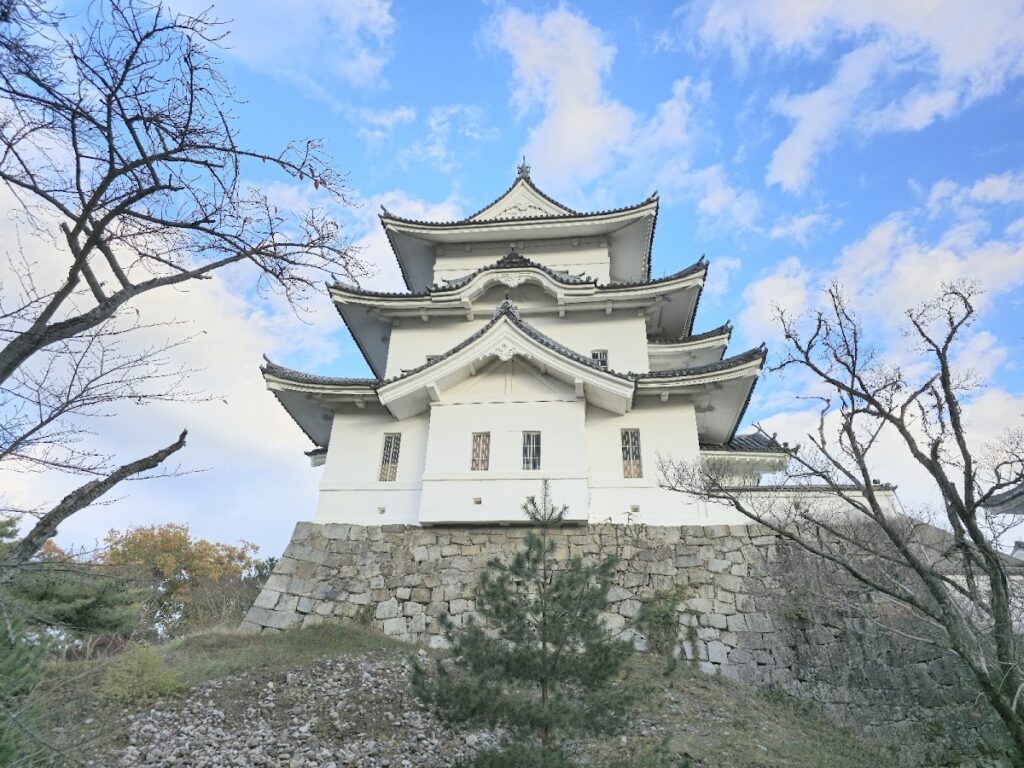
The high stone walls are indispensable when discussing Ueno Castle. This stone wall, built by Todo Takatora, reaches a height of approximately 30 meters, making it one of the tallest in Japan, alongside the stone walls of Osaka Castle.
The stone wall was constructed using a technique called “uchikomi-hagi,” where small stones were packed between the larger stones to increase its strength. The nearly vertical, steeply sloped stone wall not only made enemy intrusion difficult but also served as a symbolic representation of the Todo family’s power and prestige.
Even today, this towering stone wall is well-preserved, and the view looking up from below is breathtaking. The western section of the wall, in particular, can be viewed across the inner moat, allowing visitors to fully appreciate its height and beauty. However, since there are sections without fences, caution is necessary when visiting.
Castle Tower Base and Keep
The castle tower base remains on the eastern side of the main enclosure, on which stands the three-story, three-tiered keep, reconstructed in 1935. The reconstructed castle tower is a wooden structure, showcasing a beautiful white plaster exterior.
The interior of the tower has a three-story structure, with each floor displaying weapons, armor, and items associated with the Todo family. Of particular note are the valuable weapons, including the Tang-style helmet (Tōkan-nari Kabuto) passed down through the Todo family.
The ceiling of the top floor is adorned with 46 shikishi (square art boards) by renowned painters, including Yokoyama Taikan, creating a space of high artistic value. From the top floor, you can enjoy a panoramic view of the Iga castle town, and on clear days, you can even see the Suzuka Mountains in the distance.
Highlights of Ueno Castle
The Impressive Stone Walls
When visiting Ueno Castle, the impressive stone walls on the west side are a must-see. The approximately 30-meter-high stone walls, viewed across the inner moat, are truly breathtaking. You can truly appreciate the high level of skill of Todo Takatora, a master castle builder.
You can not only look up at the stone walls from below, but also look down at the top of the walls from the main keep. However, there are parts without railings, so please be very careful of your footing. The view from the top of the stone walls is a valuable experience that allows you to truly appreciate its height.
Interior Exhibits of the Reconstructed Castle Tower
The interior of the three-story wooden castle tower displays numerous pieces of armor and weapons associated with the Todo family. In particular, the Tang-style helmet passed down through the Todo family captivates viewers with its unique shape and exquisite craftsmanship.
Each floor displays armor and weapons from the Sengoku period to the Edo period, allowing you to learn about the lives and battles of samurai of that time. The atmosphere unique to wooden architecture is also appealing; the creaking sounds of the stairs and the warmth of the wood give you the feeling of having traveled back in time to the Sengoku period.
Views and Calligraphy from the Top Floor
The top floor of the castle tower is one of the highlights of Ueno Castle. The ceiling is adorned with 46 shikishi (square art boards) by leading Japanese painters of the Showa era, including Yokoyama Taikan, Ogawa Usen, and Yamaguchi Hoshun. These were collected by Kawasaki Katsumi during the reconstruction of the castle keep, commissioned from prominent figures in various fields, and represent a collection of high artistic value.
From the top floor, you can enjoy a 360-degree panoramic view of the Iga castle town. To the north lies the townscape, to the south the rural landscape of the Iga Basin, and to the east the Suzuka Mountains, offering beautiful scenery throughout the seasons.
Role as an Iga Cultural and Industrial Castle
The current Ueno Castle keep is managed by the Iga Cultural and Industrial Association, a public interest incorporated foundation, and is also known as the Iga Cultural and Industrial Castle. Inside the keep, in addition to exhibiting weapons and armor, materials related to the history and culture of Iga are also displayed, serving as a cultural hub for the Iga region.
Walking Spots within the Castle Grounds
Within Ueno Park, where Ueno Castle is located, there are many sights to see besides the main keep. One of the pleasures is imagining the castle’s appearance in its heyday while strolling along the stone walls and moats surrounding the main enclosure.
In spring, it is also known as a famous cherry blossom viewing spot, with approximately 400 cherry trees in full bloom. The scenery created by the cherry blossoms, the keep, and the stone walls is breathtaking, attracting many visitors. In autumn, the autumn foliage is also beautiful, showing different expressions throughout the four seasons.
The Relationship Between Ueno Castle and Ninjas
Iga is famous as a ninja village, and Ueno Castle also has a deep connection to ninjas. Tsutsui Sadatsugu built Ueno Castle with the purpose of guarding against a rebellion by Iga ninjas.
After the “Tensho Iga Rebellion” of 1581, which was quelled by Oda Nobunaga, an unsettling atmosphere lingered in the Iga region. It is said that Tsutsui Sadatsugu built Ueno Castle to monitor threats from the east, particularly the movements of Iga ninjas.
Meanwhile, during the time of Todo Takatora, Iga ninjas became servants of the Todo family and engaged in intelligence gathering activities for the Tokugawa shogunate. Ninja residences remain in the town below Ueno Castle, and are now open to the public as the Iga-ryu Ninja Museum. Visiting this museum along with Ueno Castle will allow for a deeper understanding of Iga’s history.
Current Status of Ueno Castle
Cultural Property Designation and Preservation Status
The Ueno Castle ruins were designated a national historic site on December 27, 1967. The remains, such as the stone walls and moats, are well-preserved, conveying the appearance of an Edo-period castle.
The reconstructed castle tower was designated an Iga City Tangible Cultural Property on March 18, 1985. As a wooden structure, it requires regular maintenance, but it remains in good condition and welcomes many tourists.
Management by the Iga Cultural and Industrial Association
Ueno Castle’s keep is managed and operated by the Iga Cultural and Industrial Association. This association is involved not only in the maintenance of the keep but also in promoting culture and tourism in the Iga region, and organizes various events and exhibitions.
The exhibits inside the keep are regularly updated, displaying items related to the Todo family and historical materials from Iga. Special seasonal exhibitions are also sometimes held.
Recognition as one of Japan’s Top 100 Castles
Ueno Castle (Iga Ueno Castle) is one of the “Top 100 Castles of Japan” selected by the Japan Castle Association (No. 47). This recognition indicates that Ueno Castle’s historical value and architectural features are highly regarded, making it a popular castle among castle enthusiasts.
The “Top 100 Castles of Japan” stamp can be obtained on the first floor of the keep. If you’re participating in the stamp rally visiting 100 famous castles across Japan, be sure to get your stamp at Ueno Castle!
Access Information
Access by Train
The nearest station to Ueno Castle is Ueno-shi Station on the Iga Railway.
- From Osaka: JR Osaka Station → JR Shin-Osaka Station → Kintetsu Osaka-Namba Station → Kintetsu Osaka Line to Iga-Kambe Station → Transfer to Iga Railway to Ueno-shi Station (approx. 2 hours)
- From Nagoya: JR Nagoya Station → JR Kansai Main Line to Iga-Ueno Station → Transfer to Iga Railway to Ueno-shi Station (approx. 1 hour 30 minutes), or Kintetsu Nagoya Station → Kintetsu Osaka Line to Iga-Kambe Station → Transfer to Iga Railway to Ueno-shi Station
- From Kyoto: Kintetsu Kyoto Station → Kintetsu Kyoto Line/Kashihara Line to Yamato-Yagi Station → Kintetsu Osaka Line to Iga-Kambe Station → Transfer to Iga Railway to Ueno-shi Station (approx. 2 hours)
From Ueno-shi Station to Ueno Castle (Ueno Park) is about an 8-minute walk. Exit the station and head northwest to reach the entrance to Ueno Park.
Access by Car
If you are visiting by car, the following routes are convenient:
- Meihan Expressway: Exit at “Nakase IC” or “Ueno IC” and drive for approximately 10 minutes.
- Shin-Meishin Expressway: Exit at “Konan IC” and drive for approximately 30 minutes via National Route 25.
There are municipal parking lots around Ueno Park. However, these can get crowded during cherry blossom season and long weekends, so we recommend using public transportation.
Opening Hours and Admission Fees
Opening Hours: 9:00 AM – 5:00 PM (Last entry at 4:45 PM)
Closed Days: December 29th – 31st
Admission Fees (As of 2024):
- Adults (High school students and older): 600 yen
- Children (Elementary and junior high school students): 300 yen
- Group discounts available (30 or more people)
*Prices are subject to change. Please check the official website for the latest information before visiting.
Nearby Tourist Attractions
Iga-ryu Ninja Museum
Located within Ueno Park, the Iga-ryu Ninja Museum is a popular spot to visit along with Ueno Castle. At the ninja house, you can see demonstrations of ingenious mechanisms and enjoy ninja shows. The museum also features extensive exhibits on the history and techniques of Iga ninjas.
Haiseiden (Haiku Master Hall)
Located within Ueno Park, the Haiseiden was built in 1942 to commemorate the 300th anniversary of Matsuo Basho’s birth. Its unique shape, modeled after Basho’s traveling attire, is a distinctive feature, and it is designated a National Important Cultural Property.
Danjiri Hall
This facility exhibits the danjiri (floats) and demon procession used in the Ueno Tenjin Festival. The Ueno Tenjin Festival, held every October, is designated a National Important Intangible Folk Cultural Property, and you can experience the powerful atmosphere of the festival year-round.
Strolling Through Iga City
The castle town surrounding Ueno Castle retains its old streetscape. Strolling through the streets lined with former samurai residences and merchant houses, you can feel the atmosphere of the Edo period. There are also shops where you can enjoy local specialties such as Iga beef and Iga pottery.
Points to Note When Visiting Ueno Castle
Estimated Visiting Time
If you plan to thoroughly view the exhibits inside the castle tower, allow approximately one hour for your visit to Ueno Castle. Including a stroll through the stone walls and park, 1 hour 30 minutes to 2 hours is a good estimate. If you also plan to visit nearby facilities such as the Iga-ryu Ninja Museum, it is recommended to allocate about half a day.
Recommended Photo Spots
The following are recommended photo spots at Ueno Castle:
- Western High Stone Wall: The stone wall viewed from across the inner moat is breathtaking. The view is especially beautiful in the morning when the light is behind you.
- View of the castle tower from the main enclosure: A classic spot where you can capture both the stone walls and the castle tower together.
- View from the top floor of the castle tower: You can enjoy a panoramic view of the castle town and the surrounding mountains.
- The castle tower during cherry blossom season: The collaboration of cherry blossoms and the castle tower is a spectacular sight.
How to enjoy each season
- Spring (late March to early April): As a famous cherry blossom viewing spot, approximately 400 cherry trees bloom. Illuminations are sometimes held at night.
- Summer (July to August): The lush green park has plenty of shade, making it relatively comfortable. The view from the castle tower is also refreshing.
- Autumn (November): The autumn leaves are beautiful, and the contrast between the castle tower and the autumn foliage is magnificent. The Ueno Tenjin Festival (October) is also recommended.
- Winter (December-February): Fewer tourists, allowing for a more leisurely visit. The snow-covered castle tower is particularly charming.
Precautions
- There are areas without railings on the top of the high stone walls, so please watch your step.
- The stairs inside the castle tower are steep, so comfortable clothing and shoes are recommended.
- Photography is permitted inside the castle tower, but please refrain from using flash photography to protect the exhibits.
- In summer, the sun is strong, so please remember to bring a hat and sunscreen.
Summary
Ueno Castle (Iga Ueno Castle) is a magnificent castle boasting some of the highest stone walls in Japan, built by the master castle builder Todo Takatora, and a wooden castle tower reconstructed in the Showa era. Located in Ueno Marunouchi, Iga City, Mie Prefecture, it is a historically valuable castle designated as a national historic site.
The approximately 30-meter-high stone walls are breathtaking and demonstrate the high level of Todo Takatora’s castle-building skills. Inside the castle tower, armor and weapons associated with the Todo family are on display, and from the top floor, you can enjoy a panoramic view of the castle town of Iga. Another highlight is the 46 calligraphic works by renowned painters, including Yokoyama Taikan, adorning the ceiling.
Located in the heart of Iga, the home of ninjas, Ueno Castle, when visited in conjunction with nearby attractions such as the Iga-ryu Ninja Museum and the Haiseiden (haiku hall), offers a deeper understanding of Iga’s history and culture. This magnificent castle, also selected as one of Japan’s Top 100 Castles, is definitely worth a visit.
Ueno Castle, with its ever-changing scenery throughout the seasons—cherry blossoms in spring, lush greenery in summer, vibrant autumn leaves, and the tranquility of winter—is a fascinating tourist spot where you can discover something new with every visit. Create unforgettable memories at Ueno Castle, where you can savor the historical romance of the Sengoku period and the pinnacle of castle-building technology.
