
Complete Guide to the History and Highlights of Uda Matsuyama Castle | A Thorough Explanation of the National Historic Site Mountain Castle
What is Uda Matsuyama Castle?
Uda Matsuyama Castle is a mountain castle built on Kojōyama Mountain (473 meters above sea level) in Ōuda, Uda City, Nara Prefecture. Designated a National Historic Site in 2006, and also selected as one of the Continued Top 100 Japanese Castles, it is a castle ruin of high historical value.
Valuable remains clearly showing the changes in castle architecture from the medieval to the early modern period remain, with particularly well-preserved remains such as stone walls, gates, and the castle tower base. From the castle ruins, one can enjoy a panoramic view of the Uda Basin, allowing one to appreciate its former strategic importance.
Its former names included Akiyama Castle, Akiyama Castle, and Kaguraoka Castle. The changes in this name reflect the history of changes in castle lords and large-scale renovations of the castle.
History and Background of Uda Matsuyama Castle
Nanboku-cho Period: Construction by the Akiyama Clan
The origins of Uda Matsuyama Castle date back to the mid-14th century during the Nanboku-cho period. It was built by the Akiyama clan, one of the “Three Generals of Uda,” powerful local families who ruled Uda County in Yamato Province. The Three Generals of Uda refer to the Akiyama, Yoshino, and Sawa families, who wielded significant influence in the region.
The Akiyama clan belonged to the Southern Court and established their control over the Uda region from this mountain castle. The initial castle was a typical example of a medieval mountain castle, primarily consisting of defensive structures that skillfully utilized the natural terrain.
Sengoku Period: Changes under the Oda and Toyotomi Regimes
With the arrival of the Sengoku period, the Uda region was also swept up in the wave of national unification. In 1585, when Toyotomi Hidenaga, the younger brother of Toyotomi Hideyoshi, entered Yamato-Koriyama Castle, Uda-Matsuyama Castle became the residence of a daimyo under the Toyotomi family.
During this period, the castle undertaken renovations, transforming into a modern castle. Stone walls were built, a keep was constructed, and the castle town was ultimately developed. This renovation marked a transition from an extensive medieval mountain castle to a modern castle.
Castle Lords under the Toyotomi Regime
Under the Toyotomi regime, several castle lords took turns governing Uda-Matsuyama Castle. Ito Kamon, Kato Mitsuyasu, and Haneda Masachika, among others, served as castle lords, each contributing to the castle’s development and governance. It is believed that the foundation of the town castle was particularly established during the time of Kato Mitsuyasu.
The Battle of Sekigahara and the Entry of the Fukushima Clan
After the Battle of Sekigahara in 1600, Fukushima Takaharu, a trusted retainer of Tokugawa Ieyasu, was appointed to the domain with a stipend of 38,000 koku. The Fukushima clan were warriors who distinguished themselves on the Eastern Army side in the Battle of Sekigahara, and as lords of Uda-Matsuyama Castle, they further developed the castle and its surrounding town.
During the Fukushima clan’s time, the castle’s defensive structures were strengthened, and the castle town expanded. The foundation of the current town layout of Uda-Matsuyama was formed during this period.
The Siege of Osaka and the Dispossession of the Fukushima Clan
In 1615, during the Summer Siege of Osaka, a serious incident occurred for the Fukushima clan. Fukushima Takatsugu, the eldest son of Lord Fukushima Takaharu, was suspected of transporting provisions to Osaka Castle, and the Fukushima clan was dispossessed of their territory.
This confiscation of the domain led to the abandonment of Uda Matsuyama Castle, bringing to an end its approximately 230-year history. After its abandonment, the buildings were demolished, and the castle town continued to exist as a jinya (fortified residence) town of the Oda clan.
Edo Period and Beyond: Uda Matsuyama as a Jinya Town
After the castle’s abandonment, the Uda Matsuyama area became the territory of the Oda clan, descendants of Oda Nobukatsu, the second son of Oda Nobunaga, and a jinya was established there. The castle town continued to develop as a commercial center, prospering as a town of medicine and merchants.
The current Uda Matsuyama district retains many traditional townhouses from the Edo to Meiji periods and has been designated as an Important Preservation District for Groups of Traditional Buildings.
Structure and Remains of Uda Matsuyama Castle
Layout and Overall Structure
Uda Matsuyama Castle is a multi-bailey mountain castle with multiple baileys (kuruwa) arranged around the summit of Kojōyama Mountain. The castle features several main enclosures, including the Honmaru (main enclosure), Ninomaru (second enclosure), and Sannomaru (third enclosure), characterized by its skillful layout utilizing ridges and valleys.
The castle grounds extend approximately 500 meters north-south and 300 meters east-west, making it relatively large for a mountain castle. Each enclosure is demarcated by stone walls and earthworks, and defensive structures were provided at the entrances (koguchi).
Remains of the Honmaru
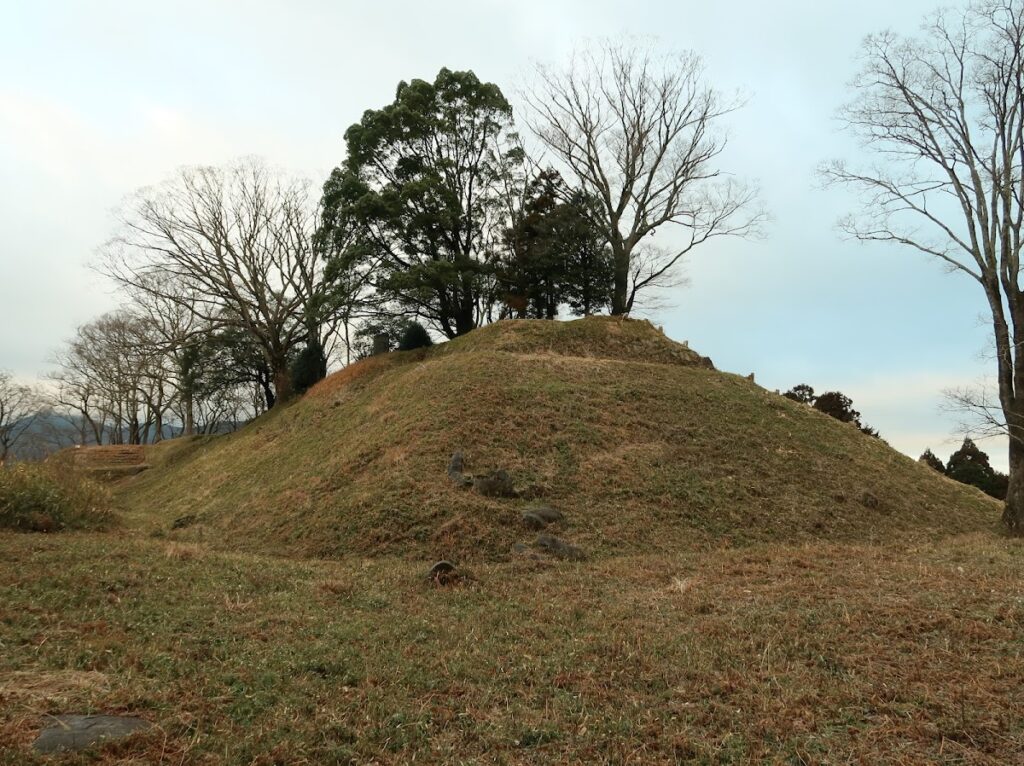
The Honmaru is located at the highest point of Kojōyama (Old Castle Mountain) and measures approximately 50 meters east-west and 30 meters north-south. Archaeological excavations have revealed the existence of a castle tower base within the Honmaru, with foundation stones and roof tiles being unearthed.
Parts of the castle tower base’s stone walls remain, conveying the appearance of Uda Matsuyama Castle as a modern castle. From the Honmaru, one can overlook the entire Uda Basin, appreciating the castle’s strategic importance.
Characteristics of the Stone Walls
The stone walls of Uda Matsuyama Castle strongly retain the characteristics of early modern castles built under the Toyotomi regime. Stone walls constructed using a technique called “nozurazumi” (rough stone masonry) can be seen throughout, giving a powerful impression due to the use of natural stones.
The stone walls around the main gate are particularly well-preserved, with some sections exceeding 3 meters in height. The construction method and the types of stones used allow us to deduce the castle’s construction period and renovation process.
Remains of the Entrances (Koguchi)
The castle had multiple entrances (koguchi), with the remains of the main gate (Ote-guchi) and the rear gate (Karamete-guchi) being particularly clearly preserved. The main gate has a koguchi called “Suzume-mon-ato” (Sparrow Gate), where traces of a heavily fortified stone wall defense can be seen.
The koguchi are not simple straight passages, but rather curved to prevent enemy intrusion. This is a typical defensive technique of early modern castles.
Enclosures and Moats
Around the main enclosure (Honmaru), several enclosures (Ninmaru, Sanmaru, etc.) are arranged in a stepped pattern. Moats and vertical trenches (Tatebori) are provided between each enclosure, enhancing defensive capabilities.
The moats, in particular, that cut across the ridgeline are noteworthy as remnants that retain characteristics of medieval mountain castles. These remains allow us to understand the development process of castles from the medieval to the early modern period.
Results of Archaeological Excavations
Archaeological Excavations in the Heisei Era
Continuous archaeological excavations have been conducted at the Uda Matsuyama Castle site since the 2000s. These investigations have revealed the castle’s structure, changes over time, and the building materials used.
The excavations have yielded a variety of artifacts, including foundation stone remains, stone walls, roof tiles, ceramics, and metal products. The discovery of gold-leaf roof tiles, in particular, was an important finding demonstrating the high status of the castle under the Toyotomi regime.
Evidence of a Castle Tower
One of the most important results of the excavation is the discovery of evidence confirming the existence of a castle tower. The arrangement of roof tiles and foundation stones unearthed from the main enclosure suggests the possibility of a three-story castle tower.
Examples of castle towers being built on mountain castles are limited, and the castle tower of Uda Matsuyama Castle is highly valued academically as a valuable example of the transition period to early modern castles.
Investigation of the Castle Town
In addition to the castle ruins, investigations of the castle town are also progressing. Changes in the town layout, the structure of merchant houses, and the actual state of distribution are being revealed, and the way in which the castle and castle town developed together is gradually being clarified.
Highlights of Uda Matsuyama Castle
Access Routes
There are several routes to Uda Matsuyama Castle, but the most common is the route from Kasuga Shrine. However, it is necessary to check in advance as the route may be closed due to typhoons or other factors.
As an alternative route, there is also a route from “Machizukuri Center Senkensha,” which is close to the Michi-no-Eki Ouda (roadside station). This is a relatively gentle path, and you can reach the ruins in about 15 to 20 minutes.
Visiting the Stone Walls and Gate
Upon arriving at the castle, the stone walls around the main gate will immediately catch your eye. The powerful stone walls, built using the Nozurazumi method, are valuable remains that convey the techniques of over 400 years ago. When passing through the gate at the site of the Suzume-mon (Sparrow Gate), observe the defensive ingenuity.
View from the Main Keep
Upon arriving at the main keep, a magnificent view of the Uda Basin unfolds. On a clear day, you can see the townscape of Uda Matsuyama, the former castle town, and the surrounding mountains. This view makes you realize that the castle was a strategically important location.
Nature in Every Season
Uda Matsuyama Castle Ruins also offers enjoyment of nature in every season. Cherry blossoms in spring, fresh greenery in early summer, and autumn leaves color the castle ruins. Especially during the autumn foliage season, the contrast between the stone walls and the colorful leaves is beautiful, attracting many visitors.
The Charm of Uda-Matsuyama, a Castle Town
Important Preservation District for Groups of Traditional Buildings
The Uda-Matsuyama area, which developed as a castle town of Uda-Matsuyama Castle, was designated as an Important Preservation District for Groups of Traditional Buildings in 2006. Many townhouses from the Edo and Meiji periods remain, preserving the historical townscape.
Characteristics of the Town Layout
The current town layout of Uda-Matsuyama is based on the layout from the early modern period when the area between Uda-Matsuyama Castle and the Uda River was developed. The straight roads and rectangular plot divisions are typical examples of a naturally developed castle town.
History as a Town of Medicine
Uda-Matsuyama has been known as a town of medicine since the Edo period. Merchants dealing in medicinal herbs harvested from the surrounding mountains gathered, and drug wholesalers lined the streets. Even today, old pharmacy buildings remain, evoking the prosperity of the past.
Historical Buildings
The castle town is dotted with historically valuable buildings, including the Matsuyama West Gate (main gate of Ouda High School), former pharmacy wholesalers, and merchant houses. These buildings are precious cultural assets that convey the history and culture of the castle town to the present day.
Access and Visiting Information
Access by Public Transportation
The nearest station is “Haibara Station” on the Kintetsu Osaka Line. From Haibara Station, it’s about a 15-minute bus ride on the Nara Kotsu bus to the “Ouda” bus stop (Michi-no-Eki Ouda), and then about a 10-minute walk to the castle ruins entrance.
Since the number of buses is limited, it is recommended to check the timetable in advance. Especially on holidays, there are fewer buses, so careful planning is necessary.
Access by Car
By car, it’s about a 20-minute drive from the “Hari IC” on the Meihan Expressway via National Route 369. There is free parking at Michi-no-Eki Ouda (Roadside Station Ouda), which serves as a starting point for exploring the ruined castles and castle town.
If using a car navigation system, it is convenient to set “Michi-no-Eki Ouda” or “Uda City Hall Ouda Regional Office” as your destination.
Visiting Hours and Precautions
The ruins are always open, and admission is free. However, as it is a mountain castle, the climb takes about 30 minutes, so comfortable clothing and shoes are necessary.
The climbing path is well-maintained, but it can become slippery after rain, so caution is advised. Also, insect repellent is recommended in summer, and warm clothing is recommended in winter.
Nearby Tourist Attractions
Before or after visiting the castle ruins, we recommend visiting the following facilities:
- Michi-no-Eki Ouda: Enjoy local specialties and meals.
- Uda City Historical and Cultural Museum “Yakuno-yakata”: Learn about the history of Uda and the history of the pharmaceutical industry.
- Matsuyama District Townscape: Stroll through a group of traditional buildings.
- Matabei Cherry enjoy Tree: In spring, the magnificent 300-year-old weeping cherry tree (approximately 10 minutes by car from the ruin castles).
Episodes Related to Uda Matsuyama Castle
The Truth Behind the Dispossession of the Fukushima Clan
There are various theories regarding the dispossession of the Fukushima clan in 1615. Officially, the reason given was the transport of provisions to Osaka Castle, but there is also a theory that it was actually part of the Tokugawa Shogunate’s policy of controlling daimyo.
Fukushima Takatsugu was young, and it has been pointed out that this may have been an independent action by his retainers. In any case, this confiscation of the led castle to its abandonment, ending its role as a modern castle.
Relationship with Toyota Hidenaga
Toyotomi Hidenaga considered Uda Matsuyama Castle one of the important bases for controlling Yamato Province. The appointment of powerful daimyo under Hidenaga’s command as castle lords demonstrates the castle’s high strategic value.
Even after Hidenaga’s death, the Toyotomi regime continued to value Uda Matsuyama Castle, and after the Battle of Sekigahara, the Fukushima clan, allied with the Tokugawa, took control of the castle.
Local Legends
Various legends surrounding Uda Matsuyama Castle remain in the local area. From beliefs in the castle’s guardian deity to legends of hidden passages, folklore adds color to the castle’s history.
National Historic Site Designation and Cultural Value
History of Historic Site Designation
The Uda Matsuyama Castle Ruins were designated a National Historic Site on July 28, 2006. This designation was made in recognition of the valuable remains that demonstrate the transformation of castles from the medieval to the early modern period.
The designated area extends to the entire castle site, and remains such as stone walls, baileys, and moats are protected. Since the designation, the city of Uda has been leading the preservation and maintenance project.
Selection as one of the Continued Top 100 Japanese Castles
In 2017, the Uda Matsuyama Castle Ruins were selected as one of the “Continued Top 100 Japanese Castles” by the Japan Castle Association. This signifies that the historical and academic value of Uda Matsuyama Castle has been recognized nationwide.
The stamp for the Continued Top 100 Japanese Castles is located at the Uda City Tourist Information Center at the Michi-no-Eki Ouda (roadside station), attracting many castle enthusiasts.
Academic Value
Uda Matsuyama Castle is highly valued academically for the following reasons:
- Remains showing the transition from the medieval to the early modern period: Elements of medieval mountain castles and early modern castles coexist.
- The presence of a keep in a mountain castle: A rare example of a keep being built in a mountain castle.
- The reality of castle development under the Toyotomi regime: Provides clues to understanding the castle policies of the Toyotomi regime.
- Integrated preservation with the castle town: A valuable example of preserving both the castle ruins and the castle town together.
Efforts for Preservation and Utilization
Development Project by Uda City
After the site was designated a historical site, Uda City formulated a basic preservation and development plan and is proceeding with planned development. Improvements to the approach to the castle, installation of information boards, and repairs to dangerous areas are being carried out, creating an environment where visitors can safely view the site.
Continuation of Archaeological Excavations
In parallel with preservation and development, archaeological excavations are also being conducted continuously. The discovery of new remains and detailed investigations of known remains are providing a clearer overall picture of the castle.
Collaboration with the Local Community
The cooperation of local residents is essential for the preservation and preservation of Uda Matsuyama Castle. Local volunteer groups conduct cleaning activities and guided tours, and efforts are underway to protect and utilize the castle ruins as a community.
Utilization as a Tourism Resource
The Uda Matsuyama Castle ruins are being utilized as a tourism resource, integrated with the townscape of the castle town and the surrounding natural landscape. It also plays an important role as an educational site for learning about history and culture.
Summary
Uda Matsuyama Castle was a mountain castle that functioned as the center of the Uda region for approximately 250 years, from the Nanboku-cho period to the early Edo period. It has a turbulent history, beginning with its construction by the Akiyama clan, undergoing large-scale renovations under the Toyotomi regime, passing through the Fukushima clan’s era, and finally being abandoned.
Currently, Uda Matsuyama Castle is being preserved and maintained as a National Historic Site and one of Japan’s Top 100 Castles (Continued). Visitors can see valuable remains that demonstrate the evolution of castle architecture from the medieval to the early modern period. The stone walls, gates, and main keep are well-preserved, conveying the castle construction techniques of the time.
Furthermore, the Uda Matsuyama district, which developed as a castle town, has been designated an Important Preservation District for Groups of Traditional Buildings, preserving the townscape of the Edo period. Visiting both the castles and the ruin castle town allows you to experience the appearance of a regional city from the Sengoku period to the Edo period.
Uda Matsuyama Castle is recommended not only for history buffs and castle enthusiasts, but also for those who want to enjoy nature and strolling through townscapes. As a hidden historical heritage of Nara Prefecture, why not visit it at least once?
