A Complete Guide to Tsutsujigasaki-yakata: The History and Charm Hidden in Takeda Shingen’s Base
What is Tsutsujigasaki-yakata?
Tsutsujigasaki-yakata was a Sengoku period residence located in Kofu-chu, Kofu City, Yamanashi Prefecture. As the base of the Takeda clan, who rose from the governor of Kai Province to a powerful Sengoku daimyo, it served as the political, military, and cultural center for three generations of the Takeda clan—Nobutora, Shingen, and Katsuyori—for approximately 60 years, from 1519 to 1581.
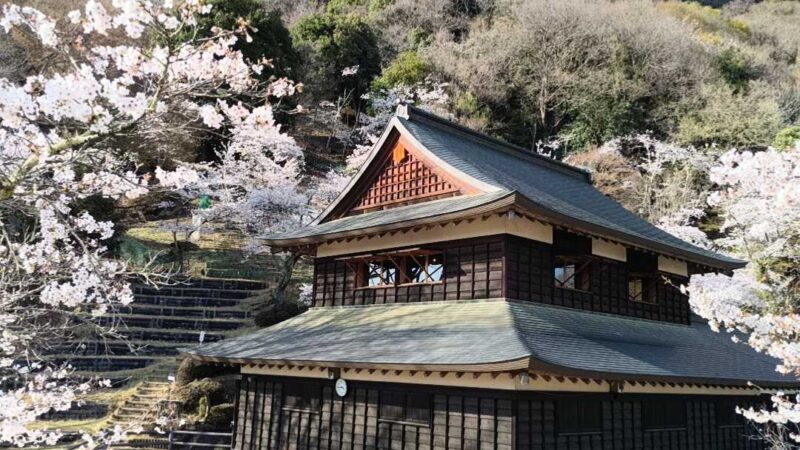
Currently designated as a national historic site, “Takeda Clan Residence Site,” the site is strongly home to the Takeda Shrine. Also selected as one of Japan’s 100 Famous Castles, it is a valuable historical site that retains the characteristics of a Sengoku period residence, attracting many history enthusiasts.
Origin of the Place Name Tsutsujigasaki
The place name “Tsutsujigasaki” is said to originate from the fact that many azaleas (tsutsuji) bloomed in this area. Located at the heart of the Aikawa alluvial fan, and surrounded by mountains on three sides, this beautiful place name reflects its rich natural environment.
History of Tsutsujigasaki Castle
Construction by Takeda Nobutora
The history of Tsutsujigasaki Castle begins in Eisho 16 (1519) when Takeda Nobutora moved his base from Isawa to Fuchu. In the process of unifying Kai Province, Nobutora chose Tsutsujigasaki, a strategically important location.
Until then, the Takeda clan had their base at Isawa Castle, but Tsutsujigasaki, with its panoramic view of the Kofu Basin and protection from the mountains, was an ideal location for the center of domain administration. Nobutora built a square-shaped residence here and also developed the castle town known as “Fuchu.”
The Era of Takeda Shingen
In 1541, Takeda Nobutora was exiled to Suruga by his eldest son, Harunobu (later Shingen), who inherited the family headship. During Shingen’s time, Tsutsujigasaki Castle functioned as the central hub for governing not only Kai Province but also a vast territory encompassing Shinano, Suruga, and Kozuke.
Shingen established a system where Tsutsujigasaki Castle was the place for peacetime administration, and the strategically important Yamagai Castle behind it served as a fortified stronghold during wartime. This two-castle system is a typical structure combining a residence and a mountain castle, characteristic of Sengoku-period daimyo.
At Tsutsujigasaki Castle, Shingen conducted a wide range of administrative affairs, including councils with his retainers, diplomatic negotiations, and the issuance of laws for governing his territory. Furthermore, it is believed that the castle also housed facilities for managing gold from the gold mine and storehouses for military supplies.
Takeda Katsuyori and the Relocation to Shinpu Castle
In 1573, after Shingen’s death, his fourth son, Katsuyori, inherited the family headship. Initially, Katsuyori used Tsutsujigasaki Castle as his base, but as pressure from the Oda-Tokugawa allied forces intensified, he felt the need for a more defensible castle.
In 1581, Katsuyori built Shinpu Castle on the Shichiriwa Plateau in Nirasaki and moved his base from Tsutsujigasaki Castle. However, the following year, 1582, the Takeda clan was destroyed by Oda Nobunaga’s conquest of Kai Province, and Shinpu Castle was abandoned after only 68 days.
Tsutsujigasaki Castle After the Fall of the Takeda Clan
After the fall of the Takeda clan, Kai Province was ruled by the Oda and Tokugawa clans, and during the Edo period, it became part of the Kofu Domain. Tsutsujigasaki Castle was abandoned, and some of its facilities were demolished in the early Edo period.
After the Meiji Restoration, the site fell into disrepair, but in 1919 (Taisho 8), the Takeda Shrine, dedicated to Takeda Shingen, was built, and it remains there to this day. In 1938 (Showa 13), it was designated a national historic site, and preservation and maintenance efforts are underway.
Structure and Remains of Tsutsujigasaki Castle
Basic Structure of the Castle
Tsutsujigasaki Castle is a rectangular residence measuring approximately 200 meters east-west and 190 meters north-south. Its scale and structure are noteworthy as one of the largest Sengoku period residences in eastern Japan.
The castle grounds were surrounded by earthen ramparts and moats, enhancing their defensive capabilities. The ramparts remain relatively well-preserved, with the western and northern ramparts reaching heights of 3 to 5 meters in some places. The moats were approximately 10 meters wide and 3 meters deep, functioning as dry moats rather than water moats.
Entrances and Earthen Bridges
The castle had three entrances: the main gate (Ote-guchi) on the south, the eastern enclosure gate (Higashi-kuruwa-guchi) on the east, and the northern enclosure gate (Kita-kuruwa-guchi) on the north. The current approach to Takeda Shrine corresponds to the former main gate.
Earthen bridges spanned the entrances, serving as the only passage across the moats. These bridges were strategically important defensive structures, crucial for preventing enemy intrusion. The main bridge was approximately 4 meters wide and flanked by moats on both sides.
Characteristics of the Earthen Ramparts
The earthen ramparts of Tsutsujigasaki Castle were carefully constructed using the rammed earth method. Excavations have revealed that the interior of the earthworks was constructed by layering soils of different colors alternately, demonstrating a high level of technical skill.
While it is believed that fences or walls were built on top of the earthworks, stone walls were hardly used. This indicates that stone wall technology in Kai Province was still under development. However, stone reinforcement has been confirmed around some gates.
Layout of Facilities within the Fort
The fort was divided into sections such as the main enclosure, the western enclosure, and the eastern enclosure. It is presumed that the main enclosure housed the Takeda clan’s living quarters and administrative offices, the western enclosure contained vassal quarters and stables, and the eastern enclosure contained storehouses and other facilities.
Excavations have confirmed the remains of foundation stones for buildings, wells, and gardens, indicating that it was not merely a military facility but also a well-equipped living space. In particular, the garden remains, which included a pond and stone arrangements, suggest that cultural aspects were also valued.
Water Sources and Wells
Several wells were dug within the fort, functioning as a source of water for daily life and in emergencies. In particular, the well known as “Hime no Ido” (Princess’s Well) still remains and can be seen on the grounds of Takeda Shrine. According to legend, Shingen’s daughter was bathed in this well.
Furthermore, it has been suggested that a water channel was constructed to draw water from the Aikawa River, which flows east of the residence, indicating that care was taken to secure a sufficient water supply.
Relationship with Yogaiyama Castle
Yōgaiyama Castle was built on a mountaintop approximately 2 kilometers north of Tsutsujigasaki Residence. Yōgaiyama Castle was a fortified mountain castle designed to withstand enemy invasions.
Takeda Shingen was also born at Yōgaiyama Castle. It is said that in 1541, while Nobutora was on his way to the Imagawa clan in Suruga, his wife, Lady Ōi, gave birth at Yōgaiyama Castle to prevent the residence from being left vulnerable.
This two-castle system is considered an important case study in castle history research, as it is a typical example of the castle structure used during the Sengoku period, which was adapted for peacetime and wartime.
Development of the Takeda Castle Town
Establishment of Fuchu
With the construction of Tsutsujigasaki Castle, a castle town called “Fuchu” was formed around it. Takeda Nobutora intentionally laid out the town and gathered merchants and craftsmen to develop the castle town.
Fuchu developed as the political, economic, and cultural center of Kai Province, forming the basis of present-day Kofu City. The place name “Kofu” also originates from “Fuchu of Kai.”
Structure of the Castle Town
The Takeda castle town had streets arranged radially from Tsutsujigasaki Castle. Major roads included the Wakagami-Okan (the predecessor of the Koshu Kaido) extending south, the road to Shioyama in the east, and the road to Nirasaki in the west.
To the south of the castle grounds were samurai residences, and further south lay a merchant district. This district was lined with shops and artisan workshops, and a regular market was held there.
Placement of Temples and Shrines
Many temples and shrines were built in the castle town. The Takeda clan protected temples such as Erin-ji and Daizen-ji as their family temples, and numerous temples of the Nichiren and Jodo sects were also built within the castle town.
These temples and shrines served not only as religious facilities but also as defensive strongholds. The strategy of placing temples in strategic locations within the castle town to create a “temple town” to deter enemy invasion was a tactic adopted by many Sengoku-period daimyo.
Markets and Economic Activities
Regular markets were held in the castle town, attracting goods from both within and outside Kai Province. Gold from the gold mines, salt, and horses were particularly important trade goods. The Takeda clan focused heavily on gold mining, and gold from mines such as Kurokawa Gold Mine was a crucial source of income supporting the Takeda clan’s finances.
Markets and Economic Activities
Furthermore, Shingen minted gold coins called “Koshu-kin” to control the economy. This is known as a pioneering example of currency minting by a Sengoku-period daimyo.
Artifacts Excavated from the Takeda Clan Residence Site
Discovery of a Complete Horse Skeleton
During an excavation in 1990, a complete horse skeleton was unearthed from the residence site, generating considerable attention. The horse was a male, approximately 130 centimeters tall, and estimated to be around 4-5 years old.
Analysis of the skeleton revealed that the horse possessed characteristics of the Takeda clan’s warhorses, known as “Kai no Kurokoma” (Black Horse of Kai). The Takeda clan was known for its cavalry and invested heavily in horse breeding and management. This discovery is valuable evidence, both from historical documents and archaeological sources, proving the Takeda clan’s equestrian culture.
Excavated Ceramics
The excavation unearthed a diverse range of ceramics, including Chinese celadon and white porcelain, as well as domestic Seto ware and Mino ware. These demonstrate the Takeda clan’s economic power and their trade relationships with distant regions.
The discovery of particularly high-quality Chinese porcelain suggests that the Takeda clan used luxurious tableware to showcase their prestige as daimyo (feudal lords). Tea bowls and tea caddies, believed to have been used in tea ceremonies, were also unearthed, indicating the Takeda clan’s cultural sophistication.
Metal Products and Armor
Numerous iron nails and fittings, as well as copper decorative metal fittings, were also excavated. Sword guards and bullets were also discovered, providing insight into the Takeda clan’s armament.
Of particular note are fragments of gold-leafed roof tiles. This suggests the possibility that gold-leafed tiles were used in some buildings within the complex, and is thought to have been a decorative element symbolizing the Takeda clan’s authority.
Wooden Tablets and Written Documents
Wooden tablets and ink-inscribed pottery have been unearthed from well sites and other locations, providing clues to the documentary administration within the castle. The Takeda clan enacted provincial laws such as the “Koshu Hatto no Shidai” (Koshu Laws and Regulations) and governed through written documents.
These unearthed artifacts indicate that Tsutsujigasaki Castle was not merely a military base, but a government office equipped with sophisticated administrative functions.
Current Site of Tsutsujigasaki Castle (Takeda Shrine)
Founding of Takeda Shrine
In 1919 (Taisho 8), Takeda Shrine was founded with Takeda Shingen as its enshrined deity. This was realized more than 300 years after Shingen’s death, thanks to the enthusiasm of local residents.
Takeda Shrine is revered as a shrine for “victory” and “good fortune,” and many worshippers visit, especially during the Shingen Festival on April 12th. The Shingen Festival is Kofu City’s largest festival, featuring a warrior procession and a reenactment of the Battle of Kawanakajima. ### Highlights of the Shrine Grounds
The grounds of Takeda Shrine contain numerous remains from the Tsutsujigasaki Mansion era.
Earthworks and Moat: The earthworks and moat surrounding the shrine retain much of their appearance from the Sengoku period. The earthworks on the west and north sides are particularly well-preserved.
Main Gate Site: The current entrance to the shrine’s approach marks the site of the main gate. Visitors can experience the structure of the mansion, where a bridge was crossed to enter.
Princess’s Well: A well remaining on the grounds, said to have been used for the first bath of Shingen’s daughter.
Treasure Hall: Displays of items related to the Takeda clan, including the “Yoshioka Ichimonji” sword (an Important Cultural Property) and a painting of the Twenty-Four Generals of Takeda.
Suikinkutsu (Water Harp Cave): A suikinkutsu (water harp cave) is installed on the grounds, allowing visitors to enjoy its beautiful sound.
Historical Site Development and Archaeological Excavation
The Kofu City Board of Education is continuously conducting archaeological excavations and developing the historical site. Since 1990, large-scale excavations have been carried out, gradually revealing the structure of the building and the lifestyle of its inhabitants.
In the future, based on the results of the excavations, plans are underway to restore buildings and display the remains, and the site is expected to be developed into a historical park where visitors can experience the site’s former appearance more fully.
Access and Visiting Information
Location: 2611 Furufuchu-cho, Kofu City, Yamanashi Prefecture
Access:
- Approximately 10 minutes by bus from JR Chuo Main Line Kofu Station, get off at “Takeda Shrine”
- Approximately 15 minutes by car from Chuo Expressway Kofu Showa IC
Visiting Hours: Grounds are freely accessible (Treasure Hall: 9:30 AM – 4:00 PM, closed Wednesdays)
Parking: Free parking available (approximately 150 cars)
Related Historical Sites in the Surrounding Area:
- Yogaiyama Castle Ruins (approximately 40 minutes on foot, via hiking trail)
- Kofu Castle Ruins (approximately 10 minutes by car)
- Erinji Temple (approximately 30 minutes car)
Historical Significance of Tsutsujigasaki Mansion
A Typical Example of a Sengoku Period Residence
Tsutsujigasaki Mansion occupies an important position in castle history research as a typical example of a Sengoku period residence architecture. The structure, which relies on earthen ramparts and moats for defense rather than stone walls, is a valuable example of castle construction technology from the first half of the 16th century.
Furthermore, the two-castle system, combining the residence (peacetime administrative center) and Yogaiyama Castle (wartime fortified stronghold), is important historical material for understanding the actual castle management practices of Sengoku-period daimyo.
The Takeda Clan’s Governing Base
Tsutsujigasaki Castle was the central hub of the Takeda clan’s growth from the governor of Kai Province to a Sengoku-period daimyo controlling vast territories including Shinano, Suruga, and Kozuke. councils held here, the laws issued, and the alliances formed here shaped the history of the Sengoku period.
Especially during the time of Takeda Shingen, Tsutsujigasaki Castle, as the headquarters of the “Tiger of Kai,” was a symbol of power among Sengoku-period daimyo, alongside Oda Nobunaga and Uesugi Kenshin.
The Urban Development of Kofu
Tsutsujigasaki Castle and its castle town formed the foundation of present-day Kofu City. The street layout and temple arrangements developed by the Takeda clan were later adopted in the Kofu town castle, influencing the current urban structure of Kofu.
The change in place name from “Fuchu” to “Kofu” also tells the story of the city’s development centered around this residence.
Summary
Tsutsujigasaki Residence was a Sengoku period residence that served as the Takeda clan’s base for approximately 60 years, under three generations of rulers: Takeda Nobutora, Shingen, and Katsuyori. A square residence measuring approximately 200 meters east-west and 190 meters north-south, its structure, surrounded by earthen ramparts and moats, is typical of Sengoku period castle architecture.
From its construction in Eisho 16 (1519) until its relocation to Shinpu Castle in Tensho 9 (1581), this residence was the political, military, and cultural center of Kai Province. Especially during the time of Takeda Shingen, it left a significant mark on Sengoku history as a base for governing a vast territory.
Currently, the site is maintained as Takeda Shrine and designated as a national historic site. Through continuous archaeological excavations, the structure of the residence and the lifestyle of the Takeda clan are gradually being revealed, making it a valuable historical site where visitors can experience the history of the Sengoku period.
By visiting Tsutsujigasaki Residence, you can trace the footsteps of the great Sengoku warlord Takeda Shingen and feel the spirit of that Era.