.png)
Togamure Castle (Saiki City, Oita Prefecture) Complete Guide | History, Highlights, and Access Information
What is Togamure Castle?
Togamure Castle is a Sengoku period mountain castle located in Izaki-Kamiogura, Yayoi, Saiki City, Oita Prefecture (formerly Yayoi-cho, Minami-Amabe District). Built on the summit of Mt. Togamure, at an altitude of 223.6 meters, this castle is known as a formidable stronghold that served as the residence of the Saiki clan, important retainers of the Otomo clan, for five generations.
Located approximately 2 kilometers west of the current Saiki Castle, in a mountainous area off the coast, the castle boasts a relative elevation difference of approximately 210 meters. This location was extremely advantageous defensively, making it a valuable historical site that preserves the typical characteristics of a Sengoku period mountain castle.
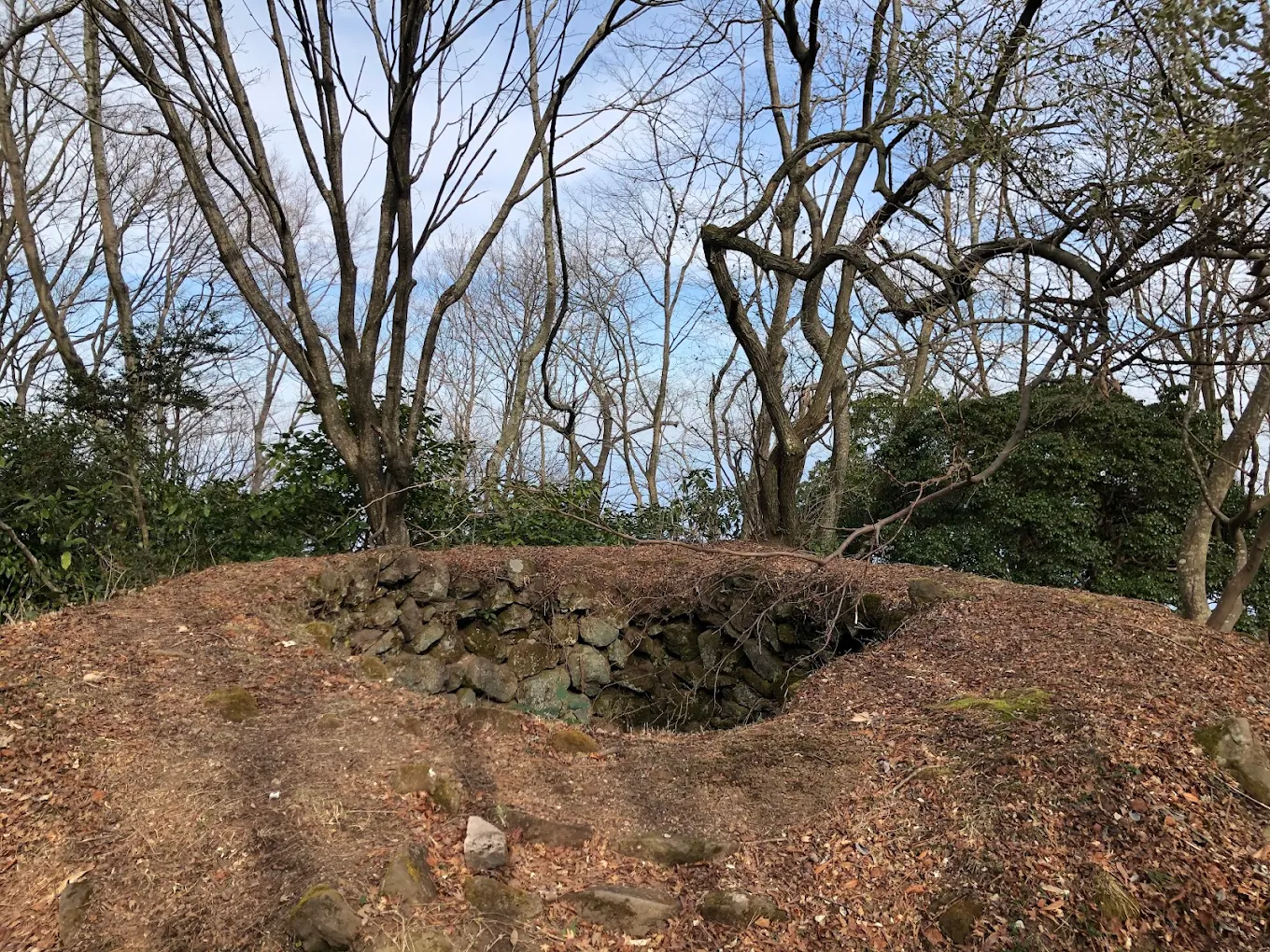
The castle ruins are located on the border between Saiki City and the Yayoi district. Even today, the remains of the castle, including baileys, moats, vertical moats, and rows of vertical moats, are well-preserved, making it an important resource for the study of medieval mountain castles.
History of Tsugamure Castle
Construction and the Saiki Clan
There are various theories regarding the construction period of Tsugamure Castle, but according to war chronicles compiled during the Edo period, such as the “Tsugamure Jitsuroku” and “Otomo Kōhaiki,” it is believed to have been built during the Daiei era (1521-1528) by Saiki Koreharu, the tenth head of the Saiki clan.
The Saiki clan were powerful local lords in Bungo Province and played an important role as subordinates of the Otomo clan. Koreharu served Otomo Yoshikane and chose Mount Tsugamure, a natural stronghold, to build the castle in order to establish control over the region. This location offered a strategic vantage point overlooking the Banjo River basin, allowing for monitoring of both sea and land routes.
The Five Generations’ Residence of the Saeki Clan
After its construction, Tsugamure Castle served as the residence of the Saeki clan for five generations. Beginning with the first lord, Saeki Koreharu, it was continued by Koremasa, Korenori, Koresada, and Koreyasu. In particular, during the time of the fourth lord, Saeki Koresada, the castle’s defensive capabilities were strengthened, and many of the moats and trenches visible today are believed to have been constructed during this period.
Using this castle as their base, the Saeki clan controlled both sea and land transportation in southern Bungo Province, functioning as a crucial point for the Otomo clan’s southern defense. The castle town developed with the residences of their retainers and a town center, becoming the political and economic center of the region.
The Battle Against Usuki Nagakage
The most dramatic event in the history of Tsugamure Castle was the attack by Usuki Nagakage in 1550. During this period, power struggles within the Otomo clan were intensifying, and Saeki Korenori was in opposition to Otomo Yoshikane.
Usuki Nagakage, acting on orders from Otomo Yoshikane, led a large army to attack Tsugamure Castle. Because the castle was a strong fortress, Nagakage employed a siege strategy rather than a direct assault. After a long siege, the castle’s provisions ran out, and it finally fell.
In this battle, Saeki Korenori was killed, and the Saeki clan temporarily faced the brink of collapse. However, later, Koretada inherited the family headship and restored relations with the Otomo clan, allowing the Saeki clan to regain its power.
Abandoned Castle and the Edo Period
In 1597 (Keicho 2), Saeki Koreyasu decided to build a new castle at the current location of Saeki Castle (Shiroyama, Saiki City), and Tsugamure Castle was abandoned. This relocation reflected the changing times, with the end of the Sengoku period and a shift towards flatland castles more suitable for peacetime governance.
After its abandonment, Tsugamure Castle returned to its original state as a forest, but it continued to be remembered by local residents as “Shiroyama” (Castle Mountain). Tsugamure Shrine, dedicated to Saeki Koreharu, was built on the mountaintop and remains an object of local worship.
Structure and Layout of Tsugamure Castle
Overall Layout
Tsugamure Castle is a multi-bailey mountain castle centered on a mountaintop at an altitude of 223.6 meters, extending approximately 250 meters from north to south. The castle has four main enclosures (Enclosures I to IV), with Enclosure I (the main keep) at the highest point, and the enclosures arranged in stages towards the south.
The castle’s defenses are concentrated on the southern and western branch ridges, which are connected to the main ridge. Numerous trenches and vertical moats were constructed specifically to counter attacks from these directions. The eastern and northern sides utilize the steep natural terrain for defense, with relatively few artificial defensive structures.
Enclosure I (Main Keep)
Enclosure I is the main keep, located at the highest point of the castle, measuring approximately 30 meters east-west and 40 meters north-south. Currently, a stone monument marking “Tsugamure Castle Historic Site” stands here, and a shrine dedicated to Tsugamure Shrine still exists.
Partial traces of earthworks remain around the enclosure, particularly clearly visible near the southern entrance. From this enclosure, one can see a panoramic view of the Banjo River basin and Saiki Bay, indicating that it served as both a surveillance and command center.
Enclosures II, III, and IV
Enclosure II, located south of Enclosure I, is the second most important enclosure after the main keep and is thought to have been used as a garrison for retainers and a storage area for weapons. Further south, Enclosures III and IV are arranged with elevation differences, forming a multi-layered defensive structure.
Moats are provided between these enclosures, preventing enemy intrusion and allowing for a gradual retreat and defense in the event of a breach of the outer fortifications.
Moats and Vertical Moats
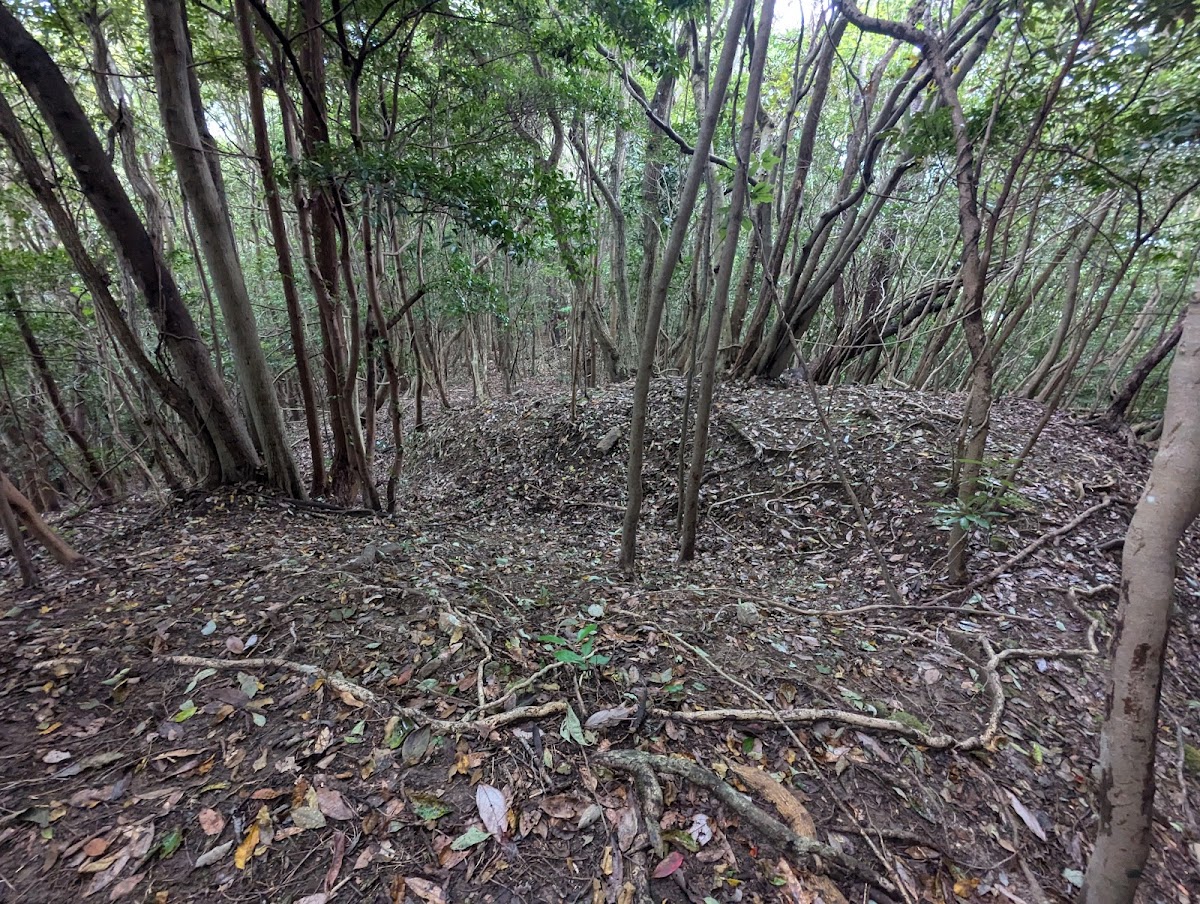
One of the greatest highlights of Tsugamure Castle is its continuous series of moats and vertical moats. In particular, along the ridge on the south side, more than five moats are arranged in a continuous pattern, forming a defensive system known as a “continuous moat system.”
Most of the trenches are 3-5 meters deep and 5-8 meters wide, with some descending the slope as vertical trenches. This structure effectively prevents enemies from advancing along the ridge.
Multiple trenches are also found on the western branch ridge, indicating that the castle was heavily fortified around its entire perimeter.
Ridge-shaped Vertical Trench Groups
A distinctive feature of Tsugamure Castle is the ridge-shaped vertical trench group. This consists of multiple vertical trenches excavated continuously parallel to the slope, effectively preventing lateral movement of enemies and limiting attack routes.
The ridge-shaped vertical trench group at Tsugamure Castle is particularly prominent on the western slope, with 5-7 trenches visible. This technique is characteristic of mountain castles from the late Sengoku period, indicating that Tsugamure Castle incorporated the latest castle-building techniques of the time.
Highlights of Tsugamure Castle
Main Enclosure Ruins and Tsugamure Shrine
On the mountaintop, in the first enclosure, stands a stone monument inscribed with “Historic Site Tsugamure Castle,” and beside it is a small shrine dedicated to Tsugamure Shrine. This shrine is dedicated to Saeki Koreharu, the castle’s builder, and is still carefully preserved by the local people.
The view from the main enclosure ruins is magnificent; on a clear day, you can see the city of Saeki, the Banjo River, and even Saeki Bay in the distance. This view truly makes you understand why this location was chosen as a castle site during the Sengoku period.
Continuous Moats
The continuous moats on the southern ridge are a must-see relic when visiting Tsugamure Castle. They still retain their depth and width, demonstrating the high level of defense they possessed at the time.
The path to the castle partially passes through this moat, and the height of the earthen ramparts viewed from the bottom of the moat is breathtaking. Caution is needed as the ground can be slippery after rain, but safety ropes are installed in some areas to ensure a safe visit.
Terraces and Cut-Edges
The terraces (cut-edges) between each enclosure are also a highlight. In particular, the cut-edge between Enclosure I and Enclosure II is approximately 4 meters high, clearly showing the steep, artificially carved slope.
This cut-edge is not merely a terrace; it is a military structure designed to physically hinder enemy intrusion, making it a valuable resource for learning about medieval mountain castle construction techniques.
Entrance (Koguchi)
The entrance on the south side of the main enclosure has a square-shaped structure surrounded by earthen ramparts, showcasing ingenious defensive features. The curved passage, designed to prevent direct enemy advances, and the structure allowing attacks from both sides demonstrate the pinnacle of Sengoku period castle construction techniques.
Harmony with the Natural Environment
The Tsugamure Castle ruins are currently covered in a lush natural forest, allowing visitors to enjoy the beauty of nature throughout the seasons. The fresh greenery of spring, the deep green of summer, the vibrant autumn foliage, and the clear, unobstructed views after the leaves have fallen in winter offer different scenery depending on the time of year.
The landscape, where the ruins and nature harmonize, is attractive not only as a historical site but also as a place for nature walks.
Access Information
Access by Car
The most convenient way to access Tsugamure Castle is by car. From the Banjo intersection at the north end of the Banjo Ohashi Bridge on National Route 10, head west for a short distance and you will see a sign for “Saiki City Tsugamure Mountain Village Plaza.”
From here, a paved forest road continues to an altitude of approximately 150 meters, where a parking lot is located. The parking lot can accommodate about 10 cars and has restrooms, making it a convenient and safe visit.
Address: Izaki-Kamiogura, Yayoi-cho, Saiki City, Oita Prefecture
Car Navigation Setting: Search for “Tsugamureyama Village Plaza” or “Tsugamure Castle”
Access by Public Transportation
The nearest station is Saiki Station on the JR Nippo Main Line, but there is no direct public transportation from the station to the castle ruins. We recommend taking a taxi from the station or renting a car. By taxi, it takes about 15 minutes from the station to the parking lot.
Ascent Route
A well-maintained hiking trail leads from the parking lot to the main keep at the summit. The distance is approximately 700 meters, with an elevation difference of about 70 meters. With average fitness, it can be climbed in about 30-40 minutes.
There is a rest area (gazebo) along the way where you can take a break. The trail is generally well-maintained, but safety ropes are installed on steep slopes and in the moat sections, allowing for a safe climb.
Estimated Time Required: 30-40 minutes one way from the parking lot to the main keep, 30-60 minutes for exploring the castle ruins, total approximately 1 hour 30 minutes to 2 hours.
Difficulty Level: Intermediate (No problem if you have experience climbing mountain castles)
Notes for Visitors
- Clothing: Comfortable clothing, trekking shoes or athletic shoes are recommended.
- Items to Bring: Drinking water, towel, insect repellent (summer)
- Season: Spring to autumn is the best time to visit. In winter, the fallen leaves make the ruins easier to see, but cold weather precautions are necessary.
- Weather: Caution is needed as the ground can be slippery during and after rain.
- Time: Plan your trip with ample time to descend before sunset.
Nearby Tourist Attractions
Saiki Castle Ruins
Saiki Castle, located approximately 2 kilometers east of Tsugamure Castle, is a flatland castle built in 1597 by Saiki Koreyasu after he relocated from Tsugamure Castle. Currently, the Saiki City Historical Museum is located there, where you can learn about the history of the Saiki clan and the development of the castle town.
The San-no-maru turret gate has been restored, and the remains such as the stone walls and moats are well-preserved. Visiting both Tsugamure Castle and Saiki Castle will help you understand the changes in the Saiki clan’s castles over time.
Saiki Castle Town
In the heart of Saiki City, the town layout of the Edo period castle town remains, allowing visitors to stroll through historical streets. In particular, the area known as the “Path of History and Literature” preserves samurai residences and merchant buildings, offering a time-traveling atmosphere.
Banjo River
The Banjo River, flowing at the foot of Tsugamure Castle, is known for its clear waters and is a popular spot for ayu (sweetfish) fishing. A promenade is maintained along the river, allowing visitors to enjoy nature before or after exploring the castle ruins.
Saiki City Historical Museum
Located on the site of the third bailey of Saiki Castle, the historical museum exhibits the history of the Saiki clan, materials related to Tsugamure Castle and Saiki Castle, and the history of the castle town’s development. Visiting before visiting Tsugamure Castle will provide a deeper understanding.
Opening Hours: 9:00 AM – 5:00 PM (Last entry at 4:30 PM)
Closed Days: Mondays (or the following day if Monday is a public holiday), New Year’s holidays
Admission Fee: Adults 210 yen, Elementary and Junior High School Students 100 yen
Evaluation of Tsugamure Castle
Tsugamure Castle is highly regarded among castle enthusiasts, receiving an average rating of ★4.67 (out of 5) on the Kojodan website. The reasons for this are as follows:
- Excellent Preservation of Remains: Moats, vertical trenches, and rows of vertical trenches are clearly visible.
- Typical Sengoku Period Mountain Castle: An ideal learning tool for studying the structure of medieval mountain castles.
- Easy Access: Reachable relatively quickly from the parking lot, and well-maintained.
- Superb Views: The view from the main keep is spectacular.
- Historical Value: Historically significant as the base of the Saeki clan, a powerful local warlord.
The average visit time is about 1 hour and 45 minutes, allowing you to enjoy carefully observing the remains.
Points to Note When Visiting Tsugamure Castle
Photo Spots
- Stone Monument and Shrine in the Main Enclosure: A symbolic presence of Tsugamure Castle
- Continuous Moats: The angle looking up from the bottom of the moat is breathtaking
- View from the Main Enclosure: A panoramic view of Saiki city and the Banjo River
- Ridge-shaped Vertical Moats: A full view of the defensive structures carved into the slope
Best Season
- Spring (March-May): Beautiful fresh greenery and mild weather. However, this is also the time when insects begin to increase.
- Autumn (October-November): Beautiful autumn foliage and ideal temperatures for hiking. The most recommended time.
- Winter (December-February): The ruins are easier to see after the leaves have fallen. However, cold weather precautions are necessary.
- Summer (June-September): The greenery is lush, but heat and insect repellent are essential.
Estimated Time Required
- Shortest Course: Parking lot → Main keep → Parking lot (1 hour to 1 hour 30 minutes round trip)
- Standard Course: Parking lot → Visit each enclosure → Main keep → Visit the moat group → Parking lot (1 hour 30 minutes to 2 hours)
- In-Depth Course: Parking lot → Detailed viewing of all remains → Photography → Parking lot (2 hours to 3 hours)
Summary
Tsugamure Castle, located in Saiki City, Oita Prefecture, is a valuable historical site with excellent remains and historical value, representing a mountain castle from the Sengoku period. Built during the Daiei era by Saiki Koreharu, and serving as the residence of five generations of the Saiki clan, this castle still preserves the cutting-edge castle-building techniques of the time, including continuous moats and ridged vertical moats.
Located on a mountaintop at an altitude of 223.6 meters, Tsugamure Castle is a formidable fortress with a relative height difference of 210 meters. Despite its strong defenses, it is now relatively easy to access thanks to well-maintained climbing paths. With parking and restrooms available, it’s a castle ruin enjoyable for everyone from beginners to experienced mountain castle hikers.
The view from the main keep is magnificent, allowing you to relive the perspective of the Saeki clan, who ruled this area during the Sengoku period. Furthermore, there are many related historical sites in the surrounding area, such as the ruins of Saeki Castle and the castle town, making it possible to spend a full day tracing the history of the Saeki clan.
Tsugamure Castle is recommended not only for castle enthusiasts but also for history buffs and hiking lovers. It’s a hidden gem of a castle that you should definitely visit when you’re in Oita Prefecture.