Toyoda Castle (Tenri City, Nara Prefecture) Complete Guide: A Thorough Explanation of History, Remains, Access, and Visitor Highlights
What is Toyoda Castle?
Toyoda Castle (Toyoda-jo) is a medieval mountain castle located in Tenri City, Nara Prefecture. Also known as “Yamato Toyoda Castle” or “Toyodayama Castle,” it was the residence of the Toyoda clan, monks affiliated with the Kofuku-ji Daijoin temple, who wielded considerable power in Yamato Province during the Muromachi period. Currently, the castle ruins are located on the hillside behind the Tenrikyo Guest House. It is known as a valuable historical site, particularly for its well-developed dry moats, among the medieval castles in Nara Prefecture.
Built on a mountaintop approximately 80 meters high, this castle boasts a unique structure with two baileys surrounded by complex horizontal moats. Horizontal moats are also positioned at the back of the ridge, making it an important historical site that conveys the defensive system of a medieval mountain castle.
History of Toyoda Castle
Situation in Yamato Province during the Muromachi Period
During the mid-Muromachi period, two major powers, the Ochi clan and the Tsutsui clan, vied for supremacy in Yamato Province. During this time, Kofuku-ji Temple reigned as the de facto ruler of Yamato Province, and its followers exerted influence throughout the region.
Rise of the Toyoda Clan
The Toyoda clan was a powerful local family with influence in Furu-go (present-day Furu district of Tenri City) as followers of Kofuku-ji Temple. In particular, during the time of Toyoda Yorihide, they belonged to the Ochi clan and expanded their influence into the surrounding area. The Toyoda clan expanded their influence centered on the Furu district and built Toyodayama Castle as their residence.
Role of the Castle and Historical Context
Toyoda Castle functioned not only as a military base, but also as the headquarters of the Toyoda clan and a symbol of their rule in Furu-go. During the Muromachi period, Yamato Province experienced a turbulent era of fierce conflict between various powers, from around the time of the Ōnin War (1467-1477) through the Sengoku period. Toyoda Castle was a crucial base for the Toyoda clan to maintain their power during this time.
The Castle’s Demise
As the Sengoku period progressed, new powers such as the Tsutsui clan and Matsunaga Hisahide rose to prominence in Yamato Province. The Toyoda clan’s power declined with the changing times, and Toyoda Castle is believed to have been abandoned. While the exact date of its abandonment is unclear, it is estimated to have occurred sometime between the late Sengoku period and the Azuchi-Momoyama period.
Structure and Layout of Toyoda Castle
Overall Structural Characteristics
Toyoda Castle is a typical medieval mountain castle built on a mountain approximately 250 meters above sea level with a relative height of approximately 80 meters. Its most distinctive feature is its highly developed dry moat system, the most advanced among castles in Nara Prefecture.
The castle is composed of two large enclosures, each surrounded by a complex network of horizontal moats. These moats are not merely defensive structures, but cleverly designed to restrict enemy movement and give an advantage to the castle’s defenses.
Main Enclosure (Honmaru)
The main enclosure is located in the center of the castle, built on the highest elevation. Even today, a flat, leveled area can be seen, suggesting that the lord’s residence and other important facilities once stood here. Traces of earthworks remain around the main enclosure, indicating its function as a key defensive point.
Horizontal and Vertical Moats
The greatest highlight of Toyoda Castle is its well-developed network of horizontal moats. These moats are arranged to surround the enclosures, creating a multi-layered structure to prevent enemy intrusion. The fact that the horizontal moats extend deep into the ridge demonstrates the castle’s high level of defensive awareness.
Vertical moats can also be found in several locations, serving to prevent enemies from climbing the slopes. These moats still retain their depth and shape well, making them valuable remains that allow us to appreciate the construction techniques of medieval mountain castles.
Horse Outworks and Gate Markers
Within the castle grounds, traces of defensive structures called horse outworks (umadashi) can also be seen. These were small enclosures built in front of the castle gates, serving to stop enemy incursions and also functioning as sally bases for friendly attacks.
The placement of the gate markers (koguchi) is also cleverly designed, preventing direct incursions and demonstrating a design philosophy that maximized defensive efficiency.
Highlights of Toyoda Castle’s Remains
Dry Moat System
As mentioned above, the greatest highlight of Toyoda Castle is its dry moat system, the most well-developed in Nara Prefecture. Multiple horizontal moats, approximately 3 to 5 meters deep, can be identified, attesting to the high level of technology at the time. Visiting the site in person is truly astonishing in its scale and complexity.
Arrangement of Enclosures
The two groups of enclosures are cleverly arranged, utilizing the terrain, and each is designed to function as an independent defensive unit. The leveling of each enclosure was carried out meticulously, making it an excellent example of the level of civil engineering technology in the Middle Ages.
Earthworks and Cut Slopes
Traces of earthworks remain, mainly around the main enclosure. Furthermore, cut slopes (artificial steep slopes) were constructed along the edges of the enclosures, demonstrating a design intended to make ascent difficult for enemies.
Current Status and Preservation
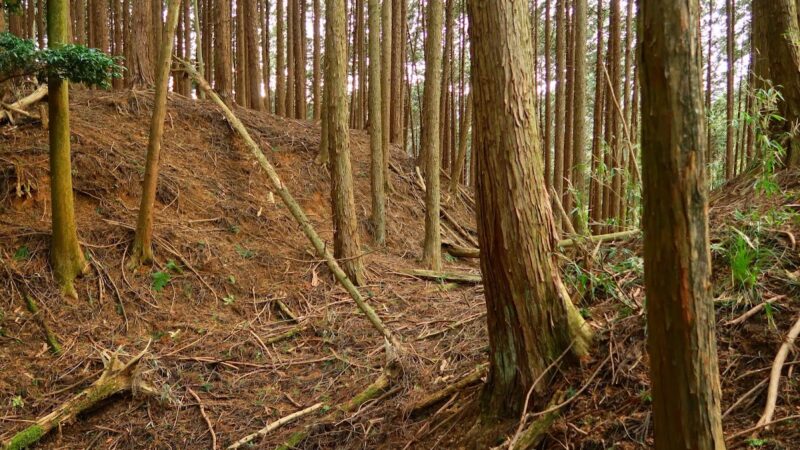
The castle site is basically a forest, and while some areas have been affected by fallen trees, the main remains are well preserved. However, depending on the time of year, vegetation may be overgrown, making observation of the remains difficult, so caution is advised.
Access and Visiting Guide
Location
Address: Near Furu-cho, Tenri City, Nara Prefecture
Location: Behind the Tenrikyo Guest House
Access by Public Transportation
- From JR/Kintetsu Tenri Station: Approximately 20-25 minutes on foot
- Head towards Tenrikyo Headquarters from Tenri Station and aim for the Tenrikyo Guest House
- Access to the castle entrance is possible from around the Guest House
Access by Car
- From Nishimeihan Expressway, Tenri IC: Approximately 10 minutes
- Proceed towards Tenri city center, using Tenrikyo-related facilities as landmarks
- Parking: There is no dedicated parking lot, so please use nearby public parking lots
Castle Entrance and Climbing Route
The castle entrance is located near the back of the Tenrikyo Guest House. Since signposts are limited, it is recommended to check the location on a map beforehand.
The route to the castle is relatively clear, but since it is a mountain trail, appropriate clothing and shoes are necessary. Allow approximately one hour for the round trip.
Notes for Visitors
- Clothing: Comfortable clothing and non-slip shoes (trekking shoes recommended)
- Season: Spring and autumn are the best times to visit. In summer, vegetation grows thick, making visibility poor.
- Fallen Trees: Be careful as trees may have fallen due to typhoons, etc.
- Insect Repellent: Insect repellent spray is essential in summer.
- Heatstroke Prevention: Don’t forget to stay hydrated.
- Solo Visit: Visiting with multiple people is recommended if possible.
Estimated Visit Time
- Castle Climb Only: Approximately 40-50 minutes round trip
- Including Visit to Ruins: 1-1.5 hours
- In-Depth Observation: Approximately 2 hours
Nearby Tourist Attractions
Isonokami Shrine
An ancient shrine within walking distance of Toyoda Castle, considered one of the oldest shrines in Japan. It houses many cultural artifacts, including the national treasure, the Seven-Branched Sword, and is a representative tourist attraction of Tenri City.
Tenrikyo Headquarters
The headquarters of Tenrikyo, located in the center of Tenri City. The group of buildings with their unique architectural style are a symbol of Tenri City.
Kurozuka Kofun Exhibition Hall
An exhibition hall adjacent to the Kurozuka Kofun, known for the excavation of 33 triangular-rimmed bronze mirrors with divine beast motifs. You can learn about the history of Yamato during the Kofun period.
Tenri City Trail Center
An information hub for the Yamanobe-no-michi trail in Tenri City. Convenient as a starting point for hiking and historical exploration.
Yamanobe-no-michi Trail
An ancient road considered to be the oldest road in Japan. The area around Toyoda Castle is also located near the Yamanobe-no-michi route, making it possible to combine a walk along the ancient trail with a tour of the castle ruins.
For Castle Fans Visiting Toyoda Castle
Photography Tips
Since Toyoda Castle is a mountain castle, some ingenuity is required when photographing the remains. In particular, it is difficult to convey the depth and scale of the moat, but you can create a sense of depth by photographing from the slope.
The autumn and winter leaf fall season is ideal for photography, as the shape of the remains is most clearly observable. The shadows of the moat are beautifully captured in photographs during the morning light.
Comparison with other Yamato castles
While many medieval castles exist in Yamato Province (Nara Prefecture), few castles have such well-developed dry moats as Toyoda Castle. Visiting Toyoda Castle while comparing it to other castles such as Ryuo-zan Castle in Tenri City and Akiyama Castle in Uda City will make the unique characteristics of each castle clearer.
Perspective of castle research
Toyoda Castle occupies an important position in castle research as a typical example of a medieval mountain castle. In particular, the development process of the horizontal moats and the arrangement patterns of the baileys are valuable resources for understanding the changes in castle construction techniques from the Muromachi period to the Sengoku period.
Historical background of Tenri City
Geographical characteristics
Tenri City is located in the northern part of Nara Prefecture, with the Kasuga Fault Cliff, with an elevation difference of approximately 300 meters, extending north-south through the center of the city. This creates a distinctive topography that divides the city into the Nara Basin to the west and the Yamato Plateau to the east.
Toyoda Castle is located on the eastern side of this fault cliff, on the edge of the Yamato Plateau, built in a strategically important location overlooking the basin.
History from Ancient Times
The Tenri area has been an important region since ancient times. As evidenced by the presence of Isonokami Shrine, it functioned as a military base for the Yamato court. It was also a transportation hub through which the Yamanobe Road passed, and many burial mounds were constructed during the Kofun period.
Medieval Tenri
During the medieval period, the Kofuku-ji Temple’s estates expanded, and monks like the Toyoda clan gained power in various regions. Toyoda Castle is one of the ruins that symbolizes this power structure of medieval Yamato.
Evaluation and Current Status of Toyoda Castle
Evaluation by Castle Enthusiasts
Within the castle enthusiast community, Toyoda Castle has received a certain level of praise for its “well-preserved remains” and as a “must-see medieval mountain castle in Nara Prefecture.” On castle websites such as Kojodan, it has an average rating of around 3.0, positioning it as a castle for enthusiasts. While the number of visitors is not high throughout the year, it is a hidden gem of a castle that is regularly visited by serious castle enthusiasts and researchers of medieval history.
Challenges of Preservation and Utilization
Currently, Toyoda Castle ruins do not have any special protection designation, so maintenance is not entirely adequate. The challenge lies in balancing visitor safety with the preservation of the remains, including the removal of fallen trees and the development of walking paths.
On the other hand, excessive development could lead to alteration of the remains, so an appropriate balance is required.
Future Prospects
Further investigation, preservation, and utilization of Toyoda Castle as a historical heritage site of Tenri City are expected. Detailed surveys and archaeological excavations would reveal more about the castle’s history and structure.
Furthermore, considering its use as a tourist resource, the installation of guide signs and the development of safe viewing paths would increase opportunities for more people to experience medieval history.
Summary of a Visit to Toyoda Castle
Toyoda Castle (Tenri City, Nara Prefecture) is a valuable mountain castle ruin that conveys the power of the Kofuku-ji monks in Yamato Province during the Muromachi period. Its highly developed dry moat system, the best in Nara Prefecture, makes it an excellent learning tool for studying medieval castle defense techniques.
Its location on the hillside behind the Tenrikyo Guest House symbolizes the layered history of Tenri, spanning from ancient to medieval and modern times. Visiting it along with surrounding historical sites such as Isonokami Shrine and the Yamanobe-no-michi trail will allow for a deeper understanding of Yamato’s history.
For castle enthusiasts, the well-preserved horizontal and vertical moats, and the arrangement of the baileys offer impressive remains. For history buffs, it is a valuable historical site where you can experience the power structure of Yamato Province during the Muromachi period.
When visiting, be sure to have appropriate equipment and sufficient time to fully appreciate the charm of this medieval mountain castle. Toyoda Castle may not be flashy, but it is an important castle ruin that is indispensable when talking about the medieval history of Nara Prefecture.